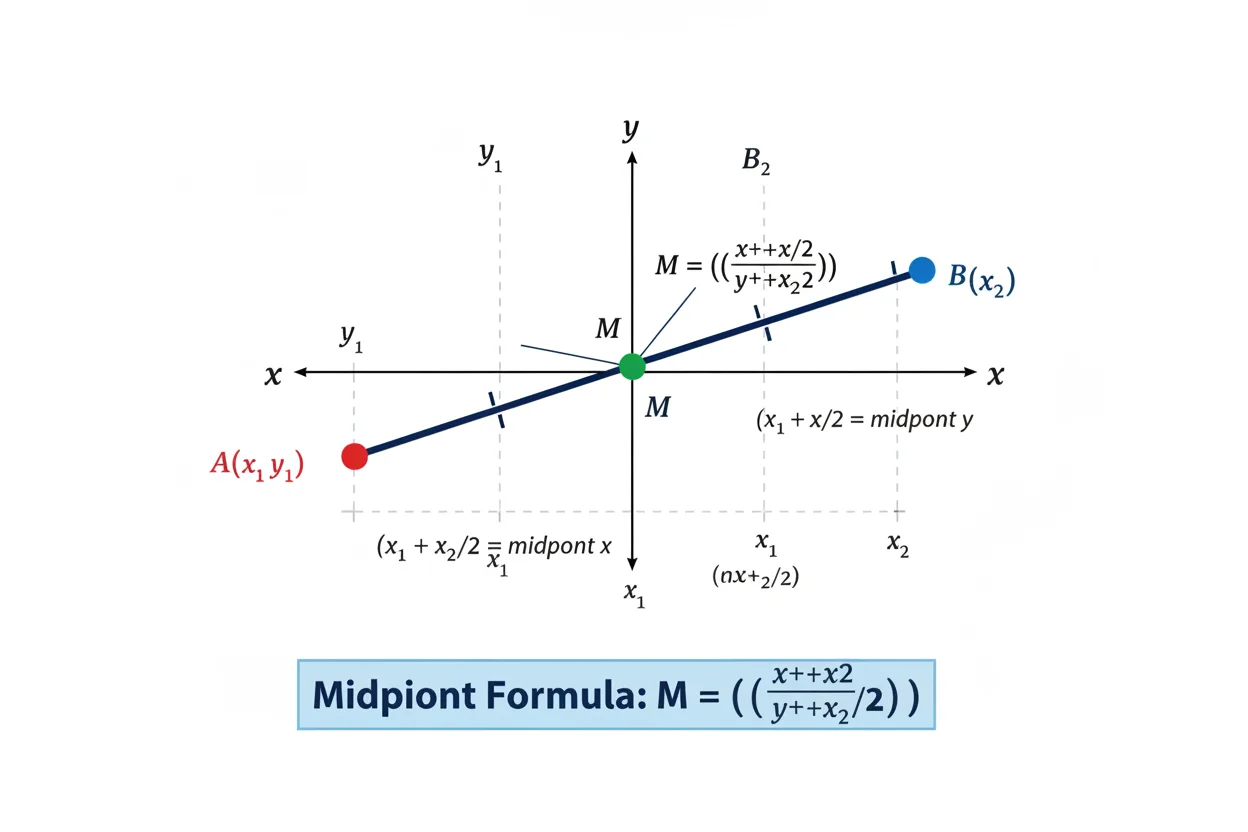

The midpoint formula finds the point exactly halfway between two endpoints. In two dimensions, if the endpoints are (x₁, y₁) and (x₂, y₂), the midpoint is M = ((x₁ + x₂)/2, (y₁ + y₂)/2). Each midpoint coordinate is simply the arithmetic average of the corresponding endpoint coordinates. In three dimensions, the same idea extends to M = ((x₁ + x₂)/2, (y₁ + y₂)/2, (z₁ + z₂)/2). A true midpoint divides a line segment into two equal-length parts, so the distance from the first endpoint to the midpoint equals the distance from the midpoint to the second endpoint. The formula is useful for segments, diagonals, circle centers, coordinate proofs, parallelograms, perpendicular bisectors, and finding a missing endpoint when the midpoint is known.
What Is a Midpoint?
A midpoint is the point that divides a line segment into two equal parts.
If M is the midpoint of segment AB:
AM = MB
and:
AB = 2AM = 2MB
In coordinate geometry, the midpoint lies exactly halfway between the endpoint coordinates.
That means its x-coordinate is halfway between the endpoint x-values, and its y-coordinate is halfway between the endpoint y-values.
2D Midpoint Formula
For endpoints:
A = (x₁, y₁)
and:
B = (x₂, y₂)
the midpoint is:
M = ((x₁ + x₂)/2, (y₁ + y₂)/2)
This can be remembered as:
average the x-coordinates
and:
average the y-coordinates
The same averaging principle works independently along each coordinate axis.
Basic Midpoint Example
Find the midpoint of:
A = (2, 4)
B = (8, 10)
Average the x-coordinates:
(2 + 8)/2 = 5
Average the y-coordinates:
(4 + 10)/2 = 7
Therefore:
M = (5, 7)
Verify With Distance
A midpoint should be equally distant from both endpoints.
Using the Distance Formula:
AM = √[(5 − 2)² + (7 − 4)²]
= √(9 + 9)
= 3√2
And:
MB = √[(8 − 5)² + (10 − 7)²]
= √(9 + 9)
= 3√2
Therefore:
AM = MB
which confirms the midpoint.
Why Coordinate Averaging Works
Suppose the x-coordinates are:
x₁
and:
x₂
The horizontal change from x₁ to x₂ is:
x₂ − x₁
Half of that change is:
(x₂ − x₁)/2
Start at x₁:
x_M = x₁ + (x₂ − x₁)/2
Simplify:
x_M = (2x₁ + x₂ − x₁)/2
Therefore:
x_M = (x₁ + x₂)/2
The same reasoning gives:
y_M = (y₁ + y₂)/2
So the midpoint formula follows directly from moving halfway along each coordinate change.
Example With Negative Coordinates
Find the midpoint of:
A = (−6, 4)
B = (2, −8)
For x:
(−6 + 2)/2
= −4/2
= −2
For y:
(4 − 8)/2
= −4/2
= −2
Therefore:
M = (−2, −2)
Negative coordinates are averaged in exactly the same way as positive values.
Example With One Negative and One Positive Coordinate
Consider:
A = (−9, 3)
B = (5, 11)
Then:
x_M = (−9 + 5)/2
= −2
and:
y_M = (3 + 11)/2
= 7
Therefore:
M = (−2, 7)
The midpoint does not need to lie at the origin when the endpoint signs differ.
Fractional Midpoints
A midpoint coordinate does not need to be an integer.
For:
A = (1, 2)
B = (6, 9)
we get:
x_M = 7/2
y_M = 11/2
Therefore:
M = (7/2, 11/2)
or:
M = (3.5, 5.5)
The fractional form is exact.
Horizontal Segment
Suppose:
A = (−4, 6)
B = (10, 6)
Then:
y_M = (6 + 6)/2
= 6
and:
x_M = (−4 + 10)/2
= 3
Therefore:
M = (3, 6)
The midpoint remains on the same horizontal line.
Vertical Segment
Suppose:
A = (5, −7)
B = (5, 9)
Then:
x_M = 5
and:
y_M = (−7 + 9)/2
= 1
Therefore:
M = (5, 1)
The midpoint remains on the same vertical line.
Midpoint on a Line
The midpoint of two points always lies on the Line From Two Points containing the endpoints.
Suppose:
A = (2, 3)
B = (6, 11)
The midpoint is:
M = (4, 7)
The line through A and B is:
y = 2x − 1
Check M:
7 = 2(4) − 1
= 7
So the midpoint lies on the segment and its supporting line.
Midpoint Divides the Segment Equally
If:
M = ((x₁ + x₂)/2, (y₁ + y₂)/2)
then the displacement from A to M is:
((x₂ − x₁)/2, (y₂ − y₁)/2)
The displacement from M to B is the same:
((x₂ − x₁)/2, (y₂ − y₁)/2)
Therefore the two half-segments have:
equal direction
and:
equal length
This proves the midpoint’s equal-division property algebraically.
1D Midpoint Formula
On a number line, endpoints are simply numbers:
x₁
and:
x₂
The midpoint is:
M = (x₁ + x₂)/2
For:
x₁ = 3
x₂ = 11
we get:
M = 7
The 2D formula is just this one-dimensional averaging idea applied to two coordinate axes.
Number-Line Example With Negatives
Find the midpoint between:
−12
and:
4
Then:
M = (−12 + 4)/2
= −8/2
Therefore:
M = −4
Distances:
|−4 − (−12)| = 8
and:
|4 − (−4)| = 8
so the point is exactly halfway.
3D Midpoint Formula
For:
A = (x₁, y₁, z₁)
and:
B = (x₂, y₂, z₂)
the midpoint is:
M = ((x₁ + x₂)/2, (y₁ + y₂)/2, (z₁ + z₂)/2)
Simply average all three coordinate pairs.
3D Midpoint Example
Suppose:
A = (2, −4, 6)
B = (8, 10, −2)
Then:
x_M = (2 + 8)/2 = 5
y_M = (−4 + 10)/2 = 3
z_M = (6 − 2)/2 = 2
Therefore:
M = (5, 3, 2)
Verify a 3D Midpoint
Using the 3D distance formula:
AM = √[(5 − 2)² + (3 + 4)² + (2 − 6)²]
= √(9 + 49 + 16)
= √74
For MB:
MB = √[(8 − 5)² + (10 − 3)² + (−2 − 2)²]
= √(9 + 49 + 16)
= √74
Therefore:
AM = MB
Finding a Missing Endpoint
The midpoint formula can be reversed.
Suppose:
M = (x_M, y_M)
and one endpoint is:
A = (x₁, y₁)
For the missing endpoint:
B = (x₂, y₂)
start with:
x_M = (x₁ + x₂)/2
Then:
x₂ = 2x_M − x₁
Similarly:
y₂ = 2y_M − y₁
Therefore:
B = (2x_M − x₁, 2y_M − y₁)
Missing Endpoint Example
Suppose:
A = (2, 5)
M = (7, 9)
Find B.
For x:
x₂ = 2(7) − 2
= 12
For y:
y₂ = 2(9) − 5
= 13
Therefore:
B = (12, 13)
Check:
((2 + 12)/2, (5 + 13)/2)
= (7, 9)
Missing 3D Endpoint
Suppose:
A = (1, 4, −2)
and midpoint:
M = (5, 7, 3)
Then:
x₂ = 2(5) − 1 = 9
y₂ = 2(7) − 4 = 10
z₂ = 2(3) − (−2) = 8
Therefore:
B = (9, 10, 8)
Midpoint and Line Intersection
The Line Intersection of two diagonals is often geometrically significant.
In a parallelogram, the diagonals bisect each other.
Therefore the intersection point is the midpoint of both diagonals.
Instead of solving two diagonal equations simultaneously, the midpoint of either diagonal can immediately identify the intersection.
Parallelogram Midpoint Property
Suppose opposite vertices are:
A = (1, 2)
C = (9, 8)
Then diagonal AC has midpoint:
M = ((1 + 9)/2, (2 + 8)/2)
= (5, 5)
If ABCD is a parallelogram, diagonal BD must also have midpoint:
(5, 5)
The diagonals therefore intersect at:
(5, 5)
Coordinate Test for a Parallelogram
A quadrilateral can be checked by comparing diagonal midpoints.
If:
midpoint AC = midpoint BD
then the diagonals bisect each other.
For a nondegenerate quadrilateral with the vertices in the appropriate order, this establishes a parallelogram.
This provides a clean coordinate proof without calculating slopes of all four sides.
Parallelogram Area and Midpoints
The midpoint itself does not determine Parallelogram Area.
However, midpoint relationships can help identify vertices, diagonals, and the center of a parallelogram.
Once the full coordinates are known, area can be calculated using:
base × height
or a vector/determinant method.
The midpoint supplies positional structure rather than area directly.
Midpoint of a Circle Diameter
If A and B are endpoints of a circle diameter, their midpoint is the circle center.
Suppose:
A = (−2, 1)
B = (8, 7)
Then:
center = ((−2 + 8)/2, (1 + 7)/2)
= (3, 4)
The diameter length can then be found with the distance formula.
Its radius is half that distance.
Circle Equation From Diameter Endpoints
Using the previous endpoints:
A = (−2, 1)
B = (8, 7)
center:
(3, 4)
Diameter:
d = √[(8 + 2)² + (7 − 1)²]
= √(100 + 36)
= √136
= 2√34
Therefore:
r = √34
The Circle Equation is:
(x − 3)² + (y − 4)² = 34
The midpoint formula provides the center directly.
Midpoint and Perimeter
A midpoint divides one side or segment but does not automatically change the total Perimeter of a figure.
If a side AB has length:
12
and M is its midpoint:
AM = MB = 6
The combined boundary length remains:
AM + MB = 12
Midpoint subdivision changes how the segment is described, not its total length.
Midsegment of a Triangle
If M and N are midpoints of two sides of a triangle, segment MN is a midsegment.
The triangle midsegment theorem states:
MN ∥ third side
and:
MN = 1/2 × third side
This is an important consequence of midpoint geometry and triangle similarity.
Midsegment Example
Suppose triangle ABC has:
BC = 14
M is midpoint of AB and N is midpoint of AC.
Then:
MN = 7
and:
MN ∥ BC
The smaller triangle AMN is similar to ABC with scale factor:
1/2
Its area is therefore:
1/4
of the original triangle’s area.
Midpoints and Similar Triangles
Connecting midpoints creates smaller Similar Triangles.
If all three side midpoints of a triangle are connected, four smaller congruent triangles are formed.
Each corresponding linear dimension is half the original.
Therefore each small triangle has:
1/4
of the original area.
The midpoint formula can locate these points exactly in coordinate geometry.
Midpoints and Congruent Triangles
A midpoint immediately provides equal segments.
If M is midpoint of AB:
AM = MB
This equality can become one of the side conditions in a Congruent Triangles proof.
For example, a shared segment and equal midpoint-created segments may support:
SSS
or:
SAS
depending on the surrounding geometry.
Midpoint and Perpendicular Bisectors
The perpendicular bisector of segment AB:
passes through the midpoint of AB
and:
is perpendicular to AB
Every point on that perpendicular bisector is equidistant from A and B.
The midpoint formula provides the point through which the perpendicular bisector must pass.
The line’s slope determines its perpendicular direction.
Perpendicular Bisector Example
Suppose:
A = (2, 2)
B = (8, 6)
Midpoint:
M = (5, 4)
Slope AB:
m = (6 − 2)/(8 − 2)
= 2/3
A perpendicular slope is:
−3/2
Therefore the perpendicular bisector is:
y − 4 = −(3/2)(x − 5)
This line passes through the midpoint and is perpendicular to AB.
Equal-Distance Property
Why does every point P on the perpendicular bisector satisfy:
PA = PB?
The perpendicular bisector creates two right triangles sharing the segment from P to the midpoint.
Each triangle has:
one equal half-segment
one shared side
one right angle
The triangles are congruent, so their hypotenuses PA and PB are equal.
This combines midpoint geometry with congruence.
Midpoint and the Law of Sines
The Law of Sines does not normally calculate midpoints directly.
However, a midpoint can split a triangle side into known equal segments.
Those new side lengths may become inputs to smaller triangles where angle-side relationships are solved using:
a/sin A = b/sin B = c/sin C
The midpoint supplies equal lengths; the Law of Sines supplies triangle relationships.
Median of a Triangle
A median connects a triangle vertex to the midpoint of the opposite side.
If:
A = (x₁,y₁)
B = (x₂,y₂)
C = (x₃,y₃)
first find the midpoint of BC:
M = ((x₂ + x₃)/2, (y₂ + y₃)/2)
Then the median from A is the segment:
AM
The equation of the median can be found using A and M.
Median Example
Let:
A = (0, 6)
B = (−4, 0)
C = (8, 0)
Midpoint of BC:
M = ((−4 + 8)/2, 0)
= (2, 0)
The median from A joins:
(0, 6)
to:
(2, 0)
Its slope is:
(0 − 6)/(2 − 0)
= −3
Therefore its line is:
y = −3x + 6
Triangle Centroid From Midpoints
The Triangle Centroid lies at the intersection of the three medians.
Each median begins at a vertex and passes through the midpoint of the opposite side.
The centroid divides every median in the ratio:
2 : 1
measured from the vertex toward the midpoint.
Thus midpoint calculations are a natural first step in coordinate centroid problems.
Rectangle Diagonals
A rectangle is a parallelogram, so its diagonals bisect each other.
Their common midpoint is the rectangle’s center.
If opposite vertices are:
(1, 3)
and:
(9, 11)
the center is:
(5, 7)
The other diagonal must have the same midpoint.
Rhombus Diagonals
A rhombus also has diagonals that bisect one another.
Therefore their intersection is the midpoint of each diagonal.
In addition, rhombus diagonals are perpendicular.
These properties help connect midpoint calculations with Rhombus Area:
A = d₁d₂/2
Kite Diagonals
For a standard kite, one diagonal bisects the other.
Therefore their intersection is the midpoint of the bisected diagonal, but not generally the midpoint of both.
This distinction is important.
A Kite Area can still be found from:
A = d₁d₂/2
because the diagonals are perpendicular.
Midpoint of a Chord
A perpendicular line from the center of a circle to a chord bisects that chord.
Therefore the foot of that perpendicular is the chord midpoint.
If chord endpoints are known in coordinates, their midpoint is found with the standard midpoint formula.
This point can then be used to analyze center distance and Chord Length.
Chord Midpoint Example
Suppose chord endpoints are:
A = (−6, 4)
B = (2, 4)
Then:
M = ((−6 + 2)/2, (4 + 4)/2)
= (−2, 4)
The chord length is:
8
and each half has length:
4
Any perpendicular bisector of this chord passes through:
(−2, 4)
Midpoint as a Vector Average
If endpoint position vectors are:
a
and:
b
the midpoint vector is:
m = (a + b)/2
In coordinates:
a = (x₁,y₁)
b = (x₂,y₂)
so:
m = ((x₁ + x₂)/2, (y₁ + y₂)/2)
This is the vector version of the midpoint formula.
Section Formula Connection
The midpoint is a special case of dividing a segment in a given ratio.
If point P divides AB internally in ratio:
AP : PB = m : n
then:
P = ((nx₁ + mx₂)/(m+n), (ny₁ + my₂)/(m+n))
For a midpoint:
m = n = 1
Therefore:
P = ((x₁ + x₂)/2, (y₁ + y₂)/2)
So midpoint is the equal-ratio case of a more general weighted-average construction.
Quarter Points
Once a midpoint is known, each half can itself be bisected.
Suppose:
A = (0, 0)
B = (8, 12)
Midpoint:
M = (4, 6)
Midpoint of A and M:
Q₁ = (2, 3)
Midpoint of M and B:
Q₃ = (6, 9)
These points divide AB into four equal segments.
Repeated Bisection
Repeated midpoint calculations can divide a segment into:
halves
quarters
eighths
and so on.
This is useful in geometric construction, subdivision, interpolation, and computer graphics.
Each bisection uses the same coordinate-average rule.
Linear Interpolation and Midpoint
A point halfway between A and B can also be written parametrically as:
P(t) = A + t(B − A)
For the midpoint:
t = 1/2
Therefore:
M = A + (B − A)/2
which simplifies to:
M = (A + B)/2
This gives another derivation of the midpoint formula.
Midpoint and Symmetry
If two points are reflections of one another across a central point M, then M is their midpoint.
Suppose:
A = (2, −1)
and M is:
(5, 4)
The reflected point B satisfies:
B = 2M − A
Therefore:
B = (10 − 2, 8 − (−1))
= (8, 9)
The midpoint of A and B is indeed:
(5, 4)
Midpoint and Coordinate Proofs
The midpoint formula can prove that two segments bisect each other.
For example, if:
midpoint AC = midpoint BD
then the two diagonals have the same bisection point.
This is particularly useful for proving that a coordinate quadrilateral is a parallelogram.
It can often replace several separate slope calculations.
Midpoint and Perimeter Problems
Suppose M is midpoint of a side AB with:
AB = 18
Then:
AM = MB = 9
If a polygon’s boundary is rewritten using A-M-B instead of side AB, the combined length remains:
9 + 9 = 18
A midpoint can simplify component calculations without changing the total Perimeter.
Units of Midpoint Coordinates
Midpoint coordinates use the same units as the endpoint coordinates.
If x and y represent meters, the midpoint coordinates also represent meters.
Unlike area or volume calculations, midpoint averaging does not change dimensional units.
It finds a position rather than a size.
Exact Fractions and Decimals
Suppose:
M = (7/2, 11/2)
This exact form can also be written:
M = (3.5, 5.5)
Both are correct.
Fractions may be preferable when subsequent calculations require exact arithmetic.
Decimals may be more convenient for plotting or measurement interpretation.
Common Midpoint Formula Mistakes
A common mistake is averaging all four coordinates together.
Instead, average corresponding coordinates separately:
x with x
y with y
and in 3D:
z with z
Another error is subtracting coordinates instead of adding them.
The midpoint formula uses:
(x₁ + x₂)/2
not:
(x₂ − x₁)/2
The latter gives half the displacement, not the midpoint position unless the first endpoint is at the origin.
Remember to divide the entire coordinate sum by 2.
When finding a missing endpoint, use:
x₂ = 2x_M − x₁
rather than merely subtracting x₁ from x_M.
Finally, distinguish midpoint from distance: a midpoint is a coordinate point, while distance is a length.
Frequently Asked Questions
What is the 2D midpoint formula?
M = ((x₁ + x₂)/2, (y₁ + y₂)/2)
What is the 3D midpoint formula?
M = ((x₁ + x₂)/2, (y₁ + y₂)/2, (z₁ + z₂)/2)
How do you find a midpoint on a number line?
M = (x₁ + x₂)/2
Why do you average the coordinates?
The midpoint lies halfway through each coordinate displacement from one endpoint to the other.
Does a midpoint divide a segment into equal lengths?
Yes:
AM = MB
Can a midpoint have fractional coordinates?
Yes.
How do you find a missing endpoint?
If M and endpoint A are known:
x₂ = 2x_M − x₁
y₂ = 2y_M − y₁
How can you verify a midpoint?
Use the distance formula and confirm:
AM = MB
Does the midpoint lie on the line through the endpoints?
Yes.
What is the midpoint of a circle diameter?
It is the circle’s center.
Where do parallelogram diagonals intersect?
At their common midpoint.
Do kite diagonals both bisect each other?
No. In a general kite, one diagonal bisects the other.
How is the midpoint formula related to a triangle median?
A median connects a vertex to the midpoint of the opposite side.
How can midpoint calculations prove a quadrilateral is a parallelogram?
Show that its two diagonals have the same midpoint.
How can I check a midpoint answer?
Average each coordinate pair independently, verify the point lies on the segment, and confirm its distances to the two endpoints are equal.