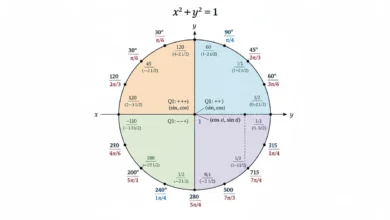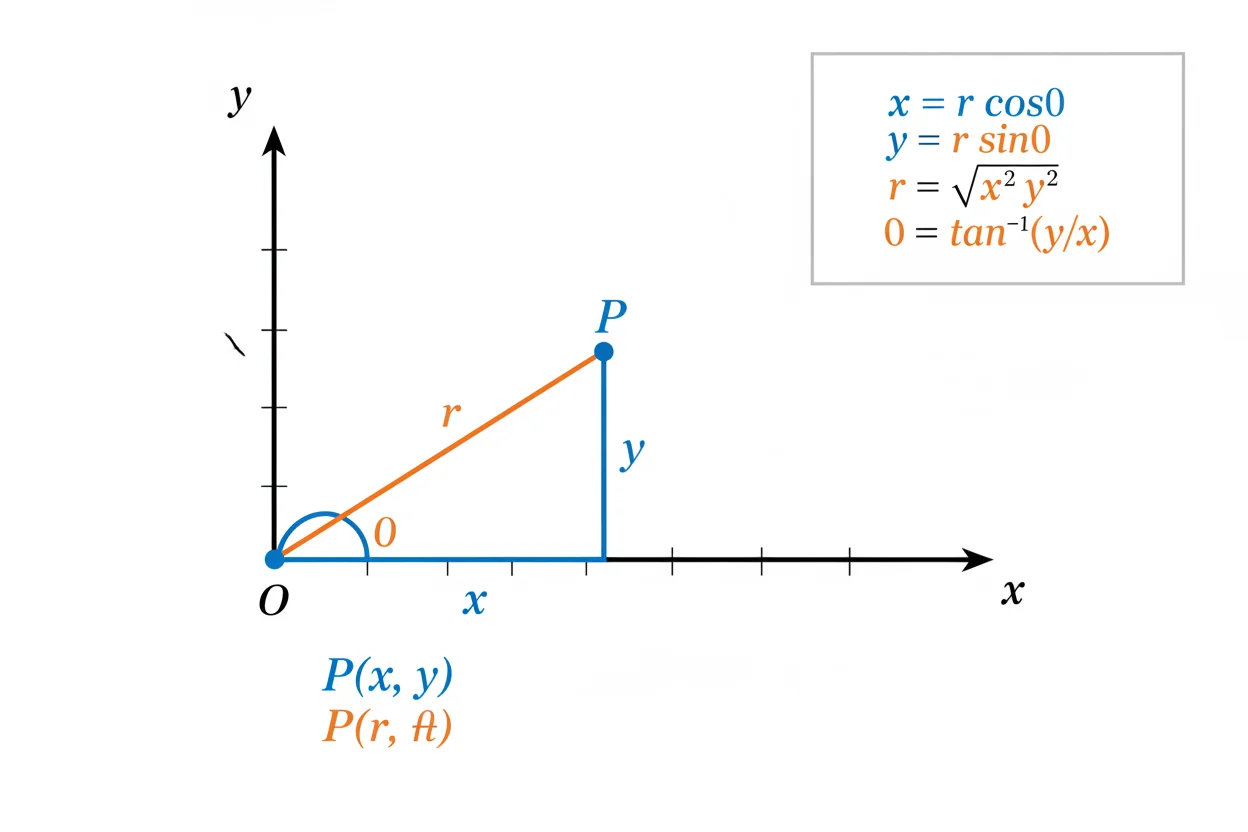

Polar and rectangular form are two ways to describe the location of a point in a plane. Rectangular coordinates use horizontal and vertical components (x, y), while polar coordinates use a distance r from the origin and an angle θ measured from the positive x-axis. To convert polar coordinates to rectangular form, use x = r cosθ and y = r sinθ. To convert rectangular coordinates to polar form, use r = √(x² + y²) and determine θ from the point’s direction, often beginning with tanθ = y/x. Quadrant information is essential because ordinary inverse tangent returns only a principal angle. The same point can have infinitely many equivalent polar representations because adding complete turns to θ does not change its direction, and a negative radius can be represented by reversing direction by π radians. Polar and rectangular form are used in coordinate geometry, circles, vectors, trigonometry, rotations, periodic motion, and equations whose symmetry is easier to express radially.
Rectangular Coordinates
A point in rectangular, or Cartesian, form is written:
(x, y)
where:
x = horizontal coordinate
y = vertical coordinate
Positive x-values lie to the right of the origin.
Negative x-values lie to the left.
Positive y-values lie above the origin.
Negative y-values lie below it.
For example:
(3, 4)
means move 3 units right and 4 units up from:
(0,0)
Polar Coordinates
A point in polar form is written:
(r, θ)
where:
r = directed distance from the origin
θ = angle measured from the positive x-axis
When:
r > 0
the point lies r units in direction θ.
The angle is normally measured counterclockwise when positive and clockwise when negative.
The broader angular conversion rules are covered in Degrees and Radians.
Polar to Rectangular Formulas
To convert:
(r, θ)
to:
(x, y)
use:
x = r cosθ
y = r sinθ
These formulas resolve the radial distance into horizontal and vertical components.
Basic Polar-to-Rectangular Example
Convert:
(r, θ) = (10, 30°)
Use:
x = 10cos30°
y = 10sin30°
Since:
cos30° = √3/2
and:
sin30° = 1/2
we get:
x = 5√3
y = 5
Therefore rectangular form is:
(5√3, 5)
Example in Radians
Convert:
(6, π/3)
to rectangular coordinates.
Use:
x = 6cos(π/3)
= 6(1/2)
= 3
And:
y = 6sin(π/3)
= 6(√3/2)
= 3√3
Therefore:
(x, y) = (3, 3√3)
Why the Conversion Formulas Work
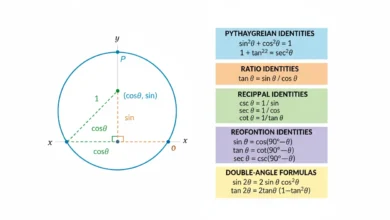
Draw a right triangle from the origin to point P.
Its hypotenuse has length:
r
The horizontal leg is:
x
The vertical leg is:
y
Using Cosine:
cosθ = x/r
Therefore:
x = r cosθ
Using Sine:
sinθ = y/r
Therefore:
y = r sinθ
The conversion formulas are simply right-triangle component relationships.
Rectangular to Polar Formulas
Starting from:
(x, y)
calculate radial distance:
r = √(x² + y²)
Then determine θ from:
tanθ = y/x
A first calculation may use:
θ = tan⁻¹(y/x)
but the final angle must be placed in the correct quadrant.
Why r = √(x² + y²)
The point:
(x, y)
and the origin form a right triangle with legs:
|x|
and:
|y|
The radial distance r is the hypotenuse.
Using the Pythagorean Theorem:
r² = x² + y²
Therefore:
r = √(x² + y²)
For the conventional nonnegative-radius representation, use:
r ≥ 0
Basic Rectangular-to-Polar Example
Convert:
(3, 4)
to polar form.
First:
r = √(3² + 4²)
= √25
= 5
Then:
tanθ = 4/3
Therefore:
θ = tan⁻¹(4/3)
Approximately:
θ ≈ 53.13°
So one polar representation is:
(5, 53.13°)
or, in radians:
(5, 0.9273)
approximately.
Exact Rectangular-to-Polar Example
Convert:
(√3, 1)
First:
r = √[(√3)² + 1²]
= √4
= 2
Then:
tanθ = 1/√3
The point lies in Quadrant I, so:
θ = 30°
Therefore:
(r, θ) = (2, 30°)
or:
(2, π/6)
Quadrant I
If:
x > 0
y > 0
the point lies in Quadrant I.
An ordinary principal inverse-tangent result is already in the correct quadrant.
Example:
(4, 4)
gives:
θ = 45°
Quadrant II
If:
x < 0
y > 0
the point lies in Quadrant II.
Suppose:
(x, y) = (−3, 3√3)
Then:
r = √(9 + 27)
= 6
The reference angle satisfies:
tanα = |3√3/−3|
= √3
so:
α = 60°
Quadrant II angle:
θ = 180° − 60°
Therefore:
θ = 120°
or:
2π/3
Quadrant III
If:
x < 0
and:
y < 0
the point lies in Quadrant III.
Suppose:
(−4, −4)
Then:
r = 4√2
Reference angle:
45°
Therefore:
θ = 225°
or:
5π/4
A calculator returning:
45°
from the ratio y/x = 1 would miss the actual quadrant if coordinate signs were ignored.
Quadrant IV
If:
x > 0
y < 0
the point lies in Quadrant IV.
For:
(√3, −1)
we get:
r = 2
Reference angle:
30°
One positive-angle representation is:
θ = 330°
or:
11π/6
A negative-angle representation is:
θ = −30°
or:
−π/6
Both describe the same direction.
Points on the Positive x-Axis
If:
y = 0
and:
x > 0
then:
θ = 0
or any coterminal angle:
2πk
where k is an integer.
For:
(5,0)
one polar representation is:
(5,0)
Points on the Negative x-Axis
If:
y = 0
and:
x < 0
then with positive radius:
θ = π
or:
180°
For:
(−5,0)
one polar form is:
(5,π)
Points on the Positive y-Axis
If:
x = 0
y > 0
then:
θ = π/2
or:
90°
For:
(0,7)
polar form is:
(7, π/2)
Points on the Negative y-Axis
If:
x = 0
y < 0
then:
θ = 3π/2
or:
270°
A negative-angle alternative is:
−π/2
For:
(0,−7)
valid forms include:
(7,3π/2)
and:
(7,−π/2)
The Origin
For:
(x,y) = (0,0)
we have:
r = 0
The angle θ is not uniquely determined.
Every expression:
(0, θ)
represents the origin regardless of θ.
This is a special feature of polar coordinates.
Equivalent Polar Coordinates
Polar coordinates are not unique.
If:
(r, θ)
represents a point, then:
(r, θ + 2πk)
represents the same point for every integer k.
In degrees:
(r, θ + 360°k)
is equivalent.
This is because adding complete rotations does not change direction.
Coterminal Example
The point:
(5, π/3)
can also be written:
(5, 7π/3)
because:
π/3 + 2π = 7π/3
It can also be written:
(5, −5π/3)
All three angles terminate in the same direction.
Negative Radius
Polar coordinates can also use a negative radius.
A negative r reverses the direction by:
π radians
or:
180°
Thus:
(r, θ)
and:
(−r, θ + π)
describe the same point.
More generally:
(−r, θ + (2k + 1)π)
is equivalent.
Negative-Radius Example
Consider:
(−4, 30°)
A positive-radius equivalent is obtained by adding 180°:
(4, 210°)
To verify:
x = −4cos30°
y = −4sin30°
which points in the direction opposite 30°, namely 210°.
Rectangular Form From Negative Radius
For:
(−6, π/3)
we have:
x = −6cos(π/3)
= −3
and:
y = −6sin(π/3)
= −3√3
Therefore:
(x,y) = (−3,−3√3)
A positive-radius representation is:
(6,4π/3)
Inverse Tangent and Quadrants
A common formula is written:
θ = tan⁻¹(y/x)
but this needs qualification.
The Inverse Trigonometric Functions principal arctangent range is:
−π/2 < θ < π/2
So it cannot by itself distinguish points in Quadrants II and III from directionally related points in Quadrants IV and I.
Always use x and y signs to restore the correct quadrant.
Example of the Quadrant Problem
For:
(x,y) = (−1,1)
we have:
y/x = −1
Then:
tan⁻¹(−1) = −45°
But the actual point lies in Quadrant II.
Therefore the standard positive angle is:
135°
or:
3π/4
The reference ratio alone does not identify the quadrant.
Polar and Rectangular Form Table
The basic relationships are:
x = r cosθ
y = r sinθ
r² = x² + y²
tanθ = y/x
These four equations allow most basic conversions.
The first two convert polar to rectangular.
The last two help convert rectangular to polar.
Polar Distance From the Origin
In rectangular coordinates:
distance from origin = √(x² + y²)
In polar coordinates, that distance is simply:
|r|
For conventional nonnegative polar radius:
distance from origin = r
This is one reason polar coordinates are convenient for radial geometry.
Distance Between Two Polar Points
For polar points:
P₁ = (r₁, θ₁)
P₂ = (r₂, θ₂)
their distance satisfies:
d² = r₁² + r₂² − 2r₁r₂ cos(θ₂ − θ₁)
Therefore:
d = √[r₁² + r₂² − 2r₁r₂ cos(θ₂ − θ₁)]
This follows from the Law of Cosines applied to the triangle formed with the origin.
Polar Distance Example
Suppose:
P₁ = (5,0)
P₂ = (5,60°)
Then:
d² = 25 + 25 − 50cos60°
= 50 − 25
= 25
Therefore:
d = 5
This is also the chord length of a radius-5 circle subtending 60°.
Verify Polar Distance in Rectangular Form
Convert:
P₁ = (5,0)
to:
(5,0)
Convert:
P₂ = (5,60°)
to:
(5/2, 5√3/2)
The Distance Formula gives:
d² = (5/2 − 5)² + (5√3/2)²
= 25/4 + 75/4
= 25
Therefore:
d = 5
Both coordinate systems agree.
Polar Form of a Circle Centered at the Origin
A circle centered at the origin with radius R has rectangular equation:
x² + y² = R²
Since:
x² + y² = r²
the polar equation becomes:
r² = R²
For nonnegative radius:
r = R
So a circle centered at the origin has the remarkably simple polar equation:
r = constant
Circle Example
The Circle Equation:
x² + y² = 25
becomes:
r² = 25
Therefore:
r = 5
Every point lies exactly 5 units from the origin.
Converting a Shifted Circle to Polar Form
Consider:
x² + y² − 6x = 0
Use:
x² + y² = r²
and:
x = r cosθ
Then:
r² − 6r cosθ = 0
Factor:
r(r − 6cosθ) = 0
The circle can be represented by:
r = 6cosθ
with the origin included naturally.
This is a common example of how certain circle equations simplify in polar coordinates.
Converting r = 6cosθ to Rectangular Form
Start with:
r = 6cosθ
Multiply by r:
r² = 6r cosθ
Use:
r² = x² + y²
and:
r cosθ = x
Therefore:
x² + y² = 6x
Complete the square:
x² − 6x + y² = 0
(x − 3)² + y² = 9
So the curve is a circle centered at:
(3,0)
with radius:
3
Polar Form of a Line Through the Origin
A line through the origin at fixed direction angle α can be written:
θ = α
For example:
θ = π/4
represents the line through the origin at 45°.
In rectangular form:
y = x
because:
tan(π/4) = 1
This provides a direct connection with Point-Slope Form when the known point is the origin.
Converting θ = α to Rectangular Form
For a nonvertical line through the origin:
tanθ = y/x
If:
θ = α
then:
y/x = tanα
Therefore:
y = x tanα
This is a straight line with slope:
m = tanα
For:
α = 30°
we obtain:
y = (√3/3)x
Converting a Rectangular Line to Polar Form
Suppose:
y = mx + b
Substitute:
y = r sinθ
x = r cosθ
Then:
r sinθ = mr cosθ + b
Therefore:
r(sinθ − m cosθ) = b
So:
r = b/(sinθ − m cosθ)
where the denominator is nonzero.
This converts a non-origin rectangular line into a polar equation.
Line Example
Convert:
y = 2
to polar form.
Use:
y = r sinθ
Therefore:
r sinθ = 2
so:
r = 2cscθ
where defined.
The same horizontal line has a polar representation based on the reciprocal of sine.
Vertical Line in Polar Form
For:
x = a
use:
x = r cosθ
Therefore:
r cosθ = a
so:
r = a secθ
where defined.
For example:
x = 3
becomes:
r = 3secθ
Polar Direction and Slope
A radial line from the origin at angle θ has direction vector:
(cosθ, sinθ)
For a nonvertical direction, its slope is:
m = sinθ/cosθ
Therefore:
m = tanθ
This directly connects polar direction to Cartesian line slope.
Point-Slope Form From Polar Direction
Suppose a line passes through rectangular point:
(x₁,y₁)
and has direction angle:
θ
Then:
m = tanθ
and the line equation is:
y − y₁ = tanθ(x − x₁)
For:
θ = 60°
through:
(2,1)
we get:
y − 1 = √3(x − 2)
This uses polar angular direction without requiring the line itself to pass through the origin.
Vectors and Polar Form
A two-dimensional vector:
v = (x,y)
can be described by:
magnitude r = √(x² + y²)
and:
direction θ
This is essentially the same conversion from rectangular to polar coordinates.
The Vector Magnitude formula therefore supplies the radial component.
Vector Example
Let:
v = (3,3√3)
Magnitude:
|v| = √(9 + 27)
= 6
Direction:
tanθ = √3
Since the vector lies in Quadrant I:
θ = 60°
Therefore the vector can be represented by:
magnitude 6
and:
direction 60°
Vector Addition Is Usually Easier in Rectangular Form
Suppose vectors are given in magnitude-direction form.
Convert each to components:
x = r cosθ
y = r sinθ
Then add corresponding components.
Afterward, convert the resulting vector back to polar form if magnitude and direction are required.
This is often easier than attempting to add polar magnitudes and angles directly.
Example of Component Addition
Vector A:
(r,θ) = (5,0°)
gives:
(5,0)
Vector B:
(5,90°)
gives:
(0,5)
Sum:
(5,5)
Convert back:
r = √50 = 5√2
θ = 45°
Therefore the resultant has polar form:
(5√2,45°)
Polar Coordinates and Rotation
Rotations about the origin are particularly simple in polar coordinates.
If a point is:
(r,θ)
and it rotates by angle α:
(r, θ + α)
The radial distance remains unchanged.
For example, rotating:
(5,30°)
by:
90°
gives:
(5,120°)
No coordinate matrix is needed for this basic polar description.
Rectangular Rotation Check
Original point:
(5cos30°, 5sin30°)
= (5√3/2, 5/2)
After a 90° counterclockwise rotation, rectangular coordinates become:
(−5/2, 5√3/2)
That point corresponds to:
r = 5
θ = 120°
matching the polar calculation.
Polar Coordinates and Circles
Polar form is especially convenient for figures centered at the origin because radial distance appears directly.
For:
r = 8
the curve is a circle of radius 8.
For a rectangular circle:
x² + y² = 64
the same geometry requires both x and y.
The polar representation is shorter because circular symmetry is radial.
Polar Coordinates and Regular Polygons
Vertices of a regular polygon centered at the origin can be represented neatly in polar form.
For a regular n-gon of circumradius R:
θₖ = θ₀ + 2πk/n
for:
k = 0,1,…,n−1
Each vertex has:
r = R
The angular separation is:
2π/n
This is also the regular polygon’s central-angle spacing.
Regular Hexagon Example
For a regular hexagon centered at the origin with circumradius:
R = 5
choose first vertex:
θ₀ = 0
Then vertex angles are:
0
π/3
2π/3
π
4π/3
5π/3
Every vertex has:
r = 5
Converting these points to rectangular coordinates gives the familiar regular-hexagon layout.
Polygon Diagonals and Polar Vertices
Once regular-polygon vertices are represented by equally spaced polar angles, the Polygon Diagonals count remains:
D = n(n − 3)/2
Polar coordinates make the vertex symmetry clear, while the diagonal formula counts the connections between nonadjacent vertices.
For an individual diagonal length, the angular difference between its endpoints can be used with the Law of Cosines or chord formula.
Regular Polygon Diagonal Length
Suppose two vertices lie on a circumcircle of radius R and differ by central angle Δθ.
Their distance is:
d = √[R² + R² − 2R²cosΔθ]
Simplify:
d = R√[2(1 − cosΔθ)]
Equivalent chord form:
d = 2R sin(Δθ/2)
Thus polar angular separation gives the diagonal or side length directly.
Perimeter From Polar Vertices
A polygon whose vertices are known in polar coordinates can have its Perimeter found by calculating distances between consecutive vertices.
For points:
(r₁,θ₁)
and:
(r₂,θ₂)
use:
d = √[r₁² + r₂² − 2r₁r₂cos(θ₂ − θ₁)]
Then add the consecutive side lengths around the boundary.
Regular Polygon Perimeter From Polar Data
For a regular n-gon with circumradius R, consecutive vertices differ by:
2π/n
So each side is:
s = 2R sin(π/n)
Therefore:
P = 2nR sin(π/n)
This shows how polar angular spacing can lead naturally to polygon perimeter.
Parallelogram Area and Polar Vectors
Two adjacent side vectors of a parallelogram may be described by:
magnitudes a and b
and:
direction angles α and β
Their included angle is:
θ = |β − α|
Then Parallelogram Area is:
A = ab|sin(β − α)|
Polar-style magnitude-direction data therefore make the side-angle area formula immediate.
Parallelogram Example
Suppose adjacent side vectors have:
a = 6
α = 20°
and:
b = 10
β = 80°
Included angle:
60°
Therefore:
A = 6(10)sin60°
= 30√3
The same result can be obtained by converting both vectors to rectangular components and using a determinant.
Rectangular Component Method
For vector:
u = (a cosα, a sinα)
and:
v = (b cosβ, b sinβ)
parallelogram area is:
|uₓvᵧ − uᵧvₓ|
Substituting the components simplifies to:
ab|sin(β − α)|
Thus the polar side-angle formula and rectangular determinant formula are mathematically equivalent.
Polar Coordinates in Prism Geometry
A Prism Volume is:
V = Bh
Polar coordinates do not change that formula.
However, if a prism base is described by vertices around an origin, polar and rectangular conversion can help determine the base geometry before calculating B.
Once base area is known:
V = Bh
The coordinate system is an intermediate geometric tool, not a different volume formula.
Example of Coordinate Preparation for a Prism
Suppose the base vertices of a triangular prism are supplied in polar form.
Convert each vertex with:
x = r cosθ
y = r sinθ
The resulting rectangular coordinates can be used to calculate the triangular base area.
Then multiply by the perpendicular prism height.
This separates coordinate conversion from the actual solid-volume relationship.
Rectangular Equation to Polar Equation
The standard substitution rules are:
x = r cosθ
y = r sinθ
x² + y² = r²
For example, convert:
x² + y² = 4x
Substitute:
r² = 4r cosθ
For:
r ≠ 0
divide by r:
r = 4cosθ
The origin also satisfies the original equation and is included by the resulting curve.
Polar Equation to Rectangular Equation
Common substitutions include:
r cosθ = x
r sinθ = y
r² = x² + y²
Sometimes multiplying an equation by r makes these substitutions possible.
Example:
r = 4sinθ
Multiply by r:
r² = 4r sinθ
Therefore:
x² + y² = 4y
Complete the square:
x² + y² − 4y = 0
x² + (y − 2)² = 4
So the polar equation represents a circle centered at:
(0,2)
with radius:
2
Polar Angle and Arc Length
For a circle of radius r and central angle θ measured in radians:
s = rθ
This Arc Length relationship is especially natural in polar geometry because r and θ are the fundamental coordinate quantities.
For:
r = 6
θ = π/3
we obtain:
s = 2π
Sector Area
For θ in radians:
A = r²θ/2
The Sector Area formula therefore also uses the same radial and angular quantities.
For:
r = 8
θ = π/4
we get:
A = 64π/8
Therefore:
A = 8π
Degrees Versus Radians in Conversion
The formulas:
x = r cosθ
y = r sinθ
work whether θ is measured in degrees or radians, provided the trigonometric evaluation uses the correct mode.
For example:
60° = π/3
So:
cos60° = cos(π/3)
and:
sin60° = sin(π/3)
The physical point is unchanged.
Exact Versus Approximate Coordinates
If:
r = 10
θ = 30°
then exact rectangular coordinates are:
(5√3, 5)
A decimal approximation is:
(8.66, 5)
Keeping exact trigonometric values is useful when later geometry requires precise calculations.
Common Polar and Rectangular Form Mistakes
A frequent mistake is reversing sine and cosine.
The correct formulas are:
x = r cosθ
y = r sinθ
Another error is writing:
r = x² + y²
The correct formula is:
r = √(x² + y²)
When calculating:
θ = tan⁻¹(y/x)
do not ignore the signs of x and y; the quadrant matters.
If x = 0, avoid dividing by zero and identify the y-axis angle directly.
Remember that polar coordinates are not unique.
A negative radius reverses direction by π.
Make sure degree or radian mode matches θ.
When converting equations, use identities such as:
r² = x² + y²
r cosθ = x
r sinθ = y
rather than substituting inconsistently.
Finally, distinguish a radial line:
θ = constant
from a circle:
r = constant
Frequently Asked Questions
What is rectangular form?
A point is written:
(x,y)
using horizontal and vertical coordinates.
What is polar form?
A point is written:
(r,θ)
using radial distance and direction angle.
How do you convert polar to rectangular?
x = r cosθ
y = r sinθ
How do you convert rectangular to polar?
r = √(x² + y²)
and determine θ from the point’s direction, often beginning with:
tanθ = y/x
Why must the quadrant be checked?
Inverse tangent alone does not distinguish all four coordinate quadrants.
What is the polar form of (3,4)?
r = 5
θ = tan⁻¹(4/3) ≈ 53.13°
so one representation is:
(5,53.13°)
Can one point have more than one polar representation?
Yes. For example:
(r,θ)
and:
(r,θ + 2π)
represent the same point.
What does a negative radius mean?
It places the point in the direction opposite θ:
(−r,θ) = (r,θ + π)
What is the origin in polar coordinates?
Any coordinate:
(0,θ)
represents the origin.
What is a circle centered at the origin in polar form?
r = R
where R is its radius.
What is a line through the origin in polar form?
θ = constant
for a fixed direction.
How is slope related to polar angle?
For a nonvertical line through the origin:
m = tanθ
How do you find the distance between two polar points?
d = √[r₁² + r₂² − 2r₁r₂cos(θ₂ − θ₁)]
How are polar coordinates useful for rotations?
A rotation by α changes:
(r,θ)
to:
(r,θ + α)
while leaving r unchanged.
How can I check a coordinate conversion?
Convert the result back to the original coordinate system and verify that the same point is recovered.