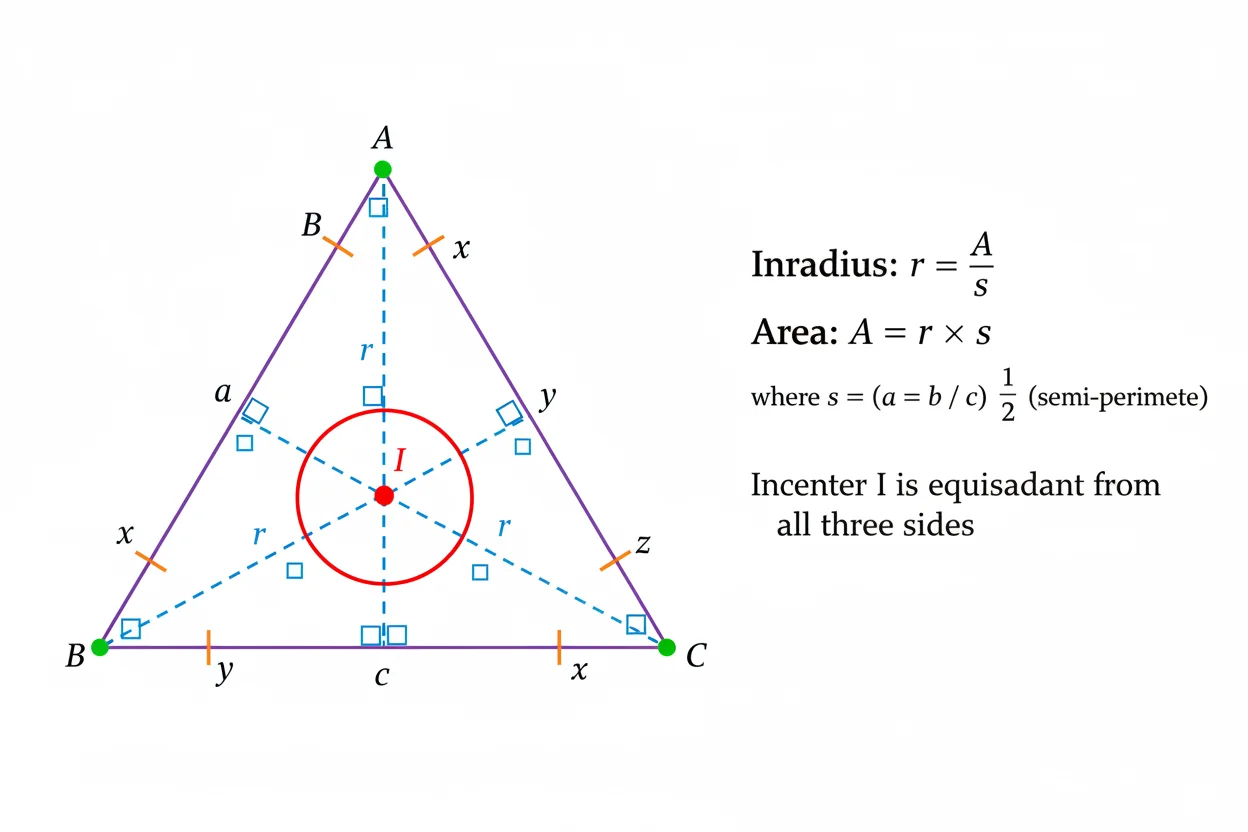
The triangle incenter is the point where the three internal angle bisectors of a triangle intersect. It always lies inside a nondegenerate triangle and is equally distant from all three sides. Because of that equal-distance property, the incenter is the center of the triangle’s incircle, the circle tangent to all three sides. If the triangle has area A and semiperimeter s, its inradius is r = A/s, equivalently A = rs. In coordinate geometry, the incenter is a side-length-weighted average of the three vertices rather than a simple arithmetic average. The incenter works the same way in acute, right, and obtuse triangles: unlike the circumcenter or orthocenter, it remains inside the triangle in every case.
What Is the Triangle Incenter?
For triangle ABC, draw the internal bisector of each interior angle.
The three angle bisectors meet at one point:
I
That point is the:
incenter
Because I lies on the bisector of angle A, it is equally distant from the two sides forming angle A.
Applying the same property at the other vertices gives:
distance from I to AB
= distance from I to BC
= distance from I to CA
That common distance is the:
inradius r
The Incircle
The circle centered at I with radius r touches all three sides of the triangle.
It is called the:
incircle
The points where it touches the sides are points of tangency.
The incircle lies entirely inside the triangle.
Every nondegenerate triangle has exactly one incircle.
Main Inradius Formula
If triangle area is A and semiperimeter is s:
r = A/s
Equivalently:
A = rs
where:
r = inradius
s = semiperimeter
and:
s = (a+b+c)/2
This is one of the most useful Triangle Area relationships involving the incenter.
Why A = rs
Drop perpendiculars from incenter I to all three sides.
Each perpendicular has length:
r
These divide the original triangle into three smaller triangles.
Their areas are:
ar/2
br/2
cr/2
Add them:
A = ar/2 + br/2 + cr/2
Factor:
A = r(a+b+c)/2
Since:
s = (a+b+c)/2
we get:
A = rs
Basic Inradius Example
Suppose a triangle has:
A = 60
and:
s = 15
Then:
r = 60/15
Therefore:
r = 4
Find Area From Inradius
From:
A = rs
suppose:
r = 5
s = 18
Then:
A = 5(18)
Therefore:
A = 90
square units.
Find Semiperimeter From Area and Inradius
Rearrange:
s = A/r
Suppose:
A = 84
r = 4
Then:
s = 21
The full perimeter is:
P = 2s
Therefore:
P = 42
Find Perimeter From Area and Inradius
Since:
s = P/2
the formula:
A = rs
becomes:
A = rP/2
Therefore:
P = 2A/r
If:
A = 72
r = 3
then:
P = 144/3
Therefore:
P = 48
Incenter and Angle Bisectors
The incenter is defined by internal angle bisectors.
If:
∠A = 70°
then the line AI divides it into:
35°
and:
35°
Likewise for the other two vertices.
The Angle Bisector Theorem provides additional side-ratio relationships when an angle bisector meets the opposite side.
Why an Angle Bisector Gives Equal Distances to Sides
Any point lying on an angle bisector is equally distant from the two lines forming the angle.
Because I lies simultaneously on all three internal angle bisectors, it is equally distant from all three triangle sides.
Those equal perpendicular distances allow a circle centered at I to touch all three sides with one radius r.
The Incenter Is Always Inside
Every internal angle bisector lies inside the triangle between its vertex and the opposite side.
Their common intersection therefore lies:
inside the triangle
This is true for:
acute triangles
right triangles
obtuse triangles
The incenter’s location does not move outside when one angle becomes obtuse.
Incenter of an Acute Triangle
For an acute triangle, the incenter lies inside, as do the centroid and orthocenter.
However, these centers generally occupy different positions.
Only special symmetric triangles cause them to coincide.
Incenter of a Right Triangle
The incenter of a Right Triangle also lies inside.
If legs are:
a and b
and hypotenuse is:
c
the inradius has a particularly simple formula:
r = (a+b−c)/2
Deriving the Right-Triangle Inradius Formula
For a right triangle:
A = ab/2
Semiperimeter:
s = (a+b+c)/2
Since:
r = A/s
we get:
r = [ab/2]/[(a+b+c)/2]
Therefore:
r = ab/(a+b+c)
This is equivalent to:
r = (a+b−c)/2
because:
c² = a²+b²
3-4-5 Triangle Inradius
For:
a = 3
b = 4
c = 5
use:
r = (3+4−5)/2
Therefore:
r = 1
Check with area and semiperimeter:
A = 6
s = 6
So:
r = A/s = 1
5-12-13 Triangle Inradius
For:
5, 12, 13
we obtain:
r = (5+12−13)/2
Therefore:
r = 2
Area:
A = 30
Semiperimeter:
s = 15
Check:
30/15 = 2
Incenter of an Obtuse Triangle
Even when one angle exceeds 90°, the internal angle bisectors still meet inside the triangle.
Therefore the incircle remains fully contained inside.
This sharply contrasts with the Triangle Circumcenter, which lies outside an obtuse triangle.
Equilateral Triangle Incenter
In an equilateral triangle, all major symmetry lines coincide.
Therefore the:
incenter
circumcenter
centroid
orthocenter
are the same point.
For side length a:
altitude h = a√3/2
The common center lies one-third of the altitude above the base.
Therefore:
r = h/3
So:
r = a√3/6
Equilateral Inradius Example
Suppose:
a = 12
Then:
r = 12√3/6
Therefore:
r = 2√3
The circumradius is:
R = 4√3
Thus:
R = 2r
for an equilateral triangle.
Equilateral Area Check
Using:
A = rs
For side:
12
semiperimeter:
s = 18
and:
r = 2√3
Therefore:
A = 36√3
The ordinary equilateral formula gives:
A = √3(12²)/4
= 36√3
The results agree.
Inradius From Three Side Lengths
If only a, b, and c are known, calculate area with Heron Formula:
s = (a+b+c)/2
A = √[s(s−a)(s−b)(s−c)]
Then:
r = A/s
Combining the expressions gives a direct side-length formula.
Direct Inradius Formula From Heron’s Formula
Start with:
r = A/s
Substitute Heron’s formula:
r = √[s(s−a)(s−b)(s−c)]/s
Simplify:
r = √[(s−a)(s−b)(s−c)/s]
This finds the inradius entirely from the three side lengths.
13-14-15 Triangle Example
Suppose:
a = 13
b = 14
c = 15
Then:
s = 21
Heron’s formula gives:
A = 84
Therefore:
r = 84/21
So:
r = 4
Verify With the Direct Formula
Using:
s−a = 8
s−b = 7
s−c = 6
Then:
r = √[(8)(7)(6)/21]
= √16
Therefore:
r = 4
Coordinate Formula for the Incenter
Suppose:
A = (x₁,y₁)
B = (x₂,y₂)
C = (x₃,y₃)
Let opposite side lengths be:
a = |BC|
b = |CA|
c = |AB|
Then the incenter is:
I = ((ax₁ + bx₂ + cx₃)/(a+b+c), (ay₁ + by₂ + cy₃)/(a+b+c))
The vertex coordinates are weighted by the lengths of the opposite sides.
Why the Incenter Is Not a Simple Average
The Triangle Centroid uses:
G = ((x₁+x₂+x₃)/3,(y₁+y₂+y₃)/3)
The incenter instead uses side-length weights.
Therefore:
centroid → equal vertex weights
incenter → opposite-side weights
Only in an equilateral triangle are all three weights equal.
Coordinate Incenter Example
Take the right triangle:
A = (0,0)
B = (6,0)
C = (0,8)
Opposite side lengths are:
a = |BC| = 10
b = |CA| = 8
c = |AB| = 6
Then:
x_I = [10(0)+8(6)+6(0)]/24
= 48/24
= 2
and:
y_I = [10(0)+8(0)+6(8)]/24
= 48/24
= 2
Therefore:
I = (2,2)
Check the Right-Triangle Inradius
The triangle is:
6-8-10
Therefore:
r = (6+8−10)/2
= 2
Since the legs lie on:
x = 0
and:
y = 0
the point:
(2,2)
is exactly 2 units from both legs.
It is also 2 units from the hypotenuse.
Side Lengths From Coordinates
The side weights in the coordinate incenter formula can be calculated with the Distance Formula:
d = √[(x₂−x₁)² + (y₂−y₁)²]
It is important to pair each side with its opposite vertex correctly.
Finding the Incenter by Angle Bisectors
Instead of using the coordinate weighted-average formula, you can:
- find equations of two internal angle bisectors;
- find their intersection;
- verify equal distances to all three sides.
This method follows the geometric definition directly.
Equal Distance to Side Lines
If a side lies on:
Ax + By + C = 0
and the incenter is:
I = (x₀,y₀)
its perpendicular distance to that side is:
d = |Ax₀ + By₀ + C|/√(A²+B²)
For a true incenter, the distance to all three side lines is the same:
d₁ = d₂ = d₃ = r
Coordinate Verification
If a proposed point I gives distances:
4
4
4
from the three side lines, then it is equidistant from those sides.
If it also lies inside the triangle, this provides a strong direct verification that I is the incenter.
Incircle Equation
If the incenter is:
I = (h,k)
and the inradius is:
r
then the incircle equation is:
(x−h)² + (y−k)² = r²
The circle is tangent to all three triangle sides.
This uses the same Circle Equation structure as any circle with known center and radius.
Incircle Example
Suppose:
I = (2,2)
r = 2
Then the incircle is:
(x−2)² + (y−2)² = 4
For the coordinate 6-8-10 right triangle, this circle touches all three sides.
Tangency Points
Let the incircle touch:
BC at D
CA at E
AB at F
Radii to the tangent points are perpendicular to the sides:
ID ⟂ BC
IE ⟂ CA
IF ⟂ AB
and:
ID = IE = IF = r
These perpendicular radii explain both the distance and area relationships.
Equal Tangent Lengths
Tangent segments from the same external point to a circle are equal.
Therefore:
AF = AE
BF = BD
CE = CD
These equalities create useful side-length relationships around an incircle.
Tangent-Length Variables
Let:
AF = AE = x
BF = BD = y
CE = CD = z
Then triangle side lengths satisfy:
c = AB = x+y
a = BC = y+z
b = CA = z+x
Adding:
a+b+c = 2(x+y+z)
Therefore:
s = x+y+z
Tangent Lengths in Terms of Semiperimeter
Solving gives:
x = s−a
y = s−b
z = s−c
So the tangent lengths from vertex A are:
s−a
from vertex B:
s−b
and from vertex C:
s−c
under the standard convention:
a opposite A
b opposite B
c opposite C
Tangent-Length Example
Suppose triangle sides are:
a = 13
b = 14
c = 15
Then:
s = 21
Tangent lengths from A:
s−a = 8
from B:
s−b = 7
from C:
s−c = 6
These values rebuild the sides:
AB = 8+7 = 15
BC = 7+6 = 13
CA = 6+8 = 14
Incenter and Angle Bisector Theorem
Suppose angle bisector from A meets BC at D.
The Angle Bisector Theorem states:
BD/DC = AB/AC
or:
BD/DC = c/b
This can determine the point where an incenter-defining angle bisector meets the opposite side.
Two such bisectors locate I.
Angle Bisector Length and Incenter
The full length of an angle bisector and the incenter’s position along it are not generally given by a universal 2:1 rule.
That 2:1 division belongs to the centroid and medians.
For the incenter, the position along an angle bisector depends on the triangle’s side lengths and angles.
This distinction prevents a common center-related error.
Incenter and Triangle Medians
The mapped Triangle Medians intersect at the centroid, not the incenter.
A median:
goes to the opposite-side midpoint
An angle bisector:
divides the vertex angle into two equal angles
In an equilateral triangle, both lines coincide.
In a general scalene triangle, they do not.
Incenter and Circumcenter
The mapped Triangle Circumcenter is equally distant from the vertices.
The incenter is equally distant from the sides.
Thus:
O → circumcircle through vertices
I → incircle tangent to sides
The two points are generally distinct.
Incenter and Orthocenter
The mapped Triangle Orthocenter is the intersection of the three altitudes.
Altitudes are perpendicular to opposite sides.
Angle bisectors divide angles.
Therefore:
altitude concurrency → orthocenter
internal angle-bisector concurrency → incenter
Only in an equilateral triangle do the two points coincide.
Incenter and Centroid
The centroid comes from medians and has a fixed:
2:1
division along each median.
The incenter comes from angle bisectors and has no corresponding universal 2:1 rule.
The centroid is the balance point of a uniform triangular lamina.
The incenter is the center of the largest circle tangent to all three sides from within the triangle.
Incenter and Triangle Altitudes
The Triangle Altitudes are not the same as the perpendiculars from I to the sides.
An altitude begins at a triangle vertex.
The inradius perpendicular begins at:
I
and ends at a side.
Both meet a side at 90°, but their starting points and purposes differ.
Inradius and Circumradius
Every triangle satisfies:
R ≥ 2r
where:
R = circumradius
r = inradius
Equality occurs exactly for an equilateral triangle.
This is known as Euler’s inequality for triangle radii.
It provides a useful reasonableness check.
Example of Euler’s Inequality
For a:
3-4-5
triangle:
R = 5/2
and:
r = 1
Therefore:
R = 2.5
while:
2r = 2
So:
R > 2r
as expected.
Inradius From Circumradius and Half-Angles
Another relationship is:
r = 4R sin(A/2) sin(B/2) sin(C/2)
This can be useful when the circumradius and all triangle angles are known.
For an equilateral triangle:
A = B = C = 60°
Therefore:
r = 4R(1/2)³
So:
r = R/2
or:
R = 2r
Inradius and Heron Factors
From:
r = √[(s−a)(s−b)(s−c)/s]
the tangent-length quantities:
s−a
s−b
s−c
appear directly.
This connects Heron’s formula, incircle tangencies, and side geometry.
Incenter and Area Partition
Joining I to all three vertices creates three smaller triangles.
Their heights to sides a, b, and c are all:
r
Therefore their areas are:
ar/2
br/2
cr/2
These areas are not generally equal because:
a, b, c
are not generally equal.
Area Ratios Around the Incenter
The three smaller triangle areas satisfy:
A_IBC : A_ICA : A_IAB = a : b : c
because each uses the same height r.
Thus the incenter divides area according to side lengths, not equally.
This differs from the centroid, which creates three equal-area triangles.
Area-Ratio Example
Suppose side lengths are:
a:b:c = 5:6:7
Then the three vertex-connected incenter regions have area ratio:
5:6:7
If total area is:
90
the proportional parts are:
25
30
35
because:
5+6+7 = 18
and:
90/18 = 5
Incenter Distance to Each Side
Because the incircle touches every side:
distance(I,AB) = r
distance(I,BC) = r
distance(I,CA) = r
This equal-distance property is often the fastest way to identify an incenter in a coordinate or construction problem.
Does the Incenter Have Equal Distances to Vertices?
No.
Equal vertex distances define the circumcenter.
For a general scalene triangle:
IA
IB
IC
are different.
The incenter is characterized by equal perpendicular distances to sides, not equal straight-line distances to vertices.
Incenter Angle Relationship
An important incenter angle property is:
∠BIC = 90° + A/2
Similarly:
∠CIA = 90° + B/2
∠AIB = 90° + C/2
These relationships follow from the fact that BI and CI bisect angles B and C.
Deriving ∠BIC
In triangle BIC:
∠IBC = B/2
∠ICB = C/2
Therefore:
∠BIC = 180° − B/2 − C/2
Since:
A+B+C = 180°
we have:
B+C = 180°−A
So:
∠BIC = 180° − (180°−A)/2
Therefore:
∠BIC = 90° + A/2
Incenter Angle Example
Suppose:
A = 60°
Then:
∠BIC = 90° + 30°
Therefore:
∠BIC = 120°
This relationship appears frequently in angle-chasing problems involving the incircle.
Find a Vertex Angle From Incenter Angles
If:
∠BIC = 130°
then:
130° = 90° + A/2
So:
A/2 = 40°
Therefore:
A = 80°
Right-Triangle Coordinate Shortcut
For a right triangle aligned with coordinate axes and right-angle vertex at the origin:
A = (0,0)
B = (a,0)
C = (0,b)
the incenter is:
I = (r,r)
because its distance from each coordinate-axis leg is r.
The inradius is:
r = (a+b−c)/2
Example
For:
a = 6
b = 8
c = 10
we get:
r = 2
Therefore:
I = (2,2)
This avoids the full weighted-coordinate calculation.
Incenter in an Isosceles Triangle
In an isosceles triangle, the incenter lies on the axis of symmetry.
That line from the apex is simultaneously:
an angle bisector
a median
an altitude
a perpendicular bisector of the base
Although the incenter lies on this common line, it does not generally coincide with the centroid or circumcenter.
Isosceles Example
Suppose equal sides are:
13
and base is:
10
Altitude:
12
Area:
A = 60
Semiperimeter:
s = 18
Therefore:
r = 60/18
So:
r = 10/3
The incenter lies:
10/3
units above the base along the symmetry axis.
Incircle Area
Once inradius r is known, the incircle’s area is:
A_circle = πr²
For:
r = 4
the incircle area is:
16π
This is a separate quantity from the triangle’s area.
Incircle Circumference
The incircle’s Circle Circumference is:
C = 2πr
For:
r = 4
we get:
C = 8π
The inradius therefore determines both the inscribed circle’s area and circumference.
Incircle and Tangent Geometry
Each triangle side is tangent to the incircle.
A radius drawn to a tangency point is perpendicular to that side.
This creates several right triangles around the incenter and is the basis for:
equal tangent lengths
A = rs
and many angle relationships.
Incenter and Similar Triangles
If two triangles are Similar Triangles with linear scale factor k:
side lengths scale by k
semiperimeter scales by k
area scales by k²
Since:
r = A/s
the inradius scales by:
k²/k = k
Therefore corresponding inradii scale linearly.
Scaling Example
Suppose:
r₁ = 3
and a similar triangle has scale factor:
4
Then:
r₂ = 12
If the first area is:
20
the second area is:
16(20)
Therefore:
320
Inradius Ratio and Area Ratio
For similar triangles:
r₂/r₁ = k
Therefore:
A₂/A₁ = (r₂/r₁)²
If inradius doubles:
area becomes 4 times as large
provided the triangles are similar.
Incenter and Triangle Solving
Finding the incenter itself does not replace general triangle solving.
A problem may first require sides or angles from:
Pythagorean relationships
Law of Sines
Law of Cosines
or other information.
Once area and semiperimeter are known:
r = A/s
becomes direct.
Perimeter and Inradius With Fixed Area
From:
A = rP/2
we obtain:
r = 2A/P
For a fixed area, a larger perimeter implies a smaller inradius under the constraints of a valid triangle.
This relationship is useful when area and total boundary length are known.
Units
The inradius is a length, so it uses:
mm
cm
m
in
ft
Triangle area and incircle area use square units.
Semiperimeter has linear units.
In:
A = rs
the unit multiplication is:
length × length = area
as required.
Exact Versus Approximate Inradius
Suppose:
r = 2√3
This is exact.
Approximately:
r ≈ 3.46
Exact radicals are preferable when additional symbolic geometry follows.
Common Triangle Incenter Mistakes
A common mistake is constructing medians instead of angle bisectors.
The incenter is the intersection of:
internal angle bisectors
not medians.
Another error is assuming it may lie outside an obtuse triangle. The incenter is always inside.
Do not confuse equal distances to sides with equal distances to vertices.
For:
r = A/s
use the semiperimeter, not the full perimeter.
In the coordinate formula, weight each vertex by the length of its opposite side.
Do not apply the centroid’s 2:1 median rule to the incenter.
When using tangent lengths:
s−a, s−b, s−c
keep the standard opposite-side notation consistent.
Finally, verify a coordinate incenter by checking equal perpendicular distances to all three side lines.
Frequently Asked Questions
What is the triangle incenter?
The triangle incenter is the intersection of the three internal angle bisectors.
Where is the incenter located?
Always inside a nondegenerate triangle.
What does the incenter represent?
It is the center of the triangle’s incircle.
What is the incircle?
The circle inside the triangle tangent to all three sides.
What is the inradius formula?
r = A/s
where A is triangle area and s is semiperimeter.
What is the equivalent area formula?
A = rs
What is the semiperimeter?
s = (a+b+c)/2
How do you find perimeter from area and inradius?
P = 2A/r
What is the right-triangle inradius formula?
r = (a+b−c)/2
where a and b are legs and c is the hypotenuse.
What is the equilateral-triangle inradius?
r = a√3/6
How do you find inradius from three sides?
r = √[(s−a)(s−b)(s−c)/s]
What is the coordinate formula for the incenter?
I = ((ax₁+bx₂+cx₃)/(a+b+c), (ay₁+by₂+cy₃)/(a+b+c))
where a, b, and c are the side lengths opposite vertices A, B, and C.
Is the incenter equidistant from the vertices?
No. It is equidistant from the three sides.
Is the incenter the same as the centroid?
Not generally.
Is the incenter the same as the circumcenter?
Not generally.
What angle relationship involves the incenter?
∠BIC = 90° + A/2
How does the inradius scale in similar triangles?
By the same linear scale factor as corresponding sides.
What inequality relates circumradius and inradius?
R ≥ 2r
with equality for an equilateral triangle.
How can I check an incenter calculation?
Verify that the point lies on two internal angle bisectors and that its perpendicular distances to all three sides are equal.