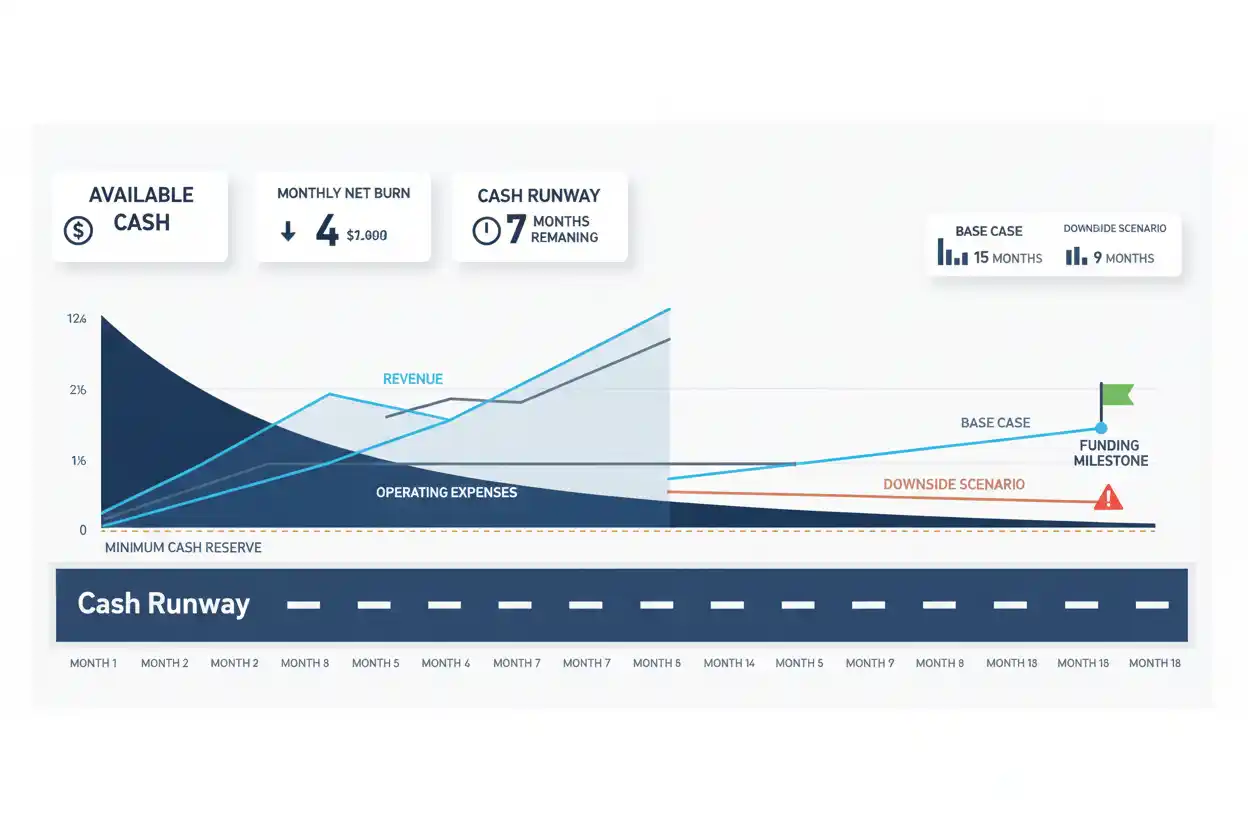

Cash runway estimates how long a business can continue operating before a defined pool of available cash is exhausted if its net cash burn follows the assumptions used in the calculation.
The simplest formula divides available cash by monthly net burn:
Cash Runway = Available Cash ÷ Monthly Net Burn Rate
If a company has $1.2 million of available cash and consumes $100,000 per month:
Cash Runway = $1,200,000 ÷ $100,000 = 12 months
The company therefore has an estimated 12 months of cash runway under a constant-burn assumption.
That result is useful, but it is not a guaranteed survival date. Revenue can rise or fall, expenses can change, customers can pay earlier or later, financing can close or fail, and management may choose to preserve a minimum cash reserve rather than spend cash to zero.
Cash runway is therefore best understood as a planning measure within business finance, not as a fixed countdown.
What Is Cash Runway?
Cash runway is the estimated period a business can fund its operations from available liquidity while it remains a net consumer of cash.
It is especially relevant for startups, early-stage companies, turnaround situations, project-based businesses, and other companies that expect negative cash flow for a period.
The metric connects two numbers:
How much usable cash is available?
and
How quickly is that cash expected to decline?
The first establishes the financial resource. The second comes from burn rate.
Together, they produce an estimate of available operating time.
Cash Runway Formula
The standard constant-burn formula is:
Cash Runway in Months = Available Cash ÷ Monthly Net Burn Rate
Suppose available cash is $750,000 and monthly net burn is $125,000.
Cash Runway = $750,000 ÷ $125,000
Cash Runway = 6 months
If burn remains at $125,000 each month and no new financing or other material cash changes occur, the modeled cash pool lasts approximately six months.
The calculation becomes less reliable when burn is expected to change materially, which is why a detailed cash flow forecast is usually preferable for decision-making.
Cash Runway Example
Consider a company with $2 million in unrestricted available cash.
Monthly operating cash outflows are $350,000, while monthly operating cash inflows are $200,000.
First calculate net burn:
Net Burn Rate = Cash Outflows − Cash Inflows
Net Burn Rate = $350,000 − $200,000
Net Burn Rate = $150,000 per month
Now calculate runway:
Cash Runway = $2,000,000 ÷ $150,000
Cash Runway ≈ 13.3 months
The company has approximately 13 months of runway under the simplified assumptions.
In practice, management should not assume it can operate normally until the final day of month 13. Cash may need to remain available for payroll, taxes, supplier commitments, contractual obligations, wind-down costs, or financing requirements.
Cash Runway vs Burn Rate
Cash runway and burn rate are directly related but answer different questions.
Burn rate measures the pace of cash consumption.
Cash runway measures how long available cash can support that rate.
For example, two companies can both burn $100,000 per month.
Company A has $500,000 of cash:
Runway = $500,000 ÷ $100,000 = 5 months
Company B has $2 million:
Runway = $2,000,000 ÷ $100,000 = 20 months
The burn rate is identical, but Company B has four times the modeled runway.
The dedicated burn rate guide covers gross burn, net burn, trend analysis, and cash-consumption mechanics in more detail.
Gross Burn Should Not Normally Be Used Blindly
Gross burn describes cash spending before inflows are deducted.
For runway planning, using gross burn without considering recurring cash inflows can materially understate the amount of time available.
Suppose a company spends $300,000 per month and receives $220,000 from customers.
Gross burn is $300,000, but net burn is:
Net Burn = $300,000 − $220,000
Net Burn = $80,000
If available cash is $800,000, a gross-burn calculation would imply:
$800,000 ÷ $300,000 ≈ 2.7 months
Using net burn:
$800,000 ÷ $80,000 = 10 months
The difference is substantial.
For conventional runway planning, net cash consumption is therefore usually the more meaningful denominator when operating inflows are expected to continue.
What Counts as Available Cash?
The numerator needs as much care as the burn-rate denominator.
Available cash should represent resources that can genuinely be used to fund the operating plan under the runway definition.
That may include unrestricted cash and qualifying cash equivalents.
Restricted cash should not automatically be included if it cannot be used for ordinary operations.
Likewise, expected financing is not the same as cash already available.
A term sheet, investor conversation, unapproved credit line, or expected government payment should not be treated as bank cash unless the model explicitly labels it as a future financing assumption.
Separating cash on hand from potential future liquidity prevents the runway calculation from becoming overly optimistic.
Minimum Cash Reserve
A business may choose not to operate until cash reaches zero.
Management can establish a minimum cash balance that should remain available for payroll, taxes, contractual obligations, emergencies, or operating stability.
In that case, usable runway cash becomes:
Runway Cash = Available Cash − Minimum Cash Reserve
Suppose total available cash is $1.5 million and management wants to preserve $300,000.
Runway Cash = $1,500,000 − $300,000
Runway Cash = $1,200,000
If monthly net burn is $120,000:
Practical Runway = $1,200,000 ÷ $120,000
Practical Runway = 10 months
Using the full $1.5 million would produce 12.5 months, but the practical decision horizon is only 10 months if the $300,000 reserve is genuinely unavailable for planned burn.
Cash Runway With Changing Burn
The simple formula assumes constant monthly burn.
Real businesses often expect burn to change.
Suppose a company has $900,000 available.
Management expects to burn:
Months 1–3: $150,000 per month
Months 4–6: $100,000 per month
Month 7 onward: $50,000 per month
The first three months consume:
3 × $150,000 = $450,000
Remaining cash:
$900,000 − $450,000 = $450,000
The next three months consume:
3 × $100,000 = $300,000
Remaining cash after six months:
$450,000 − $300,000 = $150,000
At $50,000 per month, that remaining cash lasts:
$150,000 ÷ $50,000 = 3 months
Total modeled runway is therefore approximately:
3 + 3 + 3 = 9 months
A simple average-burn formula may not capture this path accurately. Period-by-period forecasting is better when expenses or revenue are expected to change.
Cash Runway With Growing Revenue
Runway can extend even when gross spending remains unchanged if customer cash inflows increase.
Suppose a company spends $300,000 every month.
Current customer cash receipts are $100,000.
Current Net Burn = $300,000 − $100,000 = $200,000
With $1 million of cash:
Current Runway = $1,000,000 ÷ $200,000 = 5 months
Now suppose receipts rise to $200,000 while spending remains unchanged.
New Net Burn = $300,000 − $200,000 = $100,000
The same $1 million would then support:
New Runway = $1,000,000 ÷ $100,000 = 10 months
The company’s spending did not fall, but stronger inflows doubled modeled runway.
That is why runway analysis should consider revenue quality and contribution margin rather than focusing exclusively on cost cutting.
Cash Runway With Rising Costs
Runway can deteriorate quickly when expenses accelerate.
Suppose available cash is $1.2 million and current net burn is $100,000.
Current Runway = $1,200,000 ÷ $100,000 = 12 months
Management then approves hiring and expansion that raise net burn to $150,000.
New Runway = $1,200,000 ÷ $150,000
New Runway = 8 months
A $50,000 monthly increase reduced modeled runway by four months.
That does not necessarily make the expansion a bad decision. The increased spending may accelerate product development or revenue growth.
The financial question is whether the resulting milestone or economic benefit arrives before liquidity becomes constrained.
Cash Runway and Cash Flow Forecasting
Cash runway provides a compact answer.
Cash flow forecasting provides the timeline behind that answer.
Consider a business with $600,000 of cash and average burn of $100,000.
The simple calculation gives six months of runway.
However, suppose a $200,000 annual insurance payment is due next month and a $250,000 customer payment is expected three months later.
The actual cash path will differ substantially from a smooth $100,000 monthly decline.
A detailed cash forecast can show whether the company experiences a liquidity shortfall before the average-burn runway expires.
For businesses with material timing differences, the forecast should be treated as the primary liquidity model and runway as a headline summary.
Cash Runway and Working Capital
Operating growth can absorb cash through working capital.
A company may sell more products but need to purchase inventory before collecting customer cash.
Accounts receivable can rise faster than collections.
Suppliers may require payment before customers settle invoices.
These timing effects can shorten runway without necessarily appearing as weaker headline revenue.
The cash conversion cycle helps explain how inventory, receivables, and payables influence that operating cash requirement.
Cash Runway and Accounts Receivable
Large receivables can make a company appear financially stronger on an accrual income statement than its bank balance suggests.
If customers pay slowly, the business may run short of cash even while reporting growing sales.
Days sales outstanding helps measure collection timing.
For runway forecasting, management should estimate when major receivables will actually convert into usable cash.
A $500,000 receivable expected in 10 days affects runway differently from the same receivable that is disputed or routinely collected 90 days late.
Cash Runway and Inventory
Inventory can consume cash long before revenue is collected.
A business preparing for a major sales season may spend heavily on stock months before customers arrive.
This can temporarily shorten runway.
Days inventory outstanding and inventory turnover can help determine how efficiently inventory is moving.
A runway model for an inventory-heavy business should therefore incorporate purchasing cycles rather than extrapolating one average month indefinitely.
Cash Runway and Supplier Terms
Supplier payment terms can either preserve or accelerate cash consumption.
Longer legitimate payment terms may allow a company to hold cash longer while inventory is sold or customers are invoiced.
Shorter terms can create a larger working-capital requirement.
Days payable outstanding provides one way to analyze this timing.
However, intentionally paying suppliers late should not be mistaken for a sustainable runway strategy.
Runway based on overdue liabilities may overstate the company’s true financial flexibility.
Cash Runway and Break-Even
Companies often ask whether their cash lasts long enough to reach break-even.
Suppose a business has 14 months of runway and expects its operating model to reach break-even in nine months.
The five-month gap provides a theoretical cushion.
If the business has only seven months of runway but expects break-even in nine months, the current plan contains a funding gap.
That does not automatically mean the business will fail. It means something must change before cash becomes insufficient—revenue, pricing, costs, financing, timing, or the break-even plan.
Runway becomes most valuable when compared with a specific operating milestone rather than treated as an isolated number.
Cash Runway and Startup Fundraising
For startups, runway influences when fundraising discussions need to begin.
A company with 12 months of runway should not necessarily wait until month 11 to seek additional capital.
Fundraising can require investor outreach, diligence, negotiation, documentation, approvals, and closing time. Outcomes are uncertain.
The SEC’s small-business capital guidance stresses that companies raising money should be able to explain their business plan and how investors may ultimately receive liquidity; capital planning therefore needs to be part of a broader financing strategy rather than a last-minute reaction.
Management may also want enough runway to reach a product, revenue, regulatory, or profitability milestone before the next financing round.
Why Financing Does Not Fix Burn
Receiving investment or debt extends runway by increasing available cash.
It does not automatically improve the underlying burn rate.
Suppose a company has $400,000 of cash and burns $100,000 monthly.
Runway = 4 months
It then raises $1 million.
Cash becomes $1.4 million.
New Runway = $1,400,000 ÷ $100,000 = 14 months
Runway improved substantially.
However, if the company’s economics remain unchanged, it is still losing $100,000 every month.
Financing buys time. Whether that time creates value depends on what the business accomplishes with it.
Cash Runway and Business Loans
Borrowing can extend runway but creates repayment and interest obligations.
Suppose a business receives a $500,000 loan.
Available cash rises immediately, but future business loan payments become cash outflows.
A useful forecast should therefore include both the financing inflow and subsequent payments.
Adding the loan proceeds to the runway numerator while ignoring the repayment schedule can overstate future liquidity.
Cash Runway and Profitability
A company can have substantial runway while being unprofitable.
It can also be profitable yet face liquidity constraints because profit and cash are different.
A business may report net profit while receivables grow, inventory absorbs cash, or capital expenditures create large outflows.
Conversely, a company may report an accounting loss while maintaining enough cash to continue operating for years.
Runway therefore measures financial endurance under a cash-consumption assumption, not profitability.
Cash Runway and Free Cash Flow
Free cash flow can help explain whether the business is generating or consuming cash after operating and capital-investment requirements under the chosen definition.
A company with consistently positive free cash flow may not need a conventional burn-based runway calculation.
A company with negative free cash flow may need to understand how long existing liquidity can support the deficit.
The relationship depends on how management defines burn and which cash movements are included.
Consistency matters more than forcing all businesses into one formula.
Cash Runway and Cash Ratio
The cash ratio compares immediate cash resources with current liabilities.
Cash runway compares available cash with ongoing net burn.
A company might have a strong cash ratio today but a very short runway if operations are consuming cash rapidly.
Another company could have a modest cash ratio but little or no net burn because operations consistently replenish cash.
One is a point-in-time coverage metric. The other is a time-to-liquidity-exhaustion estimate.
Cash Runway and Startup Valuation
Startup valuation should not be determined from runway alone.
However, runway can influence the financing context.
A company with only a few months of cash may have less flexibility over the timing of its next financing round.
A company with substantial runway may be able to choose when to approach investors or continue pursuing operating milestones before raising capital.
Runway therefore affects financial optionality even though it is not itself a valuation formula.
Runway to a Milestone
The most useful runway question is often not “When do we reach zero?”
It is:
Do we have enough cash to reach the next value-creating milestone?
That milestone could be product launch, regulatory approval, profitability, break-even, a customer target, a financing event, production readiness, or another concrete objective.
Suppose a company has 10 months of runway and expects a product launch in six months.
The plan provides four months of modeled cushion.
If development slips by three months, that cushion falls to one month.
Runway therefore helps management understand how operational delays become financial risk.
Base-Case Cash Runway
A base case uses management’s central set of assumptions.
Suppose:
Available cash = $1.8 million
Expected monthly net burn = $150,000
Base-Case Runway = $1,800,000 ÷ $150,000
Base-Case Runway = 12 months
Management can then compare this with its expected milestones and financing timeline.
The base case should not be the only calculation.
Downside Cash Runway
A downside case tests weaker assumptions.
Suppose available cash remains $1.8 million, but lower collections and higher expenses raise monthly net burn to $225,000.
Downside Runway = $1,800,000 ÷ $225,000
Downside Runway = 8 months
The downside case eliminates four months of runway.
That difference may change hiring, financing, investment, or contingency decisions.
SEC liquidity guidance emphasizes understanding material cash requirements, sources and uses of cash, and uncertainties affecting the ability to satisfy obligations, which is consistent with using scenarios rather than presenting one deterministic liquidity estimate.
Upside Cash Runway
An upside case can model stronger revenue or lower cash consumption.
Suppose net burn declines to $90,000.
Upside Runway = $1,800,000 ÷ $90,000
Upside Runway = 20 months
The company now has substantially more time.
However, upside assumptions should not be used as the operating plan simply because they produce a more comfortable result.
Liquidity decisions should remain resilient if performance is weaker than expected.
Runway When Burn Reaches Zero
If recurring cash inflows rise enough to equal recurring cash outflows, net burn becomes zero.
The simple runway formula then no longer works because division by zero is undefined.
That is economically meaningful.
A business with zero net burn under the modeled period is no longer consuming its cash reserve at a constant rate.
If inflows exceed outflows, the business begins generating cash rather than burning it.
At that point, cash-flow forecasting and profitability analysis become more useful than a conventional runway calculation.
What Is a Good Cash Runway?
There is no universal number of months that is appropriate for every business.
Required runway depends on business volatility, financing access, revenue predictability, fixed obligations, milestone timing, economic conditions, regulatory requirements, and management’s risk tolerance.
A company that can become cash-flow positive within three months may need a different cushion from a pre-revenue company requiring two years of development.
Rather than asking for an arbitrary ideal, compare runway with the time required to execute the plan under realistic and downside scenarios.
What Is a Short Cash Runway?
A runway becomes financially tight when there is insufficient time to achieve necessary milestones, reduce burn, generate cash, or secure financing with a reasonable margin for uncertainty.
For one business, six months may be comfortable.
For another, six months may be critically short because fundraising alone can consume much of that period.
The relevant question is therefore not the raw month count but what must happen before the money represented by that runway is no longer available.
How to Extend Cash Runway
Runway can be extended by increasing available cash, lowering net burn, or both.
Reducing low-return expenditure can lower cash outflows.
Improving collections can increase inflows.
More favorable working-capital management may release cash tied up in inventory or receivables.
Higher contribution from new revenue can reduce net burn.
New equity or debt financing can increase available liquidity.
However, each action has trade-offs.
Cutting productive investment may delay milestones. Borrowing creates obligations. Aggressive collection or supplier strategies can damage commercial relationships.
The objective is to extend runway without undermining the economics the company needs to become sustainable.
How Much Does a Burn Reduction Extend Runway?
Suppose available cash is $1 million.
At $200,000 monthly net burn:
Runway = $1,000,000 ÷ $200,000 = 5 months
Reduce net burn to $160,000:
Runway = $1,000,000 ÷ $160,000 = 6.25 months
The $40,000 reduction adds approximately 1.25 months of runway.
If burn falls to $100,000:
Runway = 10 months
The relationship is easy to calculate, but the strategic consequence of achieving the reduction still needs examination.
Common Cash Runway Mistakes
One mistake is using gross spending instead of net burn without understanding the difference.
Another is counting restricted cash as freely available.
Businesses may include financing that has not actually closed or customer payments that remain uncertain.
Using one unusual month’s burn can distort the denominator.
The simple calculation can also fail when burn changes rapidly.
Perhaps the most dangerous error is treating the runway endpoint as the date management needs to start acting.
Financing, restructuring, cost reductions, or strategic changes generally need to occur well before cash reaches the minimum acceptable level.
Limitations of Cash Runway
Cash runway simplifies an uncertain operating future into a number of months.
It does not predict revenue.
It does not guarantee financing.
It does not show whether obligations are concentrated in one week.
It can overlook working-capital volatility, restricted cash, minimum balances, capital expenditure, debt payments, or large one-off transactions if those items are excluded from burn.
The output can also change rapidly as new information arrives.
For these reasons, runway should be updated alongside the cash forecast rather than treated as a permanent metric.
How Often Should Cash Runway Be Recalculated?
Recalculate runway whenever a material input changes.
That includes new financing, major customer wins or losses, hiring changes, cost reductions, delayed collections, capital expenditures, changes in supplier terms, or updated revenue forecasts.
For businesses with limited liquidity, monthly updates may not be frequent enough if conditions change quickly.
The closer the company gets to its minimum cash threshold, the more valuable detailed short-term cash forecasting becomes.
Frequently Asked Questions
What is cash runway?
Cash runway estimates how long available cash can support a business while it continues consuming cash at the assumed net burn rate.
What is the cash runway formula?
Cash Runway = Available Cash ÷ Monthly Net Burn Rate
How do you calculate cash runway?
Determine the amount of usable cash available, calculate the expected monthly net cash burn, and divide available cash by that burn rate.
What does 12 months of runway mean?
It means available cash would last approximately 12 months if the burn assumptions remain unchanged and no material additional cash inflows or outflows occur outside the model.
Is cash runway the same as burn rate?
No. Burn rate measures how quickly cash is being consumed. Runway estimates how long available cash can support that consumption.
Should gross or net burn be used for runway?
Net burn is generally more useful when recurring cash inflows are expected because it measures the decline in cash after those inflows. The definition should be applied consistently.
Can cash runway be calculated if burn changes every month?
A simple constant-burn formula becomes less useful. A period-by-period cash flow forecast should be used to identify when the cash balance reaches the defined minimum.
Should restricted cash count toward runway?
Only if that cash is genuinely available for the operating uses represented by the runway calculation. Otherwise, including it can overstate liquidity.
Does a company need to reach zero cash before runway ends?
Not necessarily. Management may define runway against a minimum required cash balance rather than zero.
What happens when net burn reaches zero?
The standard runway formula no longer applies because the business is no longer depleting cash at a positive constant net-burn rate.
How can a company increase runway?
It can reduce net cash outflows, increase cash inflows, improve working capital, raise financing, or combine these approaches.
What is a good cash runway for a startup?
There is no universal number. Runway should be compared with expected milestone timing, fundraising needs, operating uncertainty, financing access, and downside scenarios.
Final Perspective
Cash runway converts available liquidity into time:
Cash Runway = Available Cash ÷ Monthly Net Burn Rate
If the burn rate is stable, the formula gives a useful headline estimate.
If the business is changing quickly, a detailed forecast provides a better answer.
The most important runway calculation is also rarely the one that assumes cash can fall all the way to zero. Management should consider restricted funds, minimum operating reserves, large future payments, working-capital changes, and the time required to raise capital or change the operating plan.
Runway therefore should not answer only:
“How many months of cash do we have?”
A more useful question is:
“Do we have enough financial time to reach the next important milestone under both realistic and adverse assumptions?”