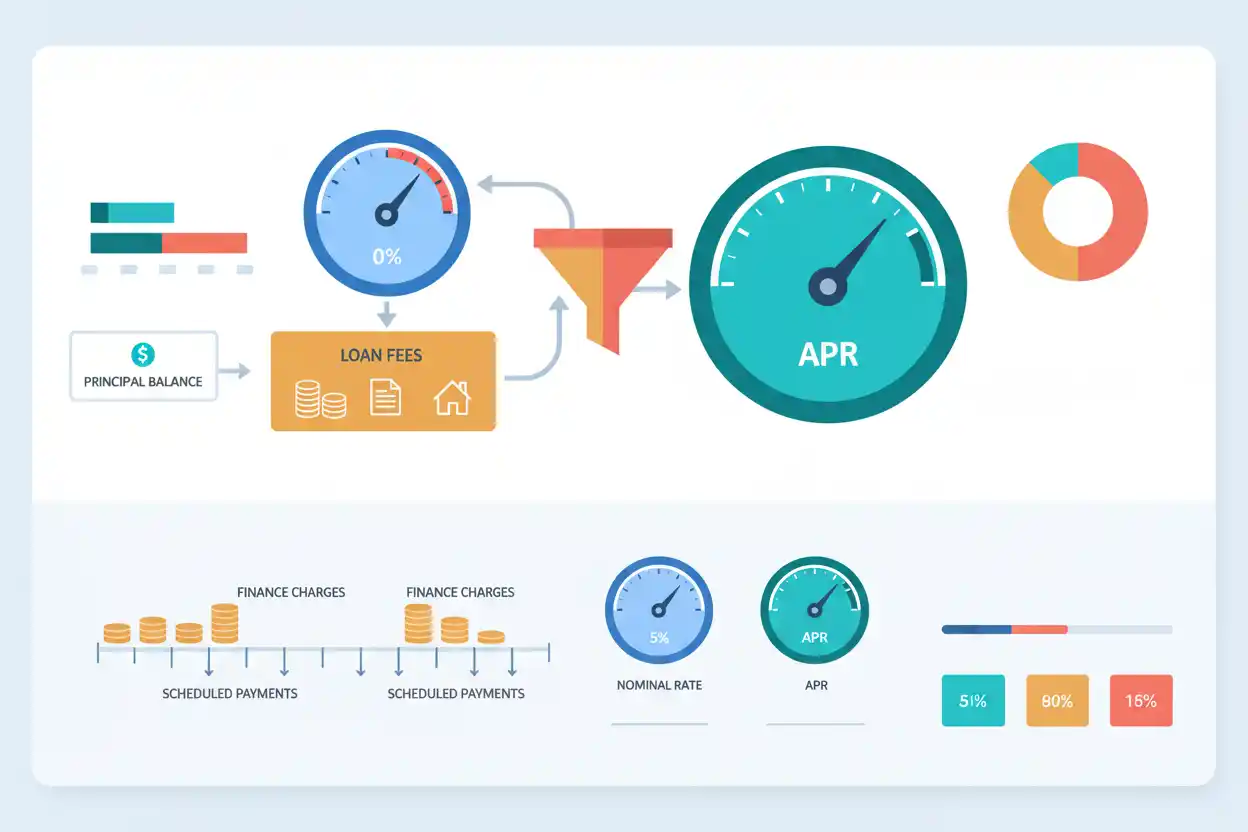
APR, or annual percentage rate, is a standardized way to express the cost of credit as a yearly rate.
It is especially useful because the interest rate alone may not capture every applicable cost associated with obtaining credit.
A loan can therefore advertise one interest rate while carrying a higher APR after qualifying finance charges and payment timing are considered.
For U.S. consumer credit covered by Regulation Z, APR is defined as a measure of the cost of credit expressed as a yearly rate. The underlying calculation relates the amount and timing of value received by the consumer to the amount and timing of payments.
What Does APR Mean?
APR stands for annual percentage rate.
Its purpose is to make borrowing costs easier to compare on an annualized basis.
APR should not be interpreted as:
a monthly payment, total interest in dollars, the principal amount borrowed, or automatically the same thing as the contractual interest rate.
Instead, APR is one part of a complete credit-cost comparison.
The related Loans & Credit pillar connects APR with amortization, payment schedules, fees, and debt-management concepts.
APR vs Interest Rate
The interest rate normally determines the interest charged according to the loan agreement.
APR measures annualized credit cost and can incorporate applicable finance charges.
Suppose a lender offers:
Interest rate = 8.00%
APR = 8.65%
The 8% figure relates to contractual interest.
The 8.65% APR indicates that the annualized cost is higher after the applicable calculation incorporates the relevant financing terms.
This does not mean you simply pay 8.65% of the original balance in cash each year.
APR is a rate representation, not a direct annual bill.
Why APR Can Be Higher Than the Interest Rate
Loan fees can increase the effective cost of obtaining credit.
Suppose a borrower signs a $10,000 loan but an applicable upfront finance charge reduces the usable proceeds.
The borrower can still be making payments associated with the contractual $10,000 obligation while receiving less economic value at origination.
That relationship pushes the annualized borrowing cost above what the nominal interest rate alone suggests.
Under Regulation Z, the finance charge generally represents the cost of consumer credit as a dollar amount and includes specified charges payable directly or indirectly by the consumer as an incident to or condition of obtaining credit, subject to detailed inclusions and exclusions.
APR Is Not Simply Interest Plus Fees Divided by Principal
A common internet shortcut is:
Approximate Rate ≈ (Interest + Fees) ÷ Principal ÷ Years
This may help illustrate the intuition behind borrowing cost, but it is not a universal APR formula.
Actual disclosed APR for covered closed-end consumer credit can require actuarial calculations that account for the timing and amount of advances and payments. Regulation Z’s Appendix J provides the formal computation framework.
Therefore, a simplified estimate should never be represented as the exact regulatory APR when the underlying transaction requires a different calculation.
Simple APR Cost Illustration
Suppose you borrow $10,000 for one year.
Assume, purely as a simplified illustration:
Interest paid = $800
Applicable financing fee = $200
Total simplified financing cost is:
Financing Cost = $800 + $200 = $1,000
Relative to $10,000:
Simplified Cost Percentage = $1,000 ÷ $10,000 × 100
Simplified Cost Percentage = 10%
This demonstrates why a financing fee can raise borrowing cost above an 8% interest rate.
It does not establish that the legally disclosed APR must equal exactly 10%, because payment timing and regulatory treatment of the charge still matter.
Amount Financed Matters
A fee can also change the amount of value the borrower effectively receives.
Suppose:
Face amount of loan = $10,000
Upfront qualifying finance charge withheld = $300
If the borrower receives $9,700 but must make payments based on the contractual transaction, the annualized credit cost can be higher than the note rate.
The correct disclosure treatment depends on the transaction and applicable rules.
APR and Amortizing Loans
An amortizing loan uses scheduled payments that reduce principal over time.
APR and amortization answer different questions.
Amortization asks:
How is the balance repaid?
APR asks:
What is the annualized cost of the credit?
A loan-payment formula therefore should not substitute APR for the contractual periodic interest rate unless the transaction explicitly requires that treatment.
APR and Accrued Interest
Accrued interest measures interest that has built up over an elapsed period.
APR is an annualized rate.
For example:
Accrued interest = $75
APR = 9.4%
These figures cannot be compared directly because one is a dollar amount for a specific period and the other is an annualized percentage measure.
APR vs APY
APR vs APY deserves its own comparison because the measures serve different purposes.
APR is commonly associated with borrowing cost.
APY is generally used for deposit-account yield and incorporates the effect of compounding into the annual percentage yield calculation. Regulation DD defines APY as a percentage reflecting total interest paid on an account based on the interest rate and compounding frequency.
APR vs Effective Interest Rate
A nominal stated annual rate and an effective annual rate can differ when interest compounds during the year.
Suppose a hypothetical rate is 12% nominal with monthly compounding and no other charges.
The monthly rate is:
Monthly Rate = 12% ÷ 12 = 1%
The mathematical effective annual rate is:
Effective Annual Rate = (1 + 0.01)^12 − 1
Effective Annual Rate ≈ 12.68%
However, this compounding calculation should not be confused automatically with a disclosed consumer-credit APR.
The nominal vs effective interest rate page owns that mathematical comparison.
Auto Loan APR
An auto loan APR can differ from an advertised vehicle-loan interest rate when qualifying financing charges affect cost.
When reviewing vehicle financing, compare:
APR, amount financed, loan term, required payment, total of payments, optional products, and cash down payment.
A low monthly payment obtained through a longer term does not necessarily produce a lower APR or lower total cost.
Business Loan APR
Business loan APR requires care because commercial lending may not use identical consumer-credit disclosure rules or terminology.
Some lenders quote interest rates, factor rates, fee percentages, or other cost metrics.
Comparisons should therefore normalize the timing and amount of cash flows instead of assuming every percentage is directly equivalent.
Personal Loan APR
A personal loan APR can be particularly useful when origination fees differ between competing offers.
Suppose:
Loan A rate = 9% with no qualifying financing fee.
Loan B rate = 8.5% but includes a substantial origination charge.
Loan B does not automatically cost less merely because its nominal rate is lower.
APR helps expose that distinction.
Credit Card APR
Credit card APR applies to revolving credit and follows different mechanics from a standard closed-end installment loan.
A credit card can also have multiple APRs for different balance categories, such as purchases, cash advances, or other transactions.
That is why the general APR concept should not absorb the specialist rules for revolving cards.
APR and Credit Card Grace Periods
A credit card grace period can affect whether interest is charged on qualifying purchases when payment conditions are satisfied.
Therefore, an account’s stated APR does not tell you how much interest a particular cardholder will necessarily pay.
Someone who consistently avoids interest under the account’s grace-period terms can have very different realized borrowing costs from someone who carries balances.
APR and Balance Transfers
A promotional APR can make a balance transfer attractive, but the balance transfer fee can materially affect the economics.
Suppose:
Transferred balance = $8,000
Transfer fee = 3%
Then:
Transfer Fee = $8,000 × 3%
Transfer Fee = $240
The borrower should evaluate the $240 charge together with the promotional rate, promotion length, post-promotional rate, and payoff plan.
APR and Cash Advances
A cash advance fee is another example of why headline APR alone may not capture the actual dollars a borrower spends.
Depending on the card terms, cash advances can have a separate APR and different interest timing from ordinary purchases.
The applicable card agreement controls.
APR and Origination Fees
A loan origination fee can be charged as a dollar amount or percentage.
For example:
Loan amount = $20,000
Origination fee = 2%
Origination Fee = $20,000 × 2%
Origination Fee = $400
Whether and how that fee affects disclosed APR depends on the credit transaction and applicable finance-charge rules.
APR and Loan Term
Two loans with similar APRs can still produce very different total interest when their terms differ.
A loan term determines how long the borrower remains obligated and how many scheduled payments occur.
A 9% APR loan for three years can therefore cost fewer total dollars than a 9% APR loan for seven years, assuming similar principal and other terms.
APR standardizes a rate; it does not erase the importance of time.
APR and Loan Payments
The loan payments page calculates the required installment from the relevant principal, rate, and term assumptions.
Borrowers should compare both:
payment affordability and borrowing cost.
A financially comfortable payment can still belong to an expensive loan if the repayment term is unusually long.
APR and Prepayment
If a borrower pays a declining-balance loan early, the total amount of interest actually paid may fall.
This does not mean the originally disclosed APR is retroactively replaced by a simple interest-paid-divided-by-principal calculation.
The prepayment penalty also needs to be examined when the contract contains one.
What Is a Good APR?
There is no universal good APR.
APR depends on:
market rates, credit risk, product type, loan term, collateral, borrower profile, fees, and lender pricing.
A reasonable comparison therefore uses offers for substantially similar products at approximately the same time.
Comparing a secured auto loan APR with a revolving credit-card APR tells you little about which offer is competitively priced because the underlying risks and structures differ.
Can 0% APR Still Cost Money?
Yes.
A 0% promotional APR does not automatically mean the transaction has zero cost.
A balance-transfer promotion may include a transfer fee.
A purchase may have other charges unrelated to the interest rate.
A financing promotion can also expire, after which another APR applies according to the terms.
Always examine the complete agreement.
Common APR Mistakes
The first mistake is assuming APR equals the interest rate.
The second is comparing APRs from products with different terms without considering total payments.
The third is treating APR as if it predicts exactly how many dollars of interest you personally will pay.
The fourth is ignoring fees that occur outside the headline rate.
Finally, borrowers should avoid calculating a homemade “APR” with a shortcut and presenting it as the lender’s required disclosure.
Frequently Asked Questions
What does APR stand for?
APR stands for annual percentage rate.
What does APR measure?
APR expresses the cost of credit as an annualized percentage rate.
Is APR the same as interest rate?
Not necessarily. APR can reflect applicable finance charges in addition to contractual interest.
Why is my APR higher than my loan rate?
Applicable financing charges and the timing of loan cash flows can raise the annualized borrowing cost above the note rate.
Does APR include every fee?
No. The treatment of a fee depends on the transaction and applicable disclosure rules. Not every charge is necessarily included as a finance charge.
Is lower APR always better?
For otherwise comparable credit, a lower APR generally indicates lower annualized credit cost, but term, amount financed, payment structure, and other contractual features still matter.
Can APR be 0%?
Yes, promotional or other credit arrangements can advertise 0% APR, but borrowers should still review fees, duration, eligibility, and what rate applies afterward.
Does APR determine my monthly payment?
Not necessarily. Scheduled payments are generally calculated from the contractual loan terms, while APR is a credit-cost measure.
What is the difference between APR and APY?
APR commonly expresses borrowing cost, while APY expresses annual yield and incorporates compounding in the deposit-account context.
Does a longer term reduce APR?
Not automatically. Term changes the timing of payments and total interest, but APR depends on the full credit-cost calculation.
Can two loans have the same interest rate but different APRs?
Yes. Different applicable fees or cash-flow structures can produce different APRs.
Should I compare loans using APR or monthly payment?
Use both, along with the amount financed, term, finance charge, total payments, collateral, and contractual conditions.
Final Takeaway
APR is designed to make borrowing costs easier to compare by expressing credit cost as a yearly rate.
The most important distinction is:
Interest Rate ≠ Automatically the Same as APR
A loan can carry an 8% contractual rate yet have a higher APR when applicable financing costs and payment timing are incorporated.
APR is therefore more informative than a headline rate alone, but it should still be read alongside the amount financed, finance charge, loan term, periodic payment, total repayment, and contractual terms.
That complete view is what reveals the real economics of borrowing.