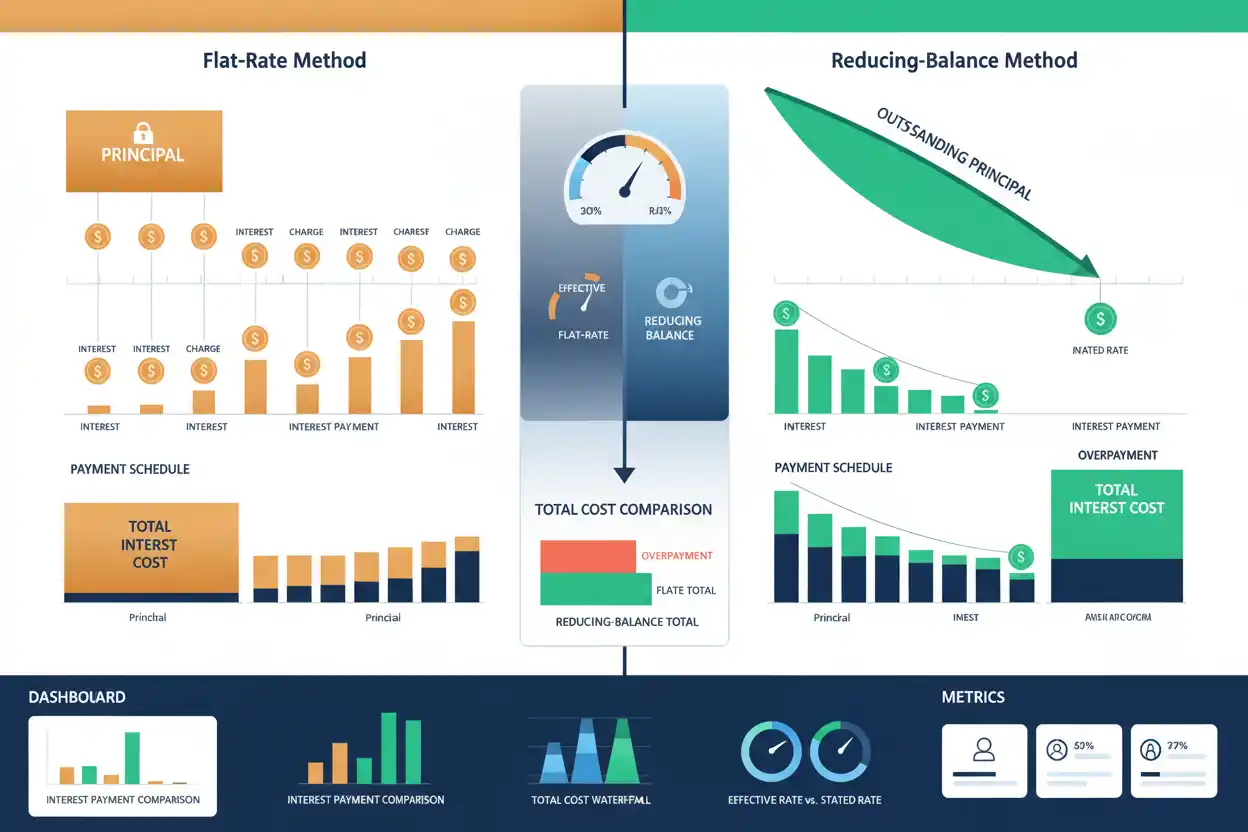
Flat vs reducing balance interest describes two different ways of determining the interest charged on a loan.
Under a flat-rate method, interest is calculated using the original principal for the stated term, even though the borrower makes payments during that period.
Under a reducing-balance method, interest is calculated from the outstanding principal, so the interest charge generally declines as principal is repaid.
The distinction can produce a surprisingly large difference in borrowing cost.
A flat rate that looks numerically low can translate into an effective borrowing cost substantially higher than a reducing-balance loan quoting the same percentage.
The core flat-rate formula is:
Flat Interest = Original Principal × Flat Annual Rate × Loan Term
The reducing-balance approach instead calculates each period’s interest as:
Periodic Interest = Outstanding Principal × Periodic Interest Rate
These formulas describe very different economics.
What Is Flat-Rate Interest?
Flat-rate interest uses the original amount borrowed as the interest base.
Suppose:
Principal = $10,000
Flat rate = 10% per year
Term = 3 years
Interest is:
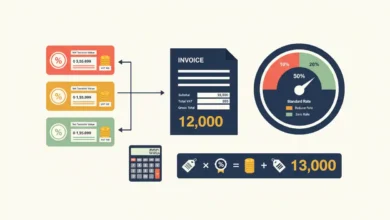
Flat Interest = $10,000 × 10% × 3
Flat Interest = $3,000
Total repayment:
Total Repayment = $10,000 + $3,000
Total Repayment = $13,000
If repaid through 36 equal monthly installments:
Monthly Payment = $13,000 ÷ 36
Monthly Payment ≈ $361.11
The interest amount was calculated from the full $10,000 for all three years even though the borrower progressively repays the debt.
What Is Reducing-Balance Interest?
Reducing-balance interest uses the principal that remains outstanding.
For the first period:
Interest = Opening Principal × Periodic Rate
After part of the payment reduces principal:
Next Interest = New Lower Principal × Periodic Rate
As a result:
Principal Falls → Interest Falls
This is the standard principle behind many amortizing loan calculations.
Reducing-Balance Example
Now assume:
Principal = $10,000
Nominal annual rate = 10%
Term = 36 months
Payments = monthly
Monthly rate:
Monthly Rate = 10% ÷ 12
Monthly Rate ≈ 0.83333%
Using a conventional EMI formula:
Payment = P × [r(1 + r)ⁿ] ÷ [(1 + r)ⁿ − 1]
the monthly payment is approximately:
Monthly Payment ≈ $322.67
Total repayment:
Total Payments ≈ $322.67 × 36
Using full precision:
Total Payments ≈ $11,616.19
Total interest:
Total Interest ≈ $11,616.19 − $10,000
Total Interest ≈ $1,616.19
Flat vs Reducing Balance Example
Using the same $10,000 principal and quoted 10% annual rate:
| Method | Approx. Monthly Payment | Approx. Total Interest | Approx. Total Repayment |
|---|---|---|---|
| Flat rate | $361.11 | $3,000.00 | $13,000.00 |
| Reducing balance | $322.67 | $1,616.19 | $11,616.19 |
The flat-rate loan charges almost twice as much total interest in this simplified comparison.
That is why percentages should not be compared without understanding the calculation method.
Why the Same 10% Rate Produces Different Costs
In the flat example, the lender continues calculating the contractual interest amount from $10,000.
In the reducing-balance example, principal falls month after month.
Suppose the reducing-balance loan reaches approximately $5,000 outstanding.
At a 10% annual rate, interest is now being calculated from about $5,000—not the original $10,000.
The flat method does not give the borrower the same benefit from the declining economic balance.
Flat Rate and Effective Cost
A flat rate can therefore understate the effective annual cost if it is interpreted like a normal declining-balance interest rate.
For the $10,000 flat-rate example:
Cash received initially = $10,000
Monthly payment = approximately $361.11
Payments = 36
Solving for the monthly rate implied by those cash flows gives approximately:
Monthly Effective Cost ≈ 1.493%
A nominal annualization is approximately:
Annualized Periodic Rate ≈ 1.493% × 12
Annualized Periodic Rate ≈ 17.92%
The effective annual rate is approximately:
Effective Annual Rate = (1 + 0.01493)¹² − 1
Effective Annual Rate ≈ 19.46%
That is far above the advertised 10% flat rate.
The exact APR or regulatory disclosure can follow different rules, but the example demonstrates why flat percentages should not be compared directly with reducing-balance rates.
Flat Interest Payment Formula
For a simple flat-rate installment loan:
Total Flat Interest = Principal × Rate × Years
Then:
Total Repayment = Principal + Total Flat Interest
And:
Installment = Total Repayment ÷ Number of Installments
For the example:
Interest = $10,000 × 10% × 3 = $3,000
Repayment = $13,000
Monthly Installment = $13,000 ÷ 36 ≈ $361.11
Reducing-Balance Formula
For each individual period:
Interestₜ = Outstanding Principalₜ × Periodic Rate
A fixed-payment reducing-balance loan can then use:
Payment = P × [r(1 + r)ⁿ] ÷ [(1 + r)ⁿ − 1]
The loan payments page owns the broader payment calculation.
Reducing Balance and Principal Allocation
Suppose:
Principal = $10,000
Monthly rate = 0.83333%
Payment = $322.67
First month’s interest:
Interest ≈ $10,000 × 0.83333%
Interest ≈ $83.33
Principal repayment:
Principal = $322.67 − $83.33
Principal ≈ $239.34
New balance:
Balance ≈ $10,000 − $239.34
Balance ≈ $9,760.66
The second month’s interest is calculated from approximately $9,760.66 rather than $10,000.
Flat vs Reducing Balance and Repayment Schedules
A repayment schedule makes the difference visible.
Under reducing balance:
interest declines, principal allocation rises, and outstanding balance falls.
Under a flat-rate quotation, the total interest may already have been calculated from the original principal.
The payment schedule should show how the lender allocates each installment and how early payoff is handled.
Flat Rate vs Simple Interest Loan
A simple interest loan generally calculates interest from the actual outstanding principal.
That resembles the reducing-balance concept more closely than a flat-rate quotation.
The word simple, however, should not be assumed to mean flat.
These are different terms.
Flat vs Daily Simple Interest
Daily simple interest uses the current principal and elapsed days.
For example:
Daily Interest = Outstanding Principal × Annual Rate ÷ Day-Count Basis
As principal falls, daily interest falls.
A flat-rate loan normally does not provide that same direct relationship between outstanding balance and quoted flat interest.
Accrued Interest
Accrued interest can arise under a reducing-balance structure as time passes between payments.
The amount depends on the outstanding principal, rate, and elapsed period.
Under a flat-rate framework, the contractual total interest may instead have been determined using the original principal.
The underlying contract matters.
Flat vs Reducing and Interest Rate Basics
The interest rate basics framework helps distinguish:
nominal rates, periodic rates, APR, effective rates, and calculation methods.
A quoted rate has little meaning unless you also know:
what balance it applies to and how often it is applied.
Flat vs Reducing and APR
APR can provide a more useful comparison because it attempts to annualize borrowing cost using the transaction’s cash flows and applicable financing charges.
A 10% flat rate and a 10% reducing-balance interest rate should not automatically produce the same APR.
The flat-rate structure generally creates a higher economic cost in the kind of example shown above.
Flat vs Reducing and Effective Rate
The nominal vs effective interest rate page owns the detailed distinction between a stated nominal percentage and the annual result after periodic compounding.
For flat-rate loans, the effective cost can be even more important because the quoted rate itself is applied to a different principal base.
Flat vs Reducing and Fixed vs Variable
The fixed vs variable interest rate comparison answers whether the rate changes.
Flat vs reducing answers which balance is used.
A fixed-rate loan can still use a reducing balance.
Indeed, many conventional fixed-rate amortizing loans do exactly that.
Flat vs Reducing and Interest Coverage
Businesses comparing financing methods should consider the effect on the interest coverage ratio.
A loan with a deceptively low flat-rate quotation can impose a higher effective financing burden than management expects.
Comparing economic borrowing cost rather than headline percentage leads to more useful coverage analysis.
Flat vs Reducing and Debt-to-Income Ratio
The debt-to-income ratio depends on required monthly payments.
In the worked example:
Flat-rate installment ≈ $361.11
Reducing-balance installment ≈ $322.67
If income is unchanged, the flat-rate structure creates a larger DTI contribution.
Payment differences therefore matter even before total interest is considered.
Flat vs Reducing and Loan Term
The loan term magnifies the differences.
A flat rate applied for five years generates interest from the original principal for five full years.
A reducing-balance loan progressively shrinks the interest base throughout that period.
Longer terms can therefore make a misleadingly low flat rate particularly expensive.
Loan Origination Fees
A loan origination fee should be evaluated separately.
Suppose a flat-rate loan also includes a 3% upfront fee.
The effective borrowing cost rises further.
Comparing only the flat interest percentage would miss both the principal-base issue and the fee.
Flat vs Reducing Personal Loan Payments
Personal loan payments can differ materially depending on the calculation method.
When a lender advertises a flat percentage, borrowers should ask for:
monthly payment, total repayment, APR or equivalent annualized cost, and an amortization or repayment schedule.
Flat vs Reducing Auto Loan Payments
Many auto loan payments use outstanding-balance interest calculations.
However, borrowers should verify the actual contract rather than assuming every vehicle financing product works identically.
Precomputed or unusual structures can affect early repayment savings.
Prepayment
A prepayment penalty can further alter the comparison.
Reducing-balance loans often reward early principal reduction because future interest is calculated from a lower balance.
A flat or precomputed structure may provide less benefit from early repayment depending on how unearned interest is treated.
Common Flat vs Reducing Balance Mistakes
One common mistake is comparing a 10% flat rate with a 10% reducing-balance rate as though they cost the same.
Another is looking only at the monthly installment.
Borrowers can also confuse flat interest with simple interest.
A fourth mistake is ignoring the effective annual cost of the cash flows.
Finally, fee differences should be added to the comparison rather than treated as unrelated charges.
Frequently Asked Questions
What is flat-rate interest?
Flat-rate interest calculates interest using the original principal for the stated term.
What is reducing-balance interest?
It calculates periodic interest from the principal that remains outstanding.
What is the flat interest formula?
Flat Interest = Original Principal × Annual Flat Rate × Term
What is the reducing-balance interest formula?
Periodic Interest = Outstanding Principal × Periodic Rate
Which method usually costs less at the same quoted percentage?
A reducing-balance loan usually produces less total interest because the interest base declines.
Why can a 10% flat rate cost much more than 10%?
Because the 10% is repeatedly applied to the original principal rather than the declining economic balance.
Is flat interest the same as simple interest?
Not necessarily. Standard simple-interest loans commonly calculate interest from the outstanding principal.
Is reducing-balance interest the same as EMI?
No. EMI is the payment structure; reducing balance describes the interest base.
Does early repayment help more with reducing balance?
Generally, reducing principal earlier lowers future interest, subject to the contract and any prepayment charges.
Should I compare monthly payments?
Yes, but also compare total repayment and annualized borrowing cost.
Can a fixed-rate loan use reducing balance?
Yes. Fixed vs variable and flat vs reducing describe different loan characteristics.
Which percentage should I compare when shopping?
Use a standardized APR or equivalent annualized borrowing-cost measure when available, together with the complete payment schedule and fees.
Final Takeaway
Flat vs reducing balance interest can turn identical-looking quoted rates into very different borrowing costs.
For a $10,000 loan at a quoted 10% for three years:
Flat Interest = $3,000
with a payment of approximately $361.11 per month.
A 10% reducing-balance amortizing loan over the same 36 months produces a payment of approximately $322.67 and total interest of only about $1,616.19.
The flat-rate cash flows imply an effective annual cost of roughly 19.46% in the simplified example—far above the advertised 10%.
Therefore, never compare loan percentages until you know whether interest is calculated on the original principal or the declining outstanding balance.