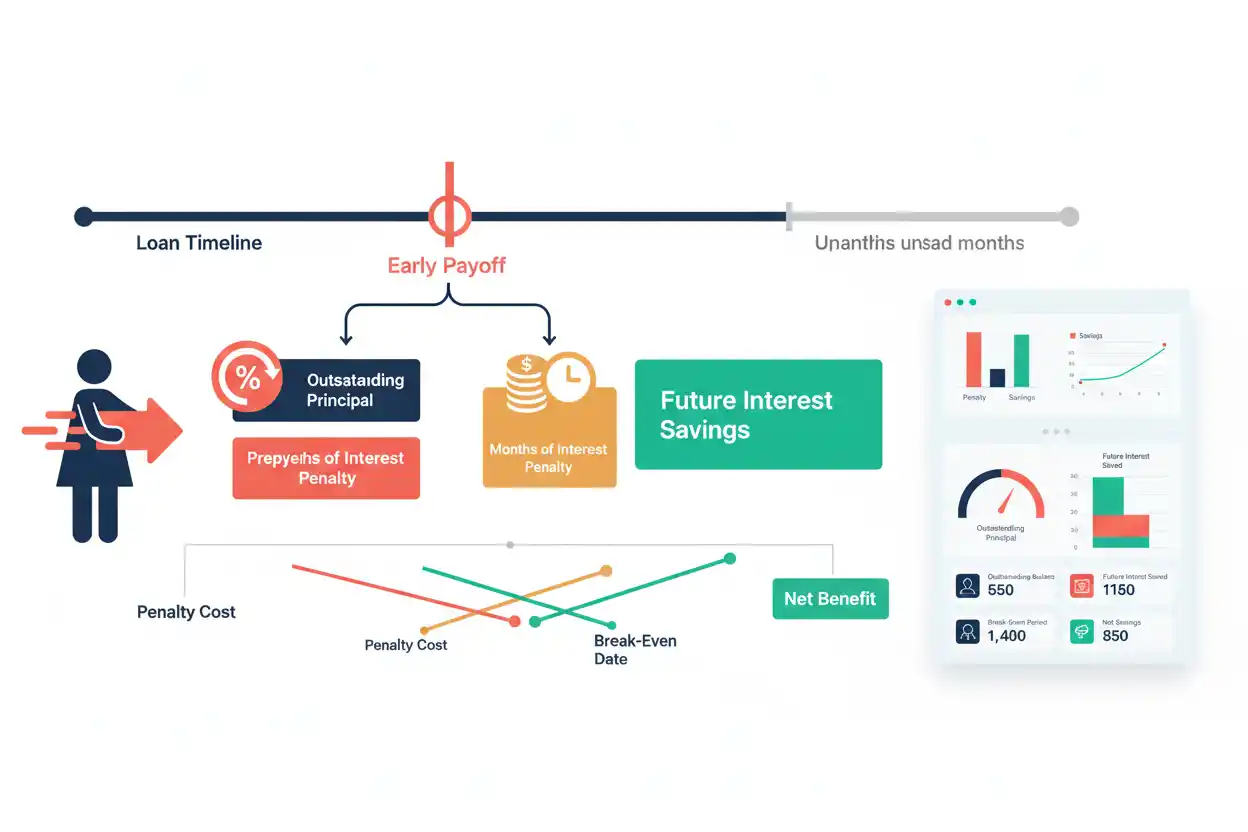

A prepayment penalty is a charge that can apply when a borrower repays some or all of a loan earlier than permitted without charge under the loan agreement.
Not every loan has one.
Where a prepayment penalty exists, its calculation can follow several structures.
A common percentage-of-balance formula is:
Prepayment Penalty = Outstanding Principal × Penalty Percentage
If the outstanding balance is $40,000 and the contract imposes a 2% qualifying prepayment charge:
Prepayment Penalty = $40,000 × 2%
Prepayment Penalty = $800
The penalty reduces the financial benefit of paying early.
However, it does not automatically mean prepayment is a bad decision. The correct comparison is between the penalty and the future interest or other costs that early repayment avoids.
What Is a Prepayment Penalty?
A prepayment penalty is an early-repayment charge.
It can potentially apply when the borrower:
pays off the entire loan before maturity, makes a principal payment above a permitted amount, refinances the loan, or completes another transaction treated as prepayment under the contract.
The exact trigger matters.
Some agreements permit unlimited additional principal.
Others permit a certain amount before a charge applies.
Some loans have no prepayment penalty at all.
Within Loans & Credit, the concept connects directly with personal loans, payoff calculations, principal balances, and repayment schedules.
Percentage-of-Balance Prepayment Penalty
One possible structure is:
Penalty = Prepaid Principal × Penalty Rate
Suppose:
Outstanding principal = $50,000
Entire loan is prepaid
Penalty = 3%
Then:
Prepayment Penalty = $50,000 × 3%
Prepayment Penalty = $1,500
If only $10,000 of principal is subject to the penalty:
Penalty = $10,000 × 3%
Penalty = $300
The contract determines whether the percentage applies to:
the whole outstanding balance or only the amount prepaid.
Months-of-Interest Penalty
Another possible structure calculates the penalty as a specified number of months of interest.
A simplified formula is:
Penalty = Outstanding Principal × Annual Interest Rate × Penalty Months ÷ 12
Suppose:
Principal balance = $40,000
Annual rate = 8%
Penalty = six months of interest
Then:
Penalty = $40,000 × 8% × 6 ÷ 12
Penalty = $1,600
This produces a larger penalty than the earlier 2%-of-balance example.
Sliding-Scale Penalty
Some contracts can reduce the penalty as the loan gets older.
For example, a hypothetical structure could charge:
3% during year one, 2% during year two, 1% during year three, and 0% afterward.
If $50,000 remains outstanding in year two:
Penalty = $50,000 × 2%
Penalty = $1,000
The borrower might therefore compare paying today with waiting until the next penalty reduction.
The actual schedule must come from the contract.
Prepayment Penalty Example
Assume:
Outstanding balance = $30,000
Interest rate = 10%
Remaining scheduled term = 36 months
Prepayment penalty = 2% of outstanding principal
Penalty:
Penalty = $30,000 × 2%
Penalty = $600
Suppose paying immediately would avoid approximately $4,000 of future interest.
Then:
Net Interest Saving Before Other Costs = $4,000 − $600
Net Saving = $3,400
Under those simplified assumptions, paying early remains financially beneficial despite the penalty.
Break-Even Formula
A useful decision formula is:
Net Prepayment Benefit = Future Interest Avoided − Prepayment Penalty − Other Incremental Payoff Costs
If:
Future interest avoided = $2,500
Penalty = $1,000
Other cost = $100
Then:
Net Benefit = $2,500 − $1,000 − $100
Net Benefit = $1,400
If the result is positive, early repayment produces an estimated financial saving.
If negative, paying early may cost more than continuing under the assumed schedule.
Prepayment Penalty vs Loan Payoff Quote
A loan payoff quote provides the amount required to satisfy the loan on a specific date.
When a prepayment penalty applies, the payoff quote may include it.
Conceptually:
Payoff Amount = Principal + Accrued Interest + Applicable Penalty + Other Charges − Credits
This is why borrowers should request a formal quote rather than paying only the displayed principal.
Prepayment Penalty and Principal Balance
The principal balance often determines the penalty base.
If the penalty is 2% of outstanding principal:
$100,000 balance:
Penalty = $2,000
$50,000 balance:
Penalty = $1,000
As principal declines, the dollar penalty also declines under a pure percentage-of-balance formula.
Prepayment Penalty and Personal Loan Payments
Personal loan payments systematically reduce principal.
A borrower planning large extra payments should verify whether:
additional principal is unlimited, a threshold applies, or full payoff triggers a separate charge.
Do not assume that because ordinary monthly payments are permitted, unlimited additional principal must also be penalty-free.
Personal Loan APR and Prepayment
The personal loan APR measures annualized borrowing cost at origination.
A prepayment penalty can change the economics when the loan is actually repaid early.
For example, a borrower can choose a loan with a competitive APR but later discover that refinancing it after one year carries a substantial exit charge.
Loan selection should therefore consider both entry costs and exit costs.
Prepayment Penalty and Repayment Schedule
A repayment schedule assumes the loan continues according to the scheduled plan.
Early repayment interrupts that schedule.
Future interest that would have appeared in later installments may never be charged.
That potential saving is the main financial reason to consider prepayment.
Prepayment Penalty and Nominal vs Effective Rates
The nominal vs effective interest rate page explains how compounding affects annual borrowing cost.
A prepayment penalty is different.
It is a separate contractual charge triggered by repayment behavior rather than simply a feature of periodic interest.
A borrower should not convert the penalty into a nominal rate without considering the timing and amount of the actual cash flows.
Prepayment Penalty and Loan Term
The loan term helps determine how much future interest remains available to save.
Suppose a borrower has:
two months remaining versus eight years remaining.
The eight-year loan can contain far more future interest, making early payoff potentially more valuable.
However, a large prepayment penalty can offset part of that benefit.
Prepayment Penalty and Simple Interest
On a simple interest loan, reducing principal earlier generally reduces future interest because interest is calculated from outstanding principal.
That makes prepayment economically attractive before considering penalties.
The net decision is:
Interest Saved vs Penalty Paid
Daily Simple Interest and Prepayment
For daily simple interest debt, paying principal today instead of next month reduces the number of days during which that principal generates interest.
Suppose:
Principal prepaid = $10,000
Rate = 9%
Days saved = 30
Approximate interest avoided:
Interest Saved = $10,000 × 9% × 30 ÷ 365
Interest Saved ≈ $73.97
If the prepayment charge is $300, paying that $10,000 only 30 days early would not break even from interest savings alone.
Prepayment Penalty and Loan Origination Fees
A loan origination fee has already increased the cost of obtaining the loan.
If the borrower then repays shortly afterward and also pays a prepayment penalty, the effective cost of using the financing for a short period can become substantial.
This is particularly important when a borrower expects to refinance quickly.
Prepayment Penalty and Debt Consolidation
Suppose an existing loan is being replaced through a debt consolidation loan.
The consolidation comparison should include any penalty required to close the old loan.
If:
New loan saves $3,000 of future interest
Old loan penalty = $2,500
New origination fee = $800
Then:
Net Result = $3,000 − $2,500 − $800
Net Result = −$300
The refinance would not save money under those assumptions.
Secured Loans and Prepayment
A secured loan can have different prepayment provisions from unsecured credit.
The presence of collateral does not itself tell you whether a penalty exists.
Always review the actual agreement.
Unsecured Loans and Prepayment
An unsecured loan can likewise have or lack an early-repayment charge depending on the product and applicable law.
Do not infer prepayment treatment solely from whether collateral is involved.
Full vs Partial Prepayment
A contract can treat full payoff and partial principal reduction differently.
Suppose:
Outstanding principal = $50,000
Annual free-prepayment allowance = $10,000
Borrower pays $15,000
If only the amount above $10,000 is penalized:
Penalized Prepayment = $15,000 − $10,000
Penalized Amount = $5,000
At 2%:
Penalty = $5,000 × 2%
Penalty = $100
This is only an illustrative structure; the actual agreement controls.
Refinance and Prepayment Penalties
Refinancing usually requires the old loan to be paid off.
Therefore, a prepayment charge can become a refinancing cost.
A borrower comparing refinance offers should calculate:
new-loan savings minus old-loan exit costs minus new-loan entry costs.
Ignoring either side can produce a false saving.
Asset Sale and Prepayment
Selling a financed asset can also trigger payoff.
For example, a secured loan may need to be satisfied before the lender releases its claim against the asset.
If the payoff occurs during a penalty period, the sale can trigger an additional charge.
That should be considered before committing to the transaction.
When a Prepayment Penalty Expires
Some penalties disappear after a defined period.
Suppose:
Penalty today = $1,500
Penalty becomes $0 in three months
Interest during those three months = approximately $600
Waiting could save:
$1,500 − $600 = $900
before considering other factors.
This type of timing analysis can be valuable when the penalty expiration date is close.
Opportunity Cost of Early Payoff
Even when no penalty exists, paying a loan early uses cash that could have been kept or invested elsewhere.
Suppose a loan costs 5% while the borrower has no emergency reserve.
Paying every available dollar toward the loan can reduce interest but leave the household vulnerable to a later cash shortage.
Therefore, the decision should consider liquidity as well as the mathematical interest saving.
Prepayment Penalty and Student Loans
Loan type matters.
Certain forms of lending have specific rules governing prepayment charges.
For example, student-loan prepayment treatment can differ from mortgage, auto, or personal-loan treatment.
Never assume a rule applying to one type of loan automatically applies to another.
Prepayment Rules Depend on Contract and Law
Whether a prepayment penalty is permitted, limited, or prohibited can depend on:
loan type, jurisdiction, borrower status, lender, contract, and applicable regulation.
The loan agreement should identify whether one applies.
For important transactions, borrowers should also confirm any applicable legal restrictions rather than relying on a generic rule.
Common Prepayment Penalty Mistakes
A common mistake is assuming every early payoff is penalty-free.
Another is assuming every loan charges a penalty.
Borrowers also compare the penalty with principal rather than the future interest being avoided.
A fourth mistake is forgetting new refinancing fees when replacing the loan.
Finally, a borrower can pay a penalty unnecessarily by refinancing only shortly before the penalty period would have expired.
Frequently Asked Questions
What is a prepayment penalty?
It is a charge that can apply when a borrower repays some or all of a loan earlier than permitted without charge under the agreement.
What is a common percentage formula?
Prepayment Penalty = Prepaid Principal × Penalty Percentage
What is a 2% penalty on $40,000?
$40,000 × 2% = $800
How does an interest-based penalty work?
A simplified version is:
Penalty = Principal × Annual Rate × Penalty Months ÷ 12
Do all loans have prepayment penalties?
No.
Can a partial extra payment trigger a penalty?
It can under some contracts, while others permit a defined amount of additional principal.
Does paying early still save money if there is a penalty?
It can. Compare future interest avoided with the penalty and other incremental costs.
Is the penalty included in a payoff quote?
When applicable, it may be included in the lender’s payoff calculation.
Can prepayment penalties expire?
Yes, some contracts reduce or eliminate the penalty after a specified period.
Is refinancing considered prepayment?
Usually the existing loan is paid off during refinancing, so any applicable early-payoff provision can matter.
Are prepayment rules the same for mortgages, auto loans, student loans, and personal loans?
No. Product-specific contracts and laws can differ materially.
What should I check before paying a loan off early?
Check the payoff quote, remaining future interest, penalty formula, expiration date, applicable fees, and effect on your available cash.
Final Takeaway
A prepayment penalty can reduce—but does not necessarily eliminate—the financial benefit of paying a loan early.
A common formula is:
Prepayment Penalty = Outstanding Principal × Penalty Rate
A 2% penalty on a $40,000 balance equals:
$800
If early payoff avoids $4,000 of future interest, the simplified net saving is still:
$4,000 − $800 = $3,200
before other costs.
The correct decision is therefore not simply “Does my loan have a penalty?”
It is:
How much does the penalty cost compared with the interest and other financing costs I can avoid by paying early?