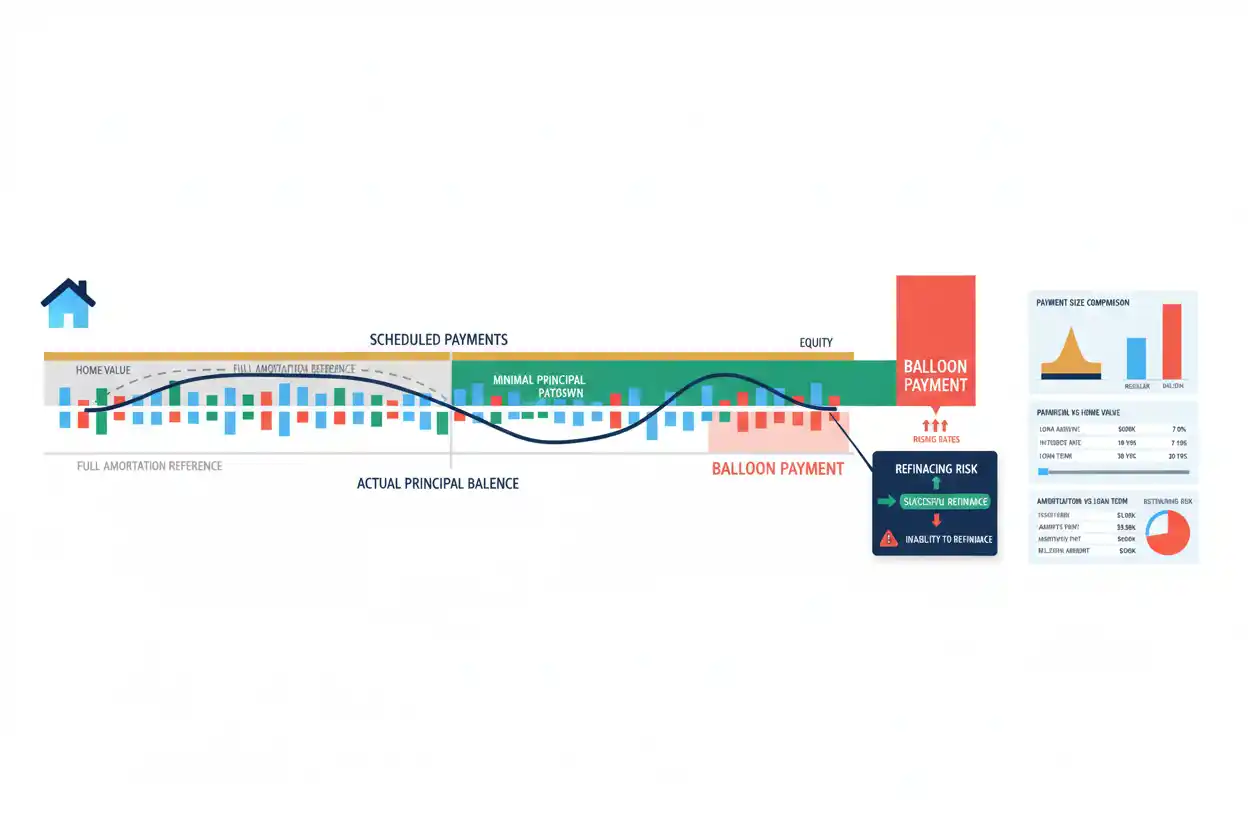

A balloon mortgage is a home loan that leaves a substantial unpaid balance due in a large final payment rather than fully repaying the mortgage through ordinary scheduled installments.
The mortgage may calculate monthly payments using an amortization period that is much longer than the actual loan term.
For example, payments might be calculated as though the mortgage will run for 30 years even though the legal maturity arrives after seven years.
The monthly payment is therefore relatively manageable, but the mortgage has not been fully amortized when the term ends.
The remaining principal becomes the balloon payment.
CFPB guidance describes a balloon payment as a large final payment that can remain after a mortgage with lower regular payments reaches the end of its shorter term. If the borrower cannot make that payment, refinancing, selling the property, or other difficult outcomes may become necessary.
Within the broader Mortgages & Home Loans framework, a balloon mortgage is best understood as a mismatch between the amortization period used to calculate payments and the actual maturity date of the loan.
What Is a Balloon Mortgage?
A balloon mortgage is not defined simply by having a large mortgage balance.
The defining feature is that the scheduled periodic payments do not fully eliminate the debt before contractual maturity.
Conceptually:
Balloon Payment = Remaining Mortgage Balance at Maturity + Applicable Accrued Amounts
A borrower can make every regular payment on time and still owe a large amount when the term ends.
That makes a balloon mortgage fundamentally different from a conventional fixed-rate mortgage that fully amortizes over its entire scheduled term.
Balloon Mortgage Payment Formula
Suppose the mortgage payment is calculated over a long amortization period.
The standard payment formula is:
Monthly Payment = P × [r(1 + r)^n] ÷ [(1 + r)^n − 1]
Where:
P = original principal
r = monthly interest rate
n = number of months in the amortization period
If the mortgage legally matures after k payments rather than after all n payments, the balloon is approximately the principal remaining after payment k.
The remaining-balance formula is:
Remaining Balance = P(1 + r)^k − A × [((1 + r)^k − 1) ÷ r]
Where:
A = scheduled monthly payment
k = number of payments made before maturity
This is the core balloon mortgage calculation.
Balloon Mortgage Example
Suppose:
Mortgage principal = $300,000
Interest rate = 6%
Payment amortization = 30 years
Actual balloon term = 7 years
Payments = monthly
Step 1: Calculate the Monthly Rate
Monthly Rate = 6% ÷ 12
Monthly Rate = 0.5%
As a decimal:
r = 0.005
Step 2: Calculate the Amortization Period
A 30-year amortization contains:
n = 30 × 12
n = 360 Payments
Step 3: Calculate the Monthly Payment
Payment = $300,000 × [0.005(1.005)^360] ÷ [(1.005)^360 − 1]
Monthly Principal-and-Interest Payment ≈ $1,798.65
The monthly payment looks exactly like the payment on a conventional 30-year mortgage at the same rate.
The difference is that this mortgage ends after seven years.
Calculate the Balloon Date
Seven years equals:
k = 7 × 12
k = 84 Payments
After the 84th scheduled payment, the borrower has not completed the 360-payment amortization.
Using the remaining-balance formula:
Remaining Balance ≈ $268,918.16
That amount is the approximate balloon principal due at the end of year seven before considering settlement-date interest, fees, or other applicable amounts.
Balloon Payment Example
The mortgage therefore looks like this:
Original principal = $300,000
Monthly payment ≈ $1,798.65
Regular payments made = 84
Balloon principal ≈ $268,918.16
The borrower has paid:
Regular Payments ≈ $1,798.65 × 84
Regular Payments ≈ $151,086.73
Yet approximately $268,918 remains.
This does not mean the borrower paid $151,087 of principal.
Much of those first seven years of payments went to mortgage interest.
The mortgage principal and mortgage interest pages separate those two components.
Why Is the Balloon So Large?
Mortgage amortization is slowest early in a long-term loan.
With a 30-year amortization:
early payments contain relatively high interest and comparatively small principal reductions.
The borrower therefore reaches year seven with a large portion of the original principal still outstanding.
This is visible in a mortgage amortization schedule.
A shorter balloon term produces even less time for principal reduction.
Balloon Mortgage vs Fully Amortizing Mortgage
Consider the same $300,000 mortgage at 6%.
A conventional 30-year mortgage:
360 Payments × Approximately $1,798.65
and then principal reaches approximately zero.
A seven-year balloon mortgage using 30-year amortization:
84 Payments × Approximately $1,798.65
followed by:
Balloon ≈ $268,918
The monthly payments can look identical while the maturity obligations are completely different.
Balloon Mortgage vs Adjustable-Rate Mortgage
An adjustable-rate mortgage creates uncertainty because the interest rate can change.
A balloon mortgage creates a different risk:
a large unpaid balance becomes due at maturity.
An ARM may fully amortize over its full term.
A balloon mortgage may have a fixed interest rate but still require a huge final payment.
Therefore:
ARM Risk = Future Rate and Payment Changes
Balloon Risk = Large Final Principal Obligation
A mortgage can also contain more than one complex feature, so the contract must be read carefully.
Balloon Mortgage vs Interest-Only Mortgage
An interest-only mortgage can temporarily require payments that do not reduce principal.
A balloon mortgage can make principal-and-interest payments and still have a balloon.
The two concepts therefore overlap in some products without being identical.
Balloon Mortgage vs Bridge Loan
A bridge loan is usually designed as temporary financing until another transaction occurs.
A balloon mortgage can also have a short maturity, but its defining feature is the large final balance.
The borrower should not assume that every short-term property loan is automatically a bridge loan or every bridge loan is automatically a balloon mortgage.
Balloon Mortgage and Biweekly Payments
Biweekly mortgage payments can accelerate principal reduction when they result in additional principal being paid during the year.
If extra payments are permitted and correctly applied, they can reduce the eventual balloon.
Suppose a borrower makes the equivalent of one additional monthly principal-and-interest payment each year.
The balance at maturity can be materially lower than under the original schedule.
The exact reduction depends on timing, rate, and how the servicer applies the additional money.
Balloon Mortgage and Cash-Out Refinance
A cash-out refinance can sometimes replace a balloon mortgage before maturity while also increasing the new mortgage amount to extract equity.
That can eliminate the immediate balloon deadline, but it can also increase debt and restart a long amortization period.
Refinancing should therefore be evaluated based on:
new rate, closing costs, new principal, new term, and total interest—not simply whether it removes the balloon.
Balloon Mortgage and CLTV
The combined loan-to-value ratio can affect refinancing flexibility when the property has subordinate financing.
Suppose:
Balloon mortgage balance = $270,000
HELOC balance = $40,000
Property value = $400,000
Combined property debt:
Combined Debt = $270,000 + $40,000
Combined Debt = $310,000
CLTV:
CLTV = $310,000 ÷ $400,000 × 100
CLTV = 77.5%
A higher combined leverage position can affect which refinance options are available.
Balloon Mortgage and Mortgage APR
The mortgage APR provides an annualized borrowing-cost measure.
A low initial payment should never distract from APR, fees, and the balloon obligation.
A loan can look inexpensive month to month yet create substantial refinancing risk at maturity.
Balloon Mortgage and Closing Costs
Mortgage closing costs matter twice when the borrower expects to refinance:
once when the balloon mortgage is originated and potentially again when replacement financing is obtained.
Repeated financing costs can materially increase the long-term cost of owning the property.
Balloon Mortgage and Mortgage Term
The mortgage term is particularly important here.
In a standard fully amortizing mortgage:
Term = Time Until Scheduled Principal Reaches Zero
In a balloon structure:
Actual Term < Amortization Period
That difference produces the final balloon.
Balloon Mortgage and Mortgage Payoff Amount
The exact amount needed at maturity can differ from the calculated principal.
A mortgage payoff amount can include:
principal, accrued interest through the payoff date, and other applicable charges or credits.
Therefore, the calculated $268,918 balance in the example should be treated as an estimate rather than a final settlement statement.
Balloon Mortgage Refinancing Risk
A common assumption is:
“I’ll simply refinance when the balloon is due.”
That creates refinancing risk.
At maturity, the borrower could face:
higher mortgage rates, lower property value, reduced income, weaker credit, stricter underwriting, or insufficient equity.
Any one of those conditions can make replacement financing less attractive or unavailable.
The refinancing decision should therefore be viewed as a future possibility—not a guaranteed exit strategy.
Property Sale as the Exit Strategy
Another balloon strategy is to sell the property before or at maturity.
Suppose:
Expected home sale price = $450,000
Balloon payoff = $270,000
Selling costs = $30,000
Estimated cash before other adjustments:
Estimated Net Equity = $450,000 − $270,000 − $30,000
Estimated Net Equity = $150,000
That plan depends heavily on property value and the ability to sell in time.
What Happens If Property Value Falls?
Suppose the home is worth only $260,000 when a $269,000 balloon becomes due.
The mortgage balance exceeds the property’s estimated value.
That makes selling or refinancing much more difficult.
This is one reason balloon financing can create more concentrated maturity risk than a fully amortizing mortgage.
Balloon Mortgage and Conforming Loans
A conforming loan follows defined eligibility standards applicable to that mortgage market segment.
Balloon mortgages are a separate structural concept.
Do not assume a mortgage qualifies for a particular program simply because its monthly payment resembles a conventional mortgage.
Balloon Mortgage and Construction Financing
A construction loan can also involve short terms and a transition to permanent financing.
However, construction financing serves a different purpose and can involve staged draws.
The balloon mortgage page should remain focused on the large maturity balance rather than construction-specific mechanics.
Balloon Mortgage Total Cash Paid Example
Using the original example:
84 monthly payments ≈ $151,086.73
Balloon principal ≈ $268,918.16
Total nominal cash paid if the mortgage is settled at that point is approximately:
$151,086.73 + $268,918.16
$420,004.89
Subtract the original $300,000 principal:
Approximate Financing Cost Before Other Fees ≈ $120,004.89
That simplified figure illustrates the interest accumulated across seven years plus the final return of remaining principal.
Actual payoff cost depends on precise payment timing and other charges.
Common Balloon Mortgage Mistakes
A frequent mistake is assuming the advertised monthly payment means the loan will be fully repaid when the term ends.
Another is ignoring the difference between amortization period and maturity.
Borrowers also assume refinancing will always be available.
A fourth mistake is failing to stress-test property value and future interest rates.
Finally, the balloon should not be calculated by simply subtracting monthly payments from the original principal because every payment includes interest.
Frequently Asked Questions
What is a balloon mortgage?
It is a mortgage that leaves a substantial balance due in a large final payment at maturity.
How is the balloon payment calculated?
For a conventional amortizing structure, calculate the principal remaining after the scheduled payments made before maturity.
What is the remaining-balance formula?
Balance = P(1 + r)^k − A × [((1 + r)^k − 1) ÷ r]
Why is the balloon payment so large?
Because the regular payments were calculated using an amortization period longer than the actual loan term.
Can a balloon mortgage have a fixed interest rate?
Yes. Balloon structure and rate structure are separate features.
Is a balloon mortgage the same as an ARM?
No. An ARM changes rates; a balloon mortgage requires a large final payment.
Can extra payments reduce the balloon?
Yes, when extra amounts are properly applied to principal.
Can I refinance a balloon mortgage?
Potentially, but future refinancing depends on credit, income, rates, property value, equity, and lender requirements.
Can I sell the home to pay the balloon?
Yes, if sale proceeds are sufficient to cover the mortgage payoff and transaction costs.
What happens if the home value falls below the balloon balance?
Selling or refinancing can become significantly more difficult.
Is the remaining principal exactly the final payoff?
Not necessarily. Accrued interest and other applicable amounts can change the final settlement amount.
What should I check before accepting a balloon mortgage?
Review the actual maturity, amortization period, balloon amount, interest rate, APR, prepayment rules, property-value risk, and realistic exit strategy.
Final Takeaway
A balloon mortgage uses ordinary-looking periodic payments but postpones a large part of principal until maturity.
In the worked example:
Original mortgage = $300,000
Rate = 6%
Payment amortization = 30 years
Actual term = 7 years
Monthly payment ≈ $1,798.65
After 84 payments, approximately:
$268,918.16
of principal remains.
That is the central balloon mortgage risk: the monthly payment can look affordable even though the borrower must refinance, sell, or produce a very large amount of cash when the shortened loan term ends.