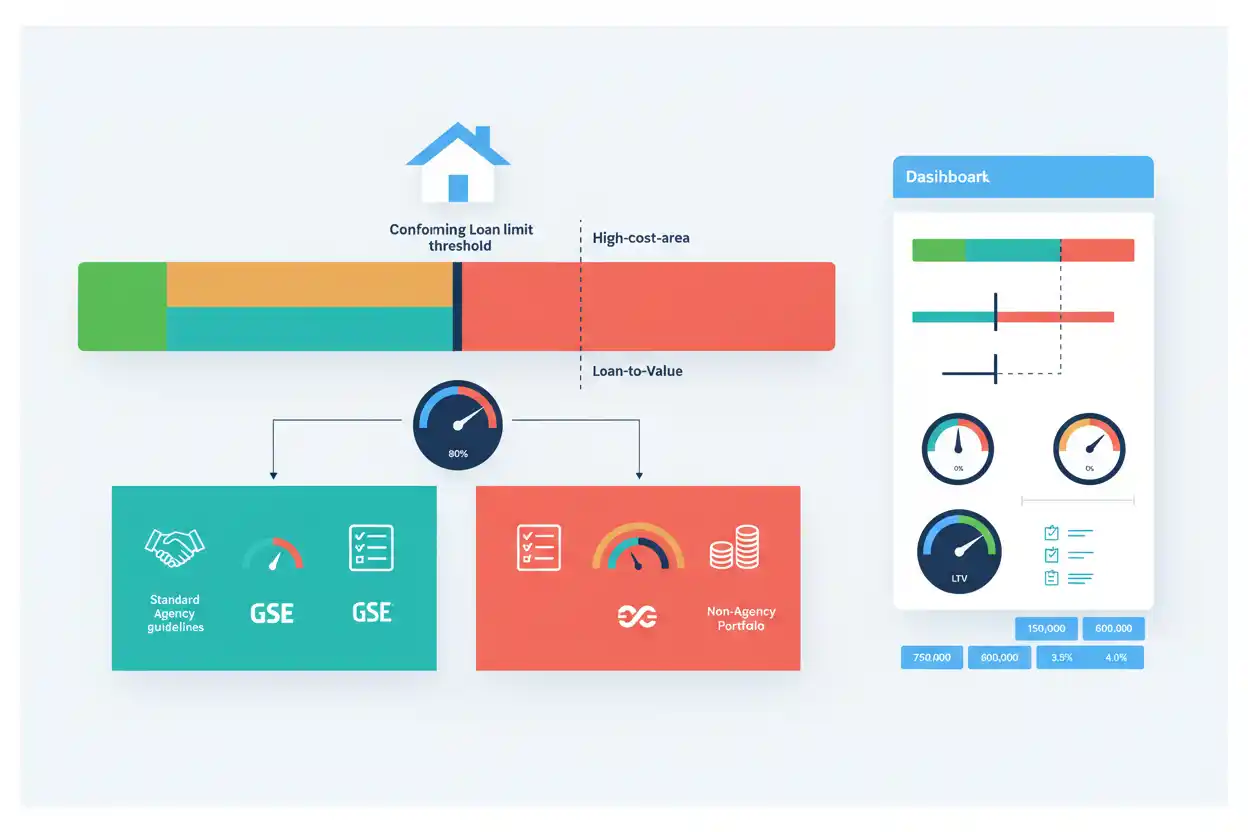

A conforming loan is a conventional mortgage structured to meet applicable purchase requirements for Fannie Mae or Freddie Mac, including the maximum loan amount that applies to the property location and type.
For 2026, the baseline conforming loan limit for a one-unit property in most of the United States is $832,750. The one-unit ceiling in qualifying high-cost areas is $1,249,125. The applicable limit can therefore depend on county or county-equivalent location rather than one nationwide number.
The simplest size test is:
Conforming Size Test = Proposed Mortgage Amount ≤ Applicable Conforming Loan Limit
However, staying below the loan limit does not by itself guarantee that a mortgage is conforming. The loan must also satisfy the applicable underwriting, documentation, property, and eligibility requirements.
Within the broader Mortgages & Home Loans framework, conforming status primarily answers which conventional mortgage market the loan fits into, while specialist pages handle payment, APR, affordability, and leverage.
What Is a Conforming Loan?
A conforming loan is generally a conventional mortgage that falls within the standards used by Fannie Mae or Freddie Mac for eligible mortgage purchases.
The word conforming therefore does not mean:
the mortgage is government-insured, the borrower is automatically approved, or every lender must offer identical terms.
Instead, it means the mortgage is designed to conform to an applicable set of conventional secondary-market standards.
The opposite category is often a jumbo mortgage, which exceeds the applicable conforming loan limit.
2026 Conforming Loan Limit
For a one-unit property in most U.S. counties during 2026:
Baseline Conforming Loan Limit = $832,750
In qualifying high-cost areas:
Maximum One-Unit High-Cost Ceiling = $1,249,125
FHFA sets the limits annually, and high-cost-area limits can vary between the baseline and national ceiling.
Therefore, never decide that a loan is jumbo based on a national headline limit without checking the actual limit for the property’s location.
Conforming Loan Example
Suppose a buyer purchases a home for:
$1,000,000
and makes a 20% down payment.
Down payment:
Down Payment = $1,000,000 × 20%
Down Payment = $200,000
Mortgage amount:
Mortgage = $1,000,000 − $200,000
Mortgage = $800,000
In a baseline-limit county:
$800,000 < $832,750
The mortgage is below the 2026 baseline conforming loan limit.
It still needs to satisfy the other applicable conforming requirements, but its size does not force it into jumbo territory.
Example Above the Conforming Limit
Now suppose the same $1,000,000 property is financed with only a 10% down payment.
Down payment:
Down Payment = $100,000
Mortgage:
Mortgage = $900,000
Compare the mortgage with the baseline limit:
$900,000 − $832,750 = $67,250
The loan exceeds the baseline limit by:
$67,250
In a baseline county, that amount would place the mortgage above the standard one-unit conforming limit.
In a qualifying high-cost county, however, $900,000 could still fall within the applicable conforming limit.
Location therefore changes the answer.
Down Payment Needed to Stay Within the Limit
Suppose:
Home price = $1,000,000
Maximum baseline conforming mortgage = $832,750
The minimum cash difference required purely to bring the loan amount down to the limit is:
Required Down Payment = Purchase Price − Maximum Conforming Loan
Required Down Payment = $1,000,000 − $832,750
Required Down Payment = $167,250
As a percentage:
Required Down Payment % = $167,250 ÷ $1,000,000 × 100
Required Down Payment = 16.725%
This does not mean 16.725% satisfies every mortgage requirement. It only solves the loan-size constraint.
Closing costs, reserves, mortgage insurance, and underwriting can require additional cash or qualifications.
Conforming Loan and LTV
The loan-to-value ratio measures mortgage principal relative to property value.
For the $1,000,000 home with an $800,000 mortgage:
LTV = $800,000 ÷ $1,000,000 × 100
LTV = 80%
For the $900,000 mortgage:
LTV = 90%
The loan limit and LTV therefore answer separate questions.
Loan limit: Is the mortgage amount within the applicable conforming ceiling?
LTV: How much of the property value is financed?
A loan can be below the conforming limit and still have a high LTV.
Conforming Loan vs Jumbo Mortgage
A conforming loan stays within the applicable conforming size limit and satisfies the relevant program standards.
A jumbo mortgage exceeds that limit.
Suppose a property is in a baseline county:
Mortgage A = $800,000
Mortgage B = $900,000
Mortgage A is below the $832,750 2026 baseline.
Mortgage B is above it.
The second loan therefore requires financing outside the standard baseline conforming size range.
The actual underwriting and pricing differences belong to the dedicated jumbo mortgage analysis.
Conforming Loan vs FHA Loan
A conforming loan and an FHA loan are not the same category.
A conforming loan is generally conventional financing tied to Fannie Mae/Freddie Mac eligibility.
An FHA loan is originated by a private lender but insured by the Federal Housing Administration. FHA also has its own county-level mortgage limits and mortgage-insurance requirements.
A homebuyer can therefore have several distinct financing paths even when the property price fits both programs.
Conforming Loan and Combined LTV
The combined loan-to-value ratio becomes important when the property has subordinate financing.
Suppose:
First conforming mortgage = $700,000
Second mortgage = $50,000
Home value = $1,000,000
First-lien LTV:
LTV = 70%
CLTV:
CLTV = ($700,000 + $50,000) ÷ $1,000,000 × 100
CLTV = 75%
The first mortgage can satisfy its size limit while combined leverage creates additional underwriting considerations.
Conforming Loans and Construction Financing
A construction loan can ultimately transition into permanent financing.
Whether the permanent mortgage qualifies as conforming depends on the applicable permanent-loan requirements.
The construction phase itself has different draw and interest mechanics, so the terms should not be treated as equivalent simply because the eventual mortgage is intended to be conforming.
Conforming Loans and Bridge Loans
A bridge loan provides temporary financing rather than ordinary permanent conforming mortgage financing.
A borrower might use bridge financing during a home transition and later replace it with a conforming mortgage.
Those are separate transactions with different risks and cost structures.
Conforming Loans and Cash-Out Refinancing
A cash-out refinance can remain within the conforming market when the new mortgage satisfies applicable loan-size and program requirements.
However, taking cash out increases the new mortgage balance.
That can move a loan closer to—or above—the applicable conforming limit.
Discount Points on Conforming Loans
Borrowers can encounter discount points when pricing a conforming mortgage.
Points are an upfront cost used to obtain a lower interest rate.
One point equals 1% of the mortgage amount.
On an $800,000 conforming mortgage:
One Point = $800,000 × 1%
One Point = $8,000
High loan amounts make even fractional points significant in dollar terms.
Mortgage APR
The mortgage APR should be compared alongside the quoted interest rate.
Two conforming loans can have similar rates but different:
points, origination charges, and other finance costs.
The loan limit tells you the mortgage category.
APR helps evaluate borrowing cost.
Closing Costs
Mortgage closing costs are separate from the down payment.
Suppose the buyer needs $167,250 down to keep a $1 million home purchase at the baseline limit.
If closing costs are another $20,000:
Estimated Cash Requirement = $167,250 + $20,000
Estimated Cash Requirement = $187,250
before credits, deposits, prepaids, and other transaction-specific adjustments.
Conforming Loan and Mortgage Insurance
A low down payment can create mortgage insurance considerations.
For conventional financing, private mortgage insurance can apply depending on the LTV and loan structure.
Therefore, increasing the down payment to remain under the conforming limit can potentially change both:
loan category and mortgage-insurance economics.
Fixed-Rate Conforming Loans
A fixed-rate mortgage can be conforming when it satisfies the relevant program requirements.
Conforming describes eligibility.
Fixed-rate describes how the interest rate behaves.
A mortgage can therefore be:
conforming fixed-rate, conforming adjustable-rate, or another eligible structure.
Mortgage Preapproval
A mortgage preapproval can help identify whether the intended mortgage amount fits the borrower’s qualifications and applicable program limits.
A buyer shopping near the conforming ceiling should pay particular attention to:
purchase price, down payment, county loan limit, and potential appraisal results.
A small change in financing can move the mortgage from one market category to another.
Conforming Loan Limits Change
Conforming loan limits are updated annually rather than remaining fixed forever.
FHFA raised the baseline one-unit limit to $832,750 for 2026 based on the applicable house-price methodology.
For any purchase after 2026, use the loan limit for that specific year rather than carrying forward the figures in this example.
Common Conforming Loan Mistakes
One mistake is assuming every loan below $832,750 is automatically conforming.
Another is ignoring high-cost-area limits.
Borrowers also confuse conforming loans with FHA loans.
A fourth mistake is comparing the mortgage amount with the home price rather than the applicable loan limit.
Finally, the conforming limit does not tell you whether the monthly payment is affordable.
Frequently Asked Questions
What is a conforming loan?
It is conventional mortgage financing structured to satisfy applicable Fannie Mae or Freddie Mac purchase requirements, including loan-size limits.
What is the 2026 baseline conforming loan limit?
For a one-unit property in most of the United States:
$832,750
What is the 2026 high-cost ceiling?
For a one-unit property, the national high-cost ceiling is:
$1,249,125
Does every high-cost county use $1,249,125?
No. Applicable high-cost limits can fall between the baseline and ceiling.
Is any loan below the limit automatically conforming?
No. Other eligibility and underwriting requirements also apply.
What happens if a loan exceeds the conforming limit?
It generally moves outside the standard conforming size range and may require jumbo or another financing structure.
Can a large home still use a conforming loan?
Yes. A sufficiently large down payment can keep the mortgage amount below the applicable limit.
Is an FHA loan a conforming loan?
No. FHA financing is a separate government-insured mortgage program.
Does conforming status determine LTV?
No. Loan size and LTV are separate measurements.
Can a conforming loan have mortgage insurance?
Yes, depending on the loan structure and LTV.
Can a cash-out refinance be conforming?
Potentially, if it satisfies the applicable conforming requirements.
Do conforming loan limits change every year?
They can. Use the official limit for the year and location of the mortgage.
Final Takeaway
The first size test for a conforming loan is:
Proposed Mortgage ≤ Applicable Conforming Loan Limit
For 2026, the one-unit baseline is:
$832,750
and the national high-cost ceiling is:
$1,249,125.
On a $1 million home, a $200,000 down payment creates an $800,000 mortgage, which falls below the baseline limit.
A $100,000 down payment creates a $900,000 mortgage, which exceeds the baseline but can still fall within the conforming range in an eligible high-cost area.
The critical point is that conforming status depends on the mortgage amount, property location, current annual limit, and complete program eligibility—not simply the home’s purchase price.