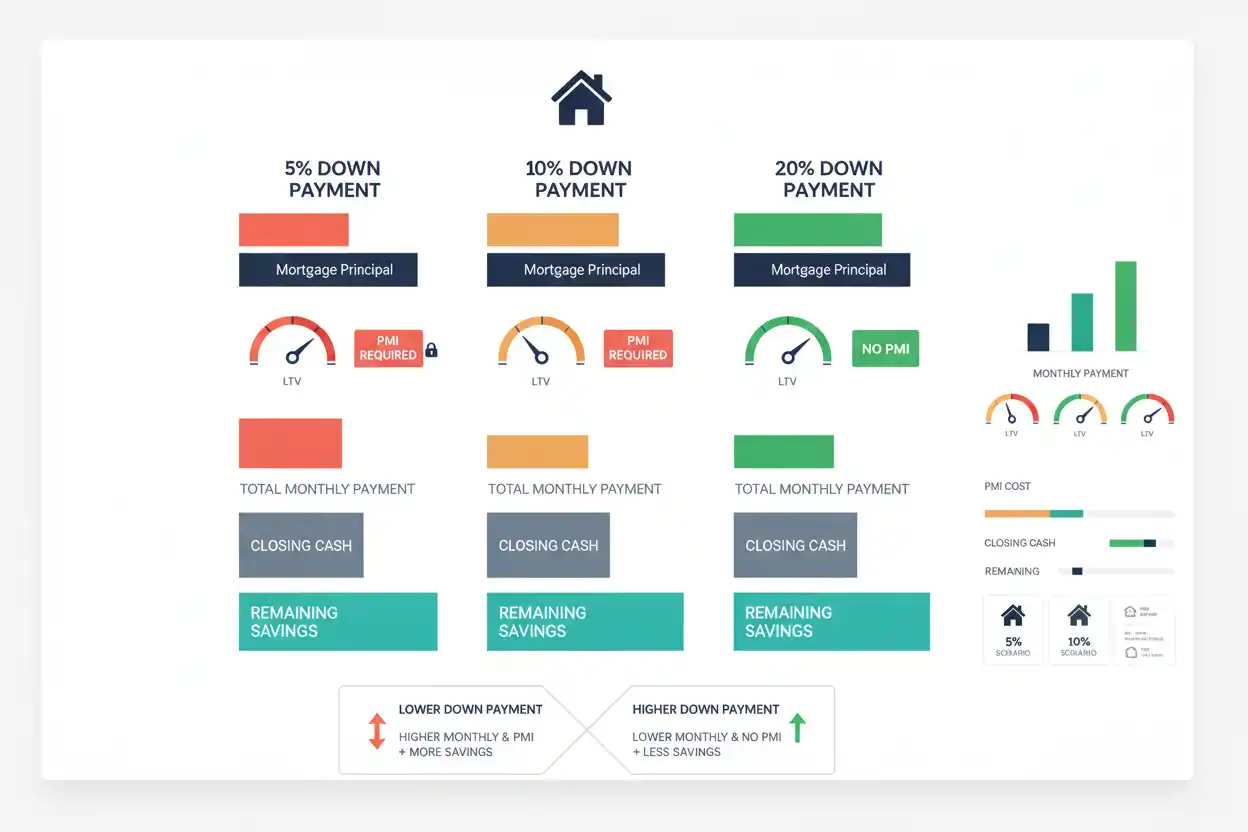
A down payment is the portion of a home purchase price paid without financing through the primary mortgage.
The basic formula is:
Down Payment = Home Price × Down Payment Percentage
The resulting mortgage amount is:
Mortgage Principal = Purchase Price − Down Payment
A larger down payment usually reduces:
the mortgage principal, loan-to-value ratio, monthly principal-and-interest payment, and total interest generated by the mortgage.
It can also influence interest-rate pricing, mortgage-insurance requirements, and loan eligibility. CFPB guidance notes that larger down payments can improve mortgage terms and that conventional borrowers with less than 20% down often encounter private mortgage insurance or use another loan program such as FHA, VA, or USDA financing.
The best down payment is therefore not automatically the largest amount of cash available.
The decision should balance mortgage cost against liquidity.
Down Payment Formula
Suppose:
Home price = $500,000
Down payment = 10%
Then:
Down Payment = $500,000 × 10%
Down Payment = $50,000
Mortgage:
Mortgage = $500,000 − $50,000
Mortgage = $450,000
Initial LTV:
LTV = $450,000 ÷ $500,000 × 100
LTV = 90%
The specialist loan-to-value ratio page covers that leverage calculation in detail.
Compare 5%, 10%, and 20% Down
Assume:
Home price = $500,000
Fixed mortgage rate = 6.5%
Term = 30 years
For illustration, the interest rate is held constant across all three scenarios so that we can isolate the effect of the down payment.
Actual lender pricing can vary with LTV.
5% Down
Down payment:
$25,000
Mortgage:
$475,000
LTV:
95%
Principal-and-interest payment:
≈ $3,002.32 per Month
10% Down
Down payment:
$50,000
Mortgage:
$450,000
LTV:
90%
Principal-and-interest payment:
≈ $2,844.31 per Month
20% Down
Down payment:
$100,000
Mortgage:
$400,000
LTV:
80%
Principal-and-interest payment:
≈ $2,528.27 per Month
Down Payment Comparison Table
| Down Payment | Mortgage | LTV | Approx. P&I Payment |
|---|---|---|---|
| 5% | $475,000 | 95% | $3,002.32 |
| 10% | $450,000 | 90% | $2,844.31 |
| 20% | $400,000 | 80% | $2,528.27 |
Increasing the down payment from 5% to 20% lowers the mortgage by:
$475,000 − $400,000 = $75,000
Monthly principal-and-interest falls by approximately:
$3,002.32 − $2,528.27
$474.05 per Month
That calculation excludes any difference in mortgage insurance or interest-rate pricing.
Down Payment and Total Interest
Under the same 6.5% 30-year assumption:
5% down produces approximately:
$605,836 of Total Interest
10% down produces approximately:
$573,950
20% down produces approximately:
$510,178
The larger down payment saves interest because less principal is financed.
However, $75,000 of additional cash had to be contributed upfront when moving from 5% down to 20%.
The borrower must decide whether that use of cash is appropriate.
Down Payment and Mortgage Insurance
Mortgage insurance protects the lender rather than creating equity for the borrower.
For conventional mortgages, private mortgage insurance can apply when the down payment is below 20%, depending on the loan. CFPB notes that 20% down on a conventional loan avoids required PMI in the standard scenario it describes.
That means moving from 10% to 20% down can affect more than the mortgage principal.
It can potentially remove a monthly mortgage-insurance expense.
FHA Down Payment
FHA loans provide a separate low-down-payment path.
HUD states that FHA down payments can be as low as 3.5% of the purchase price, and its basic 203(b) program describes approximately 96.5% financing for eligible borrowers.
On a $400,000 home:
3.5% Down Payment = $400,000 × 3.5%
Down Payment = $14,000
Base mortgage before financed upfront MIP:
$400,000 − $14,000 = $386,000
FHA mortgage insurance must then be included in the comparison.
Down Payment and Conforming Loan Limits
A larger down payment can bring a mortgage below the conforming loan limit.
Suppose:
Purchase price = $1,000,000
2026 baseline one-unit conforming limit = $832,750
Required down payment purely to reduce the loan to that size:
$1,000,000 − $832,750
$167,250
Percentage:
16.725%
A smaller down payment can push the mortgage into jumbo territory in a baseline county even if the borrower otherwise qualifies.
Down Payment and Discount Points
Discount points compete with the down payment for available closing cash.
Suppose you have $100,000 available.
You could potentially use more of it for:
down payment, points, closing costs, or cash reserves.
Paying $6,000 in points means $6,000 is no longer available to reduce principal unless you bring additional cash.
The best allocation depends on break-even and liquidity.
Down Payment and Fixed-Rate Mortgage
A fixed-rate mortgage creates predictable principal-and-interest payments.
A larger down payment reduces the principal used in that payment calculation.
If the fixed rate and term remain unchanged:
Lower Principal → Lower Monthly Payment
The relationship is linear with principal under the standard amortization formula.
Down Payment and Construction Loan
A construction loan can use borrower equity rather than a simple completed-home down payment.
Land value, construction cost, and completed property value can all affect the financing calculation.
A borrower who already owns the land can sometimes contribute land equity toward the required project equity, depending on lender rules.
Down Payment and CLTV
The combined loan-to-value ratio becomes important when part of the purchase is financed with a second mortgage.
Suppose:
Home price = $500,000
First mortgage = $400,000
Second mortgage = $50,000
Cash down = $50,000
First-mortgage LTV:
80%
CLTV:
($400,000 + $50,000) ÷ $500,000 × 100
90%
The borrower put 10% cash down but financed another 10% through subordinate debt.
Looking only at first-lien LTV would miss that leverage.
Down Payment and Mortgage APR
The mortgage APR can change across down-payment scenarios because lenders may offer different pricing and fees.
Therefore, a useful comparison requests actual offers for each down payment rather than assuming the rate will remain constant as it did in the teaching example above.
Down Payment and Closing Costs
Mortgage closing costs are generally separate from the down payment.
Suppose:
Down payment = $50,000
Closing costs and prepaids = $15,000
Potential cash need:
$50,000 + $15,000 = $65,000
before credits and deposits already applied.
A buyer who saves exactly the down payment amount can therefore still be short of cash at closing.
Down Payment and Mortgage Principal
Mortgage principal is directly determined by the down payment at purchase.
Principal = Price − Down Payment
Every additional $10,000 contributed to down payment reduces the initial mortgage principal by $10,000, assuming no other financed amounts change.
Down Payment and Home Affordability
Home affordability is not simply the maximum home price available with the cash on hand.
A buyer should preserve enough money for:
closing costs, moving, immediate repairs, and an appropriate emergency reserve.
Putting every liquid dollar into the home can create a low mortgage balance but a fragile household cash position.
Down Payment and Mortgage Affordability
The mortgage affordability calculation focuses more narrowly on financing capacity.
A larger down payment lowers the required loan and payment.
This can help a buyer qualify for a home that would otherwise create an excessive monthly payment.
However, qualification should not be confused with comfort.
Opportunity Cost of a Larger Down Payment
Suppose a buyer can choose between:
$50,000 down and $100,000 down.
The additional $50,000 reduces mortgage debt.
That can create a guaranteed reduction in future mortgage interest.
But the borrower gives up $50,000 of liquid capital that could have been kept in cash, invested, or used for other debts.
There is no universal answer because the alternatives have different risk and liquidity.
Down Payment Gifts and Assistance
Some mortgage programs permit eligible gift funds or down-payment assistance subject to program rules.
The source and documentation requirements can matter.
A buyer should not assume any borrowed or gifted money can automatically be used as down payment without lender review.
Larger Down Payment and Home Equity
Initial equity can be approximated as:
Initial Equity = Home Value − Mortgage Debt
On a $500,000 home with 20% down:
Initial Equity = $100,000
before considering transaction costs or subsequent market changes.
However, the down payment itself is not guaranteed to remain intact as market value.
If the property’s value declines, equity can fall.
Common Down Payment Mistakes
One mistake is assuming 20% is universally required.
Another is assuming the smallest permitted down payment is automatically best.
Buyers also forget closing costs and cash reserves.
A fourth mistake is focusing on monthly payment while ignoring mortgage insurance.
Finally, using all savings for the down payment can create severe liquidity pressure immediately after closing.
Frequently Asked Questions
What is a down payment?
It is the portion of a home purchase price paid without financing through the primary mortgage.
What is the down payment formula?
Down Payment = Home Price × Down Payment Percentage
What is 10% down on $500,000?
$50,000
How does a larger down payment affect the mortgage?
It reduces initial principal and LTV and generally reduces the monthly principal-and-interest payment.
Do I need 20% down?
No. Multiple mortgage programs permit smaller down payments.
Why is 20% important for conventional mortgages?
In the standard conventional scenario, 20% down can avoid required PMI.
What is the minimum FHA down payment?
Eligible FHA financing can allow a down payment as low as 3.5%.
Is the down payment part of closing costs?
It is part of cash due in the transaction but is conceptually separate from lender, title, appraisal, and other closing charges.
Can a larger down payment lower the interest rate?
It can influence lender pricing, although the actual rate change depends on the mortgage and lender.
Does a larger down payment always save money?
It reduces borrowing, but the opportunity cost of using additional cash should also be considered.
Can a down payment keep a loan conforming?
Yes. A larger down payment can reduce the mortgage below the applicable conforming loan limit.
How much cash should I keep after the down payment?
There is no universal amount. Preserve a reserve appropriate for closing costs, emergencies, home repairs, and income risk.
Final Takeaway
Down payments affect almost every major mortgage variable.
The core formulas are:
Down Payment = Purchase Price × Down Payment Percentage
and:
Mortgage = Purchase Price − Down Payment
On a $500,000 home at 6.5% for 30 years:
5% down creates a $475,000 mortgage and an approximate $3,002.32 principal-and-interest payment.
10% down creates $450,000 and approximately $2,844.31.
20% down creates $400,000 and approximately $2,528.27.
A larger down payment reduces borrowing cost, but the strongest decision also considers mortgage insurance, closing costs, loan limits, available reserves, and the value of keeping some cash liquid after the purchase.