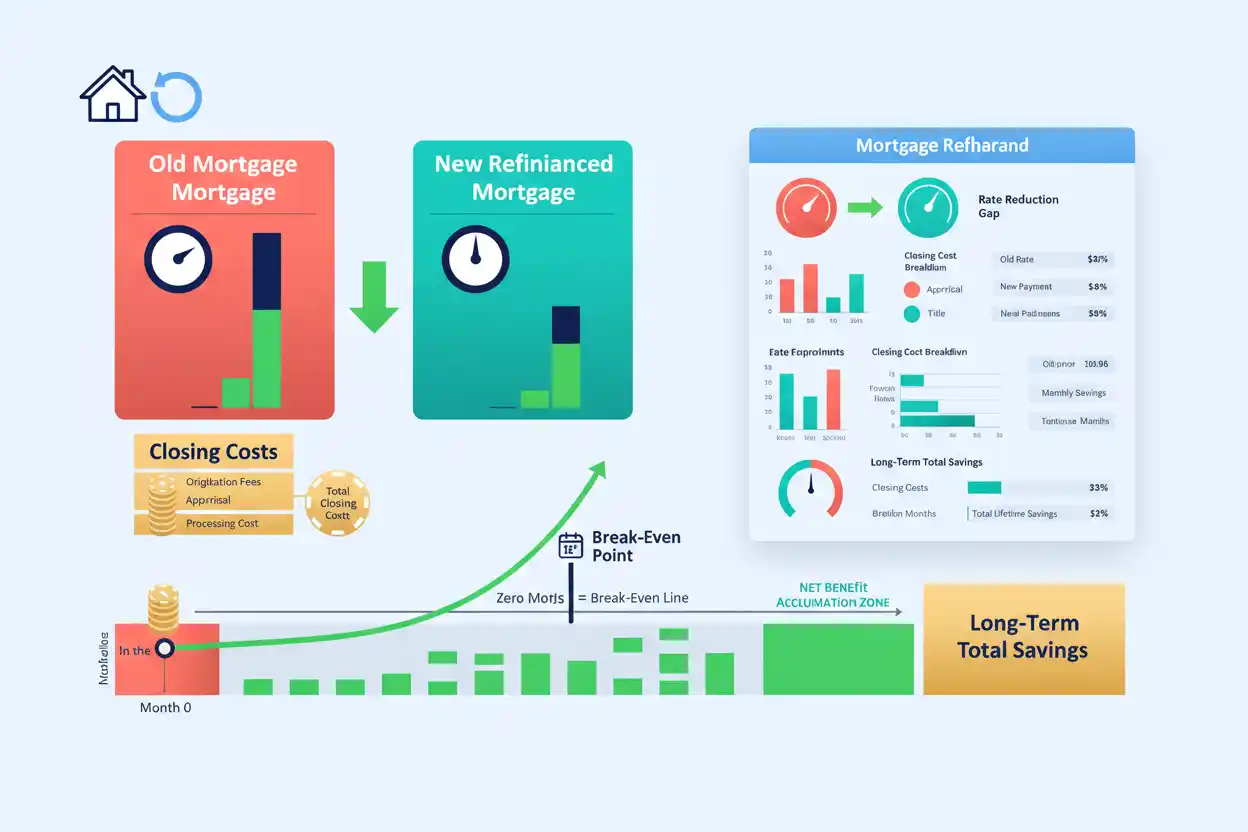

The mortgage break-even point estimates how long it takes for recurring mortgage savings to recover an upfront cost.
It is especially useful when evaluating refinancing or paying discount points for a lower interest rate.
The basic formula is:
Mortgage Break-Even Point = Upfront Incremental Cost ÷ Monthly Savings
Suppose refinancing costs $8,000 and reduces the monthly principal-and-interest payment by $200.
Break-Even = $8,000 ÷ $200
Break-Even = 40 Months
If the borrower expects to keep the replacement mortgage for substantially longer than 40 months, the transaction has time to recover its upfront cost through the modeled monthly savings.
If the borrower expects to sell or refinance again after 24 months, the simple break-even calculation suggests the cost will not be recovered.
CFPB uses the same basic concept when discussing mortgage points: a rough break-even period can be estimated by dividing the upfront cost by the monthly savings created by the lower rate.
What Is the Mortgage Break-Even Point?
The mortgage break-even point is a time threshold.
Before break-even:
Cumulative Savings < Upfront Cost
At break-even:
Cumulative Savings ≈ Upfront Cost
After break-even:
Cumulative Savings > Upfront Cost
The calculation is useful within the broader Mortgages & Home Loans decision process because mortgages frequently require the borrower to choose between paying more now and paying less later.
However, this page specifically owns the mortgage break-even point. The mortgage APR page owns annualized borrowing-cost comparison, while mortgage closing costs owns the underlying fee categories.
Mortgage Refinance Break-Even Formula
For a refinance:
Refinance Break-Even Months = Net Refinance Costs ÷ Monthly Payment Savings
Assume:
Current mortgage balance = $300,000
Current rate = 7.25%
Remaining term = 25 years
New rate = 6.25%
New term = 25 years
Refinance costs paid in cash = $8,000
Keeping the remaining term the same helps isolate the effect of the rate reduction.
Current Mortgage Payment
For a standard fixed-rate mortgage:
Payment = P × [r(1 + r)ⁿ] ÷ [(1 + r)ⁿ − 1]
At 7.25% for 25 remaining years:
Current P&I Payment ≈ $2,168.42
New Mortgage Payment
At 6.25% for the same $300,000 balance and 25-year term:
New P&I Payment ≈ $1,979.01
Monthly savings:
Monthly Savings = $2,168.42 − $1,979.01
Monthly Savings ≈ $189.41
Calculate the Break-Even Point
Break-Even = $8,000 ÷ $189.41
Break-Even ≈ 42.2 Months
That is approximately:
3 Years and 6 Months
If the borrower expects to keep the new mortgage for six years, the transaction survives the simple break-even test.
If the borrower expects to move after two years, it does not.
Savings After Five Years
Five years equals:
60 Months
Gross payment savings:
$189.41 × 60
≈ $11,364.75
Subtract refinance cost:
Net Simplified Savings = $11,364.75 − $8,000
≈ $3,364.75
The borrower is ahead by approximately $3,365 after five years under this simple cash-flow comparison.
Savings After Ten Years
Ten years equals:
120 Months
Gross payment savings:
$189.41 × 120
≈ $22,729.49
Subtract costs:
Net Simplified Savings ≈ $14,729.49
The longer the replacement mortgage remains in place after break-even, the larger the cumulative payment savings become—assuming the comparison remains otherwise unchanged.
Mortgage Break-Even for Discount Points
The same formula applies to points.
Suppose paying points costs:
$6,000
and lowers the mortgage payment by:
$110 per Month
Then:
Break-Even = $6,000 ÷ $110
≈ 54.5 Months
That is approximately:
4 Years and 7 Months
If the borrower expects to refinance after three years, paying the points would not recover its cost through the modeled monthly payment savings.
Financing Closing Costs Changes the Calculation
Suppose the earlier $8,000 refinance cost is not paid in cash.
Instead, it is added to the new mortgage.
New principal:
$300,000 + $8,000 = $308,000
At 6.25% for 25 years, the payment becomes approximately:
$2,031.78
Monthly savings relative to the old mortgage:
$2,168.42 − $2,031.78
≈ $136.64
The borrower has preserved cash at closing but created a larger mortgage and smaller monthly savings.
This illustrates why a “no-closing-cost” refinance does not necessarily mean the underlying costs disappear. CFPB notes that loans marketed as having no closing costs can shift those costs through mechanisms such as a higher interest rate or other pricing arrangements.
Simple Break-Even Has Limitations
The simple formula is useful, but it does not capture every economic difference.
Two mortgages can have different:
remaining principal balances, repayment terms, tax effects, points, financed costs, prepayment behavior, and amortization schedules.
For a more complete comparison, evaluate:
Net Position = Cash Savings + Balance Advantage − Upfront Costs
That incorporates both payment savings and differences in remaining mortgage principal.
Why Remaining Balance Matters
Suppose Loan A and Loan B both save $150 per month.
After five years:
Loan A has a remaining balance $5,000 lower than Loan B.
That balance difference is economically meaningful.
A payment-only break-even calculation would miss it.
The mortgage amortization schedule can therefore improve a refinance comparison when precision matters.
Term Reset Can Create a False Saving
Suppose a homeowner has 15 years remaining on the current mortgage.
They refinance into a new 30-year loan.
The monthly payment can fall sharply.
However, some of that reduction comes from extending repayment over another 30 years—not necessarily from a sufficiently lower borrowing cost.
The mortgage term should therefore be normalized when comparing refinance options.
Example of a Misleading Lower Payment
Current mortgage:
15 years remaining
Payment = $2,500
New mortgage:
30 years
Payment = $1,900
Apparent monthly savings:
$600
That looks attractive.
But the new mortgage contains 360 scheduled payments rather than 180.
Calling $600 a pure savings figure would overstate the economic benefit.
Mortgage APR and Break-Even
The mortgage APR can identify differences in annualized financing cost.
Break-even answers a different question:
How Long Until the Upfront Cost Is Recovered?
A mortgage can have the lower APR but require significant upfront points.
For a borrower keeping the loan for 20 years, that might be attractive.
For someone selling in 18 months, it might not.
Mortgage Closing Costs and Break-Even
The numerator in the formula comes from the relevant mortgage closing costs.
However, not every closing amount should automatically be treated as an incremental refinance cost.
For example, prepaid taxes or insurance may represent timing of expenses the homeowner would owe anyway.
A more precise break-even analysis separates:
true transaction costs from temporary funding or prepaid items.
Mortgage Escrow and Break-Even
A new mortgage escrow deposit can make cash-to-close look larger.
However, an escrow deposit is not economically identical to a lender origination fee.
If the old escrow account later returns a balance to the borrower, treating the entire new escrow deposit as a permanent refinance expense can overstate break-even time.
Mortgage DTI and Refinancing
The mortgage debt-to-income ratio can improve if refinancing lowers the qualifying monthly payment.
That can create financial flexibility even before the transaction reaches a strict dollar break-even.
However, qualification benefits and economic savings should still be analyzed separately.
Mortgage Affordability and Break-Even
Mortgage affordability focuses on whether the payment fits the borrower’s income and obligations.
Break-even focuses on whether the refinancing cost is recovered.
A refinance can improve affordability while still failing to save money over a short holding period.
Cash-Out Refinance Break-Even
A cash-out refinance requires extra care.
If the borrower increases principal by $50,000 to obtain cash, comparing the new payment with the old payment alone is not meaningful.
The transaction changed both:
mortgage pricing and the amount borrowed.
Separate the cost of replacing the old mortgage from the cost of borrowing the new cash.
Rate-and-Term Refinance
A rate-and-term refinance provides a cleaner break-even calculation because the transaction is primarily intended to change the mortgage rate, term, or both.
Even then, keeping the remaining repayment horizon similar provides a more meaningful comparison.
Mortgage Points and Break-Even
The broader mortgage points analysis can include multiple rate-and-fee combinations.
For each offer:
Point Break-Even = Extra Point Cost ÷ Payment Savings
Comparing several break-even periods can make lender pricing much easier to evaluate.
When Break-Even Is Not Enough
Suppose the borrower reaches break-even in four years but has to spend almost all emergency savings to pay closing costs.
The transaction can still create excessive liquidity risk.
Likewise, a transaction with a six-year break-even could be reasonable for someone highly likely to keep the mortgage for 20 years.
Break-even is therefore a decision tool—not the entire decision.
Common Mortgage Break-Even Mistakes
One mistake is dividing total closing cash by monthly savings without separating refundable or prepaid items.
Another is comparing loans with different terms as though every payment reduction comes from the lower rate.
Borrowers also ignore financed closing costs.
A fourth mistake is assuming they will keep the mortgage longer than is realistic.
Finally, payment-only break-even can miss differences in remaining mortgage balance.
Frequently Asked Questions
What is the mortgage break-even point?
It is the time required for recurring mortgage savings to recover an upfront financing cost.
What is the basic formula?
Break-Even Months = Upfront Cost ÷ Monthly Savings
What is the break-even on $8,000 of costs and $200 monthly savings?
40 Months
What is the break-even in the refinance example?
Approximately:
42.2 Months
Should I refinance if I will sell before break-even?
A simple financial comparison generally suggests the upfront costs will not be fully recovered through monthly savings before the sale.
Are closing costs always included in break-even?
Include costs that are truly incremental to the transaction; distinguish them from refundable or timing-related amounts such as some escrow funding.
Should financed closing costs be treated differently?
Yes. They increase mortgage principal and can reduce monthly savings while also generating interest.
Does APR replace break-even analysis?
No. APR measures annualized borrowing cost; break-even measures how long it takes to recover upfront expense.
Can discount points have a break-even point?
Yes. Divide the point cost by the monthly payment savings.
Does mortgage term matter?
Yes. Extending the term can create a lower payment without creating equivalent economic savings.
Should remaining mortgage balance be compared?
Yes, especially for a more precise refinance analysis.
What holding period should I use?
Use a realistic estimate of how long you expect to keep the mortgage before selling, refinancing, or paying it off.
Final Takeaway
The mortgage break-even point answers:
How long must I keep this financing before its recurring savings recover its upfront cost?
The core formula is:
Mortgage Break-Even Point = Upfront Cost ÷ Monthly Savings
In the worked refinance example:
Costs = $8,000
Old payment ≈ $2,168.42
New payment ≈ $1,979.01
Monthly savings ≈ $189.41
Break-even:
≈ 42.2 Months
or roughly:
3 Years and 6 Months
Use that result alongside mortgage APR, closing costs, amortization, remaining balance, term, and your realistic holding period. A refinance that looks attractive over 15 years can still be a poor decision if the mortgage will be replaced again before its costs are recovered.