A discounted price is the amount a customer pays after a discount has been deducted from the original price.
If a product normally costs $200 and receives a 25% discount, the customer pays $150.
Discounted Price = Original Price × (1 − Discount Percentage)
Discounted Price = $200 × (1 − 0.25) = $150
The $50 difference between the original $200 price and the $150 discounted price is the discount amount.
The related discount percentage measures how large that reduction is relative to the original price. Discounted price instead focuses on the final amount payable.
What Is a Discounted Price?
A discounted price is the reduced selling price after applying a percentage or fixed-dollar reduction.
Suppose an item is listed at $80 and the seller offers 15% off.
Discount amount:
$80 × 15% = $12
Discounted price:
$80 − $12 = $68
The customer pays $68.
The original price remains $80, the discount is $12, the discount percentage is 15%, and the discounted price is $68.
Keeping those four concepts separate prevents common pricing mistakes.
Discounted Price Formula
When the discount is expressed as a percentage:
Discounted Price = Original Price × (1 − Discount Rate)
If the percentage is written as a whole number:
Discounted Price = Original Price × (100% − Discount Percentage)
For a $500 product with a 20% discount:
Discounted Price = $500 × 80%
Discounted Price = $400
An equivalent two-step calculation is:
Discount Amount = Original Price × Discount Percentage
then:
Discounted Price = Original Price − Discount Amount
Both methods produce the same result.
Discounted Price Example
Suppose a business lists a product for $240 and offers a 30% promotional discount.
First calculate the discount:
Discount Amount = $240 × 30%
Discount Amount = $72
Then subtract it:
Discounted Price = $240 − $72
Discounted Price = $168
Using the direct formula:
$240 × (1 − 0.30) = $240 × 0.70 = $168
The customer pays $168.
How to Calculate a Discounted Price Step by Step
The calculation requires only the original price and discount percentage.
For an original price of $350 with an 18% discount:
Convert the percentage to decimal form:
18% = 0.18
Find the percentage remaining after the discount:
1 − 0.18 = 0.82
Multiply:
$350 × 0.82 = $287
The discounted price is $287.
The customer saves:
$350 − $287 = $63
Check:
$63 ÷ $350 × 100 = 18%
The arithmetic reconciles.
10% Discounted Price Example
Original price:
$120
Discount percentage:
10%
Customer pays:
$120 × 90% = $108
Discounted price:
$108
Savings:
$12
20% Discounted Price Example
Original price:
$250
Discount:
20%
Remaining percentage:
80%
Discounted price:
$250 × 0.80 = $200
Savings:
$50
25% Discounted Price Example
Original price:
$80
Discount:
25%
Discounted price:
$80 × 0.75 = $60
The customer saves $20 and pays $60.
30% Discounted Price Example
Original price:
$400
Discount:
30%
$400 × 0.70 = $280
The discounted price is $280.
40% Discounted Price Example
Original price:
$150
Discount:
40%
$150 × 0.60 = $90
Discounted price:
$90
Savings:
$60
50% Discounted Price Example
A 50% discount reduces the original price by half.
For a $600 item:
$600 × 0.50 = $300
The customer pays $300.
Discounted Price From a Dollar Discount
Sometimes the discount is expressed as a fixed amount instead of a percentage.
The formula becomes:
Discounted Price = Original Price − Discount Amount
Suppose:
Original Price = $500
Discount Amount = $75
Then:
Discounted Price = $500 − $75 = $425
The equivalent percentage discount is:
$75 ÷ $500 × 100 = 15%
Find the Discount Percentage From the Discounted Price
If the original and discounted prices are known:
Discount Percentage = (Original Price − Discounted Price) ÷ Original Price × 100
Suppose:
Original Price = $300
Discounted Price = $225
Difference:
$300 − $225 = $75
Percentage:
$75 ÷ $300 × 100 = 25%
The $225 price reflects a 25% discount.
Find the Original Price From the Discounted Price
If a customer paid a discounted amount and the discount percentage is known:
Original Price = Discounted Price ÷ (1 − Discount Rate)
Suppose the final price is $160 after a 20% discount.
The customer paid 80% of the original:
Original Price = $160 ÷ 0.80
Original Price = $200
Check:
20% of $200 = $40
$200 − $40 = $160
Find the Discount Amount From the Final Price
Suppose:
Original Price = $450
Discounted Price = $360
Discount amount:
$450 − $360 = $90
Discount percentage:
$90 ÷ $450 × 100 = 20%
The customer receives a $90 discount and pays $360.
Discounted Price vs. Discount Percentage
These metrics answer different questions.
Discount percentage: How large is the reduction relative to the original price?
Discounted price: What amount does the customer actually pay?
Suppose a $1,000 product receives a 15% discount.
The discount percentage is:
15%
Discount amount:
$150
Discounted price:
$850
The three values describe different parts of the transaction.
Discounted Price vs. Price Decrease Percentage
Price decrease percentage usually compares an old price with a new lower price.
For example:
Old Price = $100
New Regular Price = $85
Decrease:
15%
A discounted price can produce the same arithmetic:
Original Price = $100
15% Promotion
Discounted Price = $85
The difference is intent.
A price decrease can describe a change in the underlying regular price. A discounted price generally describes what the customer pays after a promotional, negotiated, or other explicit reduction.
Discounted Price vs. Break-Even Price
A discounted price should often be compared with the applicable break-even price.
Suppose:
Original Price = $100
Break-Even Price = $70
A 20% discount creates:
Discounted Price = $80
The product remains $10 above the current break-even level.
A 35% discount creates:
$100 × 65% = $65
The discounted price is now $5 below the existing break-even price.
If the lower price materially changes expected sales volume, the break-even calculation should also be updated.
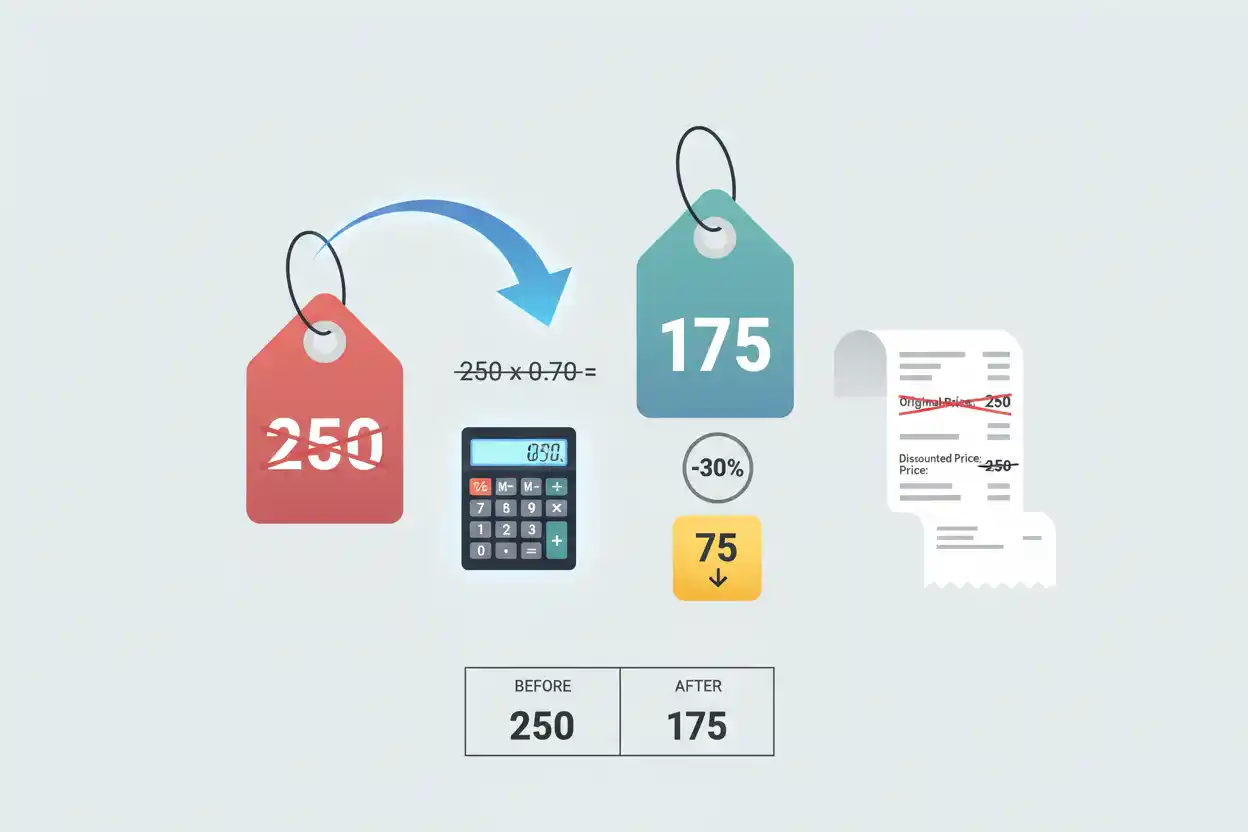
Maximum Discounted Price Reduction Before Break-Even
Suppose:
Original Price = $250
Break-Even Price = $175
Maximum dollar reduction before reaching break-even:
$250 − $175 = $75
Equivalent percentage:
$75 ÷ $250 × 100 = 30%
The business can discount the product by up to 30% before reaching the current $175 break-even threshold under the stated assumptions.
A deeper reduction would place the price below that threshold unless higher sales volume or different costs change the break-even calculation.
Discounted Price and Margin
Discounting can reduce margin much faster than the selling price itself declines.
Suppose:
Original Price = $100
Unit Cost = $60
Original margin amount:
$40
A 20% discount produces:
Discounted Price = $80
New margin amount:
$80 − $60 = $20
Price decreased 20%.
Margin dollars decreased:
($40 − $20) ÷ $40 × 100 = 50%
The promotional reduction cuts the available margin dollars in half.
Discounted Price and Required Sales Volume
Suppose a business currently sells 1,000 units at $100.
Unit cost is $60.
Original contribution:
($100 − $60) × 1,000 = $40,000
A 20% discount reduces the price to:
$80
New contribution per unit:
$80 − $60 = $20
Units required to preserve $40,000:
$40,000 ÷ $20 = 2,000 Units
Sales volume must double under these assumptions.
A lower discounted price therefore needs to create enough additional demand to compensate for reduced contribution per sale.
Discounted Price and Revenue
Revenue depends on both final selling price and volume.
Suppose the original economics are:
1,000 Units × $100 = $100,000 Revenue
A discount reduces price to $80.
If sales remain at 1,000 units:
Revenue = $80,000
Revenue declines 20%.
If volume increases to 1,300:
Revenue = 1,300 × $80 = $104,000
Revenue increases 4% despite the lower unit price.
Whether discounting increases revenue therefore depends on the demand response.
Discounted Price and Customer Churn
A lower price can be used as a retention tool when customer churn is a concern.
Suppose a subscription customer normally pays $200 per month.
Management offers a 25% retention discount:
Discounted Price = $200 × 75% = $150
Monthly revenue concession:
$50
If the customer remains for another year:
Annual Discount Cost = $50 × 12 = $600
Management should compare that $600 revenue concession with the economic value of retaining the customer.
If the customer would otherwise cancel immediately, the discounted relationship can still be attractive.
If the customer would have stayed at full price, the discount simply reduces revenue.
Discounted Price and Expansion Revenue
Discounts can stimulate expansion revenue from existing customers.
Suppose an existing account can add 100 seats at the normal price of $50 per seat.
Full-price expansion:
100 × $50 = $5,000
A 20% expansion discount produces:
Discounted Seat Price = $40
If the customer still buys 100 seats:
Expansion Revenue = $4,000
The business gives up $1,000.
But suppose the discounted price persuades the customer to buy 150 seats:
150 × $40 = $6,000
The discounted offer now generates $1,000 more total expansion revenue than selling 100 seats at full price.
The outcome depends on how quantity responds to price.
Discounted Price and Gross Revenue Retention
Gross revenue retention can be affected when discounts are granted to existing recurring customers.
Suppose a customer previously contributes:
$100,000 Annual Recurring Revenue
A permanent 10% retention discount reduces that value to:
$90,000
Revenue contraction:
$10,000
The customer is retained, so customer-count churn does not occur.
But the recurring revenue base contracts.
A discount can therefore improve customer retention while weakening gross revenue retention.
Discounted Price and CAC Payback Period
A lower customer price can extend CAC payback period when acquisition cost remains unchanged.
Suppose:
CAC = $2,000
Monthly Price = $400
Gross Margin = 75%
Monthly gross profit:
$300
Payback:
$2,000 ÷ $300 ≈ 6.67 Months
A 20% discount reduces price to:
$320
Assuming the same 75% gross-margin rate:
Monthly Gross Profit = $240
New payback:
$2,000 ÷ $240 ≈ 8.33 Months
The discount adds approximately 1.66 months to payback.
If it also lowers CAC substantially, the net acquisition economics may still improve.
Discounted Price and Annual Contract Value
Suppose an enterprise service has an annual list price of $120,000.
A 15% negotiated discount gives:
Discounted Annual Price = $120,000 × 85%
= $102,000
If the annual amount is the applicable recurring contract value, the customer’s annual contract value becomes $102,000 rather than $120,000.
For a three-year contract:
Total Discounted Contract Value = $102,000 × 3 = $306,000
compared with:
$360,000 at List Price
Total three-year concession:
$54,000
A seemingly modest annual discount can become substantial across a long contract.
Discounted Price and Annual Recurring Revenue
A discount applied broadly to recurring customers can reduce annual recurring revenue.
Suppose:
1,000 Customers
Monthly Price = $100
MRR:
$100,000
ARR:
$1,200,000
A 10% discount reduces monthly price to $90.
If the customer base remains unchanged:
MRR = $90,000
ARR = $1,080,000
ARR falls by:
$120,000
The company must add customers or expansion revenue to offset that recurring reduction.
Discounted Price and Average Revenue Per Account
For an account-based business, discounting can lower average revenue per account.
Suppose 500 accounts produce:
$250,000 Monthly Revenue
ARPA:
$500
A broad 10% discount reduces revenue to approximately:
$225,000
if everything else remains unchanged.
New ARPA:
$225,000 ÷ 500 = $450
ARPA declines by $50 per month.
This makes ARPA useful for detecting whether increased discounting is reducing account monetization.
Discounted Price and Average Revenue Per User
The same effect can appear in average revenue per user.
Suppose:
100,000 Paying Users
Monthly Revenue = $2,000,000
ARPU:
$20
If a promotion reduces average realized price by 15% while user count remains unchanged:
New ARPU ≈ $17
The promotion needs to generate greater user volume, retention, engagement, or another economic benefit to compensate for the lower monetization.
Sequential Discounts
When discounts are applied one after another, each subsequent discount generally applies to the already reduced price.
Suppose:
Original Price = $200
First discount:
20%
Price becomes:
$200 × 0.80 = $160
Then another 10%:
$160 × 0.90 = $144
The final discounted price is:
$144
Total saving:
$200 − $144 = $56
Equivalent combined discount:
$56 ÷ $200 × 100 = 28%
The discounts do not simply add to 30%.
30% Followed by 20% Discount
Original price:
$500
After 30% off:
$500 × 0.70 = $350
Then another 20%:
$350 × 0.80 = $280
Final price:
$280
Overall reduction:
$500 − $280 = $220
Equivalent discount:
$220 ÷ $500 × 100 = 44%
A 30% discount followed by 20% produces a 44% combined reduction.
Discount Plus Fixed Coupon
Suppose:
Original Price = $300
First apply a 20% discount:
$300 × 0.80 = $240
Then apply a $25 coupon:
$240 − $25 = $215
Final discounted price:
$215
Total savings:
$300 − $215 = $85
Equivalent total reduction:
$85 ÷ $300 × 100 ≈ 28.33%
A percentage discount and fixed-dollar coupon need to be applied in the order specified by the promotion.
Buy-One-Get-One Discounted Price
Some promotions do not state a conventional percentage.
Suppose two identical products normally cost $50 each.
Normal combined price:
$100
A buy-one-get-one-free offer means the customer pays:
$50
for two units.
Effective price per item:
$50 ÷ 2 = $25
Effective total discount relative to the normal $100:
($100 − $50) ÷ $100 × 100 = 50%
The effective discounted price per item is $25.
Buy One, Get One 50% Off
Suppose each item costs $80.
Normal cost for two:
$160
Promotion:
First item:
$80
Second item at 50% off:
$40
Total:
$120
Average discounted price per item:
$120 ÷ 2 = $60
Overall discount:
($160 − $120) ÷ $160 × 100 = 25%
“Buy one, get one 50% off” is equivalent to 25% off the two-item total when both items have the same original price.
Discounted Price and Sales Tax
If tax is calculated on the post-discount selling price under the applicable transaction rules, the tax is applied after determining the discount.
For a simplified arithmetic example:
Original Price = $100
20% Discount = $20
Discounted Price = $80
If tax is 10% of the taxable discounted price:
Tax = $8
Customer total:
$88
The $88 checkout amount is not the discounted merchandise price itself.
The discounted price remains $80 before the separately applied tax.
Actual tax treatment depends on the applicable jurisdiction and transaction rules.
Discounted Price and Shipping
Shipping can similarly be separate from the product’s discounted price.
Suppose:
Original Product Price = $150
20% Discount = $30
Discounted Product Price = $120
Shipping:
$15
Checkout subtotal including shipping:
$135
The $135 total should not be described as the product’s discounted price if shipping is a separate charge.
Clear price definitions matter in commercial comparisons.
Discounted Price in B2B Negotiations
Discounted price is also useful for negotiated business contracts.
Suppose list price is:
$500,000
Customer agrees to:
$425,000
Discount amount:
$75,000
Percentage:
15%
Discounted price:
$425,000
Sales teams can track the realized price alongside discount percentage to understand how much contract value is being conceded during negotiation.
Price Floors
A business may establish a minimum acceptable discounted price.
Suppose:
List Price = $1,000
Minimum Approved Price = $750
Maximum authorized discount:
($1,000 − $750) ÷ $1,000 × 100 = 25%
A sales representative can offer up to 25% off without taking the price below the stated floor.
The economic justification for that floor can come from break-even, margin, market, or strategic considerations.
Discounted Price and Customer Segmentation
Different customer segments can receive different prices.
Suppose:
Standard Price = $100
Student discount:
20% → $80
Enterprise volume discount:
10% → $90
Promotional new-customer offer:
30% → $70
The same product can therefore have several realized prices depending on customer eligibility and commercial strategy.
Management should evaluate whether segment-specific discounts improve conversion and customer economics enough to justify lower realized prices.
Discounted Price Trend Example
Suppose the average realized price of a product changes:
| Quarter | List Price | Average Realized Price |
|---|---|---|
| Q1 | $100 | $95 |
| Q2 | $100 | $92 |
| Q3 | $100 | $88 |
| Q4 | $100 | $82 |
Equivalent average discounts are approximately:
5%, 8%, 12%, and 18%
The list price has not changed, but customers are paying progressively less.
That pattern can indicate heavier promotion, weaker pricing power, different customer mix, or an intentional growth strategy.
Tracking the realized discounted price can therefore reveal trends that list price alone misses.
Common Discounted Price Mistakes
A common mistake is subtracting the percentage number directly from the price instead of converting it into a monetary amount.
Another is confusing discount percentage with the final discounted price.
Sequential discounts are often added rather than compounded.
Businesses can also ignore how discounts affect contribution, break-even economics, ARR, ARPA, or CAC payback.
Another mistake is assuming a lower price automatically increases total revenue.
Finally, a discounted price should always be compared against the correct original price and the economic costs relevant to the transaction.
Frequently Asked Questions
What is a discounted price in simple terms?
A discounted price is the amount a customer pays after a reduction has been applied to the original price.
What is the discounted price formula?
Discounted Price = Original Price × (1 − Discount Percentage)
How do you calculate 20% off a price?
Multiply the original price by 80%.
For $100:
$100 × 0.80 = $80
What is 25% off $200?
$200 × 0.75 = $150
The discounted price is $150.
What is 30% off $80?
$80 × 0.70 = $56
The customer pays $56.
How do you find the original price from a discounted price?
Original Price = Discounted Price ÷ (1 − Discount Rate)
If $80 is the price after 20% off:
$80 ÷ 0.80 = $100
How do you find the discount percentage from the final price?
Discount % = (Original Price − Discounted Price) ÷ Original Price × 100
Is discounted price the same as discount percentage?
No.
Discount percentage measures the relative reduction. Discounted price is the amount remaining after that reduction.
Are two 20% discounts equal to 40% off?
No.
0.80 × 0.80 = 0.64
The customer pays 64% of the original price, equivalent to a 36% total discount.
Can a discounted price be below break-even?
Yes.
A sufficiently large discount can reduce the selling price below the break-even price under the existing cost and volume assumptions.
Can discounting increase revenue?
Yes, if the lower price produces enough additional sales volume to more than offset the reduction in price per sale.
Can discounting reduce customer churn?
It can, particularly when customers are price-sensitive, but the business sacrifices some revenue and should evaluate whether the retained relationship remains economically attractive.
How does discounted price affect CAC payback?
Lower customer revenue can reduce monthly contribution and lengthen payback unless the discount also lowers acquisition cost, improves retention, or creates greater profitable volume.
Why is discounted price important?
It shows the actual selling amount after a promotion or negotiated reduction. Comparing it with costs, margins, break-even levels, retention, and customer acquisition economics helps determine whether the discount supports profitable growth.