Arithmetic & Number Theory: Complete Guide, Formulas & Examples

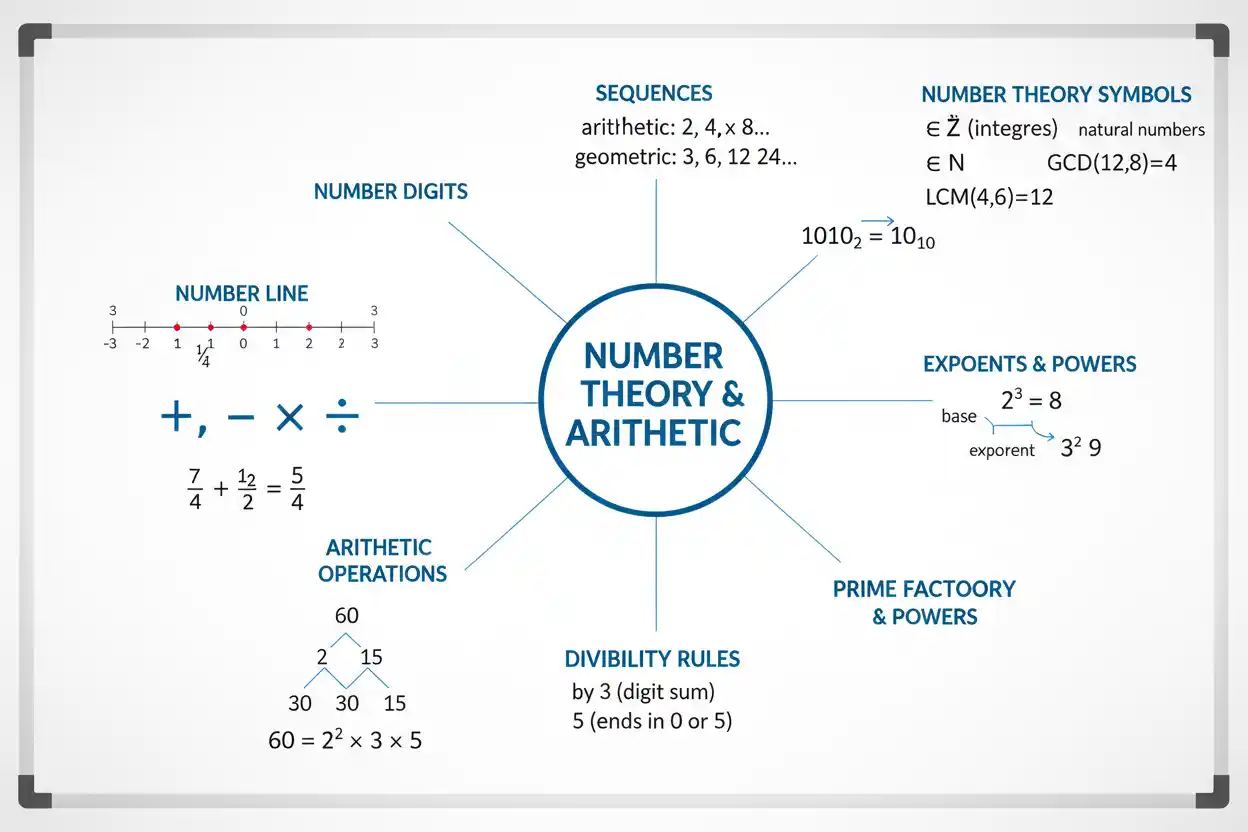
Arithmetic & number theory study numbers, their properties, and the rules used to calculate with them. Arithmetic focuses on operations such as addition, subtraction, multiplication, division, fractions, decimals, powers, and roots. Number theory examines deeper properties of integers, including factors, divisibility, prime and composite numbers, remainders, sequences, and number representations.
The four basic arithmetic operations are:
Addition: a + b
Subtraction: a – b
Multiplication: a × b
Division: a / b, where b ≠ 0
Many later mathematical ideas grow from these rules. Divisibility leads to factors and greatest common divisors, repeated multiplication leads to exponents, repeated patterns lead to sequences, and positional notation leads to decimal, binary, and other number bases.
This page provides the broad framework. Individual calculations and specialist concepts are developed on their dedicated pages so that each topic can be studied without mixing distinct search intents.
What Is Arithmetic?
Arithmetic is the study and use of numerical operations.
At its most basic level, arithmetic answers questions such as:
7 + 5 = 12
15 – 9 = 6
6 × 4 = 24
24 / 6 = 4
Arithmetic also includes fractions, decimals, percentages, powers, roots, signed numbers, and rules for evaluating expressions.
The underlying skills become important when variables are introduced in algebra basics, because algebra applies many of the same operations to unknown quantities.
What Is Number Theory?
Number theory focuses primarily on integers and their properties.
Questions in elementary number theory include:
- Which numbers divide another number exactly?
- Is an integer prime or composite?
- What is the greatest common divisor of two numbers?
- What remainder is produced by division?
- How can an integer be represented in another base?
- What patterns appear in integer sequences?
For example, 24 has factors:
1, 2, 3, 4, 6, 8, 12, 24
while 23 has only:
1 and 23
so 23 is prime and 24 is composite.
These simple observations lead into divisibility, prime factorization, modular arithmetic, combinatorics, and other number-theory topics.
Types of Numbers
Arithmetic and number theory work with several nested number systems.
Natural Numbers
Natural numbers are counting numbers:
1, 2, 3, 4, 5, …
Some conventions also include 0.
Whole Numbers
Whole numbers usually mean:
0, 1, 2, 3, 4, …
Integers
Integers include positive whole numbers, zero, and their negatives:
…, -3, -2, -1, 0, 1, 2, 3, …
Rational Numbers
A rational number can be written as:
a/b
where a and b are integers and:
b ≠ 0
Examples include:
3/4
-7/2
5 = 5/1
Terminating and repeating decimals are rational numbers. The conversion process is treated specifically under decimal to fraction.
Irrational Numbers
Irrational numbers cannot be represented as a ratio of two integers.
Examples include:
√2
and:
π
Their decimal expansions do not terminate or repeat in a fixed pattern.
Real Numbers
The real numbers include both rational and irrational numbers.
They correspond to points on the ordinary continuous number line.
Positive and Negative Numbers
Numbers greater than zero are positive.
Numbers less than zero are negative.
For example:
8 > 0
and:
-8 < 0
The distance of either number from zero is 8. This idea is represented by absolute value:
|8| = 8
|-8| = 8
Absolute value therefore measures magnitude without retaining the sign.
Addition
Addition combines quantities.
For example:
12 + 7 = 19
Addition is commutative:
a + b = b + a
and associative:
(a + b) + c = a + (b + c)
Zero is the additive identity:
a + 0 = a
Every number also has an additive inverse:
a + (-a) = 0
For example:
7 + (-7) = 0
Subtraction
Subtraction can be interpreted as adding the opposite:
a – b = a + (-b)
For example:
9 – 14 = 9 + (-14)
= -5
Unlike addition, subtraction is not commutative:
a – b ≠ b – a
in general.
For example:
8 – 3 = 5
but:
3 – 8 = -5
Multiplication
Multiplication represents repeated addition or scaling.
For positive integers:
4 × 3 = 3 + 3 + 3 + 3
= 12
Multiplication is commutative:
ab = ba
and associative:
(ab)c = a(bc)
One is the multiplicative identity:
a × 1 = a
Zero has the property:
a × 0 = 0
Division
Division asks how many times one quantity fits into another or partitions a quantity into equal parts.
The relationship is:
Dividend = Divisor × Quotient + Remainder
For example:
29 = 6 × 4 + 5
so dividing 29 by 6 gives:
Quotient = 4
Remainder = 5
The dedicated division guide covers quotient-and-remainder interpretation in detail.
Division by zero is undefined:
a / 0
is not a valid ordinary arithmetic operation.
Order of Operations
When an expression contains several operations, evaluate it in the correct order.
A standard order is:
- Parentheses or grouping
- Exponents and roots
- Multiplication and division from left to right
- Addition and subtraction from left to right
For example:
3 + 4 × 2
Multiply first:
4 × 2 = 8
Then add:
3 + 8 = 11
By contrast:
(3 + 4) × 2
requires the parentheses first:
7 × 2 = 14
Grouping can therefore change the result.
Fractions
A fraction represents a ratio:
a/b
where:
b ≠ 0
The numerator is a, and the denominator is b.
For example:
3/5
means three parts out of five equal parts.
Arithmetic with fractions requires rules for common denominators, multiplication, division, and simplification. Those methods are covered in fraction operations.
Equivalent fractions represent the same value:
1/2 = 2/4 = 3/6
because multiplying numerator and denominator by the same nonzero number does not change the ratio.
Decimals
Decimals represent numbers using powers of 10.
For example:
4.37 = 4 + 3/10 + 7/100
Place value is essential when adding or subtracting decimals.
The detailed calculation rules are separated between decimal arithmetic and decimal operations, while conversion between decimal and fractional representations has its own method.
Percentages
A percentage is a ratio measured per hundred.
For example:
25% = 25/100 = 1/4 = 0.25
To find p percent of a number N:
Amount = (p/100) × N
For example, 15% of 200 is:
(15/100) × 200 = 30
Percentages are another representation of ratios rather than a separate number system.
Factors
A factor divides an integer exactly.
For example, the positive factors of 18 are:
1, 2, 3, 6, 9, 18
because each divides 18 with zero remainder.
Factor pairs are:
1 × 18
2 × 9
3 × 6
The factors guide focuses on listing factor pairs, while common factors deals with factors shared by two or more numbers.
Divisibility
If integer a divides integer b exactly, then:
b = ak
for some integer k.
For example:
5 divides 35
because:
35 = 5 × 7
Divisibility tests provide shortcuts for recognizing these relationships. The specialist divisibility rules page covers tests for common divisors such as 2, 3, 4, 5, 9, 10, and 11.
Prime and Composite Numbers
A prime number greater than 1 has exactly two positive factors:
1 and itself
Examples include:
2, 3, 5, 7, 11, 13
A composite number greater than 1 has more than two positive factors.
Examples include:
4, 6, 8, 9, 10, 12
The distinction is developed under composite numbers.
The number 1 is neither prime nor composite.
Prime Factorization
Prime factorization writes a positive integer as a product of prime numbers.
For example:
60 = 2 × 30
= 2 × 2 × 15
= 2² × 3 × 5
Therefore:
60 = 2² × 3 × 5
The Fundamental Theorem of Arithmetic states that every integer greater than 1 has a unique prime factorization apart from the order of the factors.
This makes prime factors central to divisibility, common factors, fractions, and number-theory calculations.
Greatest Common Divisor
The greatest common divisor of two integers is the largest positive integer that divides both exactly.
For 48 and 18:
Factors of 48 include:
1, 2, 3, 4, 6, 8, 12, 16, 24, 48
Factors of 18 include:
1, 2, 3, 6, 9, 18
The greatest shared factor is:
6
so:
gcd(48,18) = 6
For larger numbers, the Euclidean algorithm finds the gcd efficiently using repeated division and remainders.
Euclidean Algorithm Example
Find:
gcd(252,105)
Divide:
252 = 2(105) + 42
Then:
105 = 2(42) + 21
Then:
42 = 2(21) + 0
The last nonzero remainder is:
21
Therefore:
gcd(252,105) = 21
This is one of the foundational algorithms in elementary number theory.
Least Common Multiple
The least common multiple of positive integers a and b is the smallest positive number divisible by both.
For example:
Multiples of 6:
6, 12, 18, 24, 30, …
Multiples of 8:
8, 16, 24, 32, …
Therefore:
lcm(6,8) = 24
For positive integers:
gcd(a,b) × lcm(a,b) = ab
So if:
gcd(6,8) = 2
then:
lcm(6,8) = (6 × 8)/2 = 24
Remainders and Modular Thinking
If dividing integer a by positive integer n produces quotient q and remainder r:
a = nq + r
with:
0 ≤ r < n
For example:
23 = 5 × 4 + 3
so the remainder is 3.
This can also be expressed as:
23 ≡ 3 (mod 5)
because 23 and 3 leave the same remainder when divided by 5.
Remainder arithmetic is one of the bridges from elementary arithmetic into number theory.
Exponents
An exponent represents repeated multiplication.
For positive integer n:
a^n = a × a × … × a
with n factors of a.
For example:
2^5 = 2 × 2 × 2 × 2 × 2
= 32
The core exponents rules include:
a^m × a^n = a^(m+n)
a^m / a^n = a^(m-n), a ≠ 0
(a^m)^n = a^(mn)
and:
a^0 = 1, a ≠ 0
These rules compress repeated multiplication into efficient symbolic form.
Roots
Roots reverse powers.
For example:
√25 = 5
because:
5² = 25
A cube root satisfies:
∛a = b
when:
b³ = a
For example:
∛64 = 4
because:
4³ = 64
The specialist cube roots guide covers cube-root rules and examples in greater depth.
Sequences
A sequence is an ordered list of values.
For example:
3, 7, 11, 15, 19, …
has a constant difference:
4
so it is an arithmetic sequence.
The nth-term formula is:
aₙ = a₁ + (n – 1)d
where:
- a₁ is the first term,
- d is the common difference,
- n is the term number.
For the sequence above:
a₁ = 3
d = 4
Therefore:
aₙ = 3 + 4(n – 1)
Sequences connect arithmetic patterns with algebraic formulas.
Fibonacci Sequence
Not every sequence has a constant difference.
The Fibonacci sequence is defined recursively:
Fₙ = Fₙ₋₁ + Fₙ₋₂
with common starting values:
F₀ = 0
F₁ = 1
This produces:
0, 1, 1, 2, 3, 5, 8, 13, …
Each term after the first two is the sum of the preceding two.
This illustrates how number patterns can be generated by recurrence rather than by repeated addition of one fixed difference.
Factorials
A factorial multiplies consecutive positive integers.
For nonnegative integer n:
n! = n × (n – 1) × … × 2 × 1
with:
0! = 1
For example:
5! = 5 × 4 × 3 × 2 × 1
= 120
The factorial operation appears naturally in counting formulas, while the dedicated factorials page covers the n! notation and related properties from its own intent.
Combinations
A combination counts selections where order does not matter.
The formula is:
C(n,r) = n! / [r!(n-r)!]
For example, the number of ways to choose 2 objects from 5 is:
C(5,2) = 5! / [2!3!]
= 10
The dedicated combinations guide focuses on nCr calculations, while combinatorics provides the broader framework for counting arrangements and selections.
Probability Connections
Arithmetic and number theory frequently support probability calculations.
A classic example is the birthday paradox, where counting possible birthday assignments helps quantify the unexpectedly high probability that at least two people in a group share a birthday.
The general complementary-probability structure is:
P(at least one match) = 1 – P(no matches)
The detailed birthday calculation belongs to its specialist page, but it illustrates how integer counting and products enter probability theory.
Number Bases
The familiar decimal system uses base 10.
Its place values are powers of 10:
…, 10³, 10², 10¹, 10⁰
The number:
472
means:
4 × 10² + 7 × 10¹ + 2 × 10⁰
Other positional systems use different bases. The base conversions guide covers conversions across bases 2 through 36.
Binary Numbers
The binary system uses base 2 and only the digits:
0 and 1
Place values are powers of 2.
For example:
1011₂
means:
1 × 2³ + 0 × 2² + 1 × 2¹ + 1 × 2⁰
= 8 + 0 + 2 + 1
= 11
The dedicated binary numbers page focuses specifically on base-2 notation and interpretation.
Binary arithmetic is fundamental in digital computing because electronic states can naturally represent two values.
Large Numbers and Digit Length
Very large integers are often easier to understand through powers and digit counts.
For a positive integer N:
Number of decimal digits = floor(log₁₀(N)) + 1
when N ≥ 1.
For example:
N = 1000
Then:
log₁₀(1000) = 3
so:
Digits = 3 + 1 = 4
The big numbers guide focuses on digit length, numerical scale, and the interpretation of very large quantities.
Floor and Ceiling
Some arithmetic problems need an integer obtained by rounding in a specific direction.
The floor function gives the greatest integer less than or equal to x:
floor(x)
The ceiling function gives the smallest integer greater than or equal to x:
ceiling(x)
For example:
floor(3.8) = 3
ceiling(3.8) = 4
The floor and ceiling functions guide treats their formulas and boundary behavior separately.
Arithmetic vs Algebra
Arithmetic performs calculations with known numbers.
For example:
8 + 5 = 13
Algebra introduces unknowns or general variables:
x + 5 = 13
The same inverse arithmetic operation solves the equation:
x = 8
This is why arithmetic fluency supports later algebraic reasoning.
The algebra basics page develops variables, expressions, equations, and algebraic properties rather than repeating the numerical foundations covered here.
Arithmetic vs Number Theory
Arithmetic asks how to calculate.
Number theory asks what structural properties integers have.
For example:
48 / 6 = 8
is an arithmetic computation.
The statement:
6 divides 48
is a divisibility observation.
Determining all factors of 48 or proving properties shared by divisible integers moves further toward number theory.
The two subjects overlap heavily at the elementary level, which is why they are often studied together.
A Worked Arithmetic and Number Theory Example
Suppose you need to analyze the integer:
360
First factor it:
360 = 36 × 10
= (2² × 3²)(2 × 5)
Therefore:
360 = 2³ × 3² × 5
From this factorization, several properties follow.
360 is composite because it has more than two positive factors.
It is divisible by:
2
because it contains a factor of 2.
It is divisible by:
3
because it contains a factor of 3.
It is divisible by:
5
because it contains a factor of 5.
It is also divisible by:
8 = 2³
and:
9 = 3²
The example demonstrates how one prime factorization can support several number-theory conclusions without repeatedly dividing 360 by every candidate integer.
Common Arithmetic and Number Theory Mistakes
A frequent error is treating division by zero as valid. It is not:
a/0
is undefined.
Another is confusing factors with multiples. A factor divides a number, while a multiple is produced by multiplying that number by an integer.
For example, 6 is a factor of 24 because:
24/6 = 4
while 24 is a multiple of 6 because:
24 = 6 × 4
Sign errors are also common. Subtracting a negative number means adding its opposite:
8 – (-3) = 8 + 3 = 11
Order-of-operations errors occur when addition is performed before multiplication without grouping.
Finally, base notation must be respected. The written digits 1011 have different numerical values depending on whether the number is interpreted in base 10, base 2, or another positional system.
Frequently Asked Questions
What is arithmetic?
Arithmetic is the branch of mathematics concerned with numerical calculations such as addition, subtraction, multiplication, division, fractions, decimals, powers, and roots.
What is number theory?
Number theory studies integers and their properties, including factors, divisibility, prime numbers, remainders, integer sequences, and related structures.
What are the four basic arithmetic operations?
They are:
Addition: a + b
Subtraction: a – b
Multiplication: a × b
Division: a/b, b ≠ 0
What is the difference between a factor and a multiple?
A factor divides a number exactly. A multiple is produced by multiplying the number by an integer.
For example, 4 is a factor of 20, while 20 is a multiple of 4.
What is a prime number?
A prime number is an integer greater than 1 with exactly two positive factors: 1 and itself.
What is a composite number?
A composite number is an integer greater than 1 with more than two positive factors.
What is prime factorization?
Prime factorization expresses an integer as a product of prime numbers.
For example:
84 = 2² × 3 × 7
What is a remainder?
If:
a = bq + r
then r is the remainder, with 0 ≤ r < |b| under the usual positive-divisor convention.
What is an arithmetic sequence?
It is a sequence with a constant difference between consecutive terms:
aₙ = a₁ + (n – 1)d
What is factorial notation?
For nonnegative integer n:
n! = n(n – 1)…2 × 1
with:
0! = 1
What is binary?
Binary is the base-2 positional number system using only the digits 0 and 1.
Why are arithmetic and number theory important?
They provide the numerical foundations for algebra, probability, combinatorics, computing, statistics, finance, measurement, and higher mathematics.