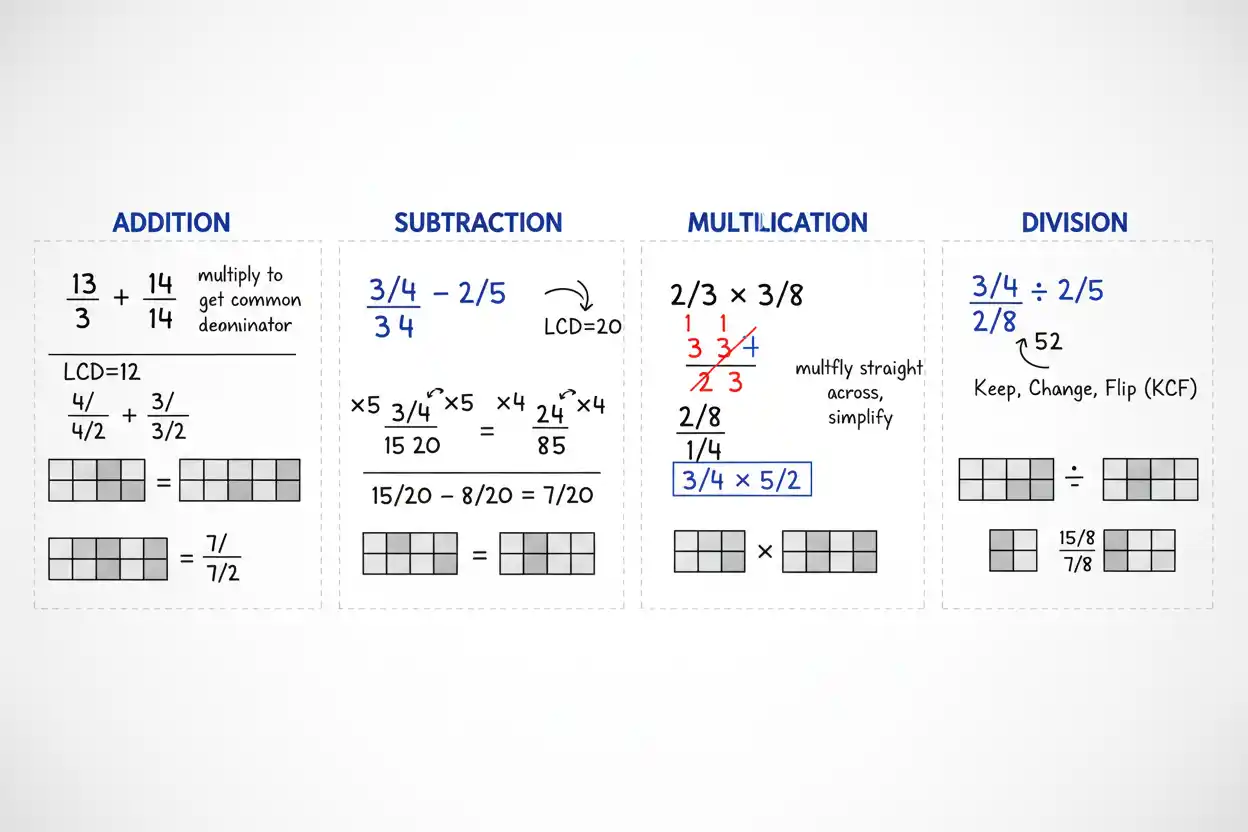
Fraction operations are the rules used to add, subtract, multiply, and divide fractions. Addition and subtraction generally require a common denominator, while multiplication works by multiplying numerators and denominators, and division uses the reciprocal of the second fraction.
For example:
1/3 + 1/6 = 1/2
3/4 – 1/8 = 5/8
2/3 × 3/5 = 2/5
3/4 ÷ 2/5 = 15/8
The arithmetic becomes much easier when the role of the numerator and denominator is kept clear and results are reduced to lowest terms.
Fraction operations belong to the wider study of arithmetic and number theory and appear throughout algebra, ratios, percentages, probability, measurements, rates, and everyday calculations.
Parts of a Fraction
A fraction has the form:
a/b
where:
a = numerator
b = denominator
and:
b ≠ 0
For:
3/5
the numerator is:
3
and the denominator is:
5
The fraction represents:
3 ÷ 5
so every fraction can also be interpreted through division.
Equivalent Fractions
Fractions can look different while representing exactly the same number.
For example:
1/2 = 2/4 = 3/6 = 50/100
Multiplying numerator and denominator by the same nonzero number does not change the fraction’s value:
a/b = (ak)/(bk)
for:
k ≠ 0
Equivalent fractions are essential when creating common denominators for addition and subtraction.
Simplifying Before and After Operations
A fraction is in lowest terms when its numerator and denominator have no positive common factor greater than 1.
For example:
12/18
has a common factor of 6.
Divide:
12 ÷ 6 = 2
18 ÷ 6 = 3
Therefore:
12/18 = 2/3
The dedicated fraction simplification page focuses on reducing fractions systematically. During fraction operations, simplification keeps calculations manageable and final answers clear.
Adding Fractions With the Same Denominator
When fractions have the same denominator, add the numerators and keep the denominator.
The rule is:
a/c + b/c = (a + b)/c
For example:
2/7 + 3/7
Add the numerators:
2 + 3 = 5
Keep the denominator:
2/7 + 3/7 = 5/7
The denominator does not become 14.
It continues to describe sevenths.
Example: Add 5/12 + 4/12
Since the denominators already match:
5/12 + 4/12 = 9/12
Simplify by dividing numerator and denominator by 3:
9/12 = 3/4
Therefore:
5/12 + 4/12 = 3/4
Subtracting Fractions With the Same Denominator
When denominators match:
a/c – b/c = (a – b)/c
For example:
7/9 – 2/9
Subtract the numerators:
7 – 2 = 5
Therefore:
7/9 – 2/9 = 5/9
Again, the denominator remains unchanged.
Adding Fractions With Different Denominators
Fractions with different denominators must first be rewritten using a common denominator.
Consider:
1/3 + 1/4
A common denominator is:
12
Rewrite:
1/3 = 4/12
and:
1/4 = 3/12
Now add:
4/12 + 3/12 = 7/12
Therefore:
1/3 + 1/4 = 7/12
Why a Common Denominator Is Necessary
The denominator tells the size of each part.
A third and a fourth are different-sized pieces, so their numerators cannot be combined directly.
The expression:
1/3 + 1/4
cannot become:
2/7
because sevenths were never the units being counted.
After converting both fractions into twelfths:
4/12 + 3/12
the pieces are the same size, so their counts can be added.
Finding a Common Denominator
Any common multiple of the denominators can be used.
For:
2/5 + 1/6
one possible common denominator is:
5 × 6 = 30
Convert:
2/5 = 12/30
1/6 = 5/30
Then:
12/30 + 5/30 = 17/30
Therefore:
2/5 + 1/6 = 17/30
When denominators share factors, using their LCM can reduce the size of intermediate numbers.
Example With Shared Denominator Factors
Calculate:
5/12 + 7/18
A common denominator could be:
12 × 18 = 216
but that is unnecessarily large.
The least common multiple of 12 and 18 is:
36
Rewrite:
5/12 = 15/36
7/18 = 14/36
Then:
15/36 + 14/36 = 29/36
Therefore:
5/12 + 7/18 = 29/36
Subtracting Fractions With Different Denominators
Consider:
5/6 – 1/4
The least common denominator is:
12
Rewrite:
5/6 = 10/12
1/4 = 3/12
Subtract:
10/12 – 3/12 = 7/12
Therefore:
5/6 – 1/4 = 7/12
Example Producing a Negative Fraction
Calculate:
2/5 – 3/4
Use denominator 20:
2/5 = 8/20
3/4 = 15/20
Subtract:
8/20 – 15/20 = -7/20
Therefore:
2/5 – 3/4 = -7/20
A negative result simply means the second fraction was larger than the first.
General Addition Formula
For:
a/b + c/d
a common denominator is:
bd
Therefore:
a/b + c/d = (ad + bc)/(bd)
For example:
2/3 + 5/7
Use:
(2 × 7 + 5 × 3)/(3 × 7)
= (14 + 15)/21
= 29/21
Therefore:
2/3 + 5/7 = 29/21
This cross-multiplication formula is valid, although using an LCM can sometimes produce smaller intermediate values.
General Subtraction Formula
Similarly:
a/b – c/d = (ad – bc)/(bd)
For example:
3/4 – 2/5
Calculate:
(3 × 5 – 2 × 4)/(4 × 5)
= (15 – 8)/20
= 7/20
Therefore:
3/4 – 2/5 = 7/20
Multiplying Fractions
Fraction multiplication does not require a common denominator.
The rule is:
a/b × c/d = ac/bd
Multiply the numerators together and multiply the denominators together.
For example:
2/3 × 4/5
= (2 × 4)/(3 × 5)
= 8/15
Therefore:
2/3 × 4/5 = 8/15
Multiplication Example
Calculate:
5/8 × 3/7
Numerator:
5 × 3 = 15
Denominator:
8 × 7 = 56
Therefore:
5/8 × 3/7 = 15/56
No common denominator is needed.
Cross-Canceling Before Multiplication
Fractions can often be simplified before multiplying.
Consider:
6/35 × 14/15
Instead of immediately calculating:
84/525
identify common factors across numerator-denominator pairs.
Simplify:
6/15 = 2/5
and:
14/35 = 2/5
So:
6/35 × 14/15
becomes:
2/5 × 2/5
Therefore:
6/35 × 14/15 = 4/25
Cross-canceling reduces the size of the numbers without changing the product.
Why Cross-Canceling Works
Multiplication allows the factors in the numerator and denominator to be regrouped:
(a × c)/(b × d)
If a numerator factor and denominator factor share a common divisor, dividing both by that divisor leaves the overall value unchanged.
This is simply fraction simplification performed before the multiplication rather than after it.
Multiplying a Fraction by a Whole Number
Write the whole number over 1.
For example:
3 × 5/8
becomes:
3/1 × 5/8
Multiply:
15/8
Therefore:
3 × 5/8 = 15/8
As a mixed number:
15/8 = 1 7/8
The improper fraction is often the more convenient form during calculation.
Multiplying Mixed Numbers
Convert each mixed number into an improper fraction first.
Consider:
1 1/2 × 2 1/3
Convert:
1 1/2 = 3/2
and:
2 1/3 = 7/3
Now multiply:
3/2 × 7/3
Cancel the common factor 3:
1/2 × 7/1
= 7/2
Convert back if desired:
7/2 = 3 1/2
Therefore:
1 1/2 × 2 1/3 = 3 1/2
Improper Fractions
An improper fraction has a numerator greater than or equal to its denominator.
Examples include:
7/4
11/5
9/9
Improper fractions are valid numbers and are often easier to use during arithmetic than mixed-number notation.
For example:
2 3/4
is normally converted to:
11/4
before multiplication or division.
Dividing Fractions
To divide by a nonzero fraction, multiply by its reciprocal.
The rule is:
a/b ÷ c/d = a/b × d/c
provided:
c ≠ 0
and:
d ≠ 0
For example:
2/3 ÷ 4/5
rewrite:
2/3 × 5/4
Then:
10/12
Simplify:
5/6
Therefore:
2/3 ÷ 4/5 = 5/6
Why Division Uses the Reciprocal
Division asks how many copies of one number fit into another.
Algebraically:
a/b ÷ c/d
means:
(a/b) / (c/d)
Multiplying numerator and denominator of the overall complex fraction by d/c gives:
(a/b × d/c) / 1
Therefore:
a/b ÷ c/d = a/b × d/c
The reciprocal rule is a consequence of ordinary division rather than an arbitrary trick.
Reciprocal of a Fraction
The reciprocal of:
a/b
is:
b/a
provided:
a ≠ 0
For example:
Reciprocal of 3/7 = 7/3
Multiplying a nonzero fraction by its reciprocal gives:
3/7 × 7/3 = 1
This multiplicative inverse is what makes fraction division work.
Division Example
Calculate:
5/6 ÷ 10/9
Take the reciprocal of the second fraction:
9/10
Then:
5/6 × 9/10
Cross-cancel:
5/10 = 1/2
and:
9/6 = 3/2
Therefore:
1/2 × 3/2 = 3/4
So:
5/6 ÷ 10/9 = 3/4
Dividing by a Whole Number
Write the whole number as a fraction over 1.
For example:
3/5 ÷ 4
becomes:
3/5 ÷ 4/1
Take the reciprocal:
3/5 × 1/4
= 3/20
Therefore:
3/5 ÷ 4 = 3/20
Whole Number Divided by a Fraction
Consider:
6 ÷ 3/4
Write:
6 = 6/1
Then multiply by the reciprocal:
6/1 × 4/3
Cross-cancel:
6/3 = 2
So:
2 × 4 = 8
Therefore:
6 ÷ 3/4 = 8
This means eight groups of three-fourths fit into 6.
Dividing Mixed Numbers
Consider:
2 1/2 ÷ 1 1/4
Convert to improper fractions:
2 1/2 = 5/2
1 1/4 = 5/4
Then:
5/2 ÷ 5/4
Multiply by the reciprocal:
5/2 × 4/5
Cancel 5:
4/2 = 2
Therefore:
2 1/2 ÷ 1 1/4 = 2
You Cannot Divide by Zero
A denominator can never be zero.
Likewise, division by the fraction:
0/b = 0
is undefined.
For example:
3/5 ÷ 0
has no defined value.
This restriction comes directly from the general rule that division by zero is undefined.
Adding Mixed Numbers
Consider:
1 1/3 + 2 1/4
One method is to convert both to improper fractions:
1 1/3 = 4/3
2 1/4 = 9/4
Use denominator 12:
4/3 = 16/12
9/4 = 27/12
Add:
16/12 + 27/12 = 43/12
Convert back:
43/12 = 3 7/12
Therefore:
1 1/3 + 2 1/4 = 3 7/12
Subtracting Mixed Numbers
Calculate:
5 1/4 – 2 2/3
Convert:
5 1/4 = 21/4
2 2/3 = 8/3
Use denominator 12:
21/4 = 63/12
8/3 = 32/12
Subtract:
63/12 – 32/12 = 31/12
Convert:
31/12 = 2 7/12
Therefore:
5 1/4 – 2 2/3 = 2 7/12
Fraction Operations and GCF
The GCF of a numerator and denominator can be used to reduce a result efficiently.
Suppose an operation produces:
42/56
The greatest common factor is:
14
Divide:
42 ÷ 14 = 3
56 ÷ 14 = 4
Therefore:
42/56 = 3/4
Finding the greatest shared factor reduces the fraction in one step.
Fraction Operations and LCM
The least common multiple is especially useful when adding or subtracting fractions.
For:
1/8 + 5/12
the LCM of 8 and 12 is:
24
Convert:
1/8 = 3/24
5/12 = 10/24
Then:
3/24 + 10/24 = 13/24
Therefore:
1/8 + 5/12 = 13/24
The LCM produces the smallest convenient common denominator.
Fraction Operations and Prime Factorization
Prime factorization can help find common denominators or simplify large values.
For example:
12 = 2² × 3
18 = 2 × 3²
Their least common multiple requires the largest exponent of each prime:
2² × 3²
= 36
So 36 is an efficient common denominator for fractions with denominators 12 and 18.
Fraction Operations With Negative Fractions
Signs follow ordinary multiplication and division rules.
For addition:
-2/5 + 1/5 = -1/5
For multiplication:
-2/3 × 3/7 = -2/7
For division:
-4/5 ÷ -2/3
Two negative signs produce a positive result:
4/5 × 3/2 = 12/10 = 6/5
Therefore:
-4/5 ÷ -2/3 = 6/5
Where to Place the Negative Sign
These forms represent the same value:
-3/5
(-3)/5
3/(-5)
But:
(-3)/(-5) = 3/5
because dividing two negative numbers produces a positive result.
Writing the sign in front of the complete fraction is usually easiest to read.
Order of Operations With Fractions
Fractions follow the ordinary order of operations.
Consider:
1/2 + 3/4 × 2/3
Multiply first:
3/4 × 2/3
Cancel:
3/3 = 1
2/4 = 1/2
So:
3/4 × 2/3 = 1/2
Now add:
1/2 + 1/2 = 1
Therefore:
1/2 + 3/4 × 2/3 = 1
Parentheses With Fractions
Compare:
1/2 + 1/3 × 3
with:
(1/2 + 1/3) × 3
For the first expression:
1/3 × 3 = 1
Then:
1/2 + 1 = 3/2
For the second:
1/2 + 1/3 = 5/6
Then:
5/6 × 3 = 15/6 = 5/2
So:
3/2 ≠ 5/2
Parentheses materially change the calculation.
Fractions and Decimals
Fractions can often be converted to decimals through division.
For example:
3/4 = 0.75
and:
1/8 = 0.125
The reverse process is covered by decimal to fraction.
Working in fractional form is often preferable when an exact result is important, especially when a decimal would repeat indefinitely.
Fraction Operations vs. Decimal Operations
Consider:
1/3 + 1/6
Using fractions:
2/6 + 1/6 = 3/6 = 1/2
If rounded decimals were used:
0.33 + 0.17 = 0.50
the final result happens to look correct, but the intermediate decimals are approximations.
The exact decimal forms are repeating:
1/3 = 0.333…
1/6 = 0.1666…
For exact calculations, fractions can avoid the rounding issues that arise in decimal operations.
Fractions and Rational Numbers
Every ordinary fraction:
a/b
with integers a and b ≠ 0 represents a rational number.
Addition, subtraction, multiplication, and division by a nonzero rational number produce another rational number.
For example:
2/3 + 5/7 = 29/21
which is still a ratio of integers.
Fraction to Percent
A fraction can be converted to a percentage by multiplying its value by 100%.
For example:
3/5 = 0.6
Then:
0.6 × 100% = 60%
Therefore:
3/5 = 60%
The dedicated fraction to percent page focuses specifically on that conversion rather than the four arithmetic operations covered here.
Fractions and Percentages
The broader percentages framework uses fractions, decimals, and parts per hundred as alternative representations.
For example:
25% = 25/100 = 1/4
This equivalence is useful when a percentage problem can be simplified by moving into fractional form.
Fibonacci Ratios
The Fibonacci sequence produces many natural fraction examples when consecutive terms are compared.
For instance:
F₁₀/F₉ = 55/34
The fraction is already in lowest terms because consecutive Fibonacci numbers are coprime.
As the indices grow, these ratios approach approximately:
1.618…
The fraction operation itself is division; the Fibonacci sequence supplies the values.
Floor and Ceiling of Fractions
The floor and ceiling functions can be applied directly to fractions.
For:
11/4
we know:
2 < 11/4 < 3
Therefore:
floor(11/4) = 2
and:
ceiling(11/4) = 3
The fraction does not need to be converted into a rounded decimal to identify the surrounding integers.
Practical Example: Recipe Scaling
A recipe requires:
3/4 cup
of an ingredient per batch.
For 3 batches:
3 × 3/4
Write 3 as:
3/1
Then:
3/1 × 3/4 = 9/4
Convert:
9/4 = 2 1/4
Therefore:
3 batches require 2 1/4 cups
Practical Example: Sharing
Suppose:
5/6
of a liter of juice is divided equally among 4 people.
Calculate:
5/6 ÷ 4
Write:
4 = 4/1
Then:
5/6 × 1/4
= 5/24
Each person receives:
5/24 liter
Practical Example: Remaining Material
A project begins with:
7/8 meter
of material and uses:
1/3 meter
Find the remainder.
Use denominator 24:
7/8 = 21/24
1/3 = 8/24
Subtract:
21/24 – 8/24 = 13/24
Therefore:
13/24 meter remains
Practical Example: Area
A rectangle has dimensions:
3/4 m
by:
2/5 m
Area is:
3/4 × 2/5
= 6/20
Simplify:
6/20 = 3/10
Therefore:
Area = 3/10 m²
Units become square units because two lengths were multiplied.
Common Fraction Addition Mistakes
A common error is adding numerator and denominator separately:
1/2 + 1/3 ≠ 2/5
The correct calculation uses a common denominator:
1/2 = 3/6
1/3 = 2/6
Therefore:
1/2 + 1/3 = 5/6
Another mistake is changing only one part of a fraction while creating an equivalent denominator.
For example, turning:
1/3
into a denominator of 12 requires multiplying both numerator and denominator by 4:
1/3 = 4/12
not:
1/12
Common Fraction Subtraction Mistakes
The same denominator rule applies to subtraction.
For:
3/4 – 1/3
it is incorrect to write:
2/1
Instead:
3/4 = 9/12
1/3 = 4/12
Then:
9/12 – 4/12 = 5/12
Common Fraction Multiplication Mistakes
A common mistake is searching for a common denominator before multiplying.
That is unnecessary.
For:
2/5 × 3/7
simply calculate:
6/35
Another mistake is cross-multiplying as though solving a proportion. Fraction multiplication uses numerator times numerator and denominator times denominator.
Common Fraction Division Mistakes
The reciprocal must be taken only for the second fraction.
For:
2/3 ÷ 4/5
use:
2/3 × 5/4
Do not flip both fractions.
Another mistake is forgetting to change division into multiplication after taking the reciprocal.
Simplify at the Right Time
Sometimes simplification is easiest before multiplication:
8/15 × 25/12
Cancel:
8/12 = 2/3
and:
25/15 = 5/3
Then:
2/3 × 5/3 = 10/9
This avoids calculating the larger unsimplified fraction:
200/180
Both routes are valid, but early cancellation usually reduces arithmetic.
How to Check Fraction Addition
Suppose:
2/3 + 1/4 = 11/12
Convert approximately:
2/3 ≈ 0.667
1/4 = 0.25
Sum:
≈ 0.917
Now:
11/12 ≈ 0.917
The magnitudes agree.
An exact check can also convert all fractions to a shared denominator.
How to Check Fraction Multiplication
Suppose:
3/5 × 2/7 = 6/35
Both original positive fractions are less than 1.
Their product should therefore be smaller than either:
6/35 ≈ 0.171
which is smaller than:
3/5 = 0.6
and:
2/7 ≈ 0.286
The result passes a magnitude check.
How to Check Fraction Division
Suppose:
3/4 ÷ 2/5 = 15/8
Reverse the operation by multiplying the quotient by the divisor:
15/8 × 2/5
Cancel:
15/5 = 3
2/8 = 1/4
Therefore:
3 × 1/4 = 3/4
The original dividend is recovered.
Frequently Asked Questions
What are the four fraction operations?
They are addition, subtraction, multiplication, and division of fractions.
How do you add fractions?
If denominators match, add the numerators and keep the denominator. If they differ, first rewrite the fractions with a common denominator.
How do you subtract fractions?
Use a common denominator, subtract the numerators, and simplify the result where possible.
How do you multiply fractions?
Multiply numerator by numerator and denominator by denominator:
a/b × c/d = ac/bd
Then simplify.
How do you divide fractions?
Multiply the first fraction by the reciprocal of the second:
a/b ÷ c/d = a/b × d/c
Do you need a common denominator when multiplying fractions?
No. Common denominators are needed for addition and subtraction, not ordinary multiplication.
Do you need a common denominator when dividing fractions?
No. Convert division into multiplication by the reciprocal.
What is the reciprocal of 3/5?
5/3
Can a denominator be zero?
No. A fraction with denominator zero is undefined.
Should fractions always be simplified?
Unless a problem requires another format, an exact fraction is generally best presented in lowest terms.
How do you calculate with mixed numbers?
Convert mixed numbers to improper fractions, perform the required operation, simplify, and convert back to a mixed number if useful.
Why is the LCM useful when adding fractions?
The LCM of the denominators provides the smallest common denominator, which keeps intermediate values relatively small.
Final Example
Evaluate:
2/3 + 5/8 × 4/15 ÷ 2/5
Follow the order of operations.
First multiply:
5/8 × 4/15
Cross-cancel:
5/15 = 1/3
4/8 = 1/2
Therefore:
5/8 × 4/15 = 1/6
Now divide:
1/6 ÷ 2/5
Multiply by the reciprocal:
1/6 × 5/2
= 5/12
Now add:
2/3 + 5/12
Convert:
2/3 = 8/12
Then:
8/12 + 5/12 = 13/12
Therefore:
2/3 + 5/8 × 4/15 ÷ 2/5 = 13/12
As a mixed number:
13/12 = 1 1/12
The central rule for fraction operations is to match the method to the operator: create common denominators for addition and subtraction, multiply straight across for multiplication, and multiply by the reciprocal for division.