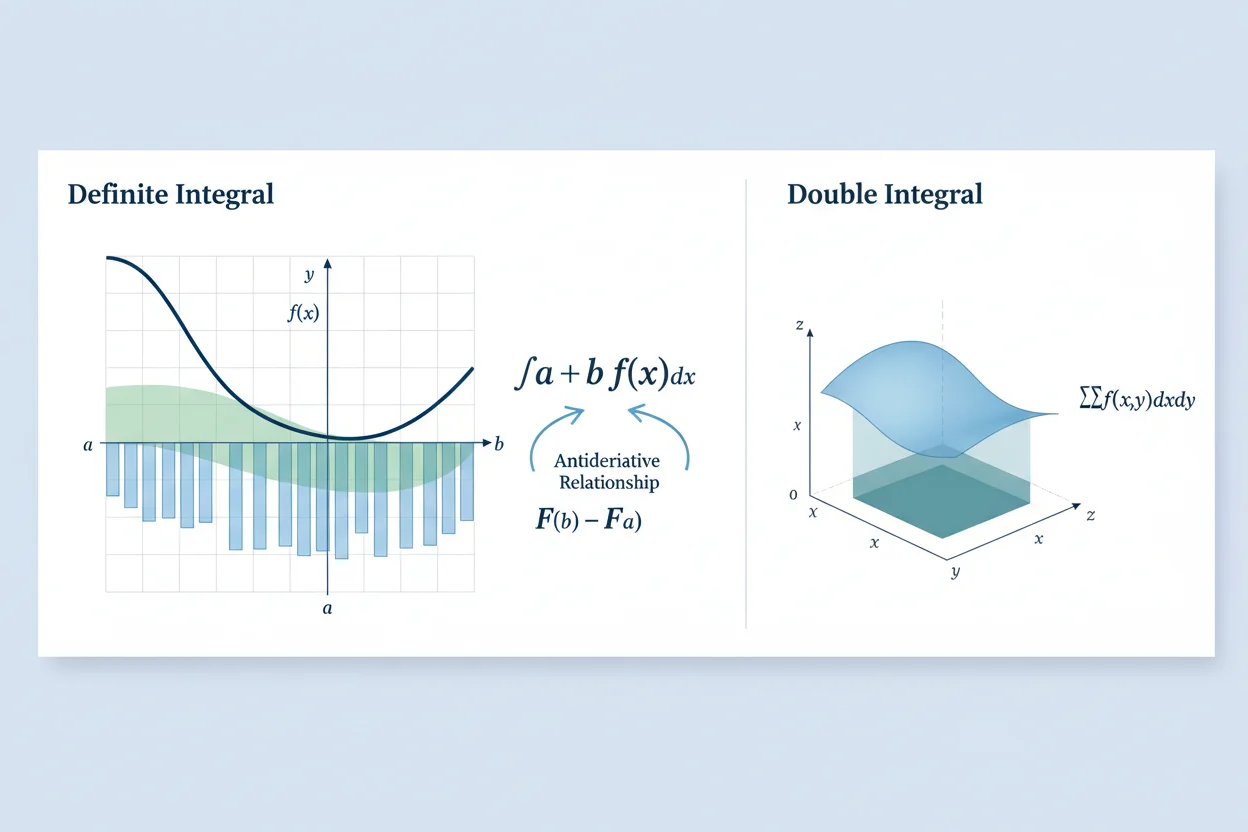
Integrals are mathematical tools for accumulation and for reversing differentiation. They can measure signed area, total change, displacement, mass, probability, volume, average value, and many other quantities built from continuously distributed contributions. An indefinite integral represents a family of antiderivatives, while a definite integral accumulates a function between specified limits and normally produces a numerical value. The integral symbol ∫ comes from the idea of summing infinitely many small contributions, and the differential such as dx identifies the variable of integration. The Fundamental Theorem Of Calculus connects integration with differentiation by showing that antiderivatives can evaluate definite integrals under suitable conditions. Some integrals can be evaluated with elementary power or trigonometric rules, while others require substitution, integration by parts, partial fractions, numerical approximation, or convergence analysis. Integrals also extend beyond one-dimensional intervals to regions, volumes, and curves. Choosing the correct type of integral therefore begins with understanding what is being accumulated and over what domain.
What Is an Integral?
An integral combines many small contributions into a total.
In one-variable calculus, the two basic forms are:
∫ f(x) dx
and:
∫ₐᵇ f(x) dx
The first is an indefinite integral.
The second is a definite integral.
Although they share the integral symbol, their outputs are different.
An indefinite integral gives a family of antiderivatives:
F(x) + C
A definite integral gives accumulated signed value over an interval:
F(b) − F(a)
when F′(x) = f(x) and the usual conditions hold.
Integral Notation
Consider:
∫ₐᵇ f(x) dx
The pieces have specific meanings.
The symbol:
∫
is the integral sign.
The function:
f(x)
is the integrand.
The number:
a
is the lower limit.
The number:
b
is the upper limit.
The symbol:
dx
indicates integration with respect to x.
Without upper and lower limits:
∫ f(x) dx
the expression represents an indefinite integral rather than one fixed accumulated value.
Integration as the Reverse of Differentiation
Suppose:
F′(x) = f(x)
Then F is an antiderivative of f.
Therefore:
∫ f(x) dx = F(x) + C
For example:
d/dx[x³] = 3x²
so:
∫ 3x² dx = x³ + C
This inverse relationship is central to symbolic integration.
However, integrals have a second interpretation—as accumulated sums—which gives them applications far beyond merely reversing derivative rules.
Indefinite Integral Formula
If:
F′(x) = f(x)
then:
∫ f(x) dx = F(x) + C
The arbitrary constant C is necessary because:
d/dx[C] = 0
For example:
∫ 2x dx = x² + C
All functions of the form:
x² + C
have derivative 2x.
The specialist indefinite-integral treatment owns the details of antiderivative families and the constant of integration.
Definite Integral Formula
If F is an antiderivative of f, then:
∫ₐᵇ f(x) dx = F(b) − F(a)
For example:
∫₀² 3x² dx
has antiderivative:
x³
Therefore:
∫₀² 3x² dx = 2³ − 0³
= 8
The dedicated definite integral treatment develops endpoint evaluation, signed accumulation, splitting intervals, and related rules in more detail.
Why Integrals Represent Accumulation
Suppose an interval is divided into many small pieces of width:
Δx
For each piece, calculate:
f(xᵢ*)Δx
This approximates a small contribution.
Adding all contributions gives a Riemann sum:
Σ f(xᵢ*)Δx
As the partition becomes finer, the sum approaches the definite integral under suitable conditions:
∫ₐᵇ f(x) dx = lim Σ f(xᵢ*)Δx
The integral therefore represents a limiting accumulation of increasingly small pieces.
This viewpoint explains why integration appears in area, mass, probability, work, and many physical totals.
Area Under a Curve
If:
f(x) ≥ 0
on:
[a, b]
then:
∫ₐᵇ f(x) dx
represents the geometric area under a curve between the graph, the x-axis, and the endpoints.
For example:
f(x) = x
from:
x = 0
to:
x = 2
gives:
∫₀² x dx
An antiderivative is:
x²/2
So:
[x²/2]₀² = 2
The region is a triangle with base 2 and height 2, whose geometric area is also:
2
Signed Area
Definite integrals measure signed area rather than automatically measuring total geometric area.
Areas above the x-axis contribute positively.
Areas below the x-axis contribute negatively.
For example:
∫₋₁¹ x dx = 0
because the negative area on:
[−1, 0]
cancels the equal positive area on:
[0, 1]
Yet the total geometric area is not zero.
This distinction is essential whenever the integrand changes sign.
Net Change
If:
F′(x) = f(x)
then:
F(b) − F(a) = ∫ₐᵇ f(x) dx
This can be interpreted as:
final value − initial value = accumulated rate
Suppose v(t) is velocity and s(t) is position:
s′(t) = v(t)
Then:
s(b) − s(a) = ∫ₐᵇ v(t) dt
The integral of velocity gives displacement over the interval.
If velocity is sometimes negative, displacement differs from total distance traveled.
Basic Power Rule for Integration
For:
n ≠ −1
the elementary power rule is:
∫ xⁿ dx = xⁿ⁺¹/(n + 1) + C
For example:
∫ x³ dx = x⁴/4 + C
and:
∫ x⁷ dx = x⁸/8 + C
The exceptional case:
n = −1
has the logarithmic formula:
∫ 1/x dx = ln|x| + C
Integrating a Polynomial
Evaluate:
∫ (6x² − 4x + 3) dx
Integrate each term:
∫ 6x² dx = 2x³
∫ −4x dx = −2x²
∫ 3 dx = 3x
Therefore:
∫ (6x² − 4x + 3) dx
= 2x³ − 2x² + 3x + C
Differentiating the result returns:
6x² − 4x + 3
which verifies the calculation.
Constant Multiple Rule
Constants can be moved outside an integral:
∫ cf(x) dx = c∫ f(x) dx
For example:
∫ 5x² dx = 5∫ x² dx
= 5x³/3 + C
This linearity property applies to both indefinite and definite integrals.
Sum and Difference Rules
Integration distributes across sums:
∫ [f(x) + g(x)] dx = ∫ f(x) dx + ∫ g(x) dx
and differences:
∫ [f(x) − g(x)] dx = ∫ f(x) dx − ∫ g(x) dx
Similarly, for definite integrals:
∫ₐᵇ [f(x) + g(x)] dx
= ∫ₐᵇ f(x) dx + ∫ₐᵇ g(x) dx
This allows complicated sums to be separated into simpler integral terms.
Reversing Bounds
For a definite integral:
∫ₐᵇ f(x) dx = −∫ᵦᵃ f(x) dx
Reversing the direction of accumulation reverses the sign.
If:
∫₁⁵ f(x) dx = 9
then:
∫₅¹ f(x) dx = −9
When the limits are equal:
∫ₐᵃ f(x) dx = 0
because there is no interval over which to accumulate.
Splitting an Integral
If c lies between a and b:
∫ₐᵇ f(x) dx = ∫ₐᶜ f(x) dx + ∫𝚌ᵇ f(x) dx
This rule is useful when:
- the function changes formula,
- the function changes sign,
- a region must be divided geometrically,
- or separate behavior needs to be analyzed.
It is also essential when certain problematic integrals must be divided around a singular point.
Exponential Integrals
A basic exponential formula is:
∫ eˣ dx = eˣ + C
For a positive constant a with a ≠ 1:
∫ aˣ dx = aˣ/ln(a) + C
For example:
∫ 3ˣ dx = 3ˣ/ln 3 + C
The exponential function eˣ is particularly important because differentiation and integration leave its basic form unchanged.
Trigonometric Integrals
Some fundamental formulas include:
∫ cos x dx = sin x + C
∫ sin x dx = −cos x + C
∫ sec²x dx = tan x + C
∫ csc²x dx = −cot x + C
These reverse standard trigonometric derivative identities.
More complicated trigonometric integrals may require identities or substitutions before a basic antiderivative rule becomes visible.
Integration by Substitution
When an integrand contains a composite function and the derivative of its inner expression, integration by substitution can simplify the calculation.
Consider:
∫ 2x(x² + 5)⁴ dx
Let:
u = x² + 5
Then:
du = 2x dx
The integral becomes:
∫ u⁴ du
Therefore:
u⁵/5 + C
Substitute back:
(x² + 5)⁵/5 + C
Substitution can be viewed as reversing the chain rule.
Integration by Parts
Products may require integration by parts.
Its formula is:
∫ u dv = uv − ∫ v du
For example:
∫ xeˣ dx
Choose:
u = x
dv = eˣ dx
Then:
du = dx
v = eˣ
So:
∫ xeˣ dx = xeˣ − eˣ + C
The method reverses the derivative product rule.
It is particularly useful when differentiating one factor simplifies it.
Partial Fraction Integration
A rational function may become easier to integrate after algebraic decomposition.
For example, a proper rational expression whose denominator factors can sometimes be rewritten as a sum of simpler fractions.
The dedicated partial fraction integration procedure determines that decomposition and then integrates the resulting pieces.
This is a technique for a particular integrand structure rather than a separate meaning of integration.
Improper Integrals
An improper integral occurs when an integration interval is unbounded or when the integrand becomes unbounded at an endpoint or interior point.
For example:
∫₁∞ 1/x² dx
cannot be evaluated by substituting infinity as an ordinary number.
Instead:
∫₁∞ 1/x² dx
means:
lim as b → ∞ of ∫₁ᵇ 1/x² dx
The result is:
1
so the integral converges.
By contrast:
∫₁∞ 1/x dx
diverges.
The convergence question is what distinguishes improper integration from ordinary definite integration.
Integrals and Limits
The definite integral itself can be defined as a limit of Riemann sums.
Improper integrals also use limits to handle infinite intervals or singularities.
The specialist concepts of a limit and broader limits therefore provide part of the foundation for rigorous integration.
However, most routine integration calculations use established theorems and antiderivative formulas rather than rebuilding every integral from its limiting definition.
Double Integrals
A double integral extends accumulation from a one-dimensional interval to a two-dimensional region.
It is written:
∬ᴿ f(x, y) dA
If f(x, y) is nonnegative, the result can represent volume beneath a surface and above the region R.
If the integrand is 1:
∬ᴿ 1 dA
gives the area of R.
The details of bounds, order of integration, and coordinate changes belong to the dedicated double-integral procedure.
Triple Integrals
A triple integral extends accumulation over a three-dimensional region:
∭ᴱ f(x, y, z) dV
For example, if ρ(x, y, z) is volume density, then:
∭ᴱ ρ(x, y, z) dV
can represent the total mass of a solid.
The conceptual principle is the same as ordinary integration—sum small contributions—but the domain and differential element are three-dimensional.
Line Integrals
A line integral accumulates a scalar or vector-related quantity along a curve.
The domain is a path rather than a standard interval or two-dimensional region.
For a scalar field f along a curve C:
∫꜀ f ds
weights the scalar field by small pieces of arc length.
Vector line integrals can instead involve quantities such as:
F · dr
These forms extend integration into geometric and physical path calculations.
Integrals and Multivariable Calculus
Multivariable calculus combines integration with functions of several independent variables.
The core accumulation concept stays the same, but domains can become regions, solids, surfaces, or paths.
At the same time, multivariable differentiation introduces tools such as gradients, partial derivatives, and directional derivatives.
The wider Calculus & Linear Algebra framework connects these concepts while keeping each specialist calculation distinct.
Integrals and Implicit Differentiation
Implicit differentiation is a differentiation method rather than an integration method.
It starts with a relation such as:
F(x, y) = 0
and determines a derivative like:
dy/dx
Integration may later appear if that derivative relationship is part of a differential equation or another recoverable-function problem.
The operations are conceptually inverse in many contexts, but implicit differentiation does not itself evaluate an integral.
Integrals and Differential Equations
Differential equations often connect rates with integral recovery.
For example:
y′ = 4x³
can be integrated:
y = x⁴ + C
An initial condition selects the required constant.
A more structured equation may require a specialist procedure such as the integrating factor for a first-order linear differential equation.
Integrals therefore play a major role in recovering unknown functions from derivative relationships.
Fundamental Theorem and Integrals
The fundamental theorem provides the central connection:
If:
F′(x) = f(x)
then:
∫ₐᵇ f(x) dx = F(b) − F(a)
This means an operation defined by accumulation can be evaluated through antiderivatives.
Conversely, if:
A(x) = ∫ₐˣ f(t) dt
for a continuous function f, then:
A′(x) = f(x)
Differentiation recovers the rate from accumulated change.
Example: Evaluate a Definite Integral
Calculate:
∫₁³ (2x² + 4x) dx
An antiderivative is:
F(x) = (2/3)x³ + 2x²
At x = 3:
F(3) = (2/3)(27) + 2(9)
= 18 + 18
= 36
At x = 1:
F(1) = 2/3 + 2
= 8/3
Therefore:
∫₁³ (2x² + 4x) dx
= 36 − 8/3
= 108/3 − 8/3
= 100/3
Approximately:
33.33
Example: Recover a Function
Suppose:
f′(x) = 5x⁴ − 6x
Find f(x).
Integrate:
f(x) = ∫ (5x⁴ − 6x) dx
= x⁵ − 3x² + C
Without additional information, C cannot be determined.
If:
f(1) = 4
then:
4 = 1 − 3 + C
so:
C = 6
The particular function is:
f(x) = x⁵ − 3x² + 6
Example: Total Change From a Rate
Suppose a quantity changes at rate:
r(t) = 3t² + 2
between:
t = 0
and:
t = 2
The accumulated change is:
∫₀² (3t² + 2) dt
An antiderivative is:
t³ + 2t
Evaluate:
[t³ + 2t]₀²
= 8 + 4
= 12
The quantity increases by 12 units over the interval.
Average Value of a Function
The average value of f on [a, b] is:
f_avg = 1/(b − a) ∫ₐᵇ f(x) dx
For example, let:
f(x) = x²
on:
[0, 2]
Then:
f_avg = 1/2 ∫₀² x² dx
Evaluate:
∫₀² x² dx = [x³/3]₀²
= 8/3
Therefore:
f_avg = 1/2 · 8/3
= 4/3
So the average function value is:
4/3
Units of Integrals
The units of an integral are determined by multiplying the units of the integrand by the units of the integration variable.
If velocity has units:
meters/second
and dt has units:
seconds
then:
∫ v(t) dt
has units:
meters
If density is:
kilograms/meter
and dx is:
meters
then:
∫ ρ(x) dx
has units:
kilograms
Unit analysis is a useful way to interpret an integral and detect setup mistakes.
Integrals and Symmetry
Symmetry can simplify certain definite integrals.
If f is odd:
f(−x) = −f(x)
then:
∫₋ₐᵃ f(x) dx = 0
If f is even:
f(−x) = f(x)
then:
∫₋ₐᵃ f(x) dx = 2∫₀ᵃ f(x) dx
For example:
∫₋₂² x³ dx = 0
because x³ is odd.
Meanwhile:
∫₋₂² x² dx = 2∫₀² x² dx
because x² is even.
Integrals and Continuity
A continuous function on a closed finite interval is integrable in the ordinary elementary sense.
This makes continuity a convenient sufficient condition for standard integration.
However, some discontinuous functions remain integrable, and some unbounded situations can still yield convergent improper integrals.
The type and severity of the discontinuity determine what framework is needed.
Analytical Versus Numerical Integration
Not every integral has an elementary antiderivative.
When symbolic techniques do not produce a convenient closed form, definite integrals can often be approximated numerically.
The underlying goal remains the same: estimate accumulated value over the specified domain.
A numerical approximation should be distinguished from an exact symbolic antiderivative.
The appropriate method depends on the integrand, the required precision, and whether a numerical or symbolic answer is needed.
Choosing an Integration Method
The structure of the integrand usually suggests the technique.
A simple power, exponential, or trigonometric form may use a direct rule.
A composite expression with an inner derivative suggests substitution.
A suitable product may suggest integration by parts.
A rational function may benefit from partial fractions.
Infinite bounds or unbounded behavior require improper-integral analysis.
Multiple variables or nonstandard geometric domains require a corresponding multiple or path integral.
The goal is not to apply the most advanced method available, but the simplest valid method matching the integrand and domain.
Common Mistakes With Integrals
One common error is confusing indefinite and definite integrals. The first gives a function family; the second gives accumulated value over fixed limits.
Another mistake is forgetting +C for an indefinite integral.
With definite integrals, upper minus lower must be preserved:
F(b) − F(a)
not:
F(a) − F(b)
Products cannot generally be integrated by multiplying separate antiderivatives.
Composite expressions often require adjustment for the derivative of the inner function.
Infinity should never be substituted directly into an antiderivative; improper integrals require limits.
Finally, signed area should not automatically be reported as total geometric area when the function crosses the axis.
Frequently Asked Questions
What are integrals?
Integrals are mathematical operations used to accumulate quantities and recover antiderivatives. Depending on their form, they can represent area, total change, volume, mass, probability, displacement, and other accumulated quantities.
What is the basic indefinite integral formula?
If:
F′(x) = f(x)
then:
∫ f(x) dx = F(x) + C
What is the basic definite integral formula?
If F′(x) = f(x), then under the usual conditions:
∫ₐᵇ f(x) dx = F(b) − F(a)
What does dx mean in an integral?
It identifies the variable of integration. In ∫f(x) dx, integration is performed with respect to x.
Why do indefinite integrals include +C?
Because all functions differing by a constant have the same derivative.
Do definite integrals need +C?
No. Any arbitrary constant cancels when the antiderivative is evaluated at the upper and lower bounds.
What does a definite integral measure?
It measures signed accumulation over an interval. Depending on the context, this can represent area, displacement, mass, probability, work, or another total.
Are integrals always areas?
No. Area is one interpretation. Integrals represent general accumulation, and their units and meaning depend on the integrand and domain.
What is the difference between an integral and an antiderivative?
An antiderivative is a function whose derivative equals the integrand. Integration is the broader operation that may seek antiderivatives or accumulated values over domains.
When is substitution useful?
It is useful when a composite function appears with, or close to, the derivative of its inner function.
When is integration by parts useful?
It is commonly useful for products where differentiating one factor simplifies it and integrating the other is manageable.
What makes an integral improper?
An integral is improper when its interval is unbounded or the integrand becomes unbounded at an endpoint or inside the interval.
Can integrals have no elementary antiderivative?
Yes. Some functions have definite integrals that are well defined even though their antiderivatives cannot be expressed using elementary functions.
How can I check an integration result?
For an indefinite integral, differentiate the proposed antiderivative. For a definite integral, also verify the endpoint substitution, sign, approximate magnitude, domain, and physical or geometric interpretation.