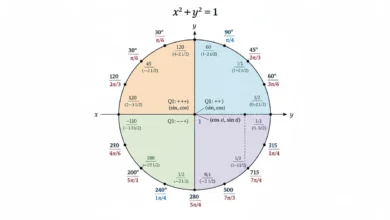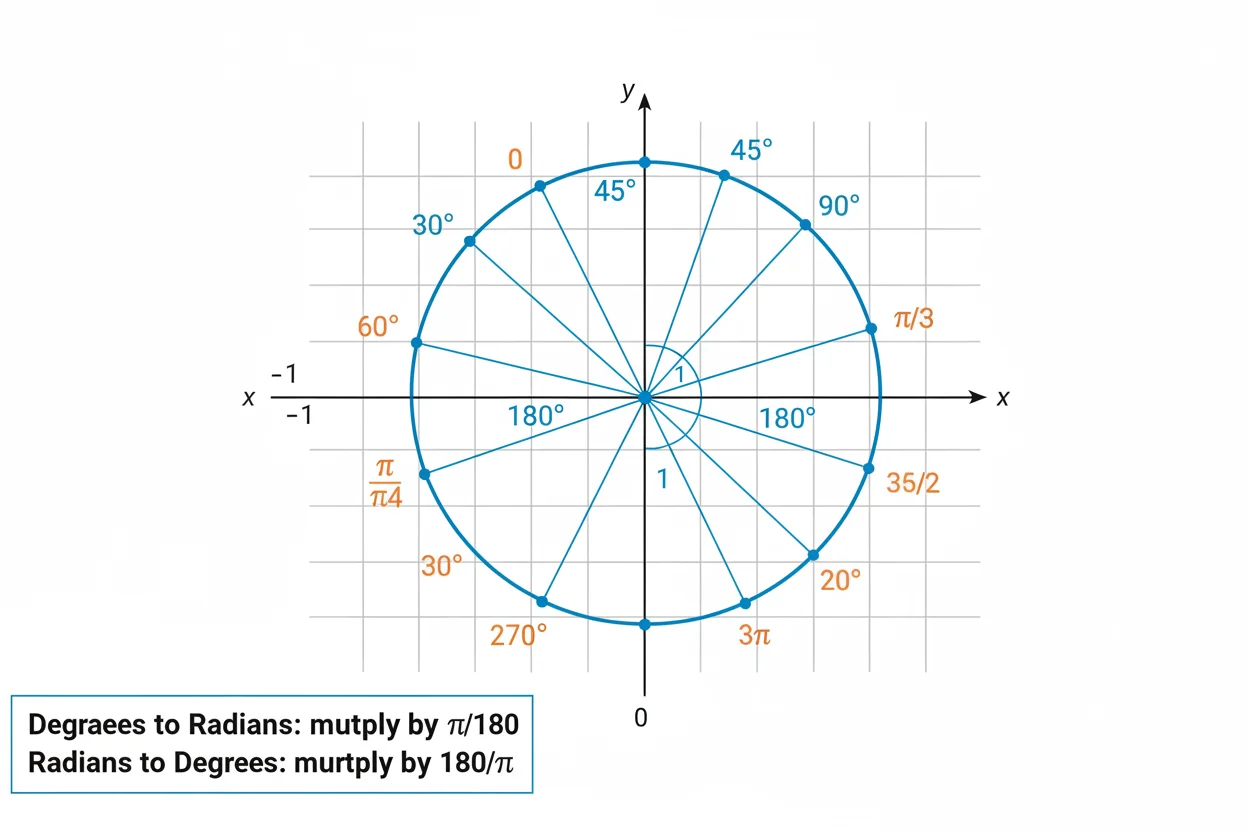
Degrees and radians are two systems for measuring angles. One complete revolution is 360 degrees or 2π radians, so 180° = π radians. To convert degrees to radians, multiply by π/180. To convert radians to degrees, multiply by 180/π. Degrees divide a full rotation into 360 equal parts, while radians measure angles through the relationship between arc length and radius. This makes radians especially natural in trigonometry, circle geometry, calculus, and rotational formulas. Familiar conversions include 30° = π/6, 45° = π/4, 60° = π/3, 90° = π/2, and 180° = π. Correctly distinguishing degrees and radians is essential because the same numerical input represents very different angles in the two systems.
What Are Degrees?
A degree is an angular unit defined so that one complete revolution contains:
360°
Therefore:
quarter turn = 90°
half turn = 180°
three-quarter turn = 270°
full turn = 360°
Degrees are convenient for everyday geometric measurements because many familiar angles have simple whole-number degree values.
The broader geometric context appears in Geometry & Trigonometry.
What Are Radians?
A radian measures an angle using radius and arc length.
For a circle of radius r and arc length s:
θ = s/r
when θ is measured in radians.
Equivalently:
s = rθ
One radian is the angle subtending an arc whose length equals the radius.
Because the complete circumference is:
2πr
the angle for one complete revolution is:
2π radians
This is the geometric reason radians occur naturally in the Arc Length formula.
Degrees and Radians Relationship
A full turn can be written:
360° = 2π rad
Divide by 2:
180° = π rad
This is the fundamental conversion relationship.
From it:
1° = π/180 rad
and:
1 rad = 180/π°
Approximately:
1 rad ≈ 57.2958°
Degrees to Radians Formula
To convert degrees to radians:
radians = degrees × π/180
If the degree measure is θ°:
θ radians = θ° × π/180
The degree units cancel conceptually against the conversion factor, leaving radians.
Example: Convert 60° to Radians
Use:
radians = 60 × π/180
Simplify:
60/180 = 1/3
Therefore:
60° = π/3
Example: Convert 45° to Radians
45° × π/180
Simplify:
45/180 = 1/4
Therefore:
45° = π/4
Example: Convert 135° to Radians
135° × π/180
Simplify by dividing by 45:
135/180 = 3/4
Therefore:
135° = 3π/4
Example: Convert 300° to Radians
300° × π/180
Simplify:
300/180 = 5/3
Therefore:
300° = 5π/3
Keeping π exact is usually preferable to immediately converting to a decimal.
Radians to Degrees Formula
To convert radians to degrees:
degrees = radians × 180/π
For an angle:
θ radians
use:
θ × 180/π
If θ contains π, the π factors often cancel.
Example: Convert π/6 to Degrees
π/6 × 180/π
Cancel π:
180/6
Therefore:
π/6 = 30°
Example: Convert 3π/4 to Degrees
3π/4 × 180/π
Cancel π:
3(180)/4
= 135°
Therefore:
3π/4 = 135°
Example: Convert 7π/6 to Degrees
7π/6 × 180/π
= 7(30)
Therefore:
7π/6 = 210°
Convert 2.5 Radians to Degrees
Not every radian measure contains π.
Use:
degrees = 2.5 × 180/π
Approximately:
degrees ≈ 143.24°
This is an approximate conversion because the radian input is given as a decimal rather than an exact multiple of π.
Common Degree-Radian Values
Several conversions appear repeatedly:
0° = 0
30° = π/6
45° = π/4
60° = π/3
90° = π/2
120° = 2π/3
135° = 3π/4
150° = 5π/6
180° = π
270° = 3π/2
360° = 2π
Recognizing these values makes many trigonometric problems much faster.
Why 180° Equals π Radians
A semicircle has arc length:
πr
because the full circumference is:
2πr
Using:
θ = s/r
for the semicircle:
θ = πr/r
Therefore:
θ = π radians
A semicircle is also:
180°
so:
180° = π radians
The conversion comes directly from circle geometry rather than being an arbitrary rule.
Why Radians Are Dimensionless
Radians are defined as:
angle = arc length/radius
Both arc length and radius use the same length unit.
For example:
cm/cm
or:
m/m
The units cancel.
Radians are therefore dimensionless in the mathematical sense, although writing “rad” can make the angle unit explicit.
Radians and the Unit Circle
On the Unit Circle:
r = 1
The arc-length formula becomes:
s = θ
because:
s = rθ = 1·θ
Therefore the numerical radian angle equals the corresponding arc length on the unit circle.
This makes radians particularly natural for defining trigonometric functions.
Quarter Turn
A quarter revolution is:
360°/4 = 90°
In radians:
2π/4 = π/2
Therefore:
90° = π/2
This angle corresponds to the top of the unit circle.
Half Turn
A half revolution is:
180°
or:
π radians
On the unit circle, this moves from:
(1, 0)
to:
(−1, 0)
It reverses direction along a straight line through the origin.
Three-Quarter Turn
Three quarters of a complete revolution is:
270°
In radians:
3(π/2)
Therefore:
270° = 3π/2
This corresponds to the bottom of the unit circle.
Full Turn
A complete revolution is:
360°
or:
2π radians
Adding either of these to an angle produces a coterminal angle with the same terminal side.
Thus:
θ
and:
θ + 360°
represent the same direction in degrees.
In radians:
θ
and:
θ + 2π
are coterminal.
Coterminal Angles in Degrees
To find coterminal degree angles, add or subtract multiples of:
360°
For example:
30° + 360° = 390°
Therefore:
30°
and:
390°
are coterminal.
Another coterminal value is:
30° − 360° = −330°
All three angles terminate in the same direction.
Coterminal Angles in Radians
Add or subtract multiples of:
2π
For example:
π/3 + 2π
= π/3 + 6π/3
= 7π/3
Therefore:
π/3
and:
7π/3
are coterminal.
Likewise:
π/3 − 2π = −5π/3
Negative Angles
A positive angle is conventionally measured counterclockwise.
A negative angle is measured clockwise.
For example:
−90°
is coterminal with:
270°
In radians:
−π/2
is coterminal with:
3π/2
because:
−π/2 + 2π = 3π/2
Reference Angles
A reference angle is the positive acute angle between an angle’s terminal side and the x-axis.
For:
150°
the reference angle is:
30°
In radians:
150° = 5π/6
and its reference angle is:
π/6
Reference angles allow familiar exact Sine and Cosine values to be extended to other quadrants.
Example: 210°
Convert:
210° × π/180
Simplify:
210/180 = 7/6
Therefore:
210° = 7π/6
Its reference angle is:
30° = π/6
Because 210° lies in Quadrant III, both sine and cosine are negative there.
Degrees and Radians in Sine
The same geometric angle has the same sine value regardless of which unit describes it.
For example:
30° = π/6
Therefore:
sin30° = sin(π/6)
= 1/2
The function value is unchanged because the physical angle is the same.
Only its numerical representation changes.
Degrees and Radians in Cosine
Similarly:
60° = π/3
so:
cos60° = cos(π/3)
= 1/2
A problem occurs only when an angle’s numerical value is interpreted in the wrong unit.
The number:
60
radians is not the same angle as:
60°
Degrees and Radians in Tangent and Cotangent
Suppose:
45° = π/4
Then:
tan45° = tan(π/4) = 1
and:
cot45° = cot(π/4) = 1
The Cotangent function therefore works identically with either unit system once the angle itself is represented correctly.
Calculator Degree Mode
If a problem asks for:
sin30°
the calculator should be in degree mode.
It should return:
0.5
If the calculator interprets 30 as radians, the result is entirely different.
Always inspect:
DEG
or:
RAD
before evaluating a numerical trigonometric function.
Calculator Radian Mode
For:
sin(π/6)
the calculator should interpret the argument in radians.
Since:
π/6 ≈ 0.523599
we obtain:
sin(π/6) = 0.5
The same physical angle was represented as:
30°
in degree mode.
Inverse Trigonometric Results
Inverse Trigonometric Functions return an angle.
The numerical result depends on the calculator’s angle mode.
For example:
sin⁻¹(1/2)
returns:
30
in degree mode
but:
π/6 ≈ 0.523599
in radian mode.
Both values represent the same principal angle.
Radians and Arc Length
For central angle θ in radians:
s = rθ
This is one of the strongest reasons radians are useful.
Suppose:
r = 12
θ = π/3
Then:
s = 12(π/3)
= 4π
No additional fraction-of-a-circle factor is required.
Arc Length in Degrees
If θ is in degrees:
s = (θ/360°)2πr
Suppose:
r = 12
θ = 60°
Then:
s = (60/360)2π(12)
= 4π
The result matches the radian method because:
60° = π/3
Find Radian Angle From Arc Length
From:
s = rθ
solve:
θ = s/r
Suppose:
s = 15
r = 10
Then:
θ = 15/10
= 1.5 radians
In degrees:
1.5 × 180/π
≈ 85.94°
Sector Area in Radians
For central angle θ measured in radians:
A = r²θ/2
The Sector Area formula becomes compact because radian measure already expresses the angular fraction naturally.
For:
r = 8
θ = π/4
we get:
A = 64(π/4)/2
= 8π
Sector Area in Degrees
For θ in degrees:
A = (θ/360°)πr²
Suppose:
r = 8
θ = 45°
Then:
A = (45/360)64π
= 8π
Again, the two unit systems produce the same geometric result.
Chord Length and Angle Units
The Chord Length formula is:
c = 2r sin(θ/2)
This can use θ in degrees or radians as long as the sine evaluation uses the corresponding mode.
For example:
θ = 60°
or:
θ = π/3
both produce:
c = 2r sin30°
= 2r sin(π/6)
= r
Exterior Angles and Degrees
Polygon Exterior Angles are commonly expressed in degrees.
For any convex polygon, one exterior angle at each vertex sums to:
360°
In radians, the same total is:
2π
For a regular n-gon:
exterior angle = 360°/n
or:
exterior angle = 2π/n radians
Both formulas describe the same rotation around the polygon.
Regular Hexagon Example
For:
n = 6
each exterior angle is:
360°/6
= 60°
In radians:
2π/6
= π/3
Therefore:
60° = π/3
appears naturally in both polygon geometry and trigonometry.
Interior Angles in Radians
The sum of the Interior Angles of an n-sided polygon is:
(n − 2)180°
In radians:
(n − 2)π
For a pentagon:
degree sum = 3(180°) = 540°
radian sum = 3π
These are equivalent measurements of the same total angle.
Right Angle
A right angle is:
90°
or:
π/2 radians
This conversion appears constantly in right-triangle geometry.
For example, the three angles in a right triangle satisfy:
A + B + π/2 = π
in radians
or:
A + B + 90° = 180°
in degrees.
Straight Angle
A straight angle is:
180°
or:
π radians
Two rays pointing in opposite directions form a straight line.
Supplementary angles therefore sum to:
180°
or:
π
depending on the chosen unit.
Full Rotation and Periodicity
Many trigonometric functions repeat after a full rotation.
For sine and cosine:
period = 360° = 2π
For tangent and cotangent:
period = 180° = π
The shorter tangent/cotangent period occurs because their relevant ratios repeat after half a revolution.
Degrees and Radians in Polar Coordinates
In Polar and Rectangular Form:
x = r cos θ
y = r sin θ
The angle θ can be described in degrees or radians.
For mathematical formulas and calculus, radians are normally preferred.
For example:
θ = 60°
and:
θ = π/3
produce the same point when r is unchanged.
Coordinate Geometry and Angle Units
Coordinate problems may first require side lengths from the Distance Formula:
d = √[(x₂ − x₁)² + (y₂ − y₁)²]
Those lengths may then enter a trigonometric equation that returns an angle.
For example, after computing triangle sides from coordinates, inverse cosine can determine an included angle.
Whether the reported answer is:
1.0472 radians
or:
60°
depends on the desired angle unit.
Angular Fractions of a Cylinder
Degrees and radians can also describe a partial cylindrical solid.
A complete circular cylinder corresponds to:
360° = 2π
If only angle θ of the circular base is included, the fraction of the complete cylinder is:
θ/360°
in degrees
or:
θ/(2π)
in radians.
Therefore the Cylinder Volume of a cylindrical sector can be written:
V = (θ/360°)πr²h
for degrees.
Cylinder Sector in Radians
For θ radians:
V = [θ/(2π)]πr²h
Simplify:
V = θr²h/2
For:
θ = π
the sector represents half a cylinder because:
π/(2π) = 1/2
The volume is therefore:
πr²h/2
Angular Fractions of Cylinder Surface Area
A partial cylindrical surface can similarly use angular fractions.
The full lateral area from Cylinder Surface Area is:
L = 2πrh
For angular sweep θ radians, the corresponding curved portion is:
L_partial = [θ/(2π)]2πrh
Therefore:
L_partial = θrh
This covers only the curved portion; additional radial cut faces may need to be included in a complete solid.
Why Radians Are Preferred in Calculus
Many calculus formulas take their simplest form only when angles are measured in radians.
For example:
d/dx[sin x] = cos x
assumes x is in radians.
Likewise:
lim [sin x/x] = 1 as x → 0
uses radians.
If degrees were used directly, additional conversion constants would appear.
Radians therefore make trigonometric calculus structurally cleaner.
Small-Angle Relationship
For small θ measured in radians:
sin θ ≈ θ
and:
tan θ ≈ θ
These approximations do not hold in the same form when θ is entered numerically in degrees.
For example:
1°
is approximately:
0.01745 radians
So:
sin1° ≈ 0.01745
not:
1
This is another indication that radians measure angular size naturally relative to circle geometry.
Converting Decimal Degrees to Radians
Suppose:
θ = 72.5°
Then:
θ = 72.5 × π/180
This can be written exactly as:
145π/360
Simplify:
θ = 29π/72
Approximately:
θ ≈ 1.26536 radians
Decimal degree measures follow the same conversion formula as integer degrees.
Converting Decimal Radians to Degrees
Suppose:
θ = 1.2 radians
Then:
degrees = 1.2 × 180/π
Approximately:
degrees ≈ 68.75°
Unless the radian value is an exact multiple of π, the resulting degree measure is usually approximate.
Degrees, Minutes, and Seconds
A degree can be subdivided into:
60 arcminutes
and each arcminute into:
60 arcseconds
So:
1° = 60′
and:
1′ = 60″
Therefore:
1° = 3600″
This notation is different from decimal degrees but represents the same angle system.
Convert DMS to Decimal Degrees
Suppose:
30° 15′ 36″
Convert:
decimal degrees = 30 + 15/60 + 36/3600
= 30 + 0.25 + 0.01
Therefore:
30° 15′ 36″ = 30.26°
That decimal value can then be converted to radians using:
× π/180
Convert Decimal Degrees to DMS
Suppose:
42.375°
The whole degrees are:
42°
Take the decimal part:
0.375 × 60 = 22.5
So:
22′
remain, with:
0.5 × 60 = 30″
Therefore:
42.375° = 42° 22′ 30″
Degree Measure Greater Than 360°
Angles do not need to stay between:
0°
and:
360°
For example:
765°
represents more than two full rotations.
Subtract:
720° = 2(360°)
to obtain the coterminal angle:
45°
Therefore:
765° = 17π/4
and is coterminal with:
π/4
Radian Measure Greater Than 2π
Suppose:
θ = 13π/3
Subtract:
2π = 6π/3
twice:
13π/3 − 12π/3 = π/3
Therefore:
13π/3
is coterminal with:
π/3
or:
60°
Degree-Radian Proportion
A conversion can also be solved through the proportion:
degrees/180 = radians/π
For example, if x radians corresponds to:
72°
then:
72/180 = x/π
Therefore:
x = 72π/180
= 2π/5
This is equivalent to multiplying by π/180.
Trigonometric Identity Inputs
Trigonometric Identities are true regardless of whether an angle is described in degrees or radians.
For example:
sin²θ + cos²θ = 1
holds for every real angle θ.
But when evaluating a numerical input, the angle must be interpreted in the correct unit.
The identity does not make 30° and 30 radians equivalent.
Common Degrees and Radians Mistakes
A common mistake is using the conversion factors backward.
Remember:
degrees → radians: multiply by π/180
radians → degrees: multiply by 180/π
Another error is using:
360° = π
The correct relationship is:
180° = π
and:
360° = 2π
When using:
s = rθ
θ must be in radians.
Calculator angle mode must match the numerical input.
Do not replace π with a decimal too early when an exact result is possible.
For negative or large angles, coterminal reduction is optional but often makes the geometry easier to interpret.
Finally, remember that an angle such as:
2
means 2 radians if no degree symbol is shown in a standard mathematical context where radian measure is assumed.
Frequently Asked Questions
What is the relationship between degrees and radians?
180° = π radians
and:
360° = 2π radians
How do you convert degrees to radians?
radians = degrees × π/180
How do you convert radians to degrees?
degrees = radians × 180/π
What is 30° in radians?
π/6
What is 45° in radians?
π/4
What is 60° in radians?
π/3
What is 90° in radians?
π/2
What is 180° in radians?
π
What is 270° in radians?
3π/2
What is 360° in radians?
2π
What is one radian in degrees?
180/π°
which is approximately:
57.2958°
Why are radians useful?
Radians directly connect angle, radius, and arc length through:
s = rθ
and make many trigonometric and calculus formulas simpler.
Can trigonometric functions use degrees?
Yes, but the numerical input must be interpreted in degree mode.
Why does calculator mode matter?
The number 30 interpreted as 30° is a different angle from 30 radians, so trigonometric values differ.
How do you find a coterminal angle in degrees?
Add or subtract multiples of:
360°
How do you find a coterminal angle in radians?
Add or subtract multiples of:
2π
How can I check a degree-radian conversion?
Verify that the fraction of a full turn is unchanged. For example:
90°/360° = 1/4
and:
(π/2)/(2π) = 1/4