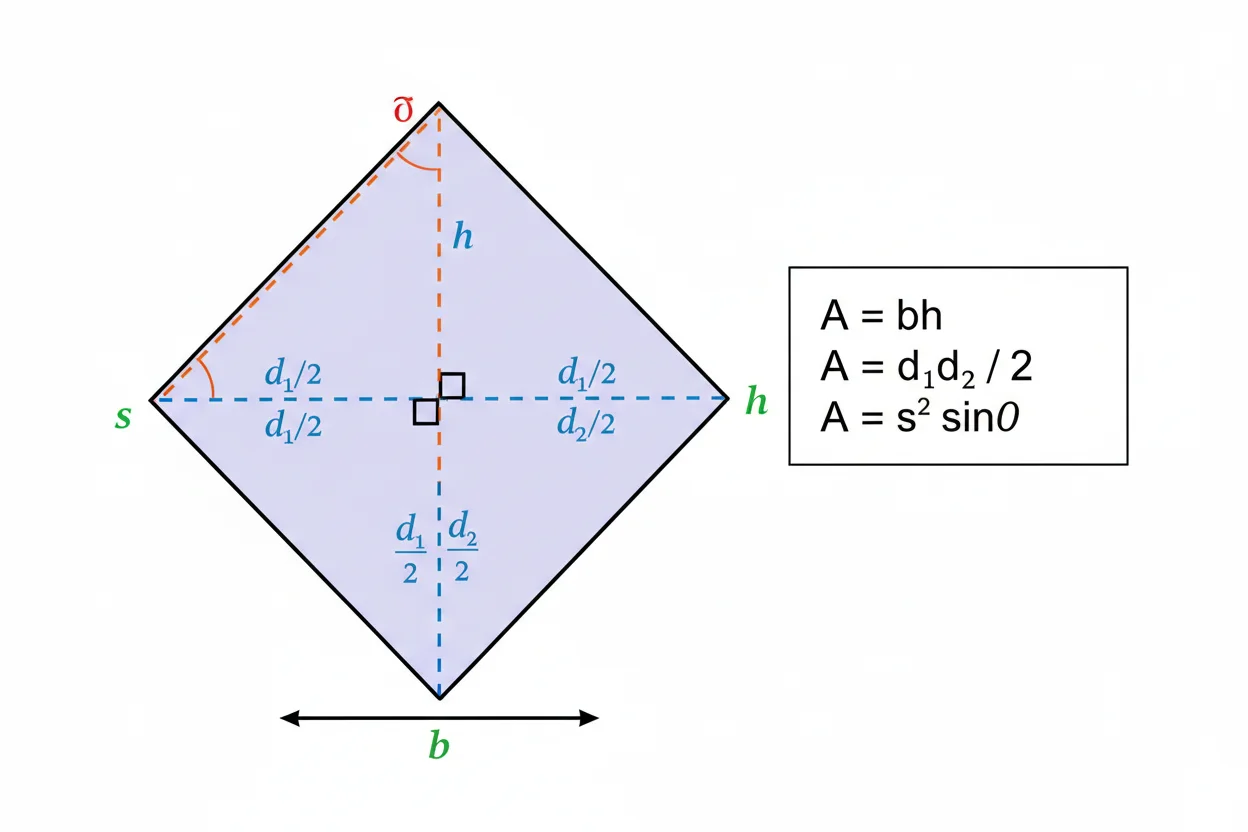

Rhombus area measures the two-dimensional region enclosed by a rhombus, a parallelogram with four equal sides. The simplest formula is A = bh, where b is a side chosen as the base and h is the perpendicular height to the opposite side. Because every side of a rhombus has the same length s, this can also be written A = sh. When both diagonals are known, the particularly useful formula is A = d₁d₂/2. If a side s and an interior angle θ are known, the area is A = s² sinθ. These formulas describe the same area from different measurements. Rhombus area is expressed in square units, and many problems use right triangles, the Pythagorean theorem, trigonometry, perimeter, or coordinates to determine missing dimensions before calculating the final area.
What Is a Rhombus?
A rhombus is a quadrilateral with four equal sides.
If each side has length s:
AB = BC = CD = DA = s
A rhombus is also a parallelogram, so opposite sides are parallel and opposite angles are equal.
Its diagonals:
bisect each other
and:
intersect at right angles
Each diagonal also bisects a pair of opposite interior angles.
These properties create several equivalent methods for finding rhombus area.
Rhombus Area Using Base and Height
The basic formula is:
A = bh
For a rhombus, the base is simply one side, so:
A = sh
where:
s = side length
h = perpendicular height
The height must be perpendicular to the selected base.
It is not usually equal to a slanted side.
Basic Base-Height Example
Suppose:
s = 12 cm
h = 7 cm
Then:
A = 12(7)
Therefore:
A = 84 cm²
This is the same base-height principle used for Parallelogram Area.
Why A = bh Works
A rhombus is a parallelogram.
If a triangular piece is cut from one end and moved to the opposite end, the rhombus can be rearranged into a rectangle with the same:
base b
and:
perpendicular height h
Because rearrangement does not change area:
A = bh
The horizontal slant affects shape but not the base-height formula.
Slanted Side Versus Height
Suppose a rhombus has:
side = 10
perpendicular height = 6
Then:
A = 10(6)
= 60
Using:
10 × 10 = 100
would be incorrect unless the rhombus were a square.
The side length becomes the height only when adjacent sides meet at:
90°
Find Height From Area
From:
A = sh
solve:
h = A/s
Suppose:
A = 96
s = 12
Then:
h = 96/12
Therefore:
h = 8
Find Side From Area and Height
Similarly:
s = A/h
If:
A = 135
h = 9
then:
s = 15
Because all rhombus sides are equal, this also determines its perimeter.
Rhombus Area Using Diagonals
If the diagonals have lengths:
d₁
and:
d₂
then:
A = d₁d₂/2
This is one of the most distinctive rhombus area formulas.
It works because the diagonals are perpendicular and bisect each other.
Basic Diagonal Example
Suppose:
d₁ = 16
d₂ = 10
Then:
A = 16(10)/2
= 160/2
Therefore:
A = 80
square units.
Why the Diagonal Formula Works
The diagonals divide the rhombus into four Right Triangles.
Each triangle has legs:
d₁/2
and:
d₂/2
Its area is:
A_triangle = 1/2(d₁/2)(d₂/2)
= d₁d₂/8
There are four triangles:
A = 4(d₁d₂/8)
Therefore:
A = d₁d₂/2
Find a Missing Diagonal
Starting with:
A = d₁d₂/2
multiply by 2:
2A = d₁d₂
Therefore:
d₁ = 2A/d₂
or:
d₂ = 2A/d₁
Missing Diagonal Example
Suppose:
A = 108
d₁ = 18
Then:
d₂ = 2(108)/18
= 216/18
Therefore:
d₂ = 12
Check:
18(12)/2 = 108
Rhombus Area Using Side and Angle
If side length is s and an interior angle is θ:
A = s² sinθ
More generally, for adjacent parallelogram sides a and b:
A = ab sinθ
Since a rhombus has:
a = b = s
the formula becomes:
A = s² sinθ
Side-Angle Example
Suppose:
s = 10
θ = 30°
Then:
A = 10²sin30°
= 100(1/2)
Therefore:
A = 50
square units.
Another Side-Angle Example
Suppose:
s = 8
θ = 60°
Then:
A = 64sin60°
= 64(√3/2)
Therefore:
A = 32√3
Approximately:
A ≈ 55.43
square units.
Why A = s² sinθ
Choose one side as the base:
b = s
The adjacent side also has length:
s
Its perpendicular component is:
h = s sinθ
Therefore:
A = sh
= s(s sinθ)
So:
A = s² sinθ
The Sine function converts the slanted side into perpendicular height.
Acute and Obtuse Interior Angles Give the Same Area
Adjacent rhombus angles are supplementary:
θ + φ = 180°
Since:
sinφ = sin(180° − θ)
we have:
sinφ = sinθ
Therefore:
s²sinφ = s²sinθ
Using either adjacent interior angle gives the same area.
Find an Interior Angle From Area
Starting with:
A = s² sinθ
we obtain:
sinθ = A/s²
Therefore:
θ = sin⁻¹(A/s²)
The principal value from Inverse Trigonometric Functions gives one angle.
The supplementary angle:
180° − θ
is the adjacent rhombus angle and produces the same area.
Angle Example
Suppose:
A = 48
s = 8
Then:
sinθ = 48/64
= 3/4
So:
θ = sin⁻¹(3/4)
Approximately:
θ ≈ 48.59°
The other interior angle is:
180° − 48.59°
≈ 131.41°
Find Side From Area and Angle
From:
A = s²sinθ
solve:
s² = A/sinθ
Therefore:
s = √(A/sinθ)
Suppose:
A = 50
θ = 30°
Then:
s = √[50/(1/2)]
= √100
Therefore:
s = 10
Rhombus Perimeter
Because all four sides are equal:
P = 4s
The Perimeter measures the outer boundary rather than the enclosed area.
If:
s = 9
then:
P = 36
Knowing perimeter gives the side length:
s = P/4
Area From Perimeter and Height
Since:
s = P/4
and:
A = sh
we obtain:
A = Ph/4
Suppose:
P = 48
h = 7
Then:
A = 48(7)/4
Therefore:
A = 84
square units.
Area From Perimeter and Angle
Using:
s = P/4
in:
A = s²sinθ
gives:
A = (P/4)²sinθ
Therefore:
A = P²sinθ/16
Suppose:
P = 40
θ = 30°
Then:
A = 1600(1/2)/16
Therefore:
A = 50
Diagonals and Side Length
The perpendicular diagonals divide the rhombus into right triangles.
Each right triangle has legs:
d₁/2
d₂/2
and hypotenuse:
s
Therefore the Pythagorean Theorem gives:
s² = (d₁/2)² + (d₂/2)²
Multiply by 4:
4s² = d₁² + d₂²
So an important rhombus identity is:
d₁² + d₂² = 4s²
Find Side From Diagonals
From:
d₁² + d₂² = 4s²
we obtain:
s = 1/2 √(d₁² + d₂²)
Suppose:
d₁ = 16
d₂ = 12
Then:
s = 1/2 √(256 + 144)
= 1/2 √400
Therefore:
s = 10
The perimeter is:
40
and area is:
16(12)/2 = 96
Find a Diagonal From Side and Other Diagonal
Rearrange:
d₂² = 4s² − d₁²
Therefore:
d₂ = √(4s² − d₁²)
Suppose:
s = 10
d₁ = 12
Then:
d₂ = √(400 − 144)
= √256
Therefore:
d₂ = 16
Area:
A = 12(16)/2
= 96
Area From Side and One Diagonal
If side s and diagonal d₁ are known:
d₂ = √(4s² − d₁²)
Therefore:
A = d₁√(4s² − d₁²)/2
Suppose:
s = 13
d₁ = 10
Then:
d₂ = √(676 − 100)
= √576
= 24
So:
A = 10(24)/2
Therefore:
A = 120
Find Height From Side and Diagonals
Once area is found from the diagonals:
A = d₁d₂/2
and:
A = sh
Therefore:
h = d₁d₂/(2s)
If:
d₁ = 12
d₂ = 16
s = 10
then:
h = 192/20
Therefore:
h = 9.6
Diagonals Bisect the Interior Angles
Each rhombus diagonal bisects a pair of opposite angles.
If one full interior angle is:
θ
then the corresponding diagonal divides it into:
θ/2
and:
θ/2
The half-diagonal right triangles can therefore connect side length, diagonal lengths, and interior angles through trigonometry.
Diagonal From Side and Angle
For side length s and interior angle θ, one diagonal can be written:
d₁ = 2s cos(θ/2)
while the other is:
d₂ = 2s sin(θ/2)
depending on which diagonal is associated with the bisected acute angle.
Multiplying:
d₁d₂/2
gives:
[2s cos(θ/2)][2s sin(θ/2)]/2
Using:
2sin(θ/2)cos(θ/2) = sinθ
we recover:
A = s²sinθ
So the diagonal and side-angle formulas are fully consistent.
Diagonal Example From Side and Angle
Suppose:
s = 10
θ = 60°
Then:
d₁ = 20cos30°
= 10√3
and:
d₂ = 20sin30°
= 10
Area:
A = (10√3)(10)/2
Therefore:
A = 50√3
This also equals:
100sin60° = 50√3
Rhombus Area From Coordinates
If four rhombus vertices are given in coordinates, several approaches are possible.
You can calculate diagonal lengths with the Distance Formula and use:
A = d₁d₂/2
Alternatively, calculate two adjacent side vectors and use the determinant magnitude.
Coordinate Diagonal Example
Suppose rhombus vertices are:
A = (0,4)
B = (3,0)
C = (0,−4)
D = (−3,0)
Diagonal AC has length:
d₁ = 8
Diagonal BD has length:
d₂ = 6
Therefore:
A = 8(6)/2
= 24
square units.
Verify the Side Lengths
Using the distance formula:
AB = √[(3 − 0)² + (0 − 4)²]
= √25
= 5
Likewise:
BC = CD = DA = 5
So the coordinate figure truly is a rhombus.
Coordinate Vector Method
Suppose one vertex is:
A
and adjacent side vectors are:
u
and:
v
The parallelogram area is:
A = |uₓvᵧ − uᵧvₓ|
A rhombus additionally requires:
|u| = |v|
The determinant therefore finds area without explicitly calculating height or diagonals.
Vector Example
Let adjacent side vectors be:
u = (3,4)
v = (−3,4)
Their lengths are:
|u| = 5
|v| = 5
Therefore they form adjacent rhombus sides.
Area:
A = |3(4) − 4(−3)|
= |12 + 12|
Therefore:
A = 24
This matches the previous coordinate example.
Diagonal Midpoint Property
A rhombus is a parallelogram, so its diagonals bisect each other.
If opposite vertices are A and C, their midpoint equals the midpoint of B and D.
Using the Midpoint Formula:
M_AC = M_BD
This provides a coordinate test for the parallelogram structure.
Diagonal Intersection
Because the diagonals bisect one another, their Line Intersection is the shared midpoint.
For the coordinate rhombus:
A = (0,4)
C = (0,−4)
midpoint:
(0,0)
For:
B = (3,0)
D = (−3,0)
midpoint is also:
(0,0)
Thus the diagonals intersect at the origin.
Rhombus and Right Triangles
Each diagonal intersection creates four right triangles.
This is why the Right Triangle relationships are particularly useful for rhombus calculations.
If the half-diagonals are:
p
and:
q
and side is:
s
then:
p² + q² = s²
These small right triangles can determine missing lengths or angles.
Right-Triangle Example
Suppose:
s = 13
and half of one diagonal is:
5
Then the other half-diagonal is:
√(13² − 5²)
= 12
Therefore full diagonals are:
10
and:
24
Area:
A = 10(24)/2
= 120
Rhombus Versus Rectangle
A Rectangle Area uses:
A = lw
because adjacent sides are perpendicular.
A general rhombus has equal sides but does not generally have right angles.
Thus:
s²
is not generally its area.
If a rhombus has a 90° interior angle, it becomes a square.
Then:
A = s²
Rhombus Versus Regular Polygon
A regular polygon must have both:
equal sides
and:
equal interior angles
A rhombus already has equal sides, but its angles are generally not all equal.
Therefore a rhombus is a Regular Polygon Area case only when it is a square.
For a square:
apothem = s/2
perimeter = 4s
So:
A = aP/2
= (s/2)(4s)/2
= s²
Rhombus Versus Kite
A kite has two pairs of adjacent equal sides.
A rhombus has all four sides equal.
Both have perpendicular diagonals, so both can use:
A = d₁d₂/2
However, a general kite has only one diagonal bisecting the other, while rhombus diagonals bisect each other.
The same area formula arises from related but not identical geometric structures.
Rhombus Versus Parallelogram
Every rhombus is a parallelogram.
Therefore all general parallelogram area formulas apply.
For side s and angle θ:
A = s²sinθ
For base s and height h:
A = sh
The diagonal formula is especially convenient because rhombus diagonals are perpendicular.
Maximum Area for Fixed Side Length
For fixed side s:
A = s²sinθ
The maximum sine value is:
1
Therefore maximum area occurs at:
θ = 90°
Then:
A_max = s²
So among rhombi with the same side length, the square has the greatest area.
Maximum Area Example
Suppose every side is:
10
Then:
A ≤ 100
A rhombus with:
θ = 30°
has:
A = 50
A square with:
θ = 90°
has:
A = 100
The side lengths are identical, but the perpendicular height differs.
Maximum Area for Fixed Perimeter
If perimeter P is fixed:
s = P/4
Therefore:
A = P²sinθ/16
The maximum occurs at:
θ = 90°
So:
A_max = P²/16
Again, the maximizing rhombus is a square.
Scaling Rhombus Area
If every linear measurement is multiplied by factor k:
s → ks
h → kh
Therefore:
A_new = (ks)(kh)
= k²A_old
The same result follows from the diagonal formula:
d₁ → kd₁
d₂ → kd₂
so:
A_new = k²d₁d₂/2
Scaling Example
Suppose a rhombus has area:
40
Every length doubles.
Then:
A_new = 2²(40)
Therefore:
A_new = 160
Its perimeter doubles, while its area quadruples.
Composite Figures With Rhombi
A composite shape may contain rhombus regions.
Calculate each component separately and then:
add nonoverlapping areas
or:
subtract removed areas
For example, if a rhombus of area:
80
contains a rectangular opening of area:
24
then remaining area is:
56
square units.
Units of Rhombus Area
If base and height are in centimeters:
cm × cm = cm²
If diagonals are in meters:
m × m = m²
Therefore area always uses square units.
Common units include:
mm²
cm²
m²
in²
ft²
Mixed Units
Convert all length measurements to compatible units before calculating area.
Suppose:
d₁ = 1.2 m
d₂ = 80 cm
Convert:
1.2 m = 120 cm
Then:
A = 120(80)/2
= 4800 cm²
which is:
0.48 m²
Exact Versus Approximate Area
If:
A = 32√3
this is exact.
Approximately:
A ≈ 55.43
Retaining exact radicals or trigonometric values until the final step avoids unnecessary rounding.
Common Rhombus Area Mistakes
A common mistake is assuming:
A = s²
for every rhombus.
That works only for a square.
Another error is using a slanted side as the perpendicular height.
When using diagonals, remember:
A = d₁d₂/2
rather than simply:
d₁d₂
Do not assume the diagonals are equal; that occurs only in the square case.
The diagonals are perpendicular and bisect each other, which is why half-diagonal right triangles work.
When using:
A = s²sinθ
make sure θ is an interior angle between adjacent sides.
For coordinate problems, verify that all four sides are equal before assuming the quadrilateral is a rhombus.
Finally, report square units.
Frequently Asked Questions
What is the basic rhombus area formula?
A = bh
or, because the base is a side:
A = sh
What is the rhombus area formula using diagonals?
A = d₁d₂/2
What is the formula using a side and angle?
A = s²sinθ
Why are the diagonals useful?
They are perpendicular and bisect each other, creating four right triangles.
How do you find a missing diagonal?
d₂ = 2A/d₁
How do you find the side from the diagonals?
s = 1/2√(d₁² + d₂²)
What identity connects the side and diagonals?
d₁² + d₂² = 4s²
How do you find height from area?
h = A/s
What is rhombus perimeter?
P = 4s
How do you find area from perimeter and angle?
A = P²sinθ/16
Are rhombus diagonals equal?
Not generally. They are equal only in the square case.
Are rhombus diagonals perpendicular?
Yes.
Do rhombus diagonals bisect each other?
Yes.
Is every rhombus a regular polygon?
No. A rhombus is regular only when it is a square.
Which rhombus has the greatest area for a fixed side length?
The square, because:
sin90° = 1
How does rhombus area scale?
If every length is multiplied by k:
area is multiplied by k²
How can I check a rhombus area answer?
Calculate the area with a second method when possible—for example, compare d₁d₂/2 with sh or s²sinθ—and verify that all final units are squared.