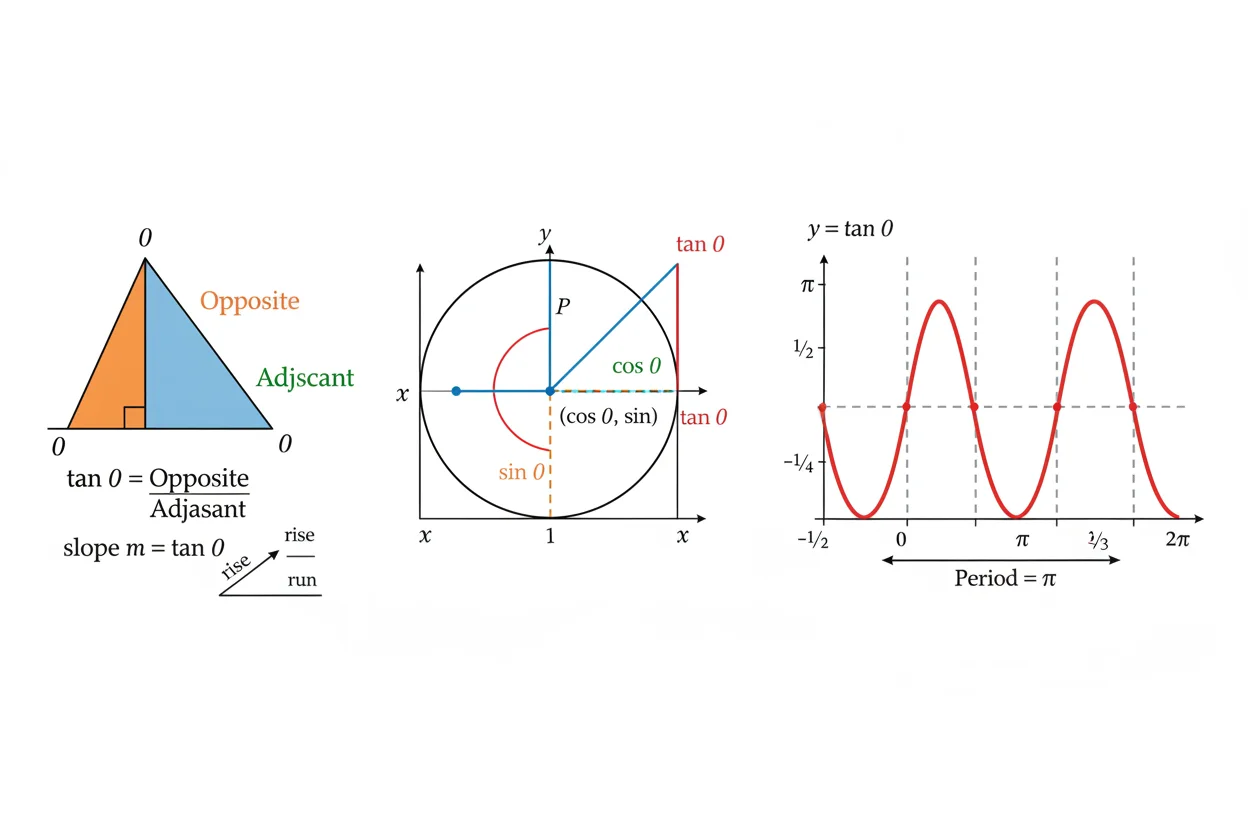

Tangent is a trigonometric function that compares the opposite and adjacent sides of a right triangle. Its basic formula is tanθ = opposite/adjacent. Tangent can also be written tanθ = sinθ/cosθ wherever cosθ is nonzero. On the unit circle, a point at angle θ has coordinates (cosθ, sinθ), so tanθ = y/x when x ≠ 0. Unlike sine and cosine, tangent has no finite maximum or minimum: its real range is all real numbers. It is undefined at θ = 90° + 180°k, repeats every 180° or π radians, and is positive in Quadrants I and III while negative in Quadrants II and IV. Tangent is especially important for solving right triangles, finding heights and distances, converting direction angles into slope, analyzing periodic functions, and working with identities involving secant.
Tangent Formula
For an acute angle θ in a Right Triangle:
tanθ = opposite/adjacent
where:
opposite = leg across from θ
adjacent = leg beside θ that is not the hypotenuse
The hypotenuse does not appear directly in the basic tangent ratio.
Basic Tangent Example
Suppose:
opposite = 3
adjacent = 4
Then:
tanθ = 3/4
Therefore:
tanθ = 0.75
If the angle is required:
θ = tan⁻¹(3/4)
Approximately:
θ ≈ 36.87°
5-12-13 Triangle Example
Suppose a:
5-12-13
right triangle has angle θ opposite the side of length 5.
Then:
tanθ = 5/12
For the other acute angle φ:
tanφ = 12/5
The two values are reciprocals because the opposite and adjacent legs switch roles.
Find the Opposite Side
From:
tanθ = opposite/adjacent
solve:
opposite = adjacent × tanθ
Suppose:
adjacent = 10
θ = 30°
Then:
opposite = 10tan30°
Since:
tan30° = √3/3
we get:
opposite = 10√3/3
Approximately:
opposite ≈ 5.77
Find the Adjacent Side
Rearrange:
adjacent = opposite/tanθ
Suppose:
opposite = 8
θ = 40°
Then:
adjacent = 8/tan40°
Approximately:
adjacent ≈ 9.53
Find an Angle Using Inverse Tangent
If:
tanθ = x
then:
θ = tan⁻¹x
for the principal inverse-tangent value.
Suppose:
tanθ = 1
Then:
θ = tan⁻¹(1)
Therefore:
θ = 45°
The broader principal-value conventions are covered by Inverse Trigonometric Functions.
Why Tangent Depends Only on the Angle
All Similar Triangles containing the same acute angle have proportional corresponding legs.
If both opposite and adjacent sides are multiplied by scale factor k:
tanθ = k(opposite)/k(adjacent)
The factor k cancels.
Therefore tangent is determined by the angle rather than the size of the triangle.
Tangent From Sine and Cosine
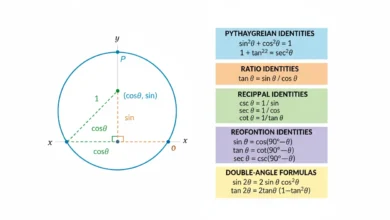
The fundamental quotient identity is:
tanθ = sinθ/cosθ
where:
cosθ ≠ 0
This follows from the right-triangle definitions:
sinθ = opposite/hypotenuse
cosθ = adjacent/hypotenuse
Divide:
sinθ/cosθ = opposite/adjacent
Therefore:
tanθ = sinθ/cosθ
Example From Sine and Cosine
Suppose:
sinθ = 3/5
cosθ = 4/5
Then:
tanθ = (3/5)/(4/5)
Therefore:
tanθ = 3/4
The Sine and Cosine ratios contain enough information to recover tangent.
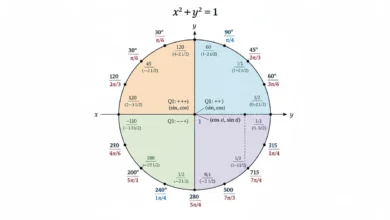
Unit Circle Definition
On the Unit Circle, the point corresponding to θ is:
(cosθ, sinθ)
Therefore:
tanθ = sinθ/cosθ
which means:
tanθ = y/x
when:
x ≠ 0
Thus tangent measures the ratio of vertical to horizontal coordinate components.
Tangent and Slope
The Slope of a nonvertical line making inclination angle θ with the positive x-axis is:
m = tanθ
This is one of the most important geometric interpretations of tangent.
A line with:
rise = Δy
and:
run = Δx
has:
m = Δy/Δx
The corresponding right triangle gives:
tanθ = Δy/Δx
Therefore:
m = tanθ
Slope Example
Suppose a line rises:
6
units for every:
8
units it moves to the right.
Then:
m = 6/8
= 3/4
Therefore:
tanθ = 3/4
and:
θ = tan⁻¹(3/4)
Approximately:
θ ≈ 36.87°
Find Slope From an Angle
If a line has inclination:
θ = 60°
then:
m = tan60°
Therefore:
m = √3
A line through point:
(2,5)
with this direction can be written using Point-Slope Form:
y − 5 = √3(x − 2)
Find an Angle From Slope
If:
m = 2
then a direction angle can be found from:
θ = tan⁻¹2
Approximately:
θ ≈ 63.43°
Under the standard 0° to 180° inclination convention, a negative slope requires quadrant interpretation rather than blindly retaining a negative principal arctangent result.
Exact Tangent Values
Important exact values include:
tan0° = 0
tan30° = √3/3
tan45° = 1
tan60° = √3
Tangent is undefined at:
90°
In radians:
tan0 = 0
tan(π/6) = √3/3
tan(π/4) = 1
tan(π/3) = √3
tan(π/2) is undefined
Tangent at 30°
In a 30-60-90 triangle, relative to 30°:
opposite = 1
adjacent = √3
Therefore:
tan30° = 1/√3
Rationalize:
tan30° = √3/3
Tangent at 45°
A 45-45-90 triangle has equal legs.
Therefore:
tan45° = leg/leg
So:
tan45° = 1
Tangent at 60°
In a 30-60-90 triangle, relative to 60°:
opposite = √3
adjacent = 1
Therefore:
tan60° = √3
Tangent at 90°
Because:
tanθ = sinθ/cosθ
and:
cos90° = 0
we get division by zero.
Therefore:
tan90°
is undefined.
This corresponds to a vertical direction whose slope is also undefined.
Domain of Tangent
Tangent is undefined wherever:
cosθ = 0
Therefore:
θ ≠ π/2 + kπ
for any integer k.
In degrees:
θ ≠ 90° + 180°k
These excluded values correspond to the vertical asymptotes of the tangent graph.
Range of Tangent
The range of tangent is:
all real numbers
or:
(−∞,∞)
Unlike sine and cosine, tangent is not restricted to:
[−1,1]
For angles approaching a vertical direction, tangent can grow arbitrarily large in magnitude.
Period of Tangent
Tangent repeats after:
π radians
or:
180°
because:
tan(θ + π) = tanθ
This is half the period of sine and cosine.
Why Tangent Has Period π
Since:
sin(θ + π) = −sinθ
and:
cos(θ + π) = −cosθ
their quotient becomes:
tan(θ + π) = (−sinθ)/(−cosθ)
Therefore:
tan(θ + π) = tanθ
Both signs cancel.
Is Tangent Odd or Even?
Tangent is an odd function:
tan(−θ) = −tanθ
For example:
tan(−45°) = −1
This gives the graph rotational symmetry about the origin.
Tangent Signs by Quadrant
Because:
tanθ = sinθ/cosθ
its sign depends on the signs of sine and cosine.
Therefore:
Quadrant I → positive
Quadrant II → negative
Quadrant III → positive
Quadrant IV → negative
Tangent is positive when sine and cosine have the same sign.
Quadrant II Example
Find:
tan150°
Reference angle:
30°
Tangent is negative in Quadrant II.
Therefore:
tan150° = −√3/3
Quadrant III Example
Find:
tan225°
Reference angle:
45°
Tangent is positive in Quadrant III.
Therefore:
tan225° = 1
Quadrant IV Example
Find:
tan300°
Reference angle:
60°
Tangent is negative in Quadrant IV.
Therefore:
tan300° = −√3
Reference Angles
For:
θ = 120°
the reference angle is:
60°
Because tangent is negative in Quadrant II:
tan120° = −tan60°
Therefore:
tan120° = −√3
Reference angles allow many exact values to be determined from first-quadrant values.
Degrees and Radians
Tangent accepts angles expressed in either degrees or radians.
Examples:
45° = π/4
60° = π/3
Therefore:
tan45° = tan(π/4) = 1
The conversion rules in Degrees and Radians must match the calculator mode used for numerical evaluation.
Tangent Graph
The basic graph:
y = tanx
crosses the origin:
(0,0)
and has vertical asymptotes at:
x = π/2 + kπ
Between consecutive asymptotes, the graph increases continuously from:
−∞
to:
+∞
The pattern repeats every:
π
Vertical Asymptotes
Tangent is undefined wherever cosine is zero.
Therefore asymptotes occur at:
…, −3π/2, −π/2, π/2, 3π/2, …
Near these values, tangent magnitude becomes arbitrarily large.
This mirrors the behavior of slopes approaching a vertical line.
Zeros of Tangent
Tangent equals zero when:
sinθ = 0
while:
cosθ ≠ 0
Therefore:
θ = kπ
for integer k.
In degrees:
θ = 180°k
Examples include:
0°
180°
360°
Transformed Tangent Functions
A transformed tangent function can be written:
y = A tan[B(x − C)] + D
where:
A affects vertical scaling/reflection
B affects period
C shifts horizontally
D shifts vertically
The period is:
π/|B|
Transformed Tangent Example
For:
y = 2tan(3x) + 1
vertical scale factor:
2
period:
π/3
midline or central horizontal reference:
y = 1
The asymptotes repeat every:
π/3
Fundamental Tangent Identity
One important identity is:
tanθ = sinθ/cosθ
Another comes from the Pythagorean identity:
1 + tan²θ = sec²θ
or equivalently:
sec²θ − tan²θ = 1
The Secant page develops this reciprocal-cosine relationship more deeply.
Deriving the Secant-Tangent Identity
Start with:
sin²θ + cos²θ = 1
Divide by:
cos²θ
Then:
sin²θ/cos²θ + 1 = 1/cos²θ
Therefore:
tan²θ + 1 = sec²θ
So:
1 + tan²θ = sec²θ
Find Tangent From Secant
From:
tan²θ = sec²θ − 1
we obtain:
tanθ = ±√(sec²θ − 1)
Suppose:
secθ = 5/4
Then:
tan²θ = 25/16 − 1
= 9/16
Therefore:
|tanθ| = 3/4
The quadrant determines whether tangent is positive or negative.
Find Secant From Tangent
From:
sec²θ = 1 + tan²θ
suppose:
tanθ = 12/5
Then:
sec²θ = 1 + 144/25
= 169/25
Therefore:
|secθ| = 13/5
Again, the quadrant determines the sign.
Complementary-Angle Relationship
In an acute right triangle:
tanθ = cot(90° − θ)
or in radians:
tanθ = cot(π/2 − θ)
This happens because the opposite and adjacent sides swap roles when switching to the complementary angle.
Tangent Addition Formula
For angles A and B where the expressions are defined:
tan(A + B) = (tanA + tanB)/(1 − tanA tanB)
Similarly:
tan(A − B) = (tanA − tanB)/(1 + tanA tanB)
These formulas can produce exact tangent values for compound angles.
Example: tan75°
Write:
75° = 45° + 30°
Then:
tan75° = [1 + √3/3]/[1 − √3/3]
Simplifying gives:
tan75° = 2 + √3
This is exact.
Double-Angle Formula
Set:
A = B = θ
Then:
tan2θ = 2tanθ/(1 − tan²θ)
where the denominator is nonzero.
For:
tanθ = 1/2
we get:
tan2θ = 1/(1 − 1/4)
= 1/(3/4)
Therefore:
tan2θ = 4/3
Solving Basic Tangent Equations
Suppose:
tanθ = 1
The reference angle is:
45°
Tangent is positive in Quadrants I and III.
On:
0° ≤ θ < 360°
the solutions are:
45°
and:
225°
Solving tanθ = −√3
Reference angle:
60°
Tangent is negative in Quadrants II and IV.
Therefore:
θ = 120°
and:
θ = 300°
over one full revolution.
General Tangent Solution
If:
tanθ = tanα
then:
θ = α + kπ
for any integer k.
In degrees:
θ = α + 180°k
Only one repeating family is needed because tangent’s period is π.
Algebraic Tangent Equation
Solve:
2tanθ − 1 = 0
Then:
tanθ = 1/2
The principal angle is:
θ₀ = tan⁻¹(1/2)
Approximately:
θ₀ ≈ 26.565°
General solutions are:
θ = 26.565° + 180°k
Tangent and Right Triangles
The broader Right Triangles framework makes tangent useful whenever two legs are involved.
Because the hypotenuse is absent from:
tanθ = opposite/adjacent
tangent is often the most direct ratio in height-and-distance problems.
Height of an Object
Suppose an observer stands:
20 m
from the base of a vertical object.
The angle of elevation to the top is:
35°
Let height be h.
Then:
tan35° = h/20
Therefore:
h = 20tan35°
Approximately:
h ≈ 14.00 m
This assumes the horizontal distance and vertical height form a right angle.
Including Observer Height
If an observer’s eye level is:
1.7 m
above the ground and the calculated vertical rise from eye level to the top is:
14.0 m
then total object height is:
14.0 + 1.7
Therefore:
15.7 m
The reference level must be identified correctly.
Angle of Depression
An angle of depression is measured downward from a horizontal line.
Because horizontal lines are parallel, it often equals the corresponding angle of elevation in the right-triangle diagram.
Tangent can then connect:
vertical difference
and:
horizontal distance
Angle-of-Depression Example
Suppose the top of a tower is:
30 m
above an observer’s level, and the angle of depression to the observer is:
40°
If horizontal distance is x:
tan40° = 30/x
Therefore:
x = 30/tan40°
Approximately:
x ≈ 35.75 m
Tangent and Triangle Altitudes
A Triangle Altitudes problem often creates right triangles.
If an altitude h and horizontal base segment x satisfy:
tanθ = h/x
then:
h = x tanθ
The tangent ratio can therefore determine a missing altitude before triangle area is calculated.
Triangle-Altitude Example
Suppose a triangle side segment adjacent to angle θ is:
8
and:
θ = 50°
Then altitude:
h = 8tan50°
Approximately:
h ≈ 9.53
If the full triangle base is known, the area follows from:
A = bh/2
Tangent and Trapezoid Area
A Trapezoid Area problem may provide slanted legs and angles rather than the perpendicular height.
If a horizontal run x and base angle θ are known:
h = x tanθ
Once h is determined:
A = (b₁ + b₂)h/2
Trapezoid Example
Suppose:
b₁ = 10
b₂ = 18
A side offset is:
x = 4
and base angle:
θ = 45°
Then:
h = 4tan45°
= 4
Area:
A = (10 + 18)(4)/2
Therefore:
A = 56
square units.
Tangent and Surface Area
The general Surface Area of a solid may depend on slant heights or triangular-face altitudes.
Tangent can recover such dimensions when a face angle and adjacent measurement are known.
For example:
tanθ = face altitude / horizontal run
Once the altitude or slant dimension is established, the appropriate face-area formula can be applied.
Pyramid Face Example
Suppose half of a square-pyramid base side is:
5
and the angle between the slant height and base plane in the central face cross section is:
60°
If slant height projection forms the adjacent side 5 and perpendicular rise is h:
tan60° = h/5
Therefore:
h = 5√3
The same cross section can then provide further dimensions needed for pyramid surface or volume calculations.
Tangent and Sphere Geometry
A sphere’s total Sphere Surface Area is:
4πr²
and its Sphere Volume is:
4πr³/3
Neither formula directly contains tangent.
However, tangent may help determine the radius from an external right-triangle measurement involving a tangent line, viewing angle, or cross section.
Once r is established, the sphere formula follows.
Tangent Line to a Circle
The word tangent also has a geometric meaning: a tangent line touches a circle at one point and is perpendicular to the radius drawn to that point.
If a tangent point is P and circle center is O:
OP ⟂ tangent line at P
This right angle creates useful Pythagorean and trigonometric relationships.
The trigonometric tangent function and tangent-line concept are related historically but should not be confused as identical definitions.
Tangent-Length Example
Suppose an external point Q is:
13
units from circle center O.
Circle radius:
OP = 5
If QP is tangent at P:
OP ⟂ QP
Therefore:
QP = √(13² − 5²)
= 12
The triangle is:
5-12-13
Tangent-function ratios can describe its acute angles.
Tangent and Regular Polygon Area
A Regular Polygon Area formula using side length s and n sides is:
A = ns²/[4tan(π/n)]
Tangent appears because an apothem divides each central isosceles triangle into two right triangles.
Specifically:
tan(π/n) = (s/2)/a
where a is the apothem.
Regular Polygon Example
For a regular hexagon:
n = 6
Then:
tan(π/6) = 1/√3
Therefore:
A = 6s²/[4(1/√3)]
Simplify:
A = 3√3s²/2
This recovers the standard regular-hexagon area formula.
Tangent and Polar Coordinates
For a point represented in Polar and Rectangular Form:
x = r cosθ
y = r sinθ
Therefore:
y/x = tanθ
when:
x ≠ 0
So:
tanθ = y/x
This gives the point’s directional slope from the origin.
Polar Example
Suppose:
(x,y) = (3,3√3)
Then:
tanθ = (3√3)/3
Therefore:
tanθ = √3
The point lies in Quadrant I, so:
θ = 60°
Its radial distance is:
r = 6
Tangent and Vector Direction
For vector:
v = (x,y)
its direction angle θ satisfies:
tanθ = y/x
when x is nonzero.
Quadrant information must still be considered.
For:
v = (−1,1)
the ratio is:
−1
but the vector lies in Quadrant II, so its standard positive direction is:
135°
rather than:
−45°
Tangent and Perpendicular Slopes
If one nonvertical, nonhorizontal line has inclination θ, a perpendicular direction has angle:
θ + 90°
The identity:
tan(θ + 90°) = −1/tanθ
where defined leads to:
m_perpendicular = −1/m
This explains the negative-reciprocal slope rule geometrically.
Parallel Lines
Parallel nonvertical lines have equal inclination angles modulo 180°.
Since tangent has period:
180°
their slopes satisfy:
tan(θ + 180°) = tanθ
Therefore parallel lines have equal slope.
Tangent’s period matches the fact that a line has the same orientation when its direction is reversed by 180°.
Tangent and Secant Identity
The identity:
1 + tan²θ = sec²θ
provides a direct connection between tangent and Secant.
If:
tanθ = 3/4
then:
sec²θ = 1 + 9/16
= 25/16
Thus:
|secθ| = 5/4
The quadrant determines the sign.
Inverse Tangent
Inverse tangent is written:
tan⁻¹x
or:
arctanx
It returns the principal angle whose tangent is x.
A common principal range is:
−90° < θ < 90°
or:
−π/2 < θ < π/2
This range gives one representative from each tangent equivalence class.
Inverse Tangent Example
Find:
tan⁻¹(√3)
The principal angle satisfying:
tanθ = √3
is:
θ = 60°
or:
π/3
Negative Inverse Tangent
For:
tan⁻¹(−1)
the principal value is:
−45°
or:
−π/4
If a geometry problem requires a standard direction angle from 0° to 180°, a line with slope −1 can instead be described by:
135°
because the two directions differ by 180° as undirected line orientations.
Tangent Derivative
In calculus, with x in radians:
d/dx(tanx) = sec²x
This follows from:
tanx = sinx/cosx
and the quotient rule.
The derivative is positive wherever tangent is defined, consistent with each tangent branch increasing between asymptotes.
Tangent Antiderivative
A standard antiderivative is:
∫ tanx dx = −ln|cosx| + C
Equivalent form:
∫ tanx dx = ln|secx| + C
where defined.
These relationships extend tangent beyond elementary triangle calculations.
Exact Versus Approximate Tangent Values
If:
tan30° = √3/3
this is exact.
Approximately:
tan30° ≈ 0.57735
Exact radical forms are preferable for symbolic calculations.
Decimals are useful for measurement problems where an approximate physical result is appropriate.
Common Tangent Mistakes
A common mistake is reversing the right-triangle ratio.
The correct definition is:
tanθ = opposite/adjacent
not:
adjacent/opposite
Another error is including the hypotenuse directly in the tangent ratio.
Do not confuse tangent with inverse tangent.
Tangent is undefined when cosine equals zero.
Remember that its period is:
π
not:
2π
When finding an angle from a coordinate ratio y/x, check the quadrant instead of relying blindly on a principal arctangent result.
For slope problems, vertical lines have undefined tangent-based slope.
When solving tangent equations, include every solution separated by:
π
or:
180°
Finally, confirm whether the word “tangent” refers to the trigonometric function or to a tangent line in the geometry problem being solved.
Frequently Asked Questions
What is the tangent formula in a right triangle?
tanθ = opposite/adjacent
How is tangent related to sine and cosine?
tanθ = sinθ/cosθ
What is tangent on the unit circle?
tanθ = y/x
where:
x ≠ 0
What is tan0°?
0
What is tan30°?
√3/3
What is tan45°?
1
What is tan60°?
√3
What is tan90°?
Undefined.
What is the domain restriction for tangent?
θ ≠ π/2 + kπ
What is the range of tangent?
All real numbers.
What is the period of tangent?
π radians
or:
180°
Is tangent positive in Quadrant III?
Yes.
Is tangent odd or even?
Tangent is odd:
tan(−θ) = −tanθ
How is tangent related to slope?
m = tanθ
for a nonvertical line with inclination θ.
What is the main tangent-sec ant identity?
1 + tan²θ = sec²θ
How do you find an angle from tangent?
Use:
θ = tan⁻¹x
then interpret the result according to the required interval or quadrant.
How is tangent used in regular polygon area?
It determines the apothem relationship and appears in:
A = ns²/[4tan(π/n)]
How can I check a tangent calculation?
Compare tanθ with sinθ/cosθ, verify its sign from the quadrant, confirm periodicity by adding 180° or π, and check that vertical-angle cases are treated as undefined.