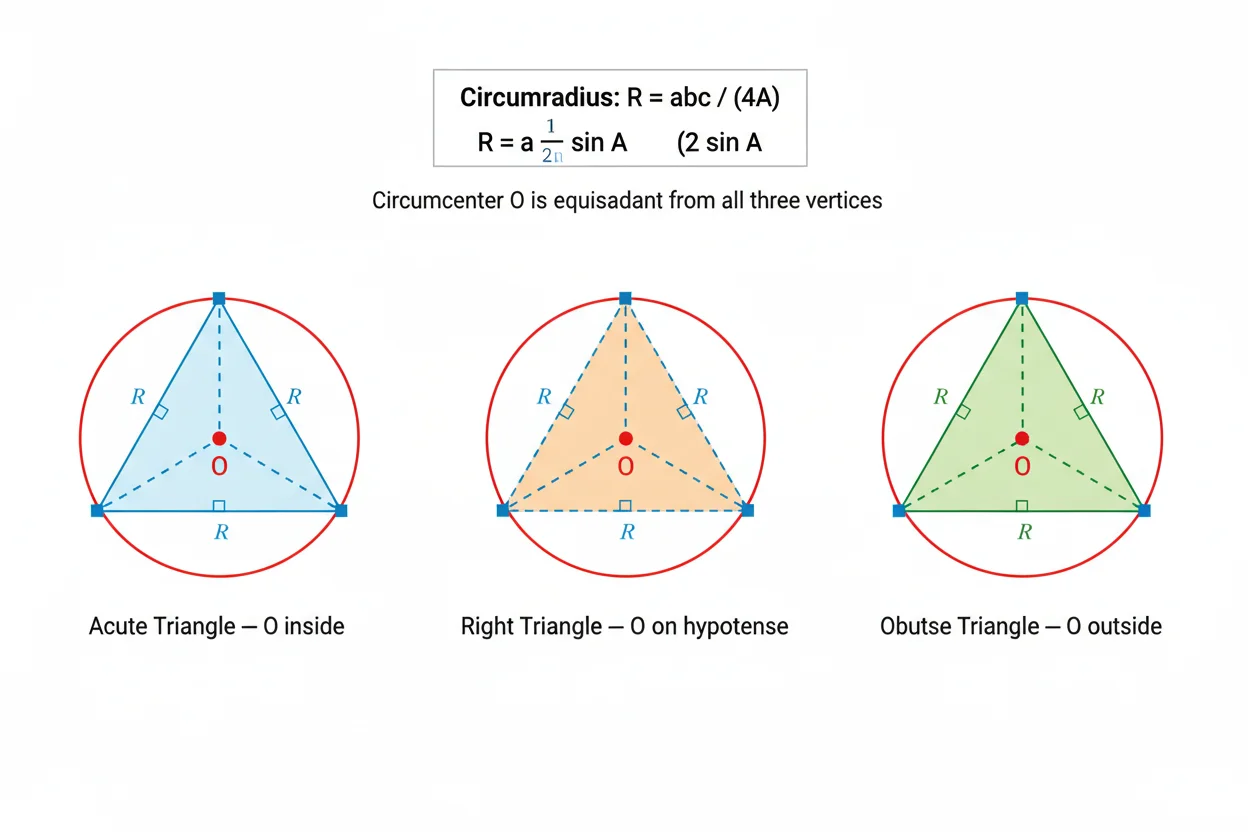

The triangle circumcenter is the point where the three perpendicular bisectors of a triangle’s sides intersect. It is equally distant from all three vertices, so it serves as the center of the unique circle passing through those vertices, called the circumcircle. If the circumcenter is O, then OA = OB = OC = R, where R is the circumradius. Its location depends on triangle type: the circumcenter lies inside an acute triangle, at the midpoint of the hypotenuse of a right triangle, and outside an obtuse triangle. The circumradius can be calculated from R = abc/(4A), where a, b, and c are the side lengths and A is the triangle area. It can also be found from R = a/(2 sin A), which is a form of the extended Law of Sines.
What Is the Triangle Circumcenter?
For triangle ABC, construct the perpendicular bisector of each side.
A perpendicular bisector:
passes through the midpoint of a side
and:
meets that side at 90°
The three perpendicular bisectors intersect at one point:
O
That point is the:
circumcenter
Because O lies on the perpendicular bisector of AB:
OA = OB
Because it also lies on the perpendicular bisector of BC:
OB = OC
Therefore:
OA = OB = OC
Circumcircle
The circle centered at O with radius:
R = OA = OB = OC
passes through all three triangle vertices.
This circle is the:
circumcircle
The radius R is the:
circumradius
Every nondegenerate Euclidean triangle has one unique circumcircle and therefore one unique circumcenter.
Main Circumradius Formula
If triangle sides are:
a, b, c
and its Triangle Area is A, then:
R = abc/(4A)
Equivalently:
A = abc/(4R)
This formula is especially useful when all three sides and the area are known.
Basic Circumradius Example
Suppose:
a = 5
b = 5
c = 6
The area is:
A = 12
Then:
R = 5(5)(6)/(4·12)
= 150/48
Therefore:
R = 25/8
or:
R = 3.125
Circumradius From the Law of Sines
The extended Law of Sines states:
a/sin A = b/sin B = c/sin C = 2R
Therefore:
R = a/(2 sin A)
R = b/(2 sin B)
R = c/(2 sin C)
Any known side and its opposite angle can determine the circumradius.
Example From a Side and Opposite Angle
Suppose:
a = 10
A = 30°
Then:
R = 10/[2sin30°]
Since:
sin30° = 1/2
we get:
R = 10
Another Circumradius Example
Suppose:
b = 12
B = 45°
Then:
R = 12/[2(√2/2)]
= 12/√2
Therefore:
R = 6√2
Approximately:
R ≈ 8.49
Why R = abc/(4A)
Triangle area can be written:
A = bc sin A/2
From the extended Law of Sines:
a = 2R sin A
Therefore:
sin A = a/(2R)
Substitute:
A = bc[a/(2R)]/2
So:
A = abc/(4R)
Rearrange:
R = abc/(4A)
The formula combines side lengths, area, and the circumcircle in one relationship.
Circumcenter From Perpendicular Bisectors
A geometric construction requires only two perpendicular bisectors.
- Find the midpoint of one side.
- Draw a line perpendicular to that side through its midpoint.
- Repeat for a second side.
- Their intersection is O.
- The third perpendicular bisector passes through the same point.
The Midpoint Formula and Slope are useful for this process in coordinate geometry.
Why Two Bisectors Are Enough
A point on the perpendicular bisector of AB satisfies:
OA = OB
A point on the perpendicular bisector of AC satisfies:
OA = OC
At their intersection:
OA = OB = OC
So the same point is automatically equally distant from B and C and therefore lies on the perpendicular bisector of BC as well.
Acute Triangle Circumcenter
In an acute triangle, all angles are less than:
90°
The perpendicular bisectors intersect:
inside the triangle
Therefore the circumcenter lies inside an acute triangle.
The circumcircle surrounds the triangle while passing through all three vertices.
Right Triangle Circumcenter
For a Right Triangle, the circumcenter is especially simple:
midpoint of the hypotenuse
If hypotenuse length is c:
R = c/2
This is one of the most useful circumcenter shortcuts.
Right Triangle Example
Suppose a right triangle has sides:
6, 8, 10
The hypotenuse is:
10
Therefore:
R = 10/2
So:
R = 5
The midpoint of the 10-unit hypotenuse is equally distant from all three vertices.
Why the Hypotenuse Is a Diameter
A right angle inscribed in a circle subtends a diameter.
Therefore, when a right triangle is inscribed in its circumcircle:
hypotenuse = diameter
So:
c = 2R
and:
R = c/2
This is also consistent with the extended Law of Sines because:
sin90° = 1
Obtuse Triangle Circumcenter
If a triangle contains an angle greater than:
90°
its perpendicular bisectors intersect:
outside the triangle
Therefore an obtuse triangle’s circumcenter lies outside its boundary.
The circumcircle still passes through all three vertices.
The center simply falls beyond the triangle itself.
Circumcenter Location Summary
For a nondegenerate triangle:
acute → circumcenter inside
right → circumcenter at midpoint of hypotenuse
obtuse → circumcenter outside
This location test is useful for checking a construction.
Equilateral Triangle Circumcenter
In an equilateral triangle, all symmetry lines coincide.
Each median is also:
an altitude
an angle bisector
a perpendicular bisector
Therefore the Triangle Centroid, circumcenter, incenter, and orthocenter are the same point.
Equilateral Circumradius
For equilateral side s, altitude is:
h = s√3/2
The common center divides the median in the centroid ratio:
vertex to center = 2h/3
Therefore:
R = 2h/3
Substitute h:
R = 2/3(s√3/2)
So:
R = s√3/3
Equivalent form:
R = s/√3
Equilateral Example
Suppose:
s = 12
Then:
R = 12√3/3
Therefore:
R = 4√3
The inradius of the same equilateral triangle is:
2√3
so:
R = 2r
for an equilateral triangle.
Coordinate Circumcenter Formula
For triangle vertices:
A = (x₁,y₁)
B = (x₂,y₂)
C = (x₃,y₃)
one reliable method is to construct two perpendicular bisectors and find their Line Intersection.
This avoids memorizing a large coordinate formula and makes the geometry explicit.
Coordinate Example
Suppose:
A = (0,0)
B = (6,0)
C = (0,8)
The triangle is right at A.
Hypotenuse BC has midpoint:
O = ((6+0)/2,(0+8)/2)
Therefore:
O = (3,4)
The circumradius is:
R = √(3² + 4²)
Therefore:
R = 5
Verify Equal Distances
For:
O = (3,4)
Distance to A:
OA = √(3² + 4²) = 5
Distance to B:
OB = √[(3−6)² + 4²]
= 5
Distance to C:
OC = √[3² + (4−8)²]
= 5
The Distance Formula confirms:
OA = OB = OC
General Coordinate Construction Example
Suppose:
A = (0,0)
B = (6,0)
C = (2,4)
Midpoint of AB:
M₁ = (3,0)
AB is horizontal, so its perpendicular bisector is:
x = 3
For AC:
midpoint M₂ = (1,2)
Slope AC:
4/2 = 2
Perpendicular slope:
−1/2
Using Point-Slope Form:
y − 2 = −1/2(x − 1)
Set:
x = 3
Then:
y − 2 = −1
So:
y = 1
Therefore:
O = (3,1)
Check the Circumradius
Distance from O to A:
R = √(3² + 1²)
Therefore:
R = √10
Check B:
OB = √[(6−3)² + (0−1)²]
= √10
Check C:
OC = √[(2−3)² + (4−1)²]
= √10
All three match.
Finding a Perpendicular Bisector With Slopes
If a side has nonzero finite slope:
m
its perpendicular bisector has slope:
−1/m
For example, if:
m = 3/4
the perpendicular slope is:
−4/3
The line must pass through the side’s midpoint.
This combines the defining perpendicular condition with the midpoint condition.
Horizontal and Vertical Cases
If a side is horizontal:
slope = 0
its perpendicular bisector is vertical.
If a side is vertical:
slope undefined
its perpendicular bisector is horizontal.
These special cases are often easier than using the negative-reciprocal rule.
Circumcenter From Equal-Distance Equations
Another coordinate method uses:
OA² = OB²
and:
OA² = OC²
If O = (x,y), write:
(x−x₁)² + (y−y₁)² = (x−x₂)² + (y−y₂)²
and a second similar equation.
The x² and y² terms cancel, producing two linear equations.
Their solution is the circumcenter.
Equal-Distance Example
Let:
A = (0,0)
B = (4,0)
C = (0,6)
Set:
OA² = OB²
Then:
x² + y² = (x−4)² + y²
Simplify:
x = 2
Set:
OA² = OC²
Then:
x² + y² = x² + (y−6)²
So:
y = 3
Therefore:
O = (2,3)
Circumradius From Three Sides and Heron’s Formula
If only sides a, b, c are known, first calculate:
s = (a+b+c)/2
and:
A = √[s(s−a)(s−b)(s−c)]
using Heron Formula.
Then:
R = abc/(4A)
This gives the circumradius entirely from side lengths.
Heron-Circumradius Example
Suppose:
a = 13
b = 14
c = 15
Semiperimeter:
s = 21
Area:
A = 84
Therefore:
R = 13(14)(15)/(4·84)
= 2730/336
Simplify:
R = 65/8
Therefore:
R = 8.125
Circumradius and Triangle Area
From:
A = abc/(4R)
a larger R does not automatically mean a larger area unless the side lengths are considered too.
For fixed side lengths a, b, c, R is fixed because those sides determine the triangle.
For partial-data problems, the relationship helps connect otherwise separate measurements.
Find Area From Circumradius
If a, b, c, and R are known:
A = abc/(4R)
Suppose:
a = 6
b = 8
c = 10
R = 5
Then:
A = 6(8)(10)/(20)
Therefore:
A = 24
This matches the right-triangle calculation:
6(8)/2 = 24
Find a Side From R and Opposite Angle
From:
a = 2R sin A
Suppose:
R = 10
A = 30°
Then:
a = 20(1/2)
Therefore:
a = 10
This chord-style relationship is extremely useful in circumcircle geometry.
Triangle Sides as Circumcircle Chords
Each triangle side is a chord of the circumcircle.
If side a subtends central angle:
2A
then:
a = 2R sin A
This is the same relationship obtained from the extended Law of Sines.
The Chord Length formula therefore connects naturally to circumcenter geometry.
Central Angle Example
Suppose:
R = 8
and inscribed angle:
A = 45°
Then the corresponding side is:
a = 16sin45°
Therefore:
a = 8√2
The corresponding central angle is:
90°
Circumcenter and Triangle Altitudes
The Triangle Altitudes intersect at the orthocenter, not the circumcenter.
The two constructions should not be confused:
perpendicular bisector → circumcenter
altitude → orthocenter
A perpendicular bisector does not generally pass through a triangle vertex.
An altitude does.
Circumcenter and Triangle Medians
The Triangle Medians intersect at the centroid.
A median connects:
vertex → opposite-side midpoint
A perpendicular bisector:
passes through a side midpoint
but does not generally begin at the opposite vertex.
Only in special symmetric triangles can the two lines coincide.
Circumcenter and Centroid
The centroid averages the triangle’s vertex positions.
The circumcenter is equidistant from the three vertices.
Those are different conditions.
In a scalene triangle, the two points are generally different.
In an equilateral triangle, they coincide.
Circumcenter and Incenter
The mapped Triangle Incenter is the intersection of internal angle bisectors.
It is equally distant from the three sides.
The circumcenter is equally distant from the three vertices.
Thus:
circumcenter → vertex equality
incenter → side equality
This is one of the easiest ways to distinguish them.
Circumcircle Versus Incircle
A circumcircle:
passes through all three vertices
An incircle:
touches all three sides
Their centers are respectively:
circumcenter O
incenter I
Their radii are:
circumradius R
inradius r
The circles serve different geometric roles.
Euler Line
In a non-equilateral triangle, the:
circumcenter O
centroid G
orthocenter H
lie on one line called the Euler line.
The centroid divides OH so that:
OG : GH = 1 : 2
Equivalently:
GH = 2OG
This relationship provides a useful connection among three major triangle centers.
Euler-Line Example
Suppose:
OG = 4
Then:
GH = 8
and:
OH = 12
The centroid lies between O and H.
The Triangle Centroid also has a separate 2:1 rule along medians, so the two ratios should not be confused.
Circumcenter in a Right Triangle and Euler Line
For a right triangle:
H = right-angle vertex
and:
O = hypotenuse midpoint
The centroid lies on the segment connecting these two points.
This gives a particularly visible example of the Euler-line relationship.
Find Orthocenter From Circumcenter and Centroid
Using vector notation:
H = 3G − 2O
This follows because G lies one-third of the way from O to H.
If coordinates of O and G are known, H can therefore be recovered.
The dedicated orthocenter page can then verify it from altitude intersections.
Circumcenter and Perpendicular Bisectors in an Isosceles Triangle
For an isosceles triangle, the perpendicular bisector of the base is also:
a median
an altitude
an angle bisector from the apex
The circumcenter lies somewhere on this symmetry axis.
Its exact location depends on whether the triangle is acute, right, or obtuse.
Isosceles Circumradius Example
Suppose equal sides are:
5
and base:
6
Area:
12
Then:
R = 5(5)(6)/(4·12)
Therefore:
R = 25/8
The circumcenter lies along the altitude through the base midpoint.
Circumcenter and Regular Polygon Geometry
Any three noncollinear vertices lying on the same circle have that circle’s center as their triangle circumcenter.
For a triangle formed from vertices of a Regular Polygon Area configuration, the polygon’s circumcenter may therefore also be the triangle’s circumcenter when the selected vertices share the same circumcircle.
Circumcenter and Circle Equation
If the circumcenter is:
O = (h,k)
and circumradius is:
R
the circumcircle equation is:
(x−h)² + (y−k)² = R²
This is the standard Circle Equation centered at O.
All three triangle vertices must satisfy it.
Circumcircle Equation Example
Suppose:
O = (3,4)
R = 5
Then:
(x−3)² + (y−4)² = 25
If triangle vertices are:
(0,0)
(6,0)
(0,8)
each satisfies the equation.
Recover Radius From Circle Equation
If:
(x−2)² + (y+1)² = 49
then circumcenter is:
(2,−1)
and:
R = 7
Any three noncollinear points on that circle form a triangle with the same circumcenter.
Scaling Circumradius
If a triangle is enlarged by scale factor k:
all sides scale by k
medians scale by k
altitudes scale by k
circumradius scales by k
Triangle area scales by:
k²
This is consistent with:
R = abc/(4A)
because the numerator scales by k³ and the denominator by k².
Scaling Example
Suppose a triangle has:
R = 6
A similar triangle has linear scale factor:
5/2
Then:
R_new = 15
If original area is A, the new area is:
25A/4
Circumradius and Area Scaling Check
Using:
R = abc/(4A)
if every side doubles:
abc → 8abc
and:
A → 4A
Therefore:
R_new = 8abc/(16A)
= 2R
The circumradius correctly doubles as a linear measurement.
Units
Circumradius is a length.
Therefore its units are:
mm
cm
m
in
ft
The circumcircle’s area uses square units, while the triangle’s area uses square units.
Do not report R in square units.
Exact Versus Approximate Circumradius
Suppose:
R = 6√2
This is exact.
Approximately:
R ≈ 8.49
Exact radicals are often preferable until a decimal measurement is required.
Common Triangle Circumcenter Mistakes
A common mistake is using medians instead of perpendicular bisectors.
The centroid comes from medians; the circumcenter comes from perpendicular bisectors.
Another error is assuming the circumcenter is always inside the triangle. It lies outside an obtuse triangle.
For a right triangle, use the shortcut:
R = hypotenuse/2
When using:
R = abc/(4A)
make sure A is the triangle’s area, not an angle.
When using:
R = a/(2sinA)
pair the side with its opposite angle.
In coordinate geometry, each perpendicular bisector must pass through the relevant side midpoint and be perpendicular to that side.
Finally, verify the result by checking that the calculated center is equally distant from all three vertices.
Frequently Asked Questions
What is the triangle circumcenter?
The triangle circumcenter is the intersection of the three perpendicular bisectors.
What is a perpendicular bisector?
A line perpendicular to a segment and passing through its midpoint.
What does the circumcenter represent?
It is the center of the triangle’s circumcircle.
What is the circumcircle?
The unique circle passing through all three triangle vertices.
What is the circumradius?
R = OA = OB = OC
where O is the circumcenter.
What is the circumradius formula using sides and area?
R = abc/(4A)
What is the circumradius formula using a side and angle?
R = a/(2sinA)
Where is the circumcenter of an acute triangle?
Inside the triangle.
Where is it in a right triangle?
At the midpoint of the hypotenuse.
What is the circumradius of a right triangle?
R = c/2
where c is the hypotenuse.
Where is the circumcenter of an obtuse triangle?
Outside the triangle.
How do you find a circumcenter from coordinates?
Construct two perpendicular bisectors and find their intersection, or solve two equal-distance equations.
Is the circumcenter always inside the triangle?
No.
Is the circumcenter the same as the centroid?
Not generally.
Is the circumcenter the same as the incenter?
No. The circumcenter is equidistant from vertices; the incenter is equidistant from sides.
What is the circumradius of an equilateral triangle?
R = s√3/3
How is circumradius related to triangle area?
A = abc/(4R)
How does circumradius scale in similar triangles?
By the same linear scale factor as corresponding sides.
How can I check a circumcenter calculation?
Confirm the center lies on at least two perpendicular bisectors and verify that its distances to all three vertices are equal.