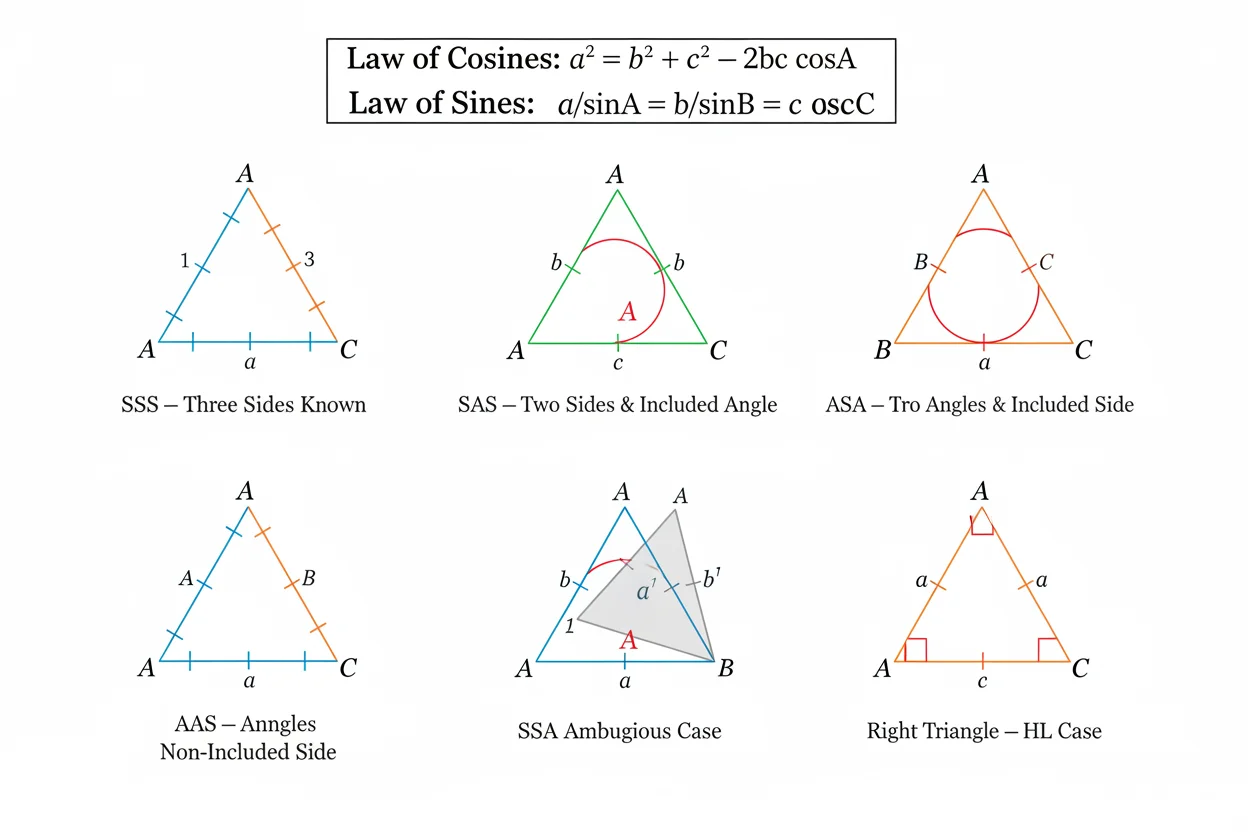
Triangle solving means determining the unknown side lengths and angle measures of a triangle from the information already given. A complete triangle has three sides and three interior angles, but only certain combinations of known measurements uniquely determine the remaining values. The main methods are the Pythagorean theorem for right triangles, trigonometric ratios for right-triangle sides and angles, the Law of Sines for matched side-angle information, and the Law of Cosines for SSS or SAS data. Before calculating, it is important to identify the known-data pattern: SSS, SAS, ASA, AAS, SSA, or a right-triangle case. The SSA case requires special care because it may produce zero, one, or two valid triangles. Every completed solution should satisfy the 180° angle sum, positive side lengths, and triangle inequalities.
Triangle Notation
For triangle ABC, standard notation pairs each side with the angle opposite it:
side a is opposite angle A
side b is opposite angle B
side c is opposite angle C
This correspondence is essential when using the Law of Sines or Law of Cosines.
The interior angles always satisfy:
A + B + C = 180°
Therefore, if two angles are known, the third is:
C = 180° − A − B
with equivalent rearrangements for A or B.
What Information Is Needed to Solve a Triangle?
A triangle is usually uniquely determined by one of these data sets:
SSS — three sides
SAS — two sides and their included angle
ASA — two angles and the included side
AAS — two angles and a nonincluded side
A right triangle can often be solved from even simpler information because one angle is already known:
90°
The SSA case is different because the given measurements may describe:
no triangle
exactly one triangle
two different triangles
This is the ambiguous case.
Triangle Inequality
Before solving an SSS triangle, verify that the side lengths can form a triangle.
For positive side lengths:
a + b > c
a + c > b
b + c > a
For example:
4, 7, 10
form a triangle because every pair sums to more than the remaining side.
But:
3, 4, 8
do not, because:
3 + 4 < 8
No ordinary nondegenerate triangle can have those side lengths.
Angle Sum Rule
The Interior Angles of every Euclidean triangle total:
180°
Suppose:
A = 48°
B = 67°
Then:
C = 180° − 48° − 67°
Therefore:
C = 65°
This rule is usually the first step in ASA or AAS problems.
Solving a Right Triangle
A Right Triangle contains:
one 90° angle
If the legs are a and b and the hypotenuse is c:
a² + b² = c²
The Pythagorean Theorem finds a missing side when two sides are known.
Trigonometric ratios find missing sides or acute angles:
sinθ = opposite/hypotenuse
cosθ = adjacent/hypotenuse
tanθ = opposite/adjacent
Right Triangle Example With Two Legs
Suppose:
a = 6
b = 8
Then:
c = √(6² + 8²)
= √100
Therefore:
c = 10
To find angle A opposite side 6:
sinA = 6/10
So:
A = sin⁻¹(0.6)
Approximately:
A ≈ 36.87°
The other acute angle is:
B = 90° − 36.87°
Therefore:
B ≈ 53.13°
The triangle is completely solved.
Right Triangle From One Side and One Acute Angle
Suppose:
c = 20
A = 30°
Then:
a = 20sin30°
= 10
and:
b = 20cos30°
= 10√3
The remaining angle is:
B = 60°
This is a 30-60-90 triangle.
SSS Triangle Solving
SSS means:
Side-Side-Side
All three side lengths are known.
The usual approach is:
first use the Law of Cosines to find the largest angle
then:
use the Law of Sines or Law of Cosines for another angle
finally:
use A + B + C = 180°
Finding the largest angle first reduces ambiguity because it lies opposite the largest side.
Law of Cosines
The Law of Cosines can be written:
a² = b² + c² − 2bc cosA
b² = a² + c² − 2ac cosB
c² = a² + b² − 2ab cosC
To find angle C:
cosC = (a² + b² − c²)/(2ab)
Therefore:
C = cos⁻¹[(a² + b² − c²)/(2ab)]
SSS Worked Example
Suppose:
a = 7
b = 9
c = 12
The largest side is:
c = 12
so find C first.
cosC = (7² + 9² − 12²)/(2·7·9)
= (49 + 81 − 144)/126
= −14/126
= −1/9
Therefore:
C = cos⁻¹(−1/9)
Approximately:
C ≈ 96.38°
Now use the Law of Sines:
sinA/7 = sin96.38°/12
So:
sinA = 7sin96.38°/12
Therefore:
A ≈ 35.43°
Finally:
B = 180° − 96.38° − 35.43°
Therefore:
B ≈ 48.19°
The solved triangle is approximately:
A = 35.43°
B = 48.19°
C = 96.38°
Check the SSS Solution
The largest side was:
12
and the largest angle is:
96.38°
That is consistent because larger sides lie opposite larger angles.
Angle sum:
35.43° + 48.19° + 96.38° = 180.00°
The result passes both checks.
SAS Triangle Solving
SAS means:
Side-Angle-Side
Two sides and the angle between them are known.
This uniquely determines a triangle.
Use the Law of Cosines first because the known angle is included between the two known sides.
After finding the third side, use the Law of Sines or another Law of Cosines equation.
SAS Worked Example
Suppose:
a = 8
b = 11
C = 52°
Find c:
c² = 8² + 11² − 2(8)(11)cos52°
= 64 + 121 − 176cos52°
Therefore:
c ≈ 8.75
Now use:
sinA/a = sinC/c
So:
sinA = 8sin52°/8.75
Therefore:
A ≈ 46.06°
Then:
B = 180° − 52° − 46.06°
Therefore:
B ≈ 81.94°
The completed triangle is approximately:
a = 8
b = 11
c = 8.75
A = 46.06°
B = 81.94°
C = 52°
Why SAS Uses Law of Cosines First
At the start of an SAS problem, no known side is paired with its opposite known angle.
That means the Law of Sines cannot initially form a complete ratio such as:
a/sinA
The Law of Cosines uses exactly the information SAS provides:
two sides and their included angle
Once the third side is known, additional methods become available.
ASA Triangle Solving
ASA means:
Angle-Side-Angle
Two angles and the side between them are known.
First find the third angle from:
A + B + C = 180°
Then use the Law of Sines.
Because two angles are known, the triangle’s shape is fixed, and the given side fixes its scale.
ASA Example
Suppose:
A = 50°
C = 70°
b = 12
First:
B = 180° − 50° − 70°
Therefore:
B = 60°
Now:
a/sin50° = 12/sin60°
Therefore:
a = 12sin50°/sin60°
Similarly:
c = 12sin70°/sin60°
Numerically:
a ≈ 10.62
c ≈ 13.02
The triangle is completely solved.
AAS Triangle Solving
AAS means:
Angle-Angle-Side
Two angles and a nonincluded side are known.
The procedure is almost identical to ASA:
- find the missing angle;
- pair the known side with its opposite angle;
- apply the Law of Sines.
Unlike SSA, AAS uniquely determines the triangle.
AAS Example
Suppose:
A = 35°
B = 75°
a = 10
Then:
C = 180° − 35° − 75°
Therefore:
C = 70°
Now:
b/sin75° = 10/sin35°
and:
c/sin70° = 10/sin35°
Both missing sides can be calculated directly.
SSA Triangle Solving
SSA means:
Side-Side-Angle
where the known angle is not between the two known sides.
This is the ambiguous case.
A sine equation can produce:
θ
and:
180° − θ
because:
sinθ = sin(180° − θ)
Both angles may produce valid triangles.
Why SSA Can Produce Two Triangles
Suppose the Law of Sines gives:
sinB = 0.8
One solution is:
B₁ = sin⁻¹(0.8)
Approximately:
B₁ ≈ 53.13°
But another angle has the same sine:
B₂ = 180° − 53.13°
Therefore:
B₂ ≈ 126.87°
If both satisfy:
A + B < 180°
then two different triangles are possible.
SSA Example With Two Possible Triangles
Suppose:
A = 30°
a = 7
b = 10
Use:
sinB/b = sinA/a
Then:
sinB = 10sin30°/7
= 5/7
The first solution is:
B₁ = sin⁻¹(5/7)
Approximately:
B₁ ≈ 45.58°
The second possibility is:
B₂ = 180° − 45.58°
Therefore:
B₂ ≈ 134.42°
Check the angle sums:
30° + 45.58° < 180°
and:
30° + 134.42° < 180°
So both are valid.
This data set produces:
two triangles
Complete the First SSA Triangle
For:
B₁ ≈ 45.58°
the third angle is:
C₁ = 180° − 30° − 45.58°
Therefore:
C₁ ≈ 104.42°
Use:
c₁/sinC₁ = 7/sin30°
So:
c₁ = 14sin104.42°
Approximately:
c₁ ≈ 13.56
Complete the Second SSA Triangle
For:
B₂ ≈ 134.42°
the third angle is:
C₂ = 180° − 30° − 134.42°
Therefore:
C₂ ≈ 15.58°
Then:
c₂ = 14sin15.58°
Approximately:
c₂ ≈ 3.76
The same initial SSA information therefore describes two geometrically different triangles.
SSA With No Triangle
The sine equation itself can reveal impossibility.
Suppose:
sinB = 1.2
No real angle has sine greater than 1.
Therefore:
no triangle exists
This can happen when the given side opposite the known angle is too short relative to another side.
SSA Height Test
For an acute known angle A, suppose:
side a is opposite A
side b is another known side
Calculate:
h = b sinA
Then, when b > a:
a < h → no triangle
a = h → one right triangle
h < a < b → two triangles
a ≥ b → one triangle
This is a useful geometric way to understand the ambiguous case.
SSA Height-Test Example
Suppose:
A = 30°
b = 10
Then:
h = 10sin30°
Therefore:
h = 5
If:
a = 4
there is no triangle.
If:
a = 5
there is one right triangle.
If:
a = 7
there are two triangles.
If:
a = 12
there is one triangle.
Law of Sines
The central relation is:
a/sinA = b/sinB = c/sinC
An equivalent reciprocal form is:
sinA/a = sinB/b = sinC/c
The Law of Sines is most useful when at least one complete opposite pair is known:
a and A
b and B
or:
c and C
Law of Cosines
The Law of Cosines is most useful for:
SSS
and:
SAS
It generalizes the Pythagorean theorem.
If:
C = 90°
then:
cos90° = 0
so:
c² = a² + b²
The right-triangle formula is therefore a special case.
Choosing Between Law of Sines and Law of Cosines
Use the Law of Sines when you have a known side-angle opposite pair.
Typical cases:
ASA
AAS
many SSA problems
Use the Law of Cosines when you have:
SSS
or:
SAS
A mixed problem may use both laws in sequence.
Avoiding the Sine Ambiguity After SSS or SAS
After finding one angle in an SSS or SAS problem, using inverse sine for another angle can sometimes create a supplementary-value concern.
One safe strategy is:
find the largest angle first with the Law of Cosines
Then use the angle sum for the final angle.
Alternatively, use the Law of Cosines again for another angle.
This prevents selecting an incorrect supplementary inverse-sine result.
Triangle Area During Solving
Triangle area can help verify or complete a solution.
The Triangle Area formulas include:
A = bh/2
A = ab sinC/2
and Heron’s formula:
A = √[s(s−a)(s−b)(s−c)]
where:
s = (a+b+c)/2
Different formulas should agree when enough information is available.
SAS Area Example
Suppose:
a = 8
b = 11
C = 52°
Then:
A = 8(11)sin52°/2
= 44sin52°
Approximately:
A ≈ 34.67
square units.
This area provides an additional consistency check on the solved triangle.
Heron’s Formula After SSS
For known sides:
a, b, c
calculate:
s = (a+b+c)/2
Then:
A = √[s(s−a)(s−b)(s−c)]
The specialist Heron Formula is especially useful when a height is not known.
Solving With an Altitude
A Triangle Altitudes construction can split a non-right triangle into two right triangles.
This allows:
sine
cosine
tangent
Pythagorean theorem
to be applied to the smaller pieces.
The method is particularly useful for isosceles triangles and geometric diagrams where an altitude is already shown.
Isosceles Triangle Example
Suppose an isosceles triangle has:
equal sides = 13
base = 10
The altitude from the apex bisects the base:
half-base = 5
Then:
h = √(13² − 5²)
= 12
Area:
A = 10(12)/2
Therefore:
A = 60
The base angles satisfy:
cosB = 5/13
and the apex angle can then be found from the angle sum.
Solving Equilateral Triangles
An equilateral triangle is already highly constrained:
a = b = c
and:
A = B = C = 60°
If one side is known, all sides and angles are known.
Its altitude is:
h = a√3/2
and area:
A_area = √3a²/4
No Law of Sines or Cosines is necessary unless used as verification.
45-45-90 Triangles
A 45-45-90 triangle has side ratio:
1 : 1 : √2
If one leg is x:
other leg = x
hypotenuse = x√2
These exact ratios can replace calculator-based trigonometry.
30-60-90 Triangles
A 30-60-90 triangle has side ratio:
1 : √3 : 2
If the shortest leg is x:
longer leg = x√3
hypotenuse = 2x
Recognizing these special triangles often simplifies triangle solving substantially.
Solving From Coordinates
If triangle vertices are given, the Distance Formula can produce the three side lengths:
d = √[(x₂−x₁)² + (y₂−y₁)²]
Once the sides are known, the problem becomes SSS.
Alternatively, slopes may reveal a right angle before any Law of Cosines calculation is needed.
Coordinate Triangle Example
Suppose:
A = (0,0)
B = (6,0)
C = (6,8)
Then:
AB = 6
BC = 8
The segments are horizontal and vertical, so they are perpendicular.
Therefore:
AC = 10
and the triangle is a:
6-8-10 right triangle
The remaining angles can be found from sine, cosine, or tangent.
Slope Test for a Right Angle
For two nonvertical lines with slopes:
m₁
and:
m₂
they are perpendicular when:
m₁m₂ = −1
Thus Slope can classify a coordinate triangle before other calculations.
Vertical and horizontal lines are also perpendicular.
Triangle Medians During Solving
A known Triangle Medians length can provide an additional side relationship.
For median mₐ:
mₐ = ½√(2b² + 2c² − a²)
This can supplement ordinary side-angle information when a median is part of the problem.
Triangle Incenter During Solving
The mapped Triangle Incenter can provide the inradius:
r = A/s
where:
s = (a+b+c)/2
If inradius and semiperimeter are known:
A = rs
This may supply the area needed to recover other dimensions.
Triangle Orthocenter During Solving
The mapped Triangle Orthocenter is the intersection of the altitudes.
Its location can immediately classify certain cases:
at a vertex → right triangle
inside → acute triangle
outside → obtuse triangle
The altitude lines can also provide perpendicular subtriangles for additional calculations.
Triangle Circumcenter During Solving
If circumradius R is known, the Triangle Circumcenter relationship:
a = 2R sinA
can determine sides from angles.
Equivalent form:
R = a/(2sinA)
This is the extended Law of Sines.
Unit Circle Connections
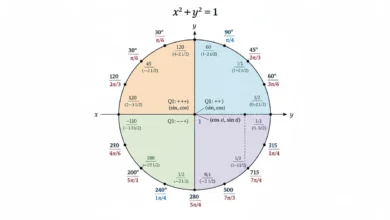
The mapped Unit Circle supplies exact sine and cosine values for familiar angles.
For example:
sin30° = 1/2
cos60° = 1/2
sin45° = cos45° = √2/2
Recognizing exact values can eliminate unnecessary decimal approximations.
Trigonometric Identities During Triangle Solving
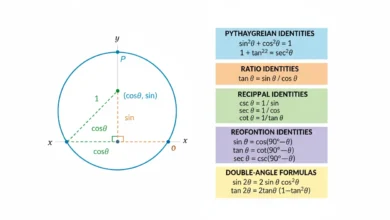
The mapped Trigonometric Identities page contains relationships such as:
sin²θ + cos²θ = 1
and:
1 + tan²θ = sec²θ
Within a right triangle, the first identity is another expression of the Pythagorean relationship between normalized side lengths.
Exterior Angles
A triangle exterior angle equals the sum of the two remote interior angles.
If exterior angle E is adjacent to interior angle C:
E + C = 180°
and:
E = A + B
This can provide missing angle information before applying a triangle-solving formula.
The broader Exterior Angles relationships are useful when diagrams supply outside rather than inside angles.
Angle Bisectors
The Angle Bisector Theorem states that if an internal angle bisector from A meets BC at D:
BD/DC = AB/AC
This can generate missing side segments before completing the triangle.
It is especially useful when the diagram contains a divided opposite side rather than a direct side length.
Congruence and Unique Solutions
Some data sets that solve a triangle also correspond to Congruent Triangles criteria.
SSS and SAS uniquely determine a triangle up to rigid motion and reflection.
ASA and AAS also determine the triangle uniquely.
SSA does not generally do so, which is exactly why its ambiguous case exists.
Similarity and Triangle Solving
When only angles are known:
AAA
the triangle’s shape is fixed but its size is not.
All triangles with the same three angles are Similar Triangles.
At least one side length is needed to establish the scale and obtain unique side lengths.
Why AAA Does Not Fully Solve a Triangle
Suppose:
A = 30°
B = 60°
C = 90°
Possible side sets include:
1, √3, 2
2, 2√3, 4
10, 10√3, 20
All have the same angles.
Therefore angle information alone determines ratios, not absolute side lengths.
Rounding Strategy
Avoid rounding intermediate values too aggressively.
If a side is:
8.754631…
keep several digits while calculating later angles.
Round only the final reported values unless the problem specifies otherwise.
Premature rounding can cause the final angle sum to appear inconsistent.
Degree and Radian Mode
Most elementary triangle-solving problems use degrees.
If an angle is shown as:
45°
the calculator must interpret it in degree mode.
If the angle is:
π/4
use radian mode.
The Degrees and Radians relationship is:
radians = degrees × π/180
Validity Checks After Solving
A completed triangle should satisfy several conditions.
First:
A + B + C = 180°
Second:
all side lengths > 0
Third:
every angle lies between 0° and 180°
Fourth:
triangle inequalities hold
Fifth:
larger sides lie opposite larger angles
These checks catch many calculation and labeling errors.
Largest Side and Largest Angle
In every triangle:
the largest side lies opposite the largest angle
and:
the smallest side lies opposite the smallest angle
Suppose:
a < b < c
Then:
A < B < C
A solved triangle violating this order is incorrect.
Common Triangle Solving Mistakes
A frequent mistake is pairing a side with the wrong opposite angle in the Law of Sines.
Another is using the Law of Sines first in an SAS case when no complete opposite pair is known.
For SSS, use the Law of Cosines rather than attempting to invent an angle.
In SSA problems, do not stop automatically after the principal inverse-sine result; check the supplementary angle.
Do not apply the Pythagorean theorem unless a right angle is known or established.
Make sure the included angle in an SAS problem lies between the two known sides.
Keep calculator mode consistent with degree or radian notation.
Finally, verify the completed angles total 180°.
Frequently Asked Questions
What does triangle solving mean?
It means finding unknown triangle sides and angles from known measurements.
What are the main triangle-solving cases?
SSS
SAS
ASA
AAS
SSA
plus right-triangle cases.
Which method is best for SSS?
Use the Law of Cosines first.
Which method is best for SAS?
Use the Law of Cosines first.
Which method is best for ASA?
Find the third angle, then use the Law of Sines.
Which method is best for AAS?
Find the third angle, then use the Law of Sines.
Why is SSA special?
It can produce zero, one, or two triangles.
What is the Law of Sines?
a/sinA = b/sinB = c/sinC
What is the Law of Cosines?
For example:
c² = a² + b² − 2ab cosC
How do you solve a right triangle?
Use the Pythagorean theorem and sine, cosine, or tangent as appropriate.
What do triangle angles add to?
180°
How do you check whether three sides form a triangle?
Verify all triangle inequalities.
Why should the largest angle often be found first in SSS?
It reduces the risk of choosing an incorrect supplementary inverse-sine value later.
Can three angles alone solve all side lengths?
No. AAA determines shape but not scale.
How can I check a completed triangle?
Verify the 180° angle sum, triangle inequalities, positive measurements, and the matching order of side and angle sizes.