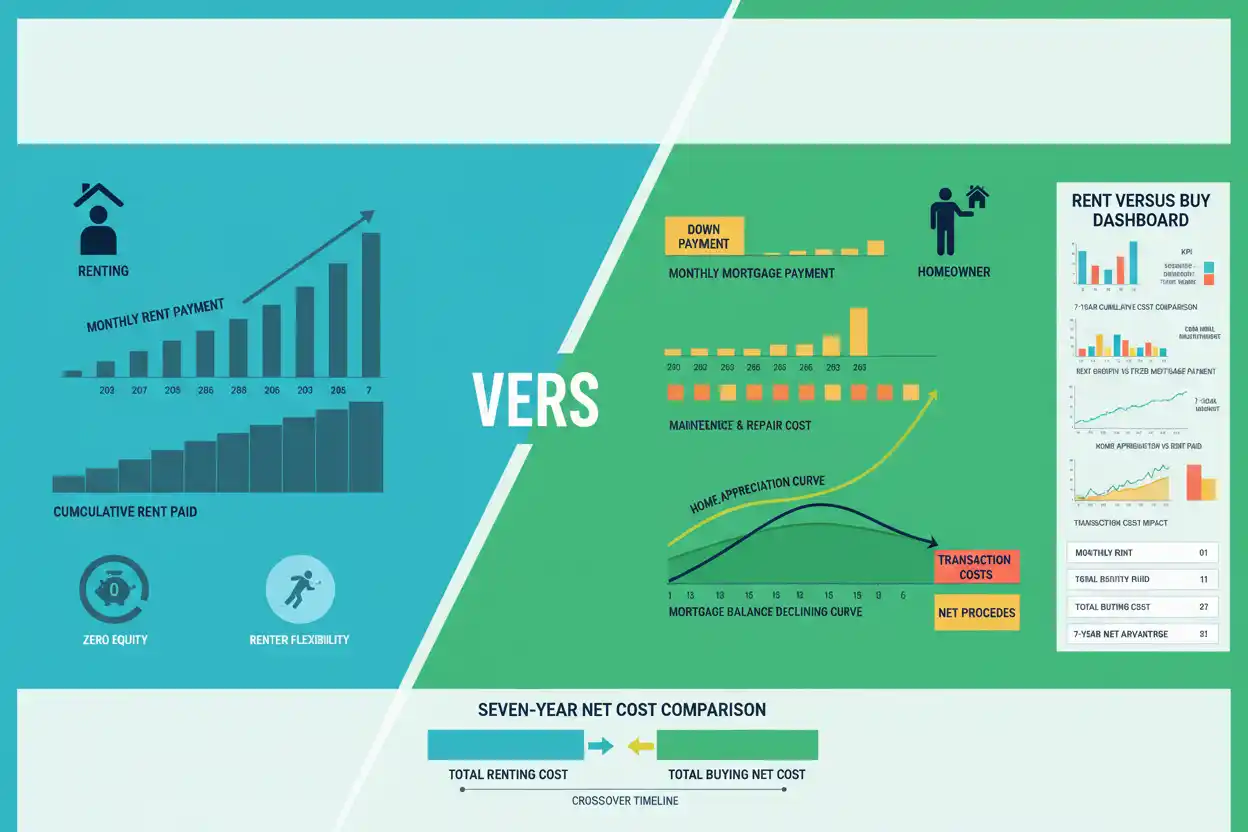

Renting vs buying is not simply a comparison between monthly rent and a mortgage payment.
A useful long-term comparison includes the complete economic cost of each choice.
For renting, that can include rent increases and renter-specific costs.
For buying, it can include the down payment, mortgage interest, property taxes, insurance, maintenance, transaction costs, and the equity recovered when the property is eventually sold.
A simplified ownership-cost formula is:
Net Ownership Cost = Down Payment + Buying Costs + Ownership Cash Outflows − Net Sale Proceeds
For renting:
Net Renting Cost = Total Rent Paid + Renter Costs − Investment Gains on Capital Not Used to Buy
The assumptions matter enormously. CFPB specifically cautions that rent-versus-buy calculators depend on assumptions such as future home-price growth and that changing those assumptions can materially change the result.
Renting vs Buying Example
Suppose you are choosing between:
Renting a comparable home for:
$2,400 per Month
or buying a:
$500,000 Home
Assume for the buying scenario:
Down payment = $100,000
Mortgage = $400,000
Mortgage rate = 6.5%
Mortgage term = 30 years
Property taxes = $6,000 per year
Homeowners insurance = $1,800 per year
Illustrative maintenance budget = $5,000 per year
Buyer closing costs = $15,000
Holding period = 7 years
For comparison, assume:
Rent increases = 3% annually
Home appreciation = 3% annually
Selling costs = 6% of eventual sale price
These percentages are assumptions for the example—not predictions or universal costs.
Mortgage Payment
A standard fixed-rate mortgage uses:
Monthly Payment = P × [r(1 + r)ⁿ] ÷ [(1 + r)ⁿ − 1]
For:
$400,000 at 6.5% for 30 years
monthly principal and interest are approximately:
$2,528.27
The fixed-rate mortgage payment is therefore already slightly higher than the starting $2,400 rent.
However, comparing those two numbers alone would be incomplete.
Monthly Ownership Cost
Add:
Property taxes:
$6,000 ÷ 12 = $500
Homeowners insurance:
$1,800 ÷ 12 = $150
Illustrative maintenance reserve:
$5,000 ÷ 12 ≈ $416.67
Initial estimated monthly ownership cash requirement:
$2,528.27 + $500 + $150 + $416.67
≈ $3,594.94
That excludes utilities and any HOA because those can apply differently to both rented and owned properties.
The home affordability calculation should use the complete ownership budget rather than principal and interest alone.
Seven Years of Rent
Starting rent:
$2,400 per Month
Assuming 3% annual increases, monthly rent becomes approximately:
Year 1: $2,400
Year 2: $2,472
Year 3: $2,546.16
Year 4: $2,622.54
Year 5: $2,701.22
Year 6: $2,782.26
Year 7: $2,865.73
Total rent paid over seven years is approximately:
$220,678.91
At the end of the period, the renter does not own the property.
However, the renter also did not have to commit the same down payment and buyer closing costs.
Mortgage Balance After Seven Years
The mortgage amortization schedule gradually reduces the $400,000 mortgage.
After 84 scheduled payments:
Remaining Mortgage Principal ≈ $361,664.98
Principal repaid:
$400,000 − $361,664.98
≈ $38,335.02
This principal reduction creates homeowner equity.
The rest of the mortgage payments largely consist of mortgage interest.
Home Value After Seven Years
Assuming 3% annual appreciation:
Future Home Value = $500,000 × (1.03)⁷
≈ $614,936.93
Again, 3% is an illustrative assumption.
Property values can rise more slowly, rise faster, remain flat, or decline.
CFPB specifically identifies falling property values as a financial risk of homeownership.
Estimated Selling Costs
Assuming illustrative selling costs equal 6%:
Selling Costs = $614,936.93 × 6%
≈ $36,896.22
Net proceeds before mortgage payoff:
$614,936.93 − $36,896.22
≈ $578,040.72
Subtract the estimated mortgage payoff amount represented by the simplified remaining principal:
$578,040.72 − $361,664.98
≈ $216,375.74
Actual sale proceeds require the lender’s exact payoff quote and real transaction expenses.
Seven-Year Ownership Cash Outflow
Down payment:
$100,000
Buyer closing costs:
$15,000
Mortgage P&I over 84 months:
$2,528.27 × 84
≈ $212,374.86
Property taxes:
$6,000 × 7 = $42,000
Insurance:
$1,800 × 7 = $12,600
Maintenance assumption:
$5,000 × 7 = $35,000
Total illustrative cash outflow:
≈ $416,974.86
Subtract net proceeds from the sale:
$416,974.86 − $216,375.74
≈ $200,599.12
Under these assumptions, the seven-year net ownership cost is approximately:
$200,599
compared with:
$220,679 of Rent
Buying appears ahead by roughly:
$20,080
before opportunity cost and several other possible differences are considered.
Opportunity Cost Can Reverse the Result
The buyer committed:
Down payment = $100,000
Buying costs = $15,000
Total initial cash:
$115,000
Suppose a renter kept and invested that $115,000 instead and earned an illustrative 5% annually.
After seven years:
Future Value = $115,000 × (1.05)⁷
≈ $161,816.55
Investment gain:
≈ $46,816.55
If that gain is included while all other assumptions remain unchanged, the rent-versus-buy comparison changes significantly.
This is why a serious calculation should include the opportunity cost of savings & investing capital.
Transaction Costs Favor Longer Holding Periods
Buying and selling real estate can create substantial transaction costs.
CFPB notes that moving again within only a few years can make buying risky and expensive because homeowners can face taxes, commissions, and other transaction expenses.
That generally means:
Short Holding Period → Renting Often Becomes More Competitive
while:
Longer Holding Period → Upfront Ownership Costs Have More Time to Be Spread Across Years
The exact break-even period depends on the assumptions.
Renting Provides Flexibility
Renting generally makes it easier to move when:
employment changes, family needs change, or another location becomes more attractive.
The renter normally avoids direct exposure to major property repairs and property-value declines.
CFPB highlights both mobility and the transfer of many property risks to the landlord as important differences between renting and owning.
Buying Builds Equity
A homeowner can build equity through:
principal repayment and property appreciation.
Suppose after seven years:
Home value ≈ $614,937
Mortgage ≈ $361,665
Gross equity:
$614,936.93 − $361,664.98
≈ $253,271.95
That does not mean the homeowner receives $253,272 after selling because transaction costs must still be deducted.
Down Payment Changes the Comparison
A larger down payment reduces the mortgage and therefore lowers:
monthly principal and interest, total mortgage interest, and loan-to-value ratio.
However, it also commits more cash to the property.
That increases the opportunity cost of money that could have remained invested elsewhere.
PMI Can Change the Result
A buyer making less than 20% down on an applicable conventional mortgage can face private mortgage insurance.
Suppose PMI adds:
$200 per Month
for five years.
Additional cost:
$200 × 60
$12,000
That can materially shift the renting-versus-buying comparison.
Refinancing Can Change Ownership Cost
Future refinancing can lower mortgage costs if rates become favorable enough to justify the transaction.
However, refinancing can also introduce:
new closing costs and a new repayment period.
The possibility of refinancing should not simply be assumed as guaranteed future savings.
Rate-and-Term Refinance
A rate-and-term refinance can be especially relevant in a long holding period.
If the homeowner reduces the rate without increasing debt materially, long-term ownership costs can fall.
The result still depends on refinance break-even.
VA Mortgage Example
For an eligible borrower, VA mortgages can change the buying side of the comparison because VA-backed loans can offer no-down-payment financing and no monthly mortgage insurance, although a funding fee can apply unless the borrower is exempt.
Different mortgage programs therefore require different rent-versus-buy inputs.
Reverse Mortgages Are a Different Stage of Ownership
A reverse mortgage is not a normal alternative for someone deciding whether to rent or buy a first home.
Instead, it is a later-stage home-equity financing structure for eligible older homeowners.
It belongs in the ownership lifecycle but should not be included as though it were an ordinary purchase mortgage.
Maintenance Is Uncertain
Maintenance is one of the hardest ownership costs to model.
A newly built property can require little major work for several years.
An older home can unexpectedly need:
a roof, HVAC system, plumbing repair, structural work, or major appliance replacement.
Therefore, a flat annual maintenance percentage should always be labeled as an assumption.
Rent Growth Is Also Uncertain
Assuming rent rises 3% every year creates a clean example.
Actual rent can:
increase faster, stay unchanged, decrease, or change sharply when the renter moves.
A renter in a rent-regulated market can have a very different outcome from a renter in a rapidly growing market.
Home Appreciation Is the Most Sensitive Variable
Change the appreciation assumption and the ownership result can move dramatically.
For example:
3% annual appreciation creates an estimated $614,937 home value after seven years.
At 0%:
Home Value = $500,000
At 5%:
Home Value ≈ $703,550
That difference dominates many smaller assumptions.
This is why CFPB recommends testing multiple scenarios rather than relying on one forecast.
Frequently Asked Questions
Is renting always cheaper than buying?
No. The outcome depends on rent, home price, mortgage terms, holding period, appreciation, maintenance, transaction costs, and alternative investment returns.
Is a mortgage payment comparable directly with rent?
Not completely. A mortgage payment contains principal repayment, while homeowners also face other ownership expenses.
Does mortgage principal count as a cost?
Principal is better viewed as converting cash into home equity rather than a pure expense.
What are the biggest ownership costs?
Mortgage interest, transaction costs, property taxes, insurance, maintenance, and opportunity cost can all be important.
Does home appreciation make buying automatically better?
No. Appreciation is uncertain, and selling costs and financing costs still matter.
Why does holding period matter?
Buying and selling involve transaction costs that become harder to recover over a short period.
Should investment returns be included?
Yes, if you want a more complete economic comparison of capital that would otherwise have been used for a down payment.
Does PMI affect renting vs buying?
Yes. PMI increases the ownership side of the calculation.
Does a larger down payment always make buying better?
Not necessarily. It lowers mortgage costs but increases the amount of cash tied up in the home.
Should maintenance be included?
Yes. Owners bear repair and maintenance risk directly.
Should I assume home prices always rise?
No.
What is the best way to compare renting vs buying?
Run several scenarios using realistic holding periods, rent growth, home appreciation, financing costs, maintenance, and opportunity-cost assumptions.
Final Takeaway
Renting vs buying is a long-term capital-allocation decision—not a comparison between two monthly payments.
In the seven-year example:
Total rent paid:
≈ $220,679
Illustrative net ownership cost after eventual sale:
≈ $200,599
Under those assumptions, buying appears ahead by roughly:
$20,080
But the renter’s unused $115,000 of initial capital could itself generate substantial investment returns.
At an illustrative 5% annual return, its gain after seven years is approximately:
$46,817
That is enough to change the conclusion.
The correct answer therefore depends on holding period, mortgage rate, rent growth, home appreciation, maintenance, transaction costs, equity growth, and the return available on capital that does not go into the house.