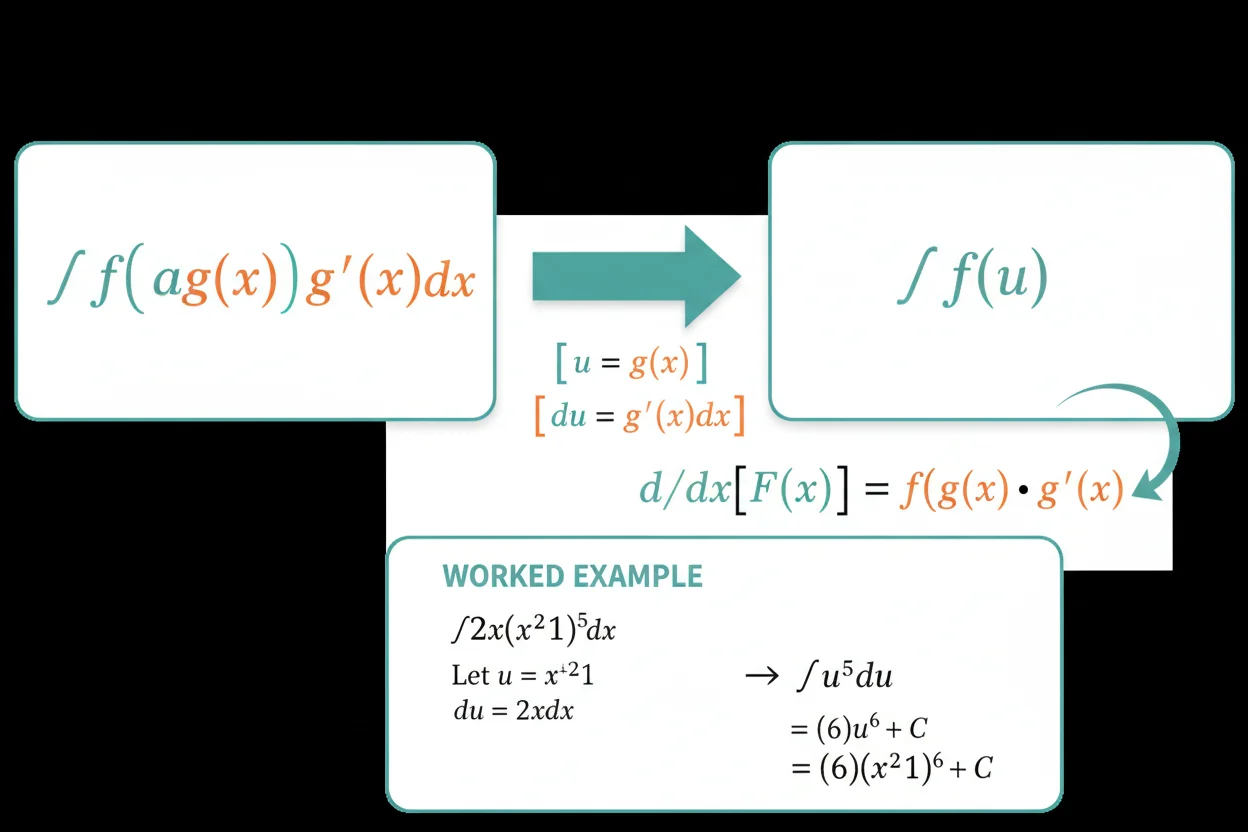
Integration by substitution is a technique for simplifying integrals by replacing a complicated expression with a new variable. It is most effective when an integrand contains a composite function together with the derivative, or a constant multiple of the derivative, of its inner expression. If u = g(x), then du = g′(x) dx, allowing an integral of the form ∫f(g(x))g′(x) dx to become ∫f(u) du. The method can therefore be understood as reversing the chain rule. After evaluating an indefinite integral in u, substitute the original expression back before adding the final constant of integration. For a definite integral, the bounds can instead be converted from x-values to u-values, avoiding the need to return to x before endpoint evaluation. Successful substitution depends on replacing the entire integral consistently rather than changing only part of the expression. The method is one of the most frequently used tools in calculus because many apparently complicated integrals reduce to basic power, logarithmic, exponential, or trigonometric forms after an appropriate change of variable.
What Is Integration by Substitution?
Suppose an integral has the form:
∫f(g(x))g′(x) dx
Choose:
u = g(x)
Then:
du = g′(x) dx
The integral becomes:
∫f(u) du
This simpler integral can be evaluated using ordinary rules.
Afterward, for an indefinite integral, replace u with g(x).
This is the basic structure of integration by substitution.
The method is closely connected to the chain rule, which states that differentiating a composite function multiplies by the derivative of its inner expression.
Integration by Substitution Formula
If:
u = g(x)
then:
du = g′(x) dx
So:
∫f(g(x))g′(x) dx = ∫f(u) du
If:
F′(u) = f(u)
then:
∫f(u) du = F(u) + C
Substitute back:
∫f(g(x))g′(x) dx = F(g(x)) + C
This is substitution in its cleanest form.
Basic Example
Evaluate:
∫2x(x² + 5)⁴ dx
The inner expression is:
x² + 5
Its derivative is:
2x
which is also present in the integrand.
Choose:
u = x² + 5
Then:
du = 2x dx
The integral becomes:
∫u⁴ du
Apply the power rule for integration:
∫u⁴ du = u⁵/5 + C
Substitute back:
∫2x(x² + 5)⁴ dx = (x² + 5)⁵/5 + C
Differentiate the result to confirm that it returns the original integrand.
Why Substitution Reverses the Chain Rule
Suppose:
F′(u) = f(u)
and:
u = g(x)
The chain rule gives:
d/dx[F(g(x))] = f(g(x))g′(x)
Therefore reversing this differentiation gives:
∫f(g(x))g′(x) dx = F(g(x)) + C
Integration by substitution packages this reverse-chain-rule structure into a systematic method.
The technique is therefore not an arbitrary change of symbols; it reflects the composition structure of the integrand.
How to Choose u
Look for an inner expression whose derivative also appears elsewhere in the integrand.
Common candidates include:
expressions inside powers
expressions inside square roots
denominators
exponents
logarithm arguments
trigonometric arguments
The ideal substitution transforms every x-dependent part of the integral into u and du.
If x remains after the substitution and cannot be expressed naturally in terms of u, the choice may not be useful.
Example: Linear Inner Function
Evaluate:
∫(3x + 4)⁵ dx
Choose:
u = 3x + 4
Then:
du = 3 dx
so:
dx = du/3
Substitute:
∫(3x + 4)⁵ dx = (1/3)∫u⁵ du
Integrate:
= u⁶/18 + C
Replace u:
∫(3x + 4)⁵ dx = (3x + 4)⁶/18 + C
Example: Exponential Composite
Evaluate:
∫4e^(4x) dx
Choose:
u = 4x
Then:
du = 4 dx
The integral becomes:
∫eᵘ du
Therefore:
eᵘ + C
Substitute back:
∫4e^(4x) dx = e^(4x) + C
If the factor 4 were not present, it could be introduced algebraically:
∫e^(4x) dx = (1/4)∫4e^(4x) dx
= e^(4x)/4 + C
Constant Multiples of du
The derivative of the inner expression does not need to appear exactly.
Suppose:
∫x(x² + 1)⁷ dx
Choose:
u = x² + 1
Then:
du = 2x dx
so:
x dx = du/2
The integral becomes:
(1/2)∫u⁷ du
Therefore:
= u⁸/16 + C
Substitute back:
∫x(x² + 1)⁷ dx = (x² + 1)⁸/16 + C
Recognizing constant-factor differences is an essential substitution skill.
Example With a Square Root
Evaluate:
∫x/√(x² + 4) dx
Choose:
u = x² + 4
Then:
du = 2x dx
so:
x dx = du/2
The integral becomes:
(1/2)∫u⁻¹ᐟ² du
Integrate:
(1/2)(2u¹ᐟ²) + C
= √u + C
Therefore:
∫x/√(x² + 4) dx = √(x² + 4) + C
Example With a Denominator
Evaluate:
∫2x/(x² + 3) dx
Choose:
u = x² + 3
Then:
du = 2x dx
So:
∫2x/(x² + 3) dx = ∫1/u du
The logarithmic rule gives:
ln|u| + C
Since:
x² + 3 > 0
for real x, we can write:
ln(x² + 3) + C
Therefore:
∫2x/(x² + 3) dx = ln(x² + 3) + C
General Logarithmic Pattern
A common substitution pattern is:
∫g′(x)/g(x) dx
Let:
u = g(x)
Then:
du = g′(x) dx
Therefore:
∫g′(x)/g(x) dx = ∫1/u du
So:
∫g′(x)/g(x) dx = ln|g(x)| + C
This pattern is worth recognizing directly.
For example:
∫5/(5x − 2) dx
gives:
ln|5x − 2| + C
because the denominator’s derivative is 5.
Trigonometric Substitution Example
Evaluate:
∫sin x cos³x dx
Choose:
u = cos x
Then:
du = −sin x dx
so:
sin x dx = −du
The integral becomes:
−∫u³ du
Therefore:
−u⁴/4 + C
Substitute back:
∫sin x cos³x dx = −cos⁴x/4 + C
Differentiate to verify:
d/dx[−cos⁴x/4]
= −(1/4)(4cos³x)(−sin x)
= sin x cos³x
Another Trigonometric Example
Evaluate:
∫sec²(5x) dx
Choose:
u = 5x
Then:
du = 5 dx
so:
dx = du/5
Therefore:
∫sec²(5x) dx = (1/5)∫sec²u du
Since:
∫sec²u du = tan u
we obtain:
∫sec²(5x) dx = tan(5x)/5 + C
Substitution With a Power of a Logarithm
Evaluate:
∫(ln x)³/x dx
Choose:
u = ln x
Then:
du = 1/x dx
The integral becomes:
∫u³ du
Therefore:
u⁴/4 + C
Substitute back:
∫(ln x)³/x dx = (ln x)⁴/4 + C
for x > 0.
This is another direct reverse-chain-rule pattern.
Indefinite Integration by Substitution
For an indefinite integral, the standard workflow is:
choose u
calculate du
rewrite the full integral
integrate with respect to u
substitute back into x
include +C
For example:
∫6x²(x³ + 2)⁴ dx
Choose:
u = x³ + 2
Then:
du = 3x² dx
so:
6x² dx = 2du
The integral becomes:
2∫u⁴ du
= 2u⁵/5 + C
Therefore:
∫6x²(x³ + 2)⁴ dx
= 2(x³ + 2)⁵/5 + C
Definite Integration by Substitution
For a definite integral, there are two valid approaches.
You may perform the substitution, integrate in u, substitute x back, and then use the original x-bounds.
Or you can transform the bounds themselves into u-values and remain entirely in u.
The second approach is often cleaner.
The important rule is not to use u-integrands with x-bounds.
Example: Changing the Bounds
Evaluate:
∫₀¹ 2x/(x² + 1) dx
Choose:
u = x² + 1
Then:
du = 2x dx
Transform the bounds.
When:
x = 0
we have:
u = 1
When:
x = 1
we have:
u = 2
So:
∫₀¹ 2x/(x² + 1) dx
becomes:
∫₁² 1/u du
Evaluate:
[ln u]₁²
= ln 2 − ln 1
= ln 2
Therefore:
∫₀¹ 2x/(x² + 1) dx = ln 2
Why Changed Bounds Are Useful
Once the bounds have been converted from x to u, there is no reason to substitute x back.
For example:
∫₁² 1/u du
should simply be evaluated with u = 1 and u = 2.
Returning to x and then using u-bounds mixes variables unnecessarily.
Changing the limits consistently keeps the transformed integral self-contained.
Example: Definite Integral With a Power
Evaluate:
∫₀¹ 3x²(x³ + 1)² dx
Choose:
u = x³ + 1
Then:
du = 3x² dx
Change the bounds:
x = 0 → u = 1
x = 1 → u = 2
Therefore:
∫₀¹ 3x²(x³ + 1)² dx
= ∫₁² u² du
= [u³/3]₁²
= 8/3 − 1/3
= 7/3
Substitution and the Fundamental Theorem
After substitution has simplified a proper definite integral, the Fundamental Theorem Of Calculus evaluates the transformed antiderivative at the new endpoints.
The two ideas have different roles.
Substitution changes variables to make the antiderivative easier to find.
The fundamental theorem converts that antiderivative into a definite accumulated value.
Substitution With eᵍ⁽ˣ⁾
A useful general pattern is:
∫g′(x)e^(g(x)) dx
Let:
u = g(x)
Then:
du = g′(x) dx
So:
∫g′(x)e^(g(x)) dx = ∫eᵘ du
Therefore:
∫g′(x)e^(g(x)) dx = e^(g(x)) + C
For example:
∫2xe^(x²) dx = e^(x²) + C
This follows immediately from recognizing the inner derivative.
Substitution With Trigonometric Compositions
Consider:
∫cos(3x + 1) dx
Choose:
u = 3x + 1
Then:
du = 3 dx
so:
dx = du/3
Therefore:
∫cos(3x + 1) dx
= (1/3)∫cos u du
= (1/3)sin u + C
Substitute back:
∫cos(3x + 1) dx = sin(3x + 1)/3 + C
Substitution With Reciprocal Powers
Evaluate:
∫x/(x² + 1)² dx
Choose:
u = x² + 1
Then:
du = 2x dx
so:
x dx = du/2
The integral becomes:
(1/2)∫u⁻² du
Integrate:
(1/2)(−u⁻¹) + C
Therefore:
∫x/(x² + 1)² dx
= −1/[2(x² + 1)] + C
Substitution After Algebraic Simplification
Sometimes the substitution pattern is hidden until the integrand is simplified.
For example:
∫(2x² + 2x)/(x³ + 3x²/2 + 4) dx
would not automatically yield a useful substitution unless the numerator is proportional to the derivative of the denominator.
Before choosing u, differentiate likely inner expressions mentally and compare them with the remaining factors.
Algebraic simplification can reveal whether the structure actually matches.
Substitution and the Power Rule
After substitution, many integrals reduce to the ordinary power rule in reverse.
For example:
∫2x(x² + 5)⁴ dx
becomes:
∫u⁴ du
The difficult-looking composite structure disappears, leaving a simple power.
Substitution therefore often acts as a bridge between a composite integrand and a basic antiderivative rule.
Substitution Versus Integration by Parts
Integration by parts is generally better suited to products such as:
xeˣ
x sin x
x ln x
where differentiating one factor simplifies the product.
Substitution is generally better suited to compositions such as:
2x(x² + 1)⁵
cos(4x)
x/(x² + 3)
The distinction can be summarized as:
substitution reverses composition
parts reverses multiplication under differentiation
Some advanced integrals require both methods.
Example Requiring Parts After Substitution
Consider:
∫x³e^(x²) dx
Write:
x³ dx = x²(x dx)
Choose:
u = x²
Then:
du = 2x dx
so:
x dx = du/2
and:
x² = u
Therefore:
∫x³e^(x²) dx
= (1/2)∫u eᵘ du
The transformed integral now requires integration by parts:
∫u eᵘ du = ueᵘ − eᵘ + C
Therefore:
∫x³e^(x²) dx
= (1/2)e^(x²)(x² − 1) + C
This example shows that substitution can simplify the composition even when another technique is still needed afterward.
Substitution and Partial Fractions
A rational integral may sometimes become simpler through substitution, but a purely rational expression with a factorable denominator may instead call for partial fraction integration.
For example:
∫1/[(x + 1)(x + 2)] dx
has no obvious inner derivative structure that simplifies the entire expression through substitution.
Breaking it into simpler rational terms is more natural.
Technique choice depends on structure rather than appearance alone.
Substitution and Improper Integrals
Substitution can be used in an improper integral, but convergence still requires the appropriate limiting definition.
For example:
∫₀∞ 2xe^(−x²) dx
Choose:
u = x²
Then:
du = 2x dx
and the transformed bounds are:
x = 0 → u = 0
x → ∞ → u → ∞
So:
∫₀∞ 2xe^(−x²) dx
= ∫₀∞ e^(−u) du
Evaluate through a limit:
lim as b → ∞ of ∫₀ᵇ e^(−u) du
= lim as b → ∞ of [−e^(−u)]₀ᵇ
= 1
Substitution simplifies the integrand, while the improper limit establishes convergence.
Substitution and Limits
When an endpoint is infinite or approaches a singularity, the transformed endpoint must be determined using a limit.
For example, if:
u = x²
then:
x → ∞
implies:
u → ∞
In more complicated substitutions, transformed endpoint behavior should be calculated rather than guessed.
The broader behavior of limits supports these variable transformations when endpoints are not ordinary finite numbers.
Integration by Substitution and Antiderivatives
The purpose of substitution is to make an antiderivative easier to recognize.
For:
∫f(g(x))g′(x) dx
the substitution:
u = g(x)
reveals:
∫f(u) du
Once an antiderivative F(u) is known:
F(g(x)) + C
is the resulting family in the original variable.
This is why differentiating the final result is such a strong verification method.
Example: Verify by Differentiation
Suppose:
∫3x² cos(x³) dx = sin(x³) + C
Differentiate:
d/dx[sin(x³)]
Apply the chain rule:
= cos(x³)(3x²)
Therefore:
= 3x² cos(x³)
The original integrand is recovered exactly.
This confirms that the substitution calculation is correct.
Substitution and Differentials
The notation:
du = g′(x) dx
expresses the differential change associated with:
u = g(x)
The broader idea of differentials explains why this notation naturally captures local changes under a change of variable.
In routine substitution, it provides a compact way to identify which part of the integrand is replaced by du.
The replacement must still be mathematically consistent across the entire integral.
What if x Remains After Substitution?
Suppose you choose:
u = g(x)
but the transformed integral still contains unrelated x terms.
That often means the substitution was incomplete or poorly chosen.
Sometimes those remaining terms can be rewritten in terms of u.
For example, if:
u = x²
then:
x² = u
so powers of x² can be replaced.
But if an awkward x remains with no useful relation to u, reconsider the substitution.
A successful change of variable should leave one integration variable.
Multiple Substitutions
Some complicated integrals can be simplified through more than one substitution in sequence.
For instance, one substitution may remove a square root or composite expression, after which another standard pattern becomes visible.
However, repeated changes of variable should simplify the integral at each stage.
If every substitution merely produces another equally complicated expression, the original technique may not be appropriate.
Substitution in Differential Equations
Integration by substitution may appear while solving differential equations.
For example, a separable equation can produce integrals whose variables must be evaluated independently.
Likewise, a first-order linear differential equation may produce an integral involving an integrating factor and a composite expression.
Substitution then serves as the integration step; it is not itself the differential-equation solution classification.
Substitution in Multivariable Calculus
Change of variables becomes even more important in multivariable calculus.
For a double integral, changing coordinates requires an additional area-scaling factor such as a Jacobian.
The elementary one-variable formula:
du = g′(x) dx
is the simplest form of this broader change-of-variables principle.
The detailed geometry of multidimensional substitutions belongs to multiple integration rather than ordinary u-substitution.
Substitution and Continuity
Standard substitution works most smoothly on intervals where the relevant functions and derivatives behave appropriately.
The continuity and monotonic behavior of a substitution can matter when transforming definite bounds or interpreting inverse changes of variable.
Routine elementary examples usually satisfy these conditions automatically, but domain restrictions should not be ignored when logarithms, roots, or singular denominators are involved.
Common Mistakes
A common mistake is choosing:
u = g(x)
but failing to calculate:
du = g′(x) dx
The derivative is what connects the old and new integration variables.
Another error is changing only the inner expression while leaving dx unchanged even though a constant factor is required.
For definite integrals, transformed u-bounds must not be paired with an x-integrand or vice versa.
Students may also substitute back into x and then accidentally keep the transformed u-bounds.
Another frequent error is forcing substitution when the derivative of the chosen inner expression is not represented anywhere in the integrand.
Finally, a correct-looking substitution result should still be differentiated whenever practical. The chain rule immediately exposes missing constant factors.
Frequently Asked Questions
What is integration by substitution?
Integration by substitution simplifies an integral by replacing an inner expression with a new variable, usually so that a composite integrand becomes a standard integral.
What is the basic substitution formula?
If:
u = g(x)
and:
du = g′(x) dx
then:
∫f(g(x))g′(x) dx = ∫f(u) du
Why does substitution work?
It reverses the chain rule for differentiation.
How do I choose u?
Look for an inner expression whose derivative appears elsewhere in the integrand, possibly multiplied by a constant.
What if the derivative differs by a constant?
Adjust the integral algebraically. For example, if du = 2x dx but the integral contains x dx, then:
x dx = du/2
Do I substitute x back for an indefinite integral?
Yes. After integrating in u, replace u with the original x-expression and include +C.
Do I need to substitute x back for a definite integral?
Not if you convert the original x-bounds to corresponding u-bounds. You can evaluate entirely in u.
Can I use x-bounds after changing the integrand to u?
No. The bounds and integration variable must be consistent.
What is the difference between substitution and integration by parts?
Substitution primarily reverses the chain rule. Integration by parts reverses the product rule.
Can substitution and integration by parts be used in the same problem?
Yes. One method may simplify the integral enough for the other method to finish it.
Can substitution be used for improper integrals?
Yes, but convergence must still be handled through the appropriate limiting process, and improper endpoints must be transformed consistently.
How can I check a substitution answer?
Differentiate the final antiderivative. The chain rule should reproduce the original integrand exactly.