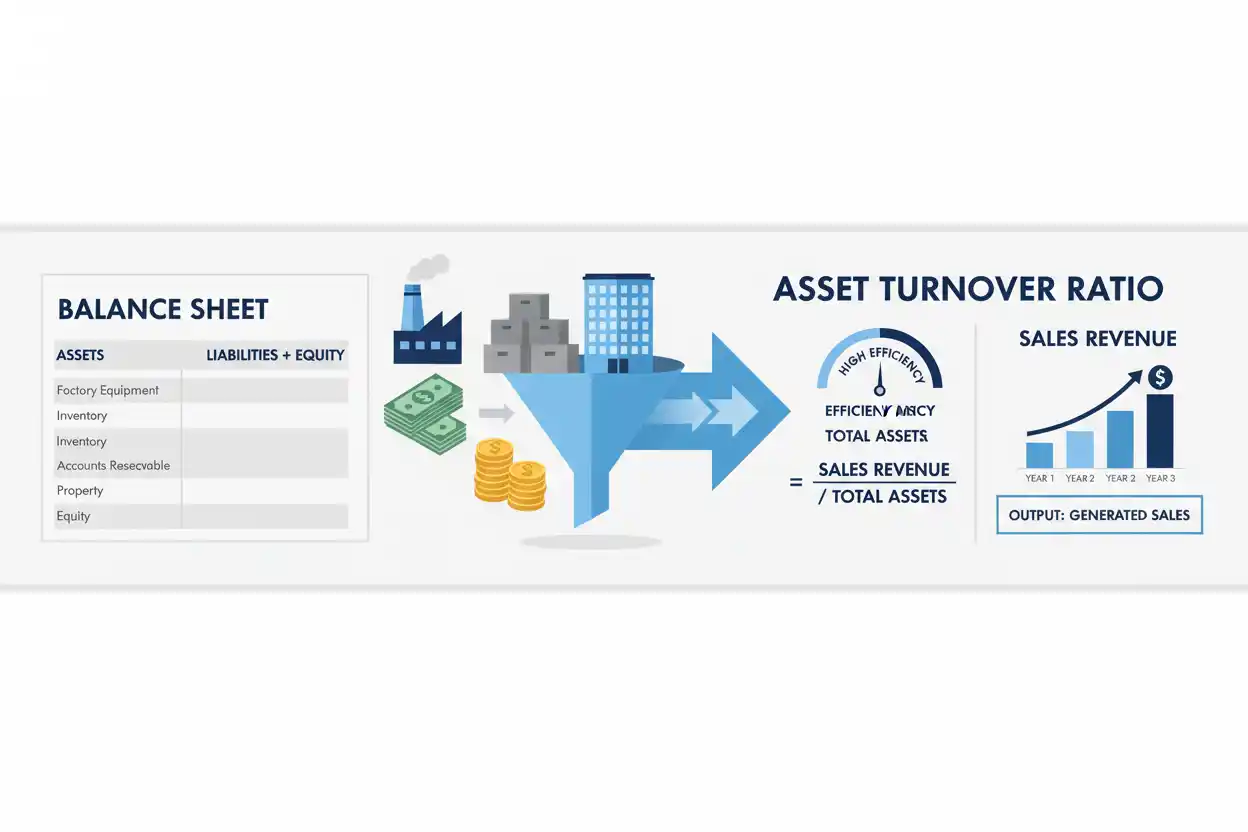
Asset turnover measures how efficiently a business uses its assets to generate revenue. It compares sales over a period with the average value of the company’s assets during that period.
A higher asset turnover generally means the company produces more revenue for each dollar invested in assets. A lower ratio means more assets are required to support the same amount of revenue. However, neither result is automatically good or bad because asset requirements differ substantially between industries.
A retailer, for example, may generate large sales from a relatively modest asset base. A utility, manufacturer, telecommunications operator, or transportation company may require expensive infrastructure before it can produce revenue. That makes asset turnover most useful when comparing similar companies or tracking the same business over time.
Asset turnover belongs within the broader discipline of business finance, where operating efficiency, profitability, liquidity, cash flow, and capital structure need to be interpreted together.
What Is Asset Turnover?
Asset turnover is an efficiency ratio that compares a company’s net sales or revenue with its average total assets.
The ratio answers a straightforward question:
How much revenue does the business generate for every dollar of assets it employs?
If a company has an asset turnover ratio of 2.0, it generated approximately $2 in revenue during the period for every $1 of average assets used in the calculation.
If another company has a ratio of 0.6, it generated $0.60 of revenue for every $1 of average assets.
That does not automatically make the first company financially stronger. The first business may operate in an asset-light industry, while the second could own factories, warehouses, power infrastructure, aircraft, or other capital-intensive assets.
Asset turnover measures revenue efficiency, not profitability.
Asset Turnover Formula
The standard calculation uses revenue in the numerator and average total assets in the denominator.
Asset Turnover = Net Sales or Revenue ÷ Average Total Assets
Average assets are commonly calculated from beginning and ending balance-sheet values.
Average Total Assets = (Beginning Total Assets + Ending Total Assets) ÷ 2
Therefore, the complete calculation can be written as:
Asset Turnover = Revenue ÷ [(Beginning Total Assets + Ending Total Assets) ÷ 2]
Using average assets helps align the balance-sheet denominator with revenue earned over the entire reporting period.
Revenue is measured across a period, while total assets represent financial position at a specific date. Relying only on year-end assets can distort the relationship when the asset base changed significantly during the year.
Asset Turnover Example
Suppose a company reports:
Beginning total assets of $800,000, ending total assets of $1,000,000, and annual revenue of $1,800,000.
First calculate average assets.
Average Total Assets = ($800,000 + $1,000,000) ÷ 2
Average Total Assets = $900,000
Now divide revenue by average assets.
Asset Turnover = $1,800,000 ÷ $900,000
Asset Turnover = 2.0
The company therefore generated $2 of annual revenue for every $1 of average assets represented in the calculation.
This does not mean the company earned $2 of profit from each dollar of assets. Revenue still has to cover direct costs, operating expenses, financing costs, taxes, and other economic requirements.
That distinction is why asset turnover should be considered alongside measures such as gross margin, net profit, and return on assets.
What Does a High Asset Turnover Mean?
A relatively high asset turnover means revenue is large compared with the company’s average asset base.
Several operating characteristics can produce that result. The company may use equipment intensively, manage inventory efficiently, collect receivables quickly, outsource asset-heavy activities, lease rather than own some operating resources, or simply operate in an inherently asset-light industry.
Consider a service company that earns $5 million of annual revenue while maintaining average assets of $1 million.
Asset Turnover = $5,000,000 ÷ $1,000,000 = 5.0
The company generates $5 of revenue for each $1 of average assets.
A high ratio can indicate efficient asset utilization, but it should not be interpreted in isolation. Assets may also be unusually old and heavily depreciated, which lowers their book value and mechanically raises the ratio. A company could also generate high sales while earning very thin margins.
For that reason, operational efficiency should ultimately be connected with profitability and cash generation.
What Does a Low Asset Turnover Mean?
A low asset turnover means the company carries a relatively large asset base compared with the revenue it generates.
This can occur because the business is inherently capital intensive. It can also reflect underused equipment, excessive inventory, weak sales, recently purchased capacity, slow expansion, inefficient working capital, or assets that have not yet begun generating their expected revenue.
Suppose a manufacturer has $10 million of average assets and $7 million of revenue.
Asset Turnover = $7,000,000 ÷ $10,000,000 = 0.70
The manufacturer produces $0.70 of revenue for every dollar of average assets.
That number alone does not establish inefficiency. A comparison with prior years, direct competitors, industry economics, capacity utilization, and profitability provides much more information.
A new production facility, for instance, might increase assets immediately while revenue takes several years to reach planned capacity. Asset turnover could temporarily decline even though management expects the investment to create substantial future value.
Asset Turnover Is Not a Profit Margin
Asset turnover and profit margin answer different questions.
Asset turnover asks how efficiently the company generates sales from assets. Profit margin asks how much profit remains from sales after specified costs.
A company can therefore have high asset turnover and low margins.
Imagine a retailer with $10 million in revenue and $5 million of average assets.
Asset Turnover = $10,000,000 ÷ $5,000,000 = 2.0
If the business earns only $200,000 of net profit:
Net Profit Margin = $200,000 ÷ $10,000,000 × 100 = 2%
The company turns its asset base over efficiently in revenue terms but retains only a small amount of each revenue dollar as profit.
Another company might have lower asset turnover but significantly higher margins.
This interaction between margin and asset efficiency becomes particularly important when studying return on assets and broader ROI analysis.
Asset Turnover and Return on Assets
Asset turnover and return on assets use similar financial information but measure different outcomes.
Asset turnover compares revenue with assets.
Asset Turnover = Revenue ÷ Average Total Assets
Return on assets compares profit with assets.
Return on Assets = Net Income ÷ Average Total Assets
Suppose a company generates $2 million of revenue from $1 million of average assets and earns $100,000 of net income.
Asset Turnover = $2,000,000 ÷ $1,000,000 = 2.0
Return on Assets = $100,000 ÷ $1,000,000 = 10%
The first figure describes sales efficiency. The second describes profitability relative to assets.
This distinction prevents a common analytical mistake: assuming that generating more sales from assets necessarily creates a superior financial return.
Asset Turnover and the DuPont Framework
Asset turnover becomes particularly useful when profitability and efficiency are analyzed together.
A simplified form of the DuPont relationship breaks return on assets into net profit margin and asset turnover.
Return on Assets = Net Profit Margin × Asset Turnover
Using the previous example:
5% Net Profit Margin × 2.0 Asset Turnover = 10% Return on Assets
This reveals two fundamentally different ways a business might improve its return on assets.
One company might increase margins by improving pricing or controlling costs. Another might produce more revenue from the same asset base. A third might improve both.
The framework also explains why comparing asset turnover alone can be misleading. Businesses often operate with different combinations of margins and asset intensity.
What Assets Are Included?
Standard total asset turnover generally uses all assets reported in the relevant balance-sheet total.
Depending on the business and its accounting, assets may include cash, accounts receivable, inventory, property, equipment, intangible assets, investments, and other recognized resources.
Because total asset turnover is deliberately broad, analysts sometimes use narrower ratios when investigating a particular part of the balance sheet.
Inventory turnover examines how efficiently inventory moves through operations. Receivables turnover focuses on customer credit and collections. Fixed asset turnover concentrates on property, plant, equipment, and other qualifying fixed assets.
These narrower ratios diagnose the components that can influence the broader asset turnover result.
Why Use Average Total Assets?
Using average assets is generally preferable because the numerator represents activity across a period.
Suppose a company starts the year with $2 million of assets and acquires another $2 million of assets near year-end.
Ending assets would be approximately $4 million before considering other changes. If annual revenue is divided exclusively by $4 million, the analysis effectively treats the additional assets as though they had been available throughout the entire year.
Using beginning and ending values gives a simple approximation of the asset base available over the period.
Average Assets = (Beginning Assets + Ending Assets) ÷ 2
However, even this method can become imperfect when asset levels fluctuate substantially during the year. Monthly or quarterly average balances can provide a more representative denominator when detailed information is available.
Should Net Sales or Total Revenue Be Used?
The numerator should follow the financial information being analyzed and remain consistent between periods or companies.
For companies reporting net sales, analysts commonly use that amount. For companies using revenue terminology, revenue may be the appropriate numerator.
The important requirement is comparability.
Changing between gross sales, net sales, or another revenue measure without understanding the difference can create an apparent improvement or deterioration that comes from accounting presentation rather than operating performance.
Consistency is particularly important when analyzing a multi-year trend.
Asset Turnover Over Time
One period gives a snapshot. Several periods reveal direction.
Assume a company’s asset turnover changes as follows:
Year 1: 1.4
Year 2: 1.6
Year 3: 1.9
The rising ratio indicates that revenue increased relative to average assets.
Management should then determine why.
Perhaps sales increased without substantial additional investment. Maybe unused facilities became productive. Inventory management improved. Receivables fell. Alternatively, older assets may have continued depreciating without replacement, reducing reported book value.
The ratio identifies the change; deeper financial analysis identifies the cause.
If the company also experiences stronger free cash flow and improved profitability, the trend may carry more economic significance than asset turnover alone suggests.
Why Industry Comparisons Matter
Asset intensity differs dramatically among business models.
A consulting firm can generate revenue largely through employee expertise, software, and relatively limited physical assets. A manufacturing company may require production facilities, machinery, inventory, vehicles, and warehouses.
Comparing their asset turnover ratios without considering those structural differences provides little analytical value.
Meaningful benchmarking usually involves competitors with comparable operating models.
Even within the same industry, however, differences in accounting policy, leasing arrangements, acquisition history, outsourcing, asset age, geography, and business mix can affect reported assets.
Industry comparison is therefore a starting point rather than an automatic verdict.
Asset Turnover and Inventory
Inventory can represent a substantial portion of total assets for retailers, wholesalers, and manufacturers.
When inventory grows faster than sales, total assets rise and asset turnover may decline.
That might indicate excess stock, slower demand, an intentional inventory build, supply-chain protection, seasonal purchasing, or preparation for expansion.
The broader ratio cannot identify which explanation applies.
For inventory-intensive businesses, inventory turnover and days inventory outstanding can provide more precise information.
This illustrates an important principle of financial analysis: start with the broad signal, then investigate the financial component responsible for it.
Asset Turnover and Accounts Receivable
Receivables also affect the asset base.
When customers take longer to pay, accounts receivable may increase. Higher receivables raise total assets and can contribute to weaker asset turnover if revenue does not increase proportionally.
However, the greater concern may be liquidity rather than asset efficiency itself.
Receivables turnover evaluates how effectively a business converts credit sales into collections, while days sales outstanding translates collection performance into an approximate number of days.
Those metrics also connect with the company’s cash conversion cycle and working capital.
Asset Turnover and Fixed Assets
Capital-intensive businesses often devote much of their balance sheets to property, plants, equipment, infrastructure, or specialized machinery.
In these cases, total asset turnover can be supplemented with fixed asset turnover.
Fixed Asset Turnover = Revenue ÷ Average Net Fixed Assets
This narrower ratio asks how effectively the business generates revenue from its fixed operating asset base.
A falling fixed asset turnover ratio after a major expansion may simply indicate that new capacity has not yet reached normal utilization. If the decline persists while expected revenue never arrives, the investment deserves closer examination.
Capital expenditure should therefore be considered together with operating capacity and free cash flow.
How Depreciation Can Affect Asset Turnover
Asset turnover uses accounting asset values, which can change even if the physical productive capacity of a business remains similar.
Depreciation reduces the carrying amount of many long-lived assets over time. As net book values decline, the denominator may become smaller.
If revenue remains stable, a shrinking denominator can cause asset turnover to rise.
That means an older asset base can sometimes appear more efficient than a newly invested asset base solely because of differences in accounting carrying values.
When comparing businesses, analysts should therefore consider asset age, recent capital expenditure, acquisitions, and depreciation policy.
A higher ratio is most meaningful when it reflects genuine operating productivity rather than only a smaller accounting denominator.
Asset Turnover After an Acquisition
Acquisitions can substantially change the ratio.
When a company buys another business, assets may increase immediately. Depending on timing and accounting treatment, the acquired business may contribute only part of a year’s revenue during the first reporting period.
Asset turnover can consequently fall after an acquisition even if management expects the deal to improve future performance.
Good analysis separates temporary transaction effects from persistent operating changes.
The same reasoning applies to major plant construction, new stores, warehouse expansion, fleet purchases, or other capacity investments.
Asset Turnover and Working Capital Efficiency
Total assets include operating resources that may be tied up in the working-capital cycle.
Excess inventory, slow customer collections, or other inefficient current-asset balances can increase the denominator without producing proportional sales growth.
A business experiencing deteriorating asset turnover should therefore examine its current ratio and quick ratio for liquidity context, but those ratios answer different questions.
Liquidity ratios ask whether short-term resources are sufficient relative to short-term obligations.
Asset turnover asks whether the company’s assets are producing revenue efficiently.
A company may have strong liquidity but weak asset utilization, or high asset utilization but limited liquidity.
Asset Turnover and Debt
Debt does not appear directly in the asset turnover formula.
Nevertheless, the way assets are financed can materially affect business risk.
Two companies might own comparable assets and generate comparable revenue, resulting in similar asset turnover. Yet one may have financed those assets primarily with equity while the other carries substantial borrowing.
Their efficiency ratio may look similar even though their financial risk differs.
This is why asset turnover should be reviewed alongside debt-to-equity ratio, financial leverage, and cash-flow capacity.
Efficiency cannot compensate indefinitely for a capital structure the business cannot support.
Can Asset Turnover Be Too High?
A very high ratio is not automatically ideal.
It may indicate excellent utilization, but it can also suggest that a business is operating with insufficient capacity or delaying necessary investment.
Equipment may be stretched beyond sustainable levels. Stores may require refurbishment. Technology infrastructure may need upgrading. Inventory may be kept so lean that product availability suffers.
A company that maximizes short-term asset turnover by avoiding productive investment could damage long-term competitiveness.
The goal is therefore not to maximize the ratio mechanically. It is to use assets efficiently while maintaining the capacity required for sustainable operations.
How to Improve Asset Turnover
Improving asset turnover requires either generating more revenue from the existing asset base, reducing assets that are not producing adequate economic value, or some combination of the two.
A business with unused productive capacity may focus on increasing sales without major additional investment. A company carrying obsolete inventory may improve inventory management. Faster collection of receivables can reduce balance-sheet assets and improve liquidity at the same time.
Management may also dispose of idle equipment, consolidate facilities, improve production scheduling, or reconsider assets that do not support expected returns.
However, selling productive assets solely to increase a financial ratio can be counterproductive.
The proper objective is better economic use of resources, not cosmetic improvement in the calculation.
Asset Turnover vs Inventory Turnover
These ratios are related but not interchangeable.
Asset turnover uses the entire asset base and revenue.
Asset Turnover = Revenue ÷ Average Total Assets
Inventory turnover isolates inventory and commonly compares it with cost of goods sold.
Inventory Turnover = Cost of Goods Sold ÷ Average Inventory
Asset turnover evaluates broad business efficiency. Inventory turnover evaluates how quickly inventory moves through the operating cycle.
A retailer with weak total asset turnover may discover that excess inventory is the primary cause. Another company may have efficient inventory but excessive fixed assets.
The narrower ratio helps diagnose the broader result.
Asset Turnover vs Working Capital Turnover
Working capital turnover examines sales relative to net working capital rather than total assets.
Working Capital Turnover = Revenue ÷ Average Working Capital
Because working capital is generally based on current assets minus current liabilities, this ratio focuses on short-term operating capital.
Asset turnover covers a much wider asset base.
The two measures can therefore move differently and should not be treated as substitutes.
Asset Turnover vs Return on Investment
Return on investment evaluates financial return relative to the amount invested under the particular ROI definition being used.
Asset turnover does not measure return. It measures sales generated from assets.
A company can produce impressive revenue relative to its assets while generating a poor return if costs consume most of that revenue.
Conversely, an asset-heavy business may generate less revenue per dollar of assets but earn attractive margins and strong cash flows.
The appropriate measure depends on the question being asked.
Common Asset Turnover Mistakes
The most common error is treating a higher ratio as universally better. Industry economics make that assumption unreliable.
A second mistake is using ending assets rather than average assets without considering whether the balance sheet changed substantially during the year.
Another problem arises when analysts compare companies using inconsistent revenue definitions or overlook major acquisitions and capital expenditures.
Depreciation can also distort comparisons between companies with old and new asset bases.
Finally, asset turnover should never be used as a substitute for profitability, liquidity, leverage, or cash-flow analysis. It provides one dimension of operating efficiency.
How to Analyze Asset Turnover Properly
Begin with the company’s current ratio and compare it with its own historical performance.
Then examine comparable businesses with similar operating models.
If the ratio changed materially, investigate both sides of the formula. Determine whether revenue changed, assets changed, or both changed at different rates.
Next, identify which asset categories drove the movement. Inventory, receivables, acquisitions, fixed assets, and cash balances may each tell a different story.
Finally, connect the result with profitability and cash generation. Improving asset efficiency matters most when it contributes to sustainable economic performance rather than merely changing an accounting ratio.
Frequently Asked Questions
What is asset turnover?
Asset turnover is an efficiency ratio that measures revenue relative to average total assets. It indicates how much sales activity a company generates from its asset base.
What is the asset turnover formula?
Asset Turnover = Revenue ÷ Average Total Assets
Average total assets are commonly calculated using beginning and ending asset balances.
How do you calculate average total assets?
Average Total Assets = (Beginning Total Assets + Ending Total Assets) ÷ 2
More frequent average balances can be used when asset levels fluctuate significantly during the period.
What does an asset turnover ratio of 2 mean?
A ratio of 2.0 means the company generated approximately $2 of revenue during the period for every $1 of average assets included in the calculation.
Is a high asset turnover good?
A high ratio can indicate efficient asset utilization, but it is not automatically good. Industry structure, profitability, asset age, capacity requirements, and accounting values should also be considered.
Is a low asset turnover bad?
Not necessarily. Capital-intensive industries naturally require more assets. A temporary decline can also follow investment in new capacity before that capacity generates its expected revenue.
Can asset turnover be negative?
Revenue and total assets are normally positive, so conventional asset turnover is generally not negative. Unusual accounting circumstances should be investigated rather than interpreted mechanically.
Is asset turnover the same as return on assets?
No. Asset turnover compares revenue with average assets. Return on assets compares earnings with average assets. One measures sales efficiency; the other measures profitability relative to assets.
Does depreciation affect asset turnover?
Yes. Depreciation can reduce the carrying value of fixed assets over time. A smaller asset denominator can increase the ratio even if physical operating efficiency has not changed.
Why are average assets used?
Revenue represents activity across an entire reporting period, while a balance sheet reports assets at a particular date. Average assets provide a better approximation of resources employed throughout the period.
What is a good asset turnover ratio?
There is no universal benchmark. A meaningful ratio depends on industry, business model, asset intensity, accounting treatment, and historical performance.
How can a company improve asset turnover?
A company can increase sales from its existing assets, reduce idle or unproductive assets, improve inventory management, collect receivables more efficiently, or improve utilization of productive capacity. Changes should make economic sense rather than simply improve the ratio.
Final Perspective
Asset turnover reveals how much revenue a company generates from the resources recorded on its balance sheet.
Its calculation is simple:
Asset Turnover = Revenue ÷ Average Total Assets
Its interpretation is not.
A higher ratio can reflect stronger utilization, an asset-light business model, an older depreciated asset base, or insufficient investment. A lower ratio can indicate inefficiency, but it can also result from necessary infrastructure, newly installed capacity, or strategic expansion.
For that reason, asset turnover is most useful when examined across time, against genuinely comparable businesses, and alongside profitability, cash flow, working capital, and leverage.
The ratio should help explain how effectively assets support sales, not serve as a standalone score for whether a company is financially strong.