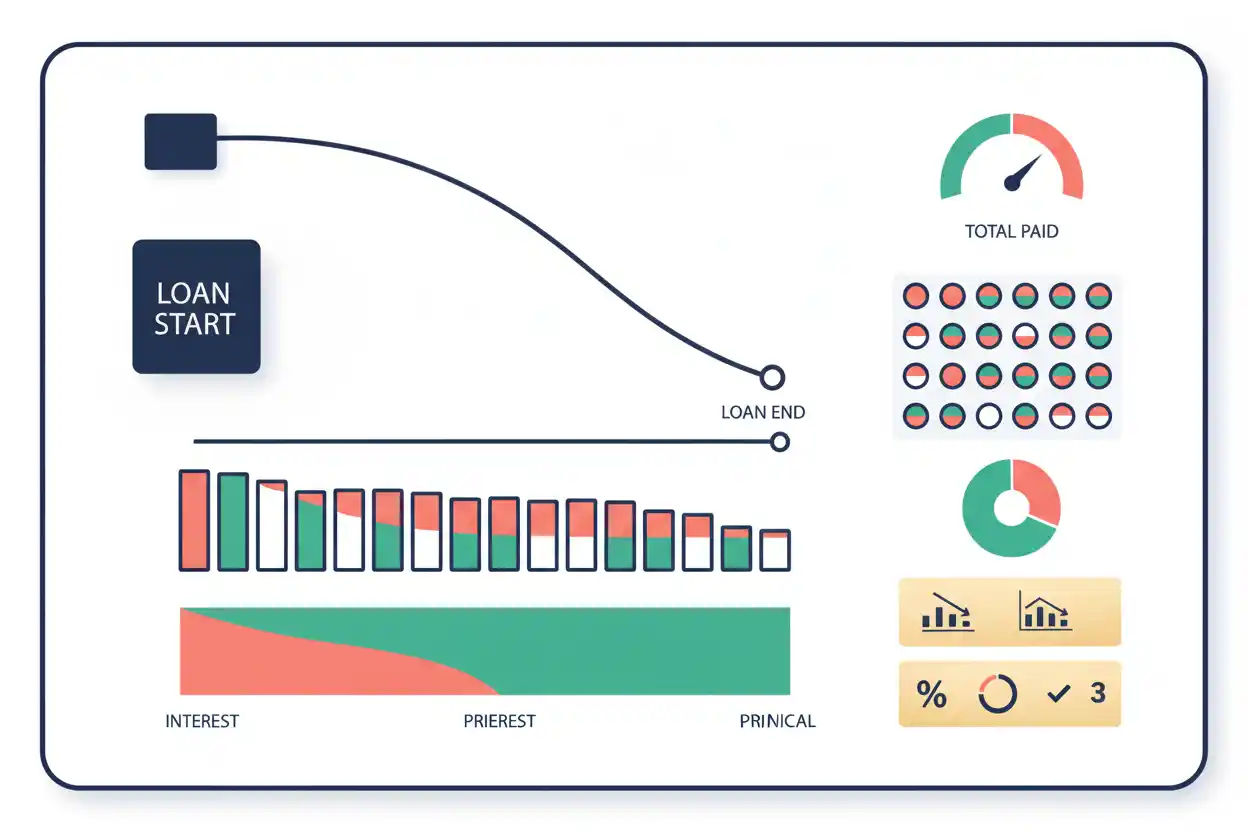

An amortizing loan is a loan designed so scheduled payments gradually repay both interest and principal over time.
With a fully amortizing fixed-rate loan, making every scheduled payment according to the agreed terms reduces the balance to approximately zero by the end of the repayment period.
The payment may remain constant even though its composition changes. Early payments normally contain more interest because the outstanding principal is larger. Later payments contain less interest and more principal as the balance declines.
What Is an Amortizing Loan?
Amortization means systematically paying down a debt over time.
CFPB mortgage guidance describes amortization as paying off a loan through regular payments so the amount owed decreases, while each payment commonly allocates part to principal and part to interest.
A standard amortizing loan therefore connects four core variables:
principal, interest rate, payment frequency, and loan term.
The principal balance falls as scheduled principal is paid.
Meanwhile, accrued interest determines the financing cost attributable to the relevant balance and period.
Amortizing Loan Formula
For a conventional fixed-rate loan with equal periodic payments:
Payment = P × [r(1 + r)^n] ÷ [(1 + r)^n − 1]
where:
P = original principal
r = periodic interest rate
n = total number of payments
If the annual nominal rate is 7.2% and payments occur monthly:
Monthly Rate = 7.2% ÷ 12 = 0.6%
If the term is four years:
Number of Payments = 4 × 12 = 48
These inputs can then be inserted into the formula.
Amortizing Loan Example
Suppose a borrower takes a $20,000 loan with:
Annual interest rate = 7.2%
Term = 4 years
Payments = monthly
First calculate the monthly rate:
r = 7.2% ÷ 12 = 0.6% = 0.006
Then calculate the number of payments:
n = 4 × 12 = 48
Now use the payment formula:
Payment = $20,000 × [0.006(1.006)^48] ÷ [(1.006)^48 − 1]
The monthly payment is approximately:
Payment ≈ $480.78
The borrower therefore makes approximately 48 payments of $480.78, subject to final-payment rounding and the actual loan agreement.
First Payment: Interest and Principal
The first month’s interest is:
Interest = Outstanding Principal × Monthly Rate
Interest = $20,000 × 0.006
Interest = $120.00
Now determine how much of the $480.78 payment reduces principal:
Principal Paid = $480.78 − $120.00
Principal Paid = $360.78
The new balance is:
New Balance = $20,000 − $360.78
New Balance = $19,639.22
Second Payment
The second month’s interest uses the smaller balance:
Interest = $19,639.22 × 0.006
Interest ≈ $117.84
Principal paid is:
Principal Paid = $480.78 − $117.84
Principal Paid ≈ $362.94
The balance becomes approximately:
New Balance = $19,639.22 − $362.94
New Balance ≈ $19,276.28
Even though the payment remains about $480.78, slightly more of it goes toward principal in the second month.
That shift continues throughout a conventional fixed-rate amortization schedule.
Amortization Schedule
A simplified opening portion of the schedule looks like this:
| Payment | Beginning Balance | Payment | Interest | Principal | Ending Balance |
|---|---|---|---|---|---|
| 1 | $20,000.00 | $480.78 | $120.00 | $360.78 | $19,639.22 |
| 2 | $19,639.22 | $480.78 | $117.84 | $362.94 | $19,276.28 |
A full repayment schedule extends this calculation through every payment period.
Total Interest on the Example Loan
Ignoring minor final-payment rounding:
Total Payments = $480.78 × 48
Total Payments ≈ $23,077.44
Then:
Total Interest ≈ $23,077.44 − $20,000
Total Interest ≈ $3,077.44
Using full precision before rounding each displayed payment produces a figure of approximately $3,077.58.
The difference illustrates why financial calculations should preserve precision internally and round only at appropriate stages.
Why Interest Is Higher at the Beginning
Interest is calculated from a larger outstanding principal early in the loan.
Suppose the monthly rate is 0.6%.
At a $20,000 balance:
Monthly Interest = $20,000 × 0.6% = $120
At a $10,000 balance:
Monthly Interest = $10,000 × 0.6% = $60
At a $5,000 balance:
Monthly Interest = $5,000 × 0.6% = $30
As the balance shrinks, less interest is generated at the same periodic rate.
Fully Amortizing vs Partially Amortizing Loans
A fully amortizing loan is structured so scheduled payments repay the balance by the end of the term.
A partially amortizing loan can leave a remaining balance due at maturity.
That remaining amount may need to be paid as a balloon payment, refinanced, or otherwise settled.
Therefore, seeing the word “amortization” does not automatically guarantee that the balance reaches zero before maturity.
Amortizing Loan vs Interest-Only Loan
In a standard amortizing loan, scheduled payments reduce principal.
With an interest-only structure, required payments during the interest-only period may not reduce principal.
For example:
Principal = $100,000
Annual rate = 6%
A simplified monthly interest-only payment is:
Interest-Only Payment = $100,000 × 6% ÷ 12
Interest-Only Payment = $500
If principal remains $100,000, the borrower still owes that principal later.
An amortizing payment would be higher because it includes scheduled principal repayment.
Amortizing Loan vs Simple Interest Loan
These labels describe different aspects of a loan.
A simple interest loan describes how interest is calculated.
An amortizing loan describes how the balance is scheduled to be repaid.
A loan can therefore use simple-interest calculations while also amortizing through scheduled payments.
Amortizing Loan vs Compound Interest Loan
A compound interest loan involves interest becoming part of the base used for future interest under the applicable structure.
Ordinary amortization does not require unpaid interest to compound.
In a properly performing standard amortizing loan, scheduled payments generally satisfy the interest due and reduce principal.
How Loan Term Changes the Payment
Keeping principal and interest rate constant, a longer term generally reduces the required periodic payment.
However, it also keeps principal outstanding for longer.
Suppose a borrower chooses between a 36-month and 60-month structure.
The 60-month loan may appear easier to afford monthly, but the borrower should also compare total interest.
This is why loan term should be evaluated alongside payment rather than independently.
How the Interest Rate Changes Amortization
A higher rate increases the interest generated by the outstanding balance.
That generally increases the required payment for a fixed term.
It also changes the principal-interest composition of each payment.
The difference between fixed vs variable interest rate structures becomes especially important when the periodic rate can change during repayment.
APR and Amortizing Loans
The note rate used in the payment formula should not automatically be assumed to equal APR.
APR is an annualized credit-cost measure that can reflect applicable finance charges, while the contractual interest rate determines interest according to the loan terms.
A loan can therefore have:
Note rate = 7.2%
APR = 7.8%
while still calculating its scheduled principal-and-interest payment from the contractual rate and financed balance.
Auto Loans
Many auto loan payments are based on amortizing structures.
However, payment timing, daily-interest calculations, fees, financed add-ons, and other contract terms can affect actual cost.
The separate auto loan APR calculation addresses annualized borrowing cost rather than simply reproducing the amortization formula.
Business Loans
A business loan payment can also use amortization, although commercial structures vary widely.
Some loans amortize monthly.
Others use seasonal schedules, interest-only periods, balloon payments, or variable rates.
Therefore, the standard fixed-payment formula should only be used when its assumptions match the actual loan.
Personal Loans
Many personal loan payments use fixed installments across a stated term.
When origination fees apply, the cash actually received can differ from the principal amount used to calculate scheduled payments.
This is why the personal loan APR can be more informative for cost comparison than payment alone.
Extra Principal Payments
Suppose the contractual payment is $480.78 but the borrower voluntarily pays an extra $100 directly toward principal each month when permitted.
The principal falls faster.
Because future interest is calculated from a smaller balance in a conventional declining-balance structure, total interest and repayment time can fall.
The actual treatment depends on how the lender applies the extra payment.
Early Payoff
An amortization schedule estimates the balance at scheduled payment dates.
A real loan payoff quote can differ because interest may accrue between the latest scheduled payment and the requested payoff date.
Borrowers should therefore obtain the actual payoff figure rather than simply using the principal shown on an older schedule.
Negative Amortization
Negative amortization is the opposite of ordinary balance reduction.
If a required payment is insufficient to cover interest and unpaid interest is added to principal, the balance can rise even though payments are being made. CFPB consumer guidance identifies this as negative amortization.
A normal fully amortizing fixed-payment loan is structured to avoid that result when payments are made according to schedule.
EMI and Amortization
EMI stands for equated monthly installment and is a common term for a fixed monthly loan payment.
The underlying mathematical formula is closely related to the standard amortizing-loan payment equation.
However, the EMI page owns the term-specific calculation, while this article focuses on the broader amortization structure.
Common Amortizing Loan Mistakes
A major mistake is using the annual interest rate directly as the periodic rate.
For monthly payments:
Monthly Rate = Annual Nominal Rate ÷ 12
under the standard simplified assumption.
Another mistake is using the number of years as n when the formula requires the number of payment periods.
For a five-year monthly loan:
n = 5 × 12 = 60
Borrowers also frequently compare loans only by monthly payment, ignoring total interest and fees.
Finally, the standard formula should not be forced onto loans with irregular payments, changing rates, balloon balances, or unusual timing.
Frequently Asked Questions
What is an amortizing loan?
An amortizing loan is structured so scheduled payments pay interest and progressively reduce principal.
What is the amortizing loan formula?
For a standard fixed-payment structure:
Payment = P × [r(1 + r)^n] ÷ [(1 + r)^n − 1]
What does amortization mean?
Amortization means reducing a debt systematically through scheduled payments over time.
Why does more of my early payment go to interest?
The outstanding balance is larger early in the loan, so the same periodic interest rate generates more interest.
Does the monthly payment always stay the same?
Not always. It can remain constant in a fixed-rate, fixed-payment loan, but variable-rate or irregular-payment loans can change.
Is an amortizing loan the same as a simple-interest loan?
No. Amortization describes repayment structure, while simple interest describes an interest-calculation method.
Can an amortizing loan have a balloon payment?
Yes, if it is only partially amortizing rather than fully amortizing.
What happens if I pay extra principal?
When permitted and properly applied, extra principal can reduce the outstanding balance sooner and may lower future interest.
Does APR determine the monthly payment?
Not necessarily. The contractual interest rate and loan terms typically drive the scheduled payment, while APR measures annualized credit cost.
How do I calculate total interest?
For a standard loan:
Total Interest = Total Scheduled Payments − Original Principal
Adjust the analysis for financed fees or other loan-specific items as needed.
What is negative amortization?
Negative amortization occurs when payments do not cover the interest due and unpaid interest is added to the balance, causing principal to grow.
Does amortization apply only to mortgages?
No. Auto loans, personal loans, business loans, and many other installment debts can use amortization.
Final Takeaway
An amortizing loan converts principal, interest rate, term, and payment frequency into a structured repayment path.
For a standard fixed-rate loan:
Payment = P × [r(1 + r)^n] ÷ [(1 + r)^n − 1]
In the example, borrowing $20,000 at 7.2% for 48 months produces a payment of approximately $480.78 per month.
The first payment includes about $120 of interest and $360.78 of principal. As the balance falls, interest generally declines and progressively more of each constant payment reduces principal.
That changing allocation is the defining logic of amortization: the payment can stay the same while the debt underneath it steadily shrinks.