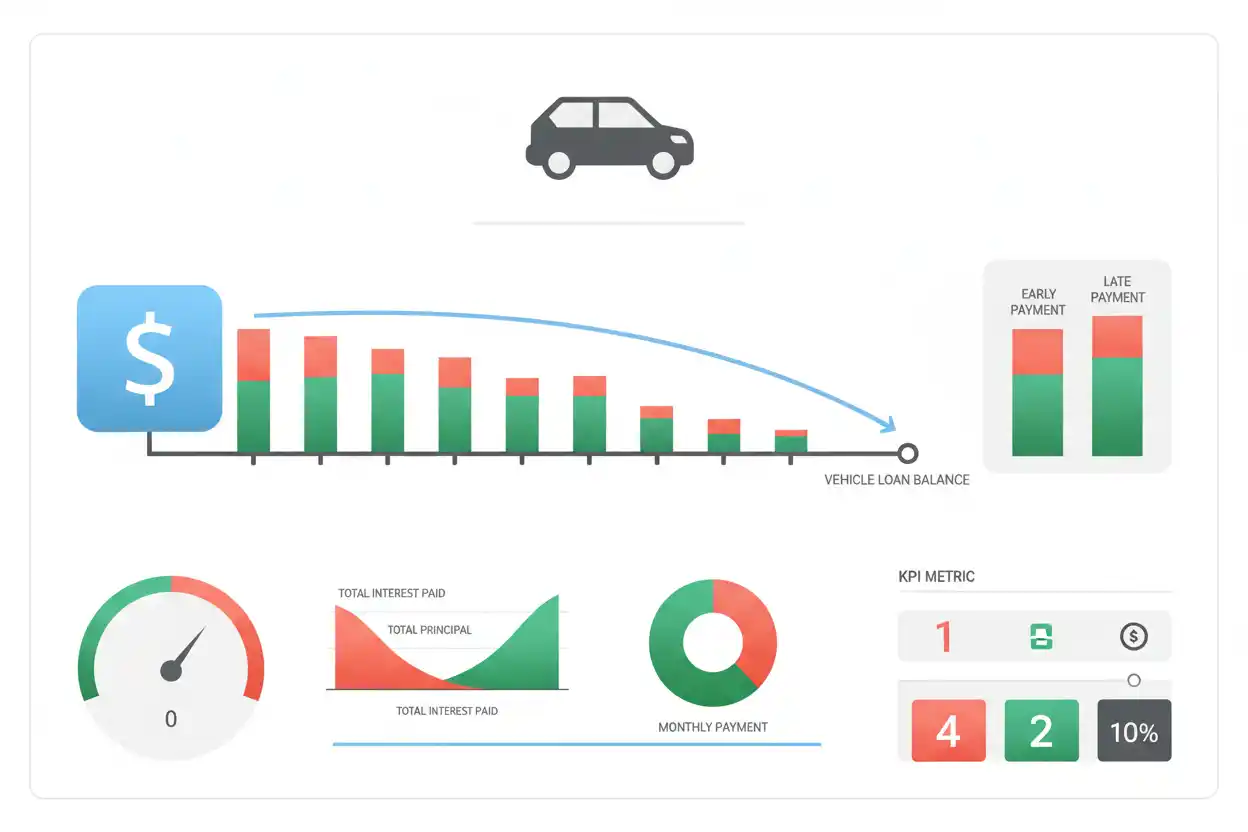

Car payments are the recurring amounts paid toward vehicle financing, but the monthly number alone does not show what is actually happening to the debt.
On a conventional amortizing car loan, each payment is divided between interest and principal.
Interest compensates the lender for providing the financing.
Principal repayment reduces the amount still owed.
Early in the loan, a larger share of each payment commonly goes toward interest because the outstanding balance is higher. As the balance falls, interest generally declines and more of the same payment reduces principal.
That principal-and-interest split is the core concept behind car payments.
For the full calculation using vehicle price, rate, term, down payment, trade-in value, and fees, the dedicated auto loan payments page owns that narrower calculator intent.
What Are Car Payments?
A car payment is a scheduled payment made under vehicle financing.
For a standard fixed-rate amortizing loan:
Car Payment = Principal Portion + Interest Portion
The amount may remain constant from month to month even though the split changes.
For example, a $594 monthly payment might initially include:
$175 of interest and $419 of principal.
Later in the loan, the payment may still be approximately $594, but perhaps only $70 goes toward interest while more than $500 reduces principal.
The exact figures depend on the loan balance and contractual rate.
Car Payment Formula
A standard fixed-rate installment payment can be calculated as:
Payment = P × [r(1 + r)ⁿ] ÷ [(1 + r)ⁿ − 1]
Where:
P = financed principal
r = periodic interest rate
n = total number of payments
However, this article focuses on what happens inside the payment rather than duplicating the full auto loan payments calculation.
Once the payment has been established, the interest portion for a conventional monthly declining-balance illustration is:
Interest Portion = Outstanding Principal × Monthly Interest Rate
Then:
Principal Portion = Total Payment − Interest Portion
Car Payment Example
Suppose a borrower has:
Financed principal = $30,000
Annual interest rate = 7%
Term = 60 months
The monthly payment is approximately:
Monthly Payment ≈ $594.04
Now examine the first payment.
Step 1: Calculate Monthly Interest Rate
Monthly Rate = 7% ÷ 12
Monthly Rate ≈ 0.58333%
Step 2: Calculate First-Month Interest
Interest = $30,000 × 0.0058333
Interest = $175
Step 3: Calculate Principal Reduction
Principal Paid = $594.04 − $175
Principal Paid ≈ $419.04
Step 4: Calculate New Balance
New Principal Balance = $30,000 − $419.04
New Principal Balance ≈ $29,580.96
The next month’s interest is then calculated from the lower balance under the simplified monthly amortization assumption.
Second Car Payment
Using the approximate new balance of $29,580.96:
Second-Month Interest = $29,580.96 × 0.0058333
Second-Month Interest ≈ $172.56
Principal reduction becomes approximately:
Principal Paid = $594.04 − $172.56
Principal Paid ≈ $421.48
More of the second payment goes toward principal because the balance is slightly lower.
This gradual shift continues across the repayment schedule.
Total Interest on the Example Loan
For the $30,000 loan:
Total Payments ≈ $594.04 × 60
Using full precision:
Total Payments ≈ $35,642.16
Then:
Total Interest = $35,642.16 − $30,000
Total Interest ≈ $5,642.16
The borrower therefore repays about $35,642 in total principal and interest over five years under the assumptions.
This is why the monthly payment should always be considered alongside total repayment.
Principal Balance vs Remaining Payments
The principal balance is the amount of borrowed principal still unpaid.
It is not the same as the sum of all remaining car payments.
Suppose the principal balance is $20,000.
The borrower might still have more than $20,000 of scheduled payments remaining because those future payments also contain interest.
This distinction matters when selling, refinancing, or paying off the vehicle early.
Accrued Interest and Car Payments
Accrued interest is interest that has accumulated since the relevant calculation or payment date.
Some auto loans accrue interest daily.
That means payment timing can affect how much of a particular payment goes toward interest.
If more days pass between payments, more interest may accrue before the next payment is applied.
The exact result depends on the loan agreement.
Simple Interest Car Loans
Many auto loans use a simple interest loan structure based on the outstanding balance.
For a daily structure:
Daily Interest = Principal × Annual Rate ÷ Applicable Day-Count Basis
The daily simple interest page owns that detailed calculation.
Paying principal down sooner can reduce future interest because later interest is calculated on a smaller balance.
Amortization and Car Payments
An amortizing loan is designed to reduce the loan balance systematically.
At the beginning:
principal is high, so interest is relatively high.
Toward the end:
principal is low, so interest is generally much smaller.
This does not mean the lender arbitrarily decides to “take interest first.”
The changing allocation results mathematically from applying the periodic rate to the outstanding balance.
Car Payments and Auto Loan APR
Auto loan APR measures annualized vehicle borrowing cost.
It is not the same as the contractual interest rate.
For example:
Interest rate = 7.0%
APR = 7.7%
The monthly principal-and-interest payment can still be calculated from the contractual rate and financed principal, while relevant financing charges cause APR to be higher.
Car Payments and APR
The broader APR concept helps borrowers compare financing cost.
However, a lower APR does not automatically create a lower monthly payment if the loan amounts or terms differ.
For example:
Loan A may have a lower APR but a 48-month term.
Loan B may have a higher APR but a 72-month term.
Loan B can still produce a lower payment because repayment is spread over more months.
Loan Term and Car Payments
The loan term has a major influence on car payments.
A longer term generally lowers the monthly amount.
However:
Longer Term → More Time Paying Interest
For the same amount financed and rate, a 72-month loan usually costs more in total interest than a 48-month loan.
A low payment obtained solely by extending the term can therefore be expensive.
Down Payment and Car Payments
A larger down payment reduces the amount financed when the other transaction details remain unchanged.
Suppose a buyer is about to finance $30,000 but adds another $5,000 to the down payment.
The financed principal falls to:
New Principal = $30,000 − $5,000
New Principal = $25,000
At the same rate and term, the monthly payment and total interest will both be lower.
The benefit comes from borrowing less.
Trade-In Equity
If a trade-in is worth more than the outstanding debt on that vehicle, positive equity can reduce the new loan.
Suppose:
Trade value = $15,000
Existing payoff = $10,000
Then:
Positive Trade Equity = $15,000 − $10,000
Positive Trade Equity = $5,000
Applying that $5,000 to the next vehicle can reduce the amount financed.
Negative Equity
If the trade is worth less than its payoff, the transaction contains negative equity.
Suppose:
Trade value = $12,000
Existing payoff = $17,000
Then:
Negative Equity = $17,000 − $12,000
Negative Equity = $5,000
If the $5,000 is rolled into the replacement loan, the borrower begins by financing more than the new vehicle transaction alone would require.
That can increase both car payments and the risk of remaining underwater on the next vehicle.
Car Payments vs Auto Lease Payments
Auto lease payments work differently.
A lease typically uses:
capitalized cost, residual value, depreciation, rent charge, and lease term.
A car loan instead amortizes borrowed principal.
The two monthly figures are therefore not directly comparable without considering upfront cash, ownership, mileage, fees, and end-of-term value.
Car Payments vs Boat Loan Payments
Boat loan payments can use the same amortization equation.
The main differences are usually financing terms, rates, collateral, principal amounts, and ownership costs.
The mathematical payment structure can be similar even though the underlying asset is different.
Car Payments vs Business Loan Payments
Business loan payments can also divide payments into principal and interest.
Commercial loans, however, can use more varied structures, including balloon payments, variable rates, and unusual repayment schedules.
Car financing is usually more standardized from the borrower’s perspective.
Car Payments and Business Loan APR
Business loan APR concerns commercial annualized financing cost, not vehicle payment allocation.
The mapped relationship illustrates an important distinction:
payment composition and borrowing cost are different analytical questions.
Car Payments and Cash Advance Fees
A cash advance fee is unrelated to ordinary auto-loan amortization, but both are financing costs.
Someone considering using expensive revolving credit for a vehicle down payment or emergency car expense should compare that credit-card cost separately rather than treating every financing source as interchangeable.
Car Payments and Compound Interest
A compound interest loan involves interest becoming part of the balance used for future interest calculations.
That is not the same thing as ordinary amortization.
A standard car loan can amortize while using simple-interest mechanics.
Borrowers should not assume that a payment containing interest automatically means the debt is compounding unpaid interest.
Fixed vs Variable Rates
Most familiar car-payment examples assume a fixed contractual rate.
A fixed vs variable interest rate loan can behave differently because future rates—and potentially payments—can change.
The contract should determine which model is appropriate.
Credit and Car Payments
A borrower’s credit profile can influence the financing rate offered.
The credit score factors page covers the broader scoring framework.
A higher rate means more of each payment must support financing cost for the same amount and term.
Debt-to-Income Ratio
The debt-to-income ratio compares recurring debt payments with gross monthly income.
A lender-approved car payment can still be uncomfortable after considering insurance, fuel, maintenance, housing, savings, and other household costs.
Approval and affordability are not identical.
Loan-to-Income Ratio
The loan-to-income ratio compares the amount borrowed with income.
It provides another view of debt burden, but it does not replace a monthly cash-flow budget.
Paying Extra Principal
If a lender applies extra money directly to principal on a declining-balance loan, future interest can fall.
Suppose an extra $1,000 reduces the principal balance immediately.
Future interest is then calculated from a smaller balance under the standard structure.
However, verify how the lender applies extra payments.
Prepayment and Payoff
Before making a large early payment, check whether a prepayment penalty applies.
When selling or refinancing the car, request a current loan payoff quote.
The payoff figure can differ from the displayed principal because additional interest or contractual amounts may need to be included.
Common Car Payment Mistakes
One common mistake is thinking the entire monthly payment reduces the loan balance.
Only the principal portion does.
Another is judging affordability solely by payment while ignoring term.
A third is assuming the principal balance equals the total amount still to be paid.
Borrowers can also overlook negative equity rolled into a new loan.
Finally, a low payment should not be confused with a low-cost vehicle. Insurance, fuel, maintenance, depreciation, taxes, and repairs exist outside the financing payment.
Frequently Asked Questions
What does a car payment include?
On a standard loan, it includes principal repayment and interest. Separate charges may exist depending on the financing arrangement.
How much of my car payment goes to principal?
It depends on the outstanding balance, contractual rate, payment amount, and timing. Early payments usually contain less principal than later payments on a standard amortizing loan.
Why does more of my first payment go toward interest?
The outstanding balance is highest at the beginning, so applying the periodic rate generates more interest.
Does my car payment decrease as principal falls?
Not usually on a fixed-payment amortizing loan. The payment can remain constant while its principal-interest allocation changes.
Is APR part of the payment?
APR measures annualized borrowing cost. The contractual interest rate generally drives the scheduled principal-and-interest payment.
Does a longer term lower car payments?
Usually yes, but it generally increases total interest.
Does a down payment lower the car payment?
Yes, when it reduces the financed principal and other terms remain unchanged.
What happens if I pay extra toward principal?
Future interest can decline on many declining-balance loans because the remaining principal is lower.
Is my principal balance the same as my payoff amount?
Not always. A payoff quote can include accrued interest and other contractual amounts.
Is a lease payment the same as a car loan payment?
No. Lease payments use depreciation and rent-charge mechanics, while loan payments amortize borrowed principal.
Why can two buyers pay different amounts for the same car?
They may finance different amounts, receive different interest rates, choose different terms, make different down payments, or finance different fees and add-ons.
Final Takeaway
Car payments are easiest to understand when separated into two components:
Car Payment = Principal + Interest
For a $30,000 loan at 7% over 60 months, the monthly payment is approximately $594.04.
The first month’s interest is $175, leaving approximately $419.04 to reduce principal.
As the balance declines, interest generally falls and progressively more of the payment goes toward principal.
The payment may stay the same, but the debt underneath it changes every month. Understanding that split makes it much easier to evaluate loan progress, total interest, refinancing, early payoff, and the real cost of financing a vehicle.