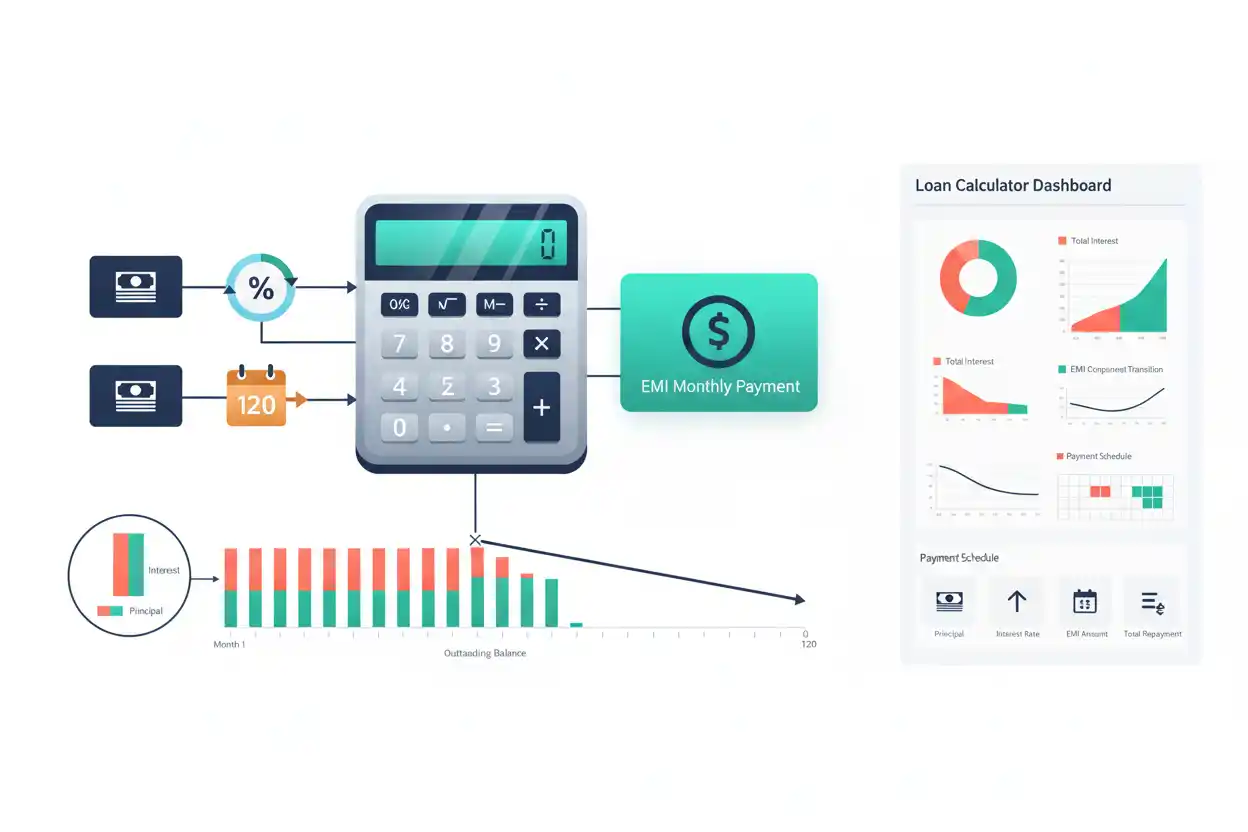

Loan payments are the scheduled amounts required to repay borrowed money according to a loan agreement.
For a conventional fixed-rate amortizing loan, the payment is determined primarily by:
the amount financed, periodic interest rate, and number of payments.
The standard formula is:
Loan Payment = P × [r(1 + r)^n] ÷ [(1 + r)^n − 1]
Where:
P = principal
r = periodic interest rate
n = total number of payments
A monthly payment can appear simple, but several financial questions sit underneath it:
How much goes to interest?
How much reduces principal?
How does the term change total cost?
What happens when the rate changes?
How do fees affect the economics?
Those questions make loan payments one of the core calculations in the Loans & Credit cluster and the broader Finance category.
What Are Loan Payments?
Loan payments are contractual cash payments made to satisfy debt.
A standard payment on an amortizing loan normally includes:
Loan Payment = Interest Portion + Principal Portion
The interest component compensates the lender for providing financing.
The principal component reduces the outstanding debt.
As principal declines, interest usually declines under a conventional reducing-balance structure.
Loan Payment Formula
For fixed periodic payments:
Payment = P × [r(1 + r)^n] ÷ [(1 + r)^n − 1]
If payments occur monthly:
Monthly Rate = Annual Nominal Interest Rate ÷ 12
and:
Number of Payments = Loan Term in Years × 12
For example:
Annual rate = 8%
Loan term = 5 years
Then:
Monthly Rate = 8% ÷ 12
Monthly Rate ≈ 0.66667%
and:
Number of Payments = 5 × 12 = 60
Loan Payment Example
Suppose:
Principal = $25,000
Annual interest rate = 8%
Term = 60 months
Payments = monthly
Step 1: Calculate the Monthly Rate
r = 8% ÷ 12
r = 0.0066667
Step 2: Identify Number of Payments
n = 60
Step 3: Apply the Formula
Payment = $25,000 × [0.0066667(1.0066667)^60] ÷ [(1.0066667)^60 − 1]
The approximate payment is:
Monthly Loan Payment ≈ $506.91
The borrower therefore makes approximately 60 scheduled payments of $506.91 under the example assumptions.
Total Payments
Using full precision:
Total Payments = Monthly Payment × Number of Payments
Total Payments ≈ $506.91 × 60
Total Payments ≈ $30,414.59
Total interest is:
Total Interest = $30,414.59 − $25,000
Total Interest ≈ $5,414.59
A $25,000 loan therefore costs approximately $5,415 in contractual interest over five years under the example.
First Payment Breakdown
The first month’s interest is:
Interest = Opening Principal × Monthly Rate
Interest = $25,000 × 0.0066667
Interest ≈ $166.67
Principal repayment is:
Principal Repaid = $506.91 − $166.67
Principal Repaid ≈ $340.24
New principal balance:
New Balance = $25,000 − $340.24
New Balance ≈ $24,659.76
Second Payment Breakdown
Second-month interest is calculated from approximately $24,659.76:
Interest ≈ $24,659.76 × 0.0066667
Interest ≈ $164.40
Principal repayment becomes:
Principal Repaid ≈ $506.91 − $164.40
Principal Repaid ≈ $342.51
More of the same payment goes toward principal because the balance is lower.
A complete repayment schedule extends this process through every installment.
EMI and Loan Payments
EMI means equated monthly installment.
The mathematical formula is the same standard fixed-payment equation shown above when the assumptions match.
The distinction is mainly terminology and scope.
EMI specifically describes an equal monthly installment.
Loan payments can be monthly, weekly, biweekly, quarterly, annual, irregular, or structured in other ways.
How Loan Term Changes Payments
The loan term changes both payment size and total interest.
Using the same $25,000 principal at 8%:
| Term | Approx. Monthly Payment | Approx. Total Interest |
|---|---|---|
| 36 months | $783.41 | $3,202.73 |
| 48 months | $610.32 | $4,295.51 |
| 60 months | $506.91 | $5,414.59 |
| 72 months | $438.33 | $6,559.83 |
A longer term lowers the monthly payment.
However:
Longer Term → More Time Paying Interest
The 72-month loan costs more than twice as much interest as the 36-month version in this example.
How Interest Rate Changes Payments
Holding principal and term constant:
Higher Rate → Higher Payment
Suppose two borrowers each finance $25,000 for five years.
Borrower A receives 6%.
Borrower B receives 12%.
Borrower B’s payment will be substantially higher because more of each installment must cover financing cost while principal is still repaid within the same 60 months.
The interest rate basics page explains the relationship among annual, periodic, effective, and disclosed rates.
Fixed vs Variable Loan Payments
The example assumes a fixed rate.
The fixed vs variable interest rate distinction becomes important when the contractual rate can change.
A variable-rate increase can cause:
a higher payment, a longer remaining term, or both depending on the agreement.
Therefore, today’s payment may not represent the entire future payment path.
Flat vs Reducing-Balance Payments
The standard amortization formula assumes an outstanding-balance approach.
The flat vs reducing balance interest comparison shows why this matters.
A flat-rate loan can calculate financing cost using original principal instead of the declining balance.
Two loans quoting “10%” can therefore produce very different payments and total costs.
Simple Interest Loan Payments
A simple interest loan calculates interest using principal rather than charging interest on prior interest under normal conditions.
Some simple-interest loans accrue interest daily.
Payment timing can then affect how much of a payment is allocated to interest.
Compound Interest Loan Payments
A compound interest loan can add unpaid interest to the balance used for future interest calculations.
That is different from ordinary amortization.
A loan should not be described as compound-interest debt merely because the payment formula contains an exponent.
Origination Fees and Loan Payments
A loan origination fee can affect the transaction in two important ways.
If the fee is financed:
Higher Principal → Higher Payment
If the fee is withheld:
the scheduled payment might stay unchanged while the borrower receives less net cash.
In the second case, payment alone understates the effective financing cost.
Loan Payments and APR
APR measures annualized borrowing cost.
The contractual rate typically drives the scheduled interest calculation, while APR can reflect applicable financing charges.
A loan can therefore have:
Interest rate = 8%
APR = 8.8%
while its scheduled payment is still calculated using the contractual rate and financed principal.
Loan Payments and Leasing Costs
Leasing costs should not be calculated using the standard loan-payment formula unless the lease structure specifically supports that treatment.
Leases can involve:
residual value, rent charge, return obligations, and purchase options.
A lower lease payment is not necessarily equivalent to a lower loan payment because ownership outcomes differ.
Loan Payoff Quote vs Remaining Payments
A loan payoff quote is the amount required to settle the debt on a particular date.
It is not normally:
Remaining Number of Payments × Scheduled Payment
That multiplication includes future interest that may never be incurred after early payoff.
The actual payoff instead depends on current principal, accrued interest, fees, credits, and applicable prepayment provisions.
Auto Loan Payments
Auto loan payments use the same general amortization mathematics when the financing is fixed-rate and fully amortizing.
However, vehicle transactions introduce additional variables such as:
down payment, trade equity, negative equity, taxes, and financed add-ons.
Business Loan Payments
Business loan payments can follow conventional amortization, but commercial lending can also involve balloon payments, seasonal repayment, weekly payments, or variable rates.
The standard formula should be used only when the contract assumptions match.
Personal Loan Payments
Personal loan payments commonly use fixed installments.
Origination fees can make the amount received smaller than the face amount of the loan, so payment affordability and borrowing cost should both be evaluated.
Boat Loan Payments
Boat loan payments often use similar amortization mathematics but can extend over much longer terms.
The resulting payment can look affordable even while lifetime interest becomes substantial.
Loan Payments and DTI
The debt-to-income ratio compares qualifying monthly debt payments with gross monthly income.
Suppose:
Gross monthly income = $6,000
Existing debt payments = $1,200
New loan payment = $506.91
Then:
New DTI = ($1,200 + $506.91) ÷ $6,000 × 100
New DTI ≈ 28.45%
A payment can therefore affect both household cash flow and borrowing capacity.
Interest-Only Payments
Some loans require only interest for a period.
For example:
Principal = $100,000
Annual rate = 6%
Monthly interest-only amount:
Interest-Only Payment = $100,000 × 6% ÷ 12
Interest-Only Payment = $500
That payment does not reduce principal in the simplified example.
A later transition to amortizing payments can therefore produce a significant payment increase.
Balloon Loans
Some loans calculate smaller periodic payments but leave a large balance due at maturity.
Such loans are not fully amortizing.
The monthly payment can look attractive, but the borrower must be able to refinance or pay the remaining balance at the balloon date.
Extra Principal Payments
Additional principal can reduce future interest on many declining-balance loans.
Suppose an extra $2,000 is applied directly to principal.
The next interest calculation begins from a balance that is $2,000 lower.
The amount of savings depends on:
rate, timing, remaining term, and prepayment conditions.
Common Loan Payment Mistakes
One mistake is using the annual rate directly in a formula requiring a monthly rate.
Another is entering years instead of the number of payments.
Borrowers also compare monthly payments without comparing terms.
A fourth mistake is assuming APR should be entered directly into every payment formula.
Finally, the standard formula should not be forced onto variable-rate, interest-only, balloon, flat-rate, or irregular-payment loans without adjusting the model.
Frequently Asked Questions
What is the standard loan payment formula?
Payment = P × [r(1 + r)^n] ÷ [(1 + r)^n − 1]
What determines a monthly loan payment?
Principal, periodic interest rate, number of payments, and loan structure are the main variables.
What is the payment on $25,000 at 8% for five years?
Approximately $506.91 per month.
How much interest does that loan cost?
Approximately $5,414.59 over 60 months under the stated assumptions.
Why does more of the payment go to interest at first?
Because the outstanding principal is highest early in the loan.
Does a longer loan term lower the payment?
Generally yes, but it usually increases total interest.
Is EMI the same as a loan payment?
EMI is specifically an equal monthly installment. Loan payments can use other frequencies and structures.
Should I use APR or interest rate in the payment formula?
Use the contractual periodic interest rate required by the loan terms unless the model specifically calls for another rate.
Can a loan payment change?
Yes. Variable rates, escrow components, payment resets, or contract modifications can change payments.
What happens if I pay extra principal?
Future interest can decrease and the loan can be repaid sooner, subject to the lender’s terms.
Is the payoff amount equal to all remaining payments?
No. Remaining scheduled payments generally include future interest that may not be owed after early payoff.
Why should I calculate total payments?
Because two loans with very different terms can have similar monthly payments but dramatically different lifetime costs.
Final Takeaway
For a conventional fixed-rate amortizing loan:
Loan Payment = P × [r(1 + r)^n] ÷ [(1 + r)^n − 1]
A $25,000 loan at 8% for 60 months produces an approximate payment of:
$506.91 per Month
and total interest of about:
$5,414.59
Extending the same loan to 72 months lowers the payment to approximately $438.33, but increases total interest to roughly $6,559.83.
That tradeoff is the central lesson of loan payments: a smaller monthly payment can improve short-term affordability while making the debt more expensive overall.