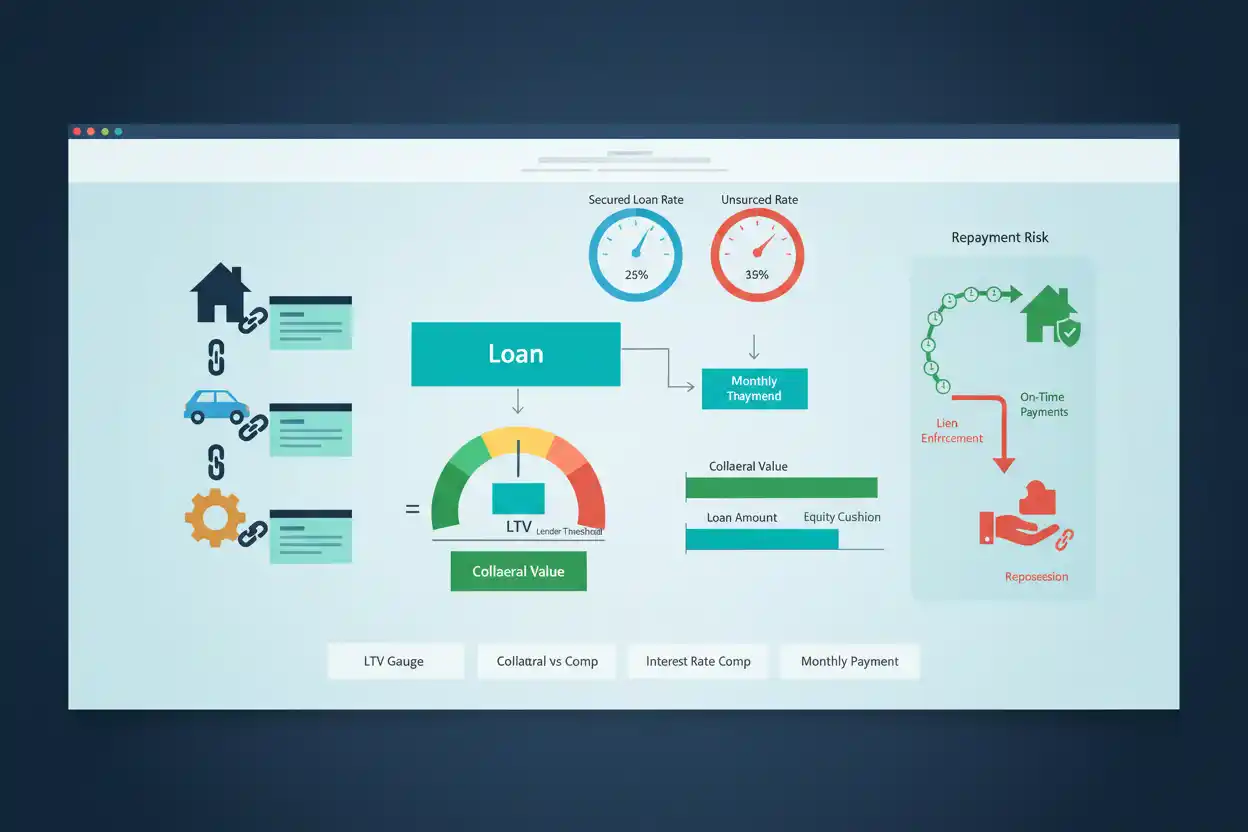
A secured loan is debt backed by collateral.
Collateral is property or another asset that provides the lender with security under the loan agreement. If the borrower fails to repay according to the contract, the lender may have rights against that collateral, subject to applicable law and the financing documents.
Common secured lending examples include:
mortgages secured by real estate, vehicle loans secured by vehicles, and equipment financing secured by business assets.
There is no universal mathematical formula that makes a loan “secured.” The defining feature is collateral.
However, one important secured-loan calculation is loan-to-value:
Loan-to-Value Ratio = Loan Amount ÷ Collateral Value × 100
If a borrower receives a $30,000 loan secured by collateral worth $40,000:
LTV = $30,000 ÷ $40,000 × 100
LTV = 75%
This ratio helps describe how much is being borrowed relative to the value of the asset securing the loan.
What Is a Secured Loan?
A secured loan is a loan for which specified property supports the lender’s claim.
The asset does not eliminate the borrower’s repayment obligation.
Instead, it provides an additional source of recovery if contractual payments are not made.
The broader Loans & Credit framework separates secured borrowing from unsecured credit, repayment mechanics, rates, and collateral risk across the Finance category.
Secured Loan Formula
Because secured loan is a legal and financial structure rather than one formula, several calculations can be relevant.
Loan-to-Value
LTV = Loan Amount ÷ Collateral Value × 100
Collateral Coverage
Collateral Coverage Ratio = Collateral Value ÷ Loan Balance
Standard Amortizing Payment
If the secured loan uses fixed amortizing payments:
Payment = P × [r(1 + r)^n] ÷ [(1 + r)^n − 1]
The collateral does not change this payment formula. It changes the lender’s security position.
Secured Loan Example
Suppose:
Loan amount = $30,000
Collateral value = $40,000
Annual fixed interest rate = 7%
Term = 60 months
Calculate LTV
LTV = $30,000 ÷ $40,000 × 100
LTV = 75%
Calculate Collateral Coverage
Collateral Coverage = $40,000 ÷ $30,000
Collateral Coverage ≈ 1.33×
The collateral is worth approximately 1.33 times the initial loan balance.
Calculate Monthly Payment
Using the standard loan payments formula:
Monthly Payment ≈ $594.04
Total scheduled payments are approximately:
Total Payments ≈ $35,642.16
Total interest is approximately:
Total Interest ≈ $5,642.16
Secured Loan vs Unsecured Loan
An unsecured loan does not rely on specified pledged collateral in the same way.
Secured loan:
Credit Obligation + Collateral
Unsecured loan:
Credit Obligation Without the Same Specific Collateral Pledge
Secured loans can sometimes offer lower borrowing costs because collateral can reduce the lender’s loss exposure.
However, the borrower assumes a significant additional risk: the secured asset can be exposed if the loan goes into default.
Collateral Does Not Guarantee Approval
A valuable asset does not automatically make every loan acceptable to a lender.
Underwriting can also consider:
credit history, income, debt obligations, loan purpose, collateral type, collateral condition, marketability, and lender policy.
The credit score factors page explains one part of that broader underwriting picture.
Why Loan-to-Value Matters
Suppose two borrowers both pledge assets worth $100,000.
Borrower A requests $50,000:
LTV = 50%
Borrower B requests $90,000:
LTV = 90%
Borrower B has much less collateral value above the loan amount.
If the asset value declines, the lender’s collateral cushion can disappear quickly.
That can affect pricing or approval depending on the loan type.
Equity in Collateral
Equity can be approximated as:
Collateral Equity = Collateral Value − Secured Loan Balance
Suppose:
Asset value = $40,000
Loan balance = $30,000
Equity = $40,000 − $30,000
Equity = $10,000
As the principal balance falls, equity can increase if asset value remains stable.
However, depreciating assets can lose value at the same time principal is being repaid.
Depreciating Collateral Example
Suppose after one year:
Loan balance = $25,000
Asset value falls to $28,000
New LTV:
LTV = $25,000 ÷ $28,000 × 100
LTV ≈ 89.3%
Even though principal declined from $30,000 to $25,000, LTV increased from 75% to about 89.3% because the asset value fell faster.
This is common enough with rapidly depreciating assets that borrowers should monitor both sides of the ratio.
Secured Loan Repayment Schedule
A repayment schedule shows principal and interest reduction over time.
The fact that the loan is secured does not change the normal amortization mechanics.
Each payment can still be divided into:
interest and principal.
The collateral simply remains attached to the lender’s security position until the relevant obligation is satisfied and the lien or claim is released according to the applicable process.
Secured Loan and Simple Interest
A simple interest loan can be secured.
For example, many vehicle loans combine:
collateral security with outstanding-balance interest.
Those are separate characteristics.
Secured tells you the lender has collateral.
Simple interest tells you how interest is calculated.
Secured Loan and Prepayment
A prepayment penalty can affect early repayment depending on the loan.
If the borrower wants the collateral released, the loan normally must be satisfied according to the contractual payoff process.
A penalty, if applicable, can increase the required payoff.
Secured Loan and Loan Payoff Quote
A loan payoff quote can be particularly important before selling secured collateral.
Suppose a vehicle is worth $18,000 but the payoff is $21,000.
The borrower has:
Negative Equity = $21,000 − $18,000
Negative Equity = $3,000
Selling the vehicle alone would not generate enough cash to satisfy the loan.
Secured Loan and Loan Term
A longer loan term can create a lower monthly payment while keeping the lender’s claim against collateral outstanding for longer.
With rapidly depreciating assets, that can increase the period during which the loan balance is close to or above asset value.
Secured Loan APR
APR provides a borrowing-cost measure that can incorporate applicable finance charges.
A secured loan should not be selected simply because its nominal rate is lower than an unsecured alternative.
Compare:
APR, fees, collateral risk, payment, term, and total repayment.
Secured Loan Origination Fees
A loan origination fee can exist on secured financing.
If financed into the debt, the fee increases principal.
That can increase LTV.
Suppose:
Collateral value = $40,000
Cash loan = $30,000
Financed fee = $1,000
New principal:
$31,000
New LTV:
$31,000 ÷ $40,000 × 100
LTV = 77.5%
The financed fee has increased leverage against the asset.
Fixed vs Variable Secured Loans
A fixed vs variable interest rate structure can apply to secured debt.
Mortgages and other secured loans may offer fixed or variable rates.
A variable-rate increase can raise borrowing cost even though the pledged collateral has not changed.
Secured Loan and Debt-to-Income Ratio
The debt-to-income ratio evaluates payment burden.
Collateral does not replace income.
A borrower can have excellent collateral and still struggle with a payment that is too large relative to monthly cash flow.
Secured Loan and Loan-to-Income Ratio
The loan-to-income ratio compares principal with annual income.
It complements LTV.
For example:
Loan = $30,000
Collateral = $40,000
Annual income = $60,000
LTV:
75%
LTI:
$30,000 ÷ $60,000 × 100 = 50%
One ratio measures collateral leverage.
The other measures loan size relative to income.
Secured Auto Loans
Auto loan payments commonly involve a security interest in the financed vehicle.
The payment may use ordinary amortization mathematics, while the vehicle serves as collateral.
If payments are not maintained, the collateral creates consequences beyond normal collection on unsecured debt.
Secured Business Loans
Business loan payments can be secured by equipment, real estate, inventory, receivables, or other business assets depending on the financing.
Businesses should evaluate whether pledged assets are essential to continuing operations.
Losing a critical asset can create consequences much larger than the loan balance alone.
Student Loans and Secured Debt
Student loan interest is included in the mapped lending relationship because student borrowing provides a useful contrast.
Student loans are generally not structured as ordinary asset-backed loans with a vehicle or house pledged as collateral.
Repayment rights, protections, and collection rules are instead defined by the specific student-loan program and contract.
Secured Loan and Insurance
Lenders can require insurance on collateral for some secured loans.
This is economically important because the borrower’s total ownership cost may include:
loan payment plus insurance plus maintenance plus taxes or registration.
The financing payment should not be mistaken for the complete cost of the asset.
What Happens When Collateral Value Falls?
Falling collateral value can increase LTV.
Suppose:
Loan balance = $80,000
Asset value = $100,000
LTV = 80%
Asset value falls to $75,000:
LTV = $80,000 ÷ $75,000 × 100
LTV ≈ 106.7%
The loan now exceeds the asset’s current value.
This can make selling or refinancing more difficult.
Collateral Is Not a Substitute for Affordability
A secured loan can appear easier to obtain because an asset supports the debt.
That should not encourage overborrowing.
If the payment cannot be supported by normal cash flow, collateral simply changes what can be lost after default.
The first question should still be:
Can I afford the payment under realistic conditions?
Common Secured Loan Mistakes
One mistake is assuming secured automatically means cheap.
Another is focusing on a lower rate while ignoring the risk to collateral.
Borrowers also confuse collateral value with guaranteed sale proceeds.
A fourth mistake is ignoring depreciation.
Finally, a low monthly payment achieved through a long term can leave the loan secured against the asset for many years.
Frequently Asked Questions
What is a secured loan?
A secured loan is debt supported by pledged collateral.
What is collateral?
Collateral is property or another asset subject to the lender’s security rights under the loan agreement.
What is a common secured-loan formula?
Loan-to-value is:
LTV = Loan Amount ÷ Collateral Value × 100
What is a 75% LTV?
It means the loan equals 75% of the stated collateral value.
Are secured loans cheaper?
They can have lower rates than comparable unsecured borrowing, but pricing depends on many underwriting variables.
What happens if I cannot repay?
The lender can have rights against the pledged collateral, subject to the contract and applicable law.
Is a car loan secured?
Many vehicle loans are secured by the financed vehicle.
Is a mortgage secured?
Yes, a mortgage loan is secured by real property under its legal structure.
Can a secured loan use simple interest?
Yes. Collateral structure and interest-calculation method are separate features.
Does collateral eliminate the need for good credit?
No. Lenders can still evaluate credit, income, debt, and other risks.
Can a secured loan have an origination fee?
Yes.
What should I compare before taking a secured loan?
Compare LTV, APR, payment, term, fees, prepayment rules, collateral value, and the consequences of losing the pledged asset.
Final Takeaway
A secured loan is defined by collateral, not by a special payment formula.
One of its most useful measurements is:
Loan-to-Value = Loan Amount ÷ Collateral Value × 100
A $30,000 loan secured by a $40,000 asset has:
75% LTV
If that loan charges 7% for 60 months, the standard amortizing payment is approximately:
$594.04 per Month
But payment affordability is only part of the decision.
A secured loan also places an asset at risk. Compare the rate, APR, fees, loan term, collateral value, LTV, repayment schedule, and consequences of default before treating a lower advertised rate as automatically better financing.