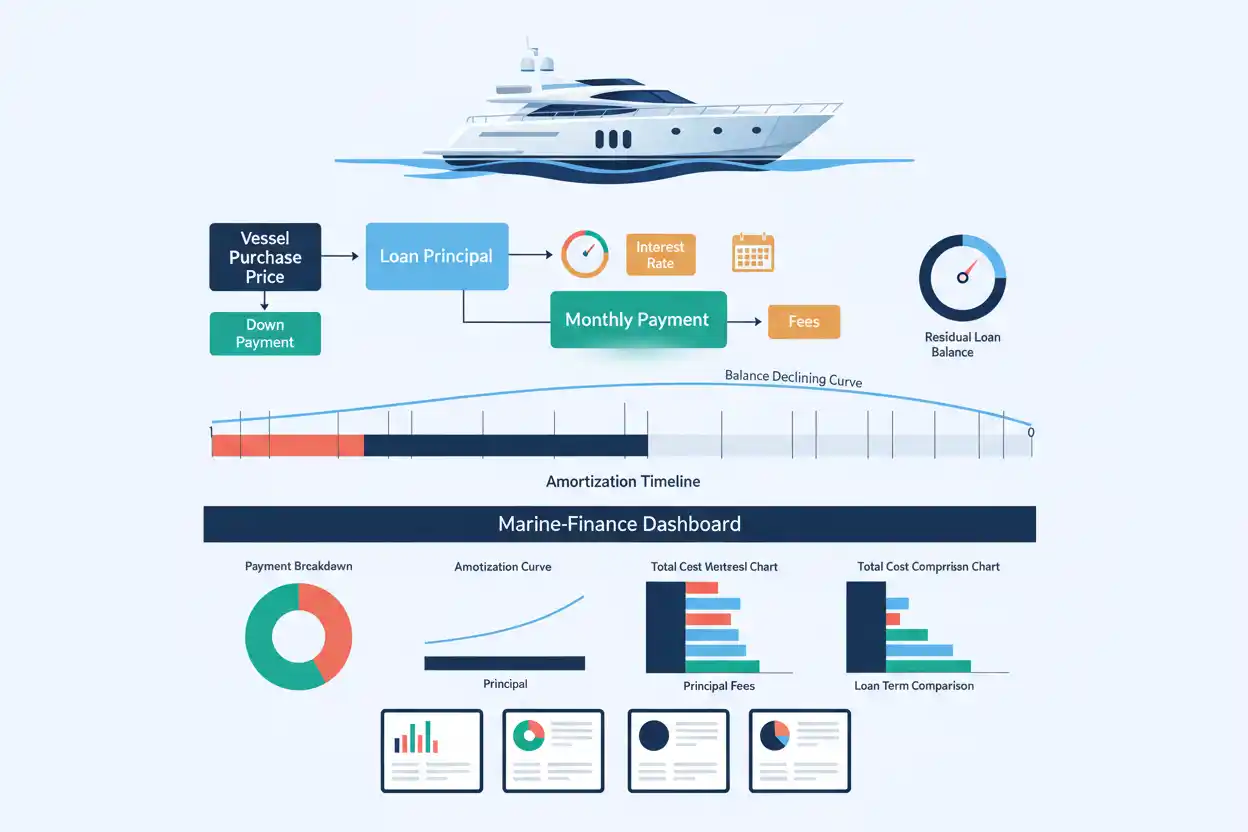

Boat loan payments are scheduled repayments on financing used to purchase a boat or other qualifying marine asset.
For a standard fixed-rate amortizing boat loan, the monthly payment is primarily determined by three variables:
the amount financed, periodic interest rate, and number of payments.
The standard formula is:
Boat Loan Payment = P × [r(1 + r)^n] ÷ [(1 + r)^n − 1]
where:
P = financed principal
r = periodic interest rate
n = number of payments
A longer term can make a large boat purchase appear more affordable each month, but it can also produce a substantial increase in lifetime interest.
That tradeoff makes term selection especially important when financing expensive assets over many years.
What Are Boat Loan Payments?
Boat loan payments are periodic amounts required to repay marine financing according to the loan agreement.
A typical payment on an amortizing loan contains:
interest on the outstanding balance and principal repayment that reduces the debt.
The borrower should distinguish the payment from the broader ownership cost of the boat.
Dockage, storage, fuel, maintenance, insurance, registration, repairs, equipment, and depreciation can all create substantial expenses beyond the loan itself.
The Loans & Credit framework therefore provides only the financing side of the ownership decision.
Boat Loan Payment Formula
For a fixed-rate loan with equal monthly payments:
Monthly Payment = P × [r(1 + r)^n] ÷ [(1 + r)^n − 1]
Convert an annual nominal rate into a monthly rate:
Monthly Rate = Annual Interest Rate ÷ 12
Convert years into monthly payments:
Number of Payments = Years × 12
For example, a 10-year loan has:
n = 10 × 12 = 120 Payments
Determine the Amount Financed
A simplified financing calculation is:
Amount Financed = Boat Purchase Price + Financed Costs − Down Payment − Trade-In Credit − Rebates
Depending on the transaction, financed costs could include certain taxes, registration amounts, equipment, warranties, or fees.
Not every charge should automatically be financed, and the exact treatment depends on the lender and transaction.
Suppose:
Boat price = $80,000
Down payment = $20,000
No additional financed costs in the example
Then:
Amount Financed = $80,000 − $20,000
Amount Financed = $60,000
Boat Loan Payment Example
Assume:
Principal = $60,000
Annual interest rate = 8.25%
Term = 10 years
Payments = monthly
Step 1: Calculate Monthly Rate
Monthly Rate = 8.25% ÷ 12
Monthly Rate = 0.6875%
As a decimal:
r = 0.006875
Step 2: Calculate Number of Payments
n = 10 × 12
n = 120
Step 3: Calculate Payment
Payment = $60,000 × [0.006875(1.006875)^120] ÷ [(1.006875)^120 − 1]
The approximate monthly payment is:
Boat Loan Payment ≈ $735.92
The borrower therefore pays approximately $735.92 per month for principal and interest under the example assumptions.
Total Cost of the Example Loan
Total scheduled payments are approximately:
Total Payments = $735.9158 × 120
Total Payments ≈ $88,309.89
Total interest is therefore:
Total Interest = $88,309.89 − $60,000
Total Interest ≈ $28,309.89
The borrower finances $60,000 but pays more than $28,000 of interest over the 10-year term.
This is why a monthly payment should never be evaluated without total repayment.
How Loan Term Changes Boat Payments
Long terms can produce dramatic differences.
Using the same $60,000 principal and 8.25% rate:
| Term | Approx. Monthly Payment | Approx. Total Interest |
|---|---|---|
| 7 years / 84 months | $942.66 | $19,183.74 |
| 10 years / 120 months | $735.92 | $28,309.89 |
| 15 years / 180 months | $582.08 | $44,775.16 |
The 15-year option reduces the payment by more than $360 compared with the seven-year loan.
However, it creates roughly $25,591 more total interest.
The loan term therefore matters as much as the advertised rate when comparing marine financing.
How Interest Rate Changes Boat Loan Payments
The payment rises when the rate rises and the principal and term remain unchanged.
That happens because each payment must cover a greater financing cost while still retiring the same principal by the end of the term.
The basic relationship is:
Higher Rate → Higher Payment and Higher Total Interest
The effect becomes especially large over long terms.
Boat Loan APR
The contractual rate used in the payment formula is not automatically identical to APR.
APR can reflect the annualized cost of credit after qualifying financing charges are considered.
A boat loan could therefore have:
Contractual rate = 8.25%
APR = 8.70%
while the scheduled payment is still calculated using the contractual rate and financed principal.
The distinction follows the same logic explained by auto loan APR, although the underlying product and lender terms differ.
Boat Loan Payments vs APR vs APY
APR vs APY separates borrowing cost from compound yield.
APR is relevant to evaluating credit.
APY is generally associated with savings and deposit yield.
A boat buyer should compare rate, APR, amount financed, term, fees, payment, and total interest rather than trying to convert the loan into a deposit-style APY.
Boat Loan Amortization
At the beginning of the example loan:
Principal = $60,000
Monthly rate = 0.6875%
First-month interest is:
Interest = $60,000 × 0.006875
Interest = $412.50
If the payment is $735.92:
Principal Paid = $735.92 − $412.50
Principal Paid ≈ $323.42
The approximate remaining balance becomes:
New Balance = $60,000 − $323.42
New Balance ≈ $59,676.58
As principal falls, the interest portion generally declines and more of each payment goes toward principal.
A full repayment schedule tracks these changes over all 120 payments.
Principal Balance
The principal balance tells you how much borrowed principal remains.
It is not the same as the sum of all remaining payments because the remaining scheduled payments also contain future interest.
This distinction matters when selling, refinancing, or trading the boat.
Down Payment Impact
A larger down payment reduces the amount financed.
Suppose the buyer puts down $30,000 instead of $20,000 on the same $80,000 purchase.
The principal becomes:
New Principal = $80,000 − $30,000
New Principal = $50,000
At the same rate and term, both monthly payment and total interest fall because less money is borrowed.
Boat Loan Fees
Fees can influence either the principal or the annualized cost depending on how they are charged.
A loan origination fee can increase financing cost.
Documentation, lien-recording, registration, appraisal, inspection, or other charges may also arise depending on the transaction.
The borrower should identify which amounts:
are paid in cash, are financed, or are part of the cost-of-credit calculation.
Secured Boat Loans
Many boat loans are structured as secured loans in which the financed asset supports the lender’s claim.
Collateral can affect underwriting and rate decisions.
However, secured status also means default can create a risk of repossession or other enforcement according to the agreement and applicable law.
The lower payment should therefore never be considered separately from the contractual obligation.
Simple Interest Boat Loans
A simple interest loan calculates interest from the outstanding principal rather than applying interest repeatedly to previously paid interest under a conventional structure.
If interest accrues daily, the daily simple interest calculation becomes relevant.
Payment timing can therefore affect the interest accumulated between payments on some loans.
Fixed vs Variable Boat Loan Rates
Boat financing can use different rate structures.
A fixed vs variable interest rate comparison is especially important for long terms.
With a fixed rate, the contractual rate generally remains unchanged according to the agreement.
With a variable rate, future interest cost can change as the reference rate changes.
Long-term borrowers should understand this risk before evaluating a low introductory payment.
Boat Loan vs Auto Loan Payments
The mathematics behind auto loan payments and boat loan payments can be identical when both use standard fixed-rate amortization.
The differences are usually found in:
principal amounts, collateral, available terms, rates, fees, depreciation patterns, and underwriting.
Therefore, copying an auto-loan rate assumption into a boat calculation can produce an unrealistic estimate.
Boat Loan vs Business Loan Payments
A business loan payment can also use amortization, but commercial financing may include different payment frequencies, balloon structures, collateral terms, or seasonal repayment schedules.
If a boat is acquired for business use, the applicable financing structure should be modeled from the actual business-loan agreement rather than assuming consumer boat-loan terms.
Boat Loan vs Business Loan APR
Business loan APR addresses annualized commercial borrowing cost.
It should not be substituted mechanically for a consumer marine-loan APR because disclosure practices and transaction structures can differ.
The common principle is to normalize fees and payment timing before comparing financing alternatives.
Boat Loan vs Auto Lease
An auto lease payment uses residual value, depreciation, and rent charge rather than full principal amortization.
It is therefore not directly comparable with a boat loan simply because both produce monthly payments.
The economic ownership structures are different.
Balance Transfer Fees and Boat Financing
A balance transfer fee relates to revolving credit, not marine lending.
Its relevance to boat financing is analytical: financing costs can exist outside the headline rate.
A boat buyer should likewise identify origination and transaction charges instead of assuming the stated interest rate represents every dollar of financing cost.
Affordability and Debt Ratios
A boat payment can be mathematically affordable under a lender’s formula while still placing pressure on household cash flow.
The debt-to-income ratio compares recurring debt payments with gross income.
The loan-to-income ratio examines borrowing relative to income from another angle.
Neither includes the full non-financing cost of owning a boat.
A realistic budget should also account for maintenance, insurance, fuel, storage, dockage, equipment, registration, and unexpected repairs.
Prepayment
Extra principal payments can shorten repayment and reduce future interest on many declining-balance loans.
Before relying on that strategy, check whether the contract includes a prepayment penalty and confirm how additional payments are applied.
Payoff Amount
If you sell or refinance the boat, the remaining scheduled principal may not equal the exact amount needed to satisfy the debt on a particular day.
A loan payoff quote can account for accrued interest and other contractual amounts through the payoff date.
Boat Depreciation and Long Terms
Long financing terms create another economic risk: the loan balance may decline more slowly than the market value of the boat.
That can leave the borrower owing more than the asset could be sold for during part of the term.
A low monthly payment therefore does not necessarily mean the financing position is strong.
Common Boat Loan Payment Mistakes
One mistake is entering the purchase price instead of the actual amount financed.
Another is forgetting to convert an annual rate into a monthly rate.
Borrowers can also underestimate the effect of a 10-, 15-, or longer repayment term on total interest.
A fourth mistake is budgeting for the loan payment while ignoring maintenance, storage, insurance, and operating costs.
Finally, comparing loans only by monthly payment can favor an unnecessarily long and expensive term.
Frequently Asked Questions
How are boat loan payments calculated?
For a standard fixed-rate loan:
Payment = P × [r(1 + r)^n] ÷ [(1 + r)^n − 1]
What affects a boat loan payment?
The main variables are principal financed, interest rate, repayment term, and financed fees or costs.
What is the payment on a $60,000 boat loan?
At 8.25% for 120 months, the example payment is approximately $735.92 per month.
How much interest would that example cost?
Approximately $28,309.89 over 10 years under the assumptions used.
Does a larger down payment reduce the payment?
Yes. Borrowing less reduces the principal used in the payment formula.
Why do long boat loans have lower payments?
The principal is spread across more payment periods, but the borrower generally pays interest for much longer.
Is APR the same as the boat loan interest rate?
Not necessarily. APR can reflect annualized borrowing cost including qualifying finance charges.
Can boat loans have variable rates?
Some financing structures can. Review whether the loan is fixed or variable before estimating future payments.
Can paying extra principal save interest?
It can on many declining-balance loans when extra payments are properly applied, subject to the contract’s prepayment terms.
Should I budget only for the monthly loan payment?
No. Boat ownership can also require insurance, fuel, maintenance, storage, dockage, registration, equipment, and repairs.
Final Takeaway
Boat loan payments use the same core amortization mathematics found in many installment loans:
Payment = P × [r(1 + r)^n] ÷ [(1 + r)^n − 1]
Financing $60,000 at 8.25% for 10 years produces a payment of approximately $735.92 per month and total interest of roughly $28,309.89.
Extending the same financing to 15 years lowers the payment to approximately $582.08, but total interest rises to about $44,775.16.
For that reason, the right boat loan is not simply the one with the lowest monthly payment. Compare the amount financed, rate, APR, term, fees, total interest, collateral terms, and full cost of boat ownership before deciding.