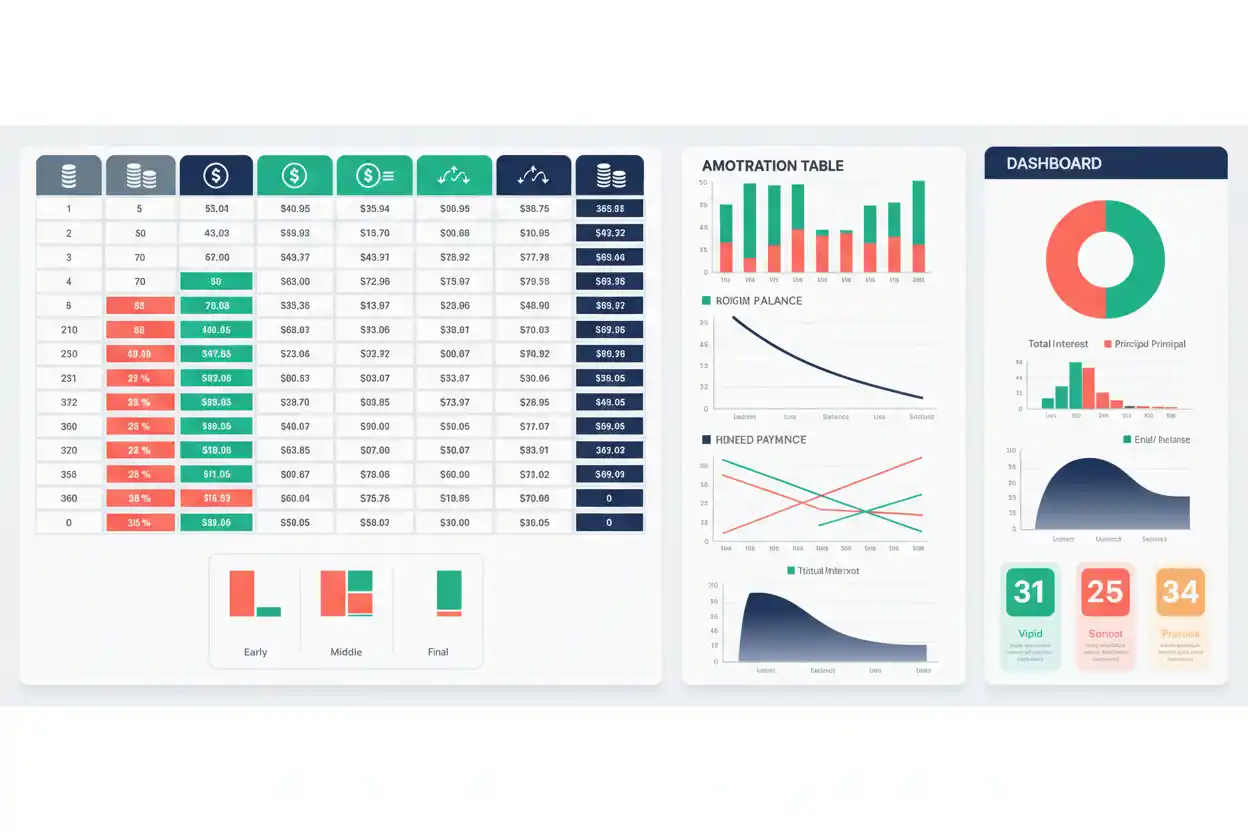

Repayment schedules show how a loan changes from one payment period to the next.
For a standard amortizing loan, each row normally identifies:
beginning principal balance, scheduled payment, interest, principal repayment, and ending principal balance.
The core formulas are:
Interest = Beginning Principal × Periodic Interest Rate
Principal Repaid = Payment − Interest
Ending Principal = Beginning Principal − Principal Repaid
The next period then begins with the previous period’s ending balance.
This creates a complete mathematical path from the original amount borrowed to the final scheduled payoff.
What Is a Repayment Schedule?
A repayment schedule is a table or timeline showing how debt is expected to be repaid.
For a conventional fixed-rate loan, it answers:
How much is due each period?
How much goes to interest?
How much reduces principal?
What balance remains afterward?
The broader Loans & Credit framework uses repayment schedules to connect loan payment formulas with the actual evolution of debt throughout the Finance category.
Repayment Schedule Formula
For each payment period:
Interestₜ = Beginning Balanceₜ × Periodic Rate
Principalₜ = Paymentₜ − Interestₜ
Ending Balanceₜ = Beginning Balanceₜ − Principalₜ
Then:
Beginning Balanceₜ₊₁ = Ending Balanceₜ
This sequence repeats until principal reaches approximately zero.
Loan Payment Used in the Schedule
For a standard fixed-rate amortizing loan, the periodic payment can be calculated as:
Payment = P × [r(1 + r)^n] ÷ [(1 + r)^n − 1]
Where:
P = original principal
r = periodic rate
n = total number of payments
The specialist loan payments page owns that payment formula in depth.
A repayment schedule begins after the payment has been established.
Repayment Schedule Example
Assume:
Principal = $20,000
Annual interest rate = 6%
Term = 36 months
Monthly rate = 0.5%
Monthly payment:
Payment ≈ $608.44
The first three rows are approximately:
| Payment | Beginning Balance | Payment | Interest | Principal | Ending Balance |
|---|---|---|---|---|---|
| 1 | $20,000.00 | $608.44 | $100.00 | $508.44 | $19,491.56 |
| 2 | $19,491.56 | $608.44 | $97.46 | $510.98 | $18,980.58 |
| 3 | $18,980.58 | $608.44 | $94.90 | $513.54 | $18,467.04 |
The payment is essentially constant.
Interest declines.
Principal repayment rises.
The balance falls.
That is conventional amortization.
First Payment Calculation
Beginning balance:
$20,000
Interest:
Interest = $20,000 × 0.5%
Interest = $100
Principal:
Principal = $608.44 − $100
Principal = $508.44
Ending balance:
Ending Balance = $20,000 − $508.44
Ending Balance = $19,491.56
Second Payment Calculation
Beginning balance:
$19,491.56
Interest:
Interest = $19,491.56 × 0.5%
Interest ≈ $97.46
Principal:
Principal ≈ $608.44 − $97.46
Principal ≈ $510.98
Ending balance:
Ending Balance ≈ $18,980.58
The schedule is self-updating because each new row begins from the previous row’s result.
Why Interest Declines
The principal balance gets smaller.
With the periodic rate unchanged:
Smaller Principal × Same Rate = Smaller Interest Charge
As a result, more of the fixed payment becomes available for principal repayment.
That is why standard amortization accelerates principal reduction later in the loan.
Repayment Schedule vs Amortization Schedule
The terms are often used interchangeably for installment loans.
An amortizing loan schedule specifically demonstrates how a balance is reduced through payments.
A broader repayment schedule could also include:
interest-only periods, irregular installments, balloons, variable rates, or other structures.
Therefore, every amortization schedule is a repayment schedule, but not every repayment schedule necessarily describes conventional level-payment amortization.
Repayment Schedule and Simple Interest
A simple interest loan can use a repayment schedule.
If interest is calculated from outstanding principal:
Interest = Current Principal × Applicable Periodic Rate
The interest amount changes as principal changes.
When actual payment dates vary, the schedule may need to use elapsed days rather than a fixed monthly period.
Daily Simple Interest Schedule
With daily simple interest:
Interest = Principal × Annual Rate × Days ÷ Day-Count Basis
Suppose:
Principal = $10,000
Annual rate = 8%
Days = 30
Basis = 365
Interest ≈ $65.75
If the next payment arrives after 35 days instead, interest increases.
Therefore, a daily-interest schedule can differ from a simple monthly projection.
Accrued Interest in a Repayment Schedule
Accrued interest represents interest accumulated since the relevant starting point.
If a payment arrives later than scheduled, additional accrued interest can change the allocation.
For example:
Expected interest = $100
Actual accrued interest = $115
A $600 payment now leaves:
Principal Reduction = $600 − $115
Principal Reduction = $485
rather than $500.
The ending principal will therefore be higher than originally projected.
Repayment Schedule and EMI
An EMI schedule normally shows equal monthly installments.
Although the EMI remains level, principal and interest components change every month.
This makes the repayment schedule especially useful for explaining why the balance does not decline by the same dollar amount each period.
Repayment Schedule and Loan Term
The loan term determines the number of rows or payment periods in a conventional schedule.
A five-year monthly loan has:
5 × 12 = 60 Scheduled Monthly Payments
A longer term produces more rows, a lower payment when other assumptions stay constant, and generally more total interest.
Repayment Schedule and Fixed Rates
With a fixed vs variable interest rate fixed-rate loan, the periodic rate remains stable under the contractual fixed-rate terms.
That allows the schedule to be projected more easily at origination.
A variable-rate schedule requires assumptions about future rates.
Variable-Rate Repayment Schedules
Suppose a loan begins at 5% and resets to 7% after two years.
The original payment or remaining term may need to be recalculated.
The repayment schedule therefore changes at the reset date.
A fixed spreadsheet that assumes 5% forever would no longer represent the contract.
Flat vs Reducing-Balance Schedules
The flat vs reducing balance interest distinction materially changes how interest appears.
A standard reducing-balance schedule calculates interest from the outstanding principal.
A flat-rate structure may determine interest from the original principal in a different manner.
Borrowers should not assume a flat-rate table follows normal amortization mechanics.
Compound Interest and Repayment Schedules
A compound interest loan can increase the balance when unpaid interest becomes part of the amount used for later interest.
If payments are insufficient, the schedule can show:
interest added, principal not reduced, and balance increasing.
That contrasts sharply with positive amortization.
Negative Amortization
Suppose:
Beginning balance = $50,000
Interest due = $400
Payment = $300
Then:
Unpaid Interest = $400 − $300
Unpaid Interest = $100
If the $100 is capitalized:
Ending Balance = $50,000 + $100
Ending Balance = $50,100
The borrower made a payment, yet the balance increased.
A good repayment schedule makes this immediately visible.
Extra Payment Example
Suppose the normal schedule shows:
Beginning principal = $18,000
Payment = $608.44
Interest = $90
Normal principal reduction:
$608.44 − $90 = $518.44
Now the borrower adds $1,000 directly to principal.
Total principal reduction becomes:
$518.44 + $1,000 = $1,518.44
Ending principal is reduced much more quickly.
Future interest is then calculated from the smaller balance.
How Extra Payments Change the Schedule
Additional principal can:
shorten the loan term, reduce total interest, or alter later scheduled payments if the loan is formally recast.
The exact result depends on lender policy.
A borrower should verify that extra money is actually being applied to principal rather than simply advancing the next payment due date.
Prepayment Penalties
Before changing the schedule aggressively, review any prepayment penalty.
A schedule showing thousands of dollars of future interest savings can still overstate the net benefit if an early-repayment charge applies.
The correct comparison is:
Net Savings = Future Interest Avoided − Prepayment Costs
Repayment Schedule and Payoff Quote
A loan payoff quote differs from the scheduled balance.
A repayment schedule assumes the borrower continues making payments according to the modeled dates.
A payoff quote calculates what is needed to end the loan on a specific actual date.
Accrued interest or charges can therefore cause the two figures to differ.
Secured Loan Repayment Schedules
A secured loan can use a conventional amortization schedule.
The mathematics of principal and interest can be identical to unsecured financing.
The difference is that collateral secures the lender’s claim.
Therefore, repayment schedule and collateral structure should be analyzed separately.
Personal Loan Repayment Schedules
Personal loan payments commonly use fixed installments.
A repayment table can help borrowers see:
how slowly principal declines early, total interest over the term, and the potential effect of extra payments.
Student Loan Repayment Schedules
Student loan payments can follow several repayment structures.
A standard fixed-payment plan can resemble ordinary amortization.
Income-based payment structures can vary because payments may depend on income and family size rather than only principal, rate, and a fixed amortization period.
Student Loan Interest and Schedule Timing
Student loan interest can accrue daily.
That means a simplified monthly schedule may not exactly reproduce the servicer’s actual interest allocation when months contain different numbers of days or payments arrive on different dates.
Balloon Payment Schedule
Suppose a five-year loan uses payments based on a 20-year amortization period.
The schedule can show ordinary principal and interest for 60 months, followed by a large remaining balance.
That final amount is the balloon.
The presence of a balloon means the loan is not fully amortized by its legal maturity.
Interest-Only Schedule
During an interest-only period:
Payment = Interest
and:
Principal Reduction = $0
If:
Principal = $100,000
Annual rate = 6%
Monthly interest-only payment:
$100,000 × 6% ÷ 12 = $500
The balance remains $100,000 until principal payments begin.
Repayment Schedule and APR
APR measures annualized borrowing cost.
A repayment schedule normally displays contractual payment cash flows.
Fees incorporated into APR may not appear as ordinary interest rows.
Therefore, amortization alone should not be used as a complete APR analysis.
Common Repayment Schedule Mistakes
One mistake is calculating every period’s interest from the original principal.
Another is subtracting the entire payment from principal.
Borrowers also assume projected schedules remain correct after variable-rate resets or payment delays.
A fourth mistake is failing to account for extra payments.
Finally, a repayment schedule should not be confused with a lender’s current payoff quote.
Frequently Asked Questions
What is a repayment schedule?
It is a table or timeline showing how scheduled payments affect interest, principal, and the remaining balance.
What columns does an amortization schedule contain?
Common columns are payment number, beginning balance, payment, interest, principal, and ending balance.
What is the interest formula?
Interest = Beginning Principal × Periodic Rate
How do I calculate principal repayment?
Principal = Payment − Interest
How do I calculate ending balance?
Ending Balance = Beginning Balance − Principal Repaid
Why does interest decline over time?
Because the outstanding principal becomes smaller under a normal reducing-balance loan.
Does every repayment schedule have equal payments?
No. Variable-rate, interest-only, balloon, and irregular loans can have different payment patterns.
Can extra payments change the schedule?
Yes. Additional principal can reduce future interest and shorten the term.
Why does my lender’s schedule differ from my calculator?
Differences can arise from day counts, payment timing, rounding, fees, variable rates, and contract-specific rules.
Is the balance on my schedule my payoff amount?
Not necessarily. A payoff quote can include accrued interest and other charges through a specific date.
Can a repayment schedule show a growing balance?
Yes. Negative amortization can cause the balance to increase.
Does APR appear directly in the schedule?
Not necessarily. The schedule usually uses the contractual interest rate, while APR can incorporate additional finance charges.
Final Takeaway
A repayment schedule converts a loan into a period-by-period explanation of where every payment goes.
The key formulas are:
Interest = Beginning Balance × Periodic Rate
Principal = Payment − Interest
Ending Balance = Beginning Balance − Principal
On a $20,000 loan at 6% for 36 months, the approximately $608.44 first payment contains:
$100 of Interest
and:
$508.44 of Principal
leaving approximately:
$19,491.56
outstanding.
The schedule then repeats that process until the balance reaches zero—or until a rate change, extra payment, missed payment, balloon, or other contractual event changes the path.