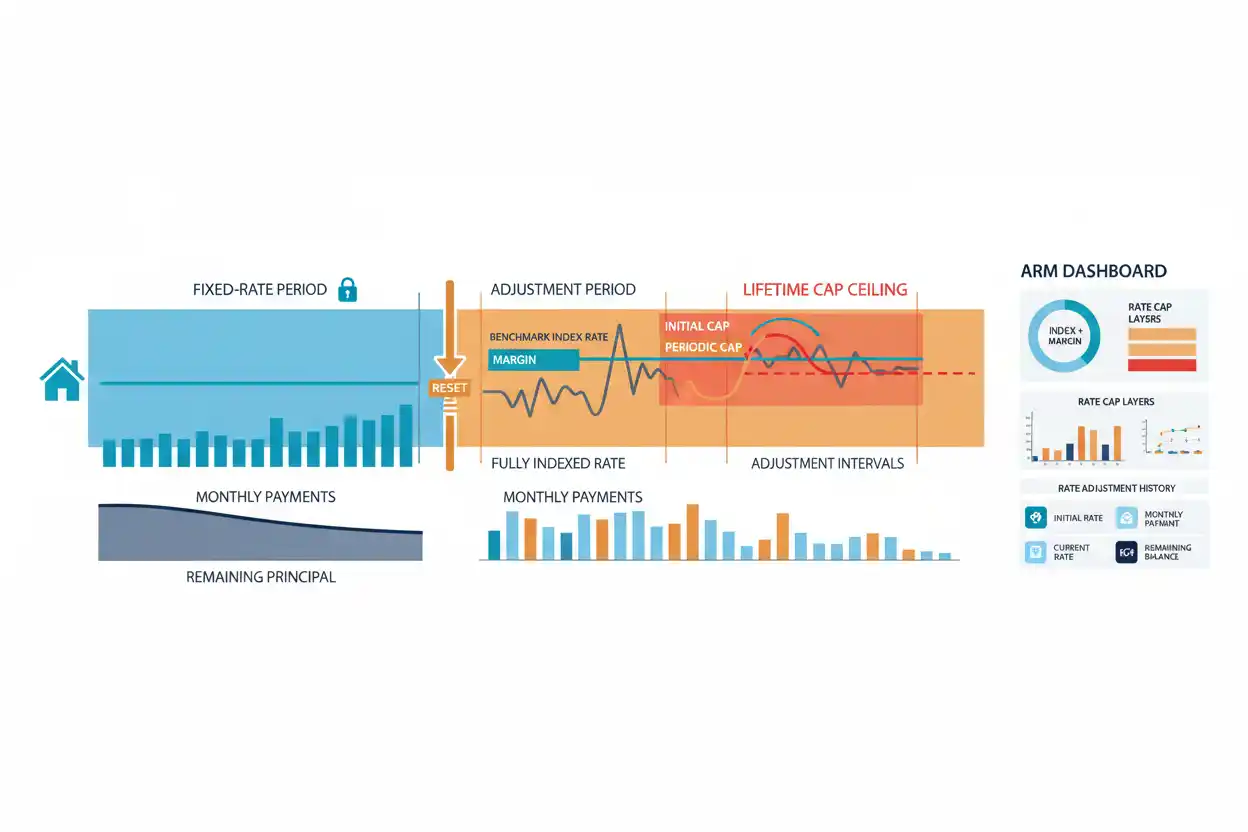
An adjustable-rate mortgage, or ARM, is a mortgage whose interest rate can change after an initial period according to the loan’s contractual adjustment rules.
The central rate relationship is:
Fully Indexed Rate = Index + Margin
Suppose:
Index = 5.25%
Margin = 2.50%
Then:
Fully Indexed Rate = 5.25% + 2.50%
Fully Indexed Rate = 7.75%
However, the mortgage does not necessarily reset immediately to 7.75%.
Rate caps can limit how far the actual rate moves at the first adjustment, at later adjustments, and over the entire life of the loan.
That interaction among index, margin, adjustment schedule, and caps defines the economics of an adjustable-rate mortgage.
What Is an Adjustable-Rate Mortgage?
An ARM combines:
an initial interest-rate period and later rate adjustments.
For example, an ARM can begin with a rate that remains unchanged for several years.
After that initial period, the rate can reset periodically according to the mortgage terms.
The broader Mortgages & Home Loans pillar connects ARMs with fixed-rate mortgages, refinancing, affordability, mortgage APR, payment structures, and home equity.
ARM Rate Formula
A common relationship is:
Fully Indexed Rate = Index + Margin
The index is a benchmark specified by the mortgage.
The margin is an additional percentage stated in the loan terms.
Suppose:
Index = 4.00%
Margin = 2.75%
Then:
Fully Indexed Rate = 6.75%
If the index later rises to 5.50%:
Fully Indexed Rate = 8.25%
The margin stayed at 2.75%.
Only the index changed.
ARM Terminology
A notation such as a hypothetical 5/1 ARM generally indicates an initial rate period followed by a particular adjustment frequency.
The exact meaning should always be verified from the loan documents rather than inferred solely from the shorthand.
The important questions are:
When can the first adjustment occur?
How frequently can later adjustments occur?
Which index applies?
What margin is added?
What caps limit changes?
Adjustable-Rate Mortgage Example
Suppose:
Original mortgage = $350,000
Initial rate = 5.5%
Initial fixed period = 5 years
Original amortization term = 30 years
The initial payment is calculated like a normal fixed-rate payment using 5.5% and 360 months:
Initial Payment = P × [r(1 + r)^n] ÷ [(1 + r)^n − 1]
The result is approximately:
Initial Principal-and-Interest Payment ≈ $1,987.26 per Month
Remaining Balance Before the First Reset
After 60 scheduled payments, the principal has not fallen to:
$350,000 − ($1,987.26 × 60)
because much of each payment covered interest.
Using the amortization balance formula, the remaining principal is approximately:
Remaining Balance After 5 Years ≈ $323,612.11
That remaining balance becomes important when the mortgage payment is recalculated.
Fully Indexed Rate at Reset
Assume that at the first adjustment:
Index = 5.25%
Margin = 2.50%
Then:
Fully Indexed Rate = 7.75%
Now assume the mortgage has a hypothetical initial adjustment cap that allows the rate to rise by no more than two percentage points from the 5.5% initial rate.
The cap would limit the first reset to:
Maximum First-Reset Rate = 5.5% + 2.0%
Maximum First-Reset Rate = 7.5%
Even though the fully indexed rate is 7.75%, the applicable first-reset rate in this hypothetical example becomes 7.5% because of the cap.
New ARM Payment
Remaining principal:
$323,612.11
New rate:
7.5%
Remaining term:
25 Years = 300 Months
Recalculating the payment:
New Payment ≈ $2,391.46 per Month
Increase:
Payment Increase = $2,391.46 − $1,987.26
Payment Increase ≈ $404.20 per Month
Percentage increase:
$404.20 ÷ $1,987.26 × 100 ≈ 20.3%
The mortgage payment increases by about one-fifth even though the borrower did not borrow additional principal.
Why ARM Payments Change
A standard amortizing ARM recalculates payments because the interest rate has changed while a substantial principal balance remains outstanding.
The new payment must generally be sufficient to amortize the remaining principal across the remaining term under the applicable rate and loan rules.
Conceptually:
New Payment = Function(Remaining Principal, New Rate, Remaining Term)
The how mortgage payments work page owns the broader mortgage-payment mechanics.
ARM Index
The index is the changing reference component.
If:
Index falls, the fully indexed rate can fall.
If:
Index rises, the fully indexed rate can rise.
However, caps, floors, adjustment timing, and other contractual terms can prevent the actual rate from moving one-for-one with the index immediately.
ARM Margin
The margin is the contractual spread added to the index.
Suppose:
Margin = 2.5%
Index at one adjustment = 3%
Fully Indexed Rate = 5.5%
Index later = 6%
Fully Indexed Rate = 8.5%
The margin remains constant in this example.
Initial Adjustment Cap
The initial adjustment cap limits how much the rate can change at the first adjustment.
Suppose:
Initial rate = 5%
Initial adjustment cap = 2 percentage points
Then the first adjusted rate cannot exceed:
7%
under the simplified upward-cap interpretation.
The contract controls the exact rule.
Periodic Adjustment Cap
A periodic cap limits how much the rate can change at a later adjustment.
Suppose:
Current rate = 7%
Periodic cap = 1 percentage point
Even if the fully indexed rate is 9%, the next rate could be limited to:
8%
depending on the loan terms.
Another adjustment could potentially move the rate further later.
Lifetime Cap
A lifetime cap limits how high the rate can rise over the mortgage’s entire life.
Suppose:
Initial rate = 5.5%
Lifetime upward cap = 5 percentage points
Then:
Maximum Lifetime Rate = 5.5% + 5%
Maximum Rate = 10.5%
A borrower considering an ARM should stress-test the mortgage near its maximum permitted rate rather than assuming today’s payment will continue.
ARM vs Fixed-Rate Mortgage
A fixed-rate mortgage provides a stable contractual interest rate under its fixed terms.
An ARM accepts future rate uncertainty.
The basic tradeoff is:
Fixed Rate = Greater Rate Certainty
ARM = Potential Initial Pricing Advantage + Future Adjustment Risk
Neither is automatically better.
The correct choice depends on pricing, holding period, expected refinancing, financial flexibility, and risk tolerance.
ARM and Mortgage APR
Mortgage APR provides another annualized cost measure.
An ARM’s APR should not be interpreted as a guarantee that the mortgage’s actual future rate will follow one exact path.
Variable-rate products inherently depend on future index movements and contractual adjustments.
ARM and Mortgage Interest
The mortgage interest paid over the life of an ARM cannot be known with the same certainty as a fully fixed-rate mortgage when future rates are unknown.
Any long-term projection must assume a future interest-rate path.
Therefore, ARM comparisons should include scenarios rather than one deterministic total-interest number.
ARM Scenario Analysis
A useful comparison can model at least:
Scenario 1: rates remain near the initial level.
Scenario 2: rates rise moderately.
Scenario 3: rates approach contractual caps.
Suppose the borrower can comfortably afford the initial $1,987 payment but cannot afford $2,400 or more.
That indicates a meaningful payment-reset risk even if the ARM begins with attractive pricing.
ARM and Home Affordability
Home affordability should not be based solely on the introductory ARM payment.
A more resilient budget asks:
Can the household afford a materially higher payment after adjustment?
Qualifying for the initial payment and comfortably surviving later resets are different questions.
ARM and Mortgage Affordability
The specialist mortgage affordability analysis should therefore consider potential adjusted payments.
A borrower who uses the entire monthly budget at the introductory rate has little room for a later increase.
ARM and Mortgage Debt-to-Income Ratio
A higher ARM payment can increase the mortgage debt-to-income ratio.
Suppose:
Gross monthly income = $8,000
Other qualifying debts = $1,000
Initial mortgage payment = $1,987.26
Initial DTI contribution:
($1,987.26 + $1,000) ÷ $8,000 × 100
≈ 37.3%
After payment rises to $2,391.46:
($2,391.46 + $1,000) ÷ $8,000 × 100
≈ 42.4%
Rate changes can therefore materially alter household payment burden.
ARM and Mortgage Term
The mortgage term determines the remaining number of payments used at a reset.
In the example:
Original term = 360 months
Payments completed = 60
Remaining term:
360 − 60 = 300 Months
The new rate is applied to the remaining principal over those remaining periods under the simplified recalculation.
ARM and Rate Locks
A mortgage rate lock generally concerns the mortgage pricing available during the origination process.
It should not be confused with an ARM’s later contractual adjustments.
A rate lock at closing does not convert a mortgage designed to adjust later into a permanently fixed-rate loan.
ARM and Refinancing
Refinancing is often considered when an ARM approaches a reset.
However, refinancing is not guaranteed.
Future:
credit profile, home value, income, interest rates, closing costs, and lender requirements
can all affect whether replacing the ARM is attractive or even available.
Therefore, “I’ll refinance before it adjusts” should not be treated as a certainty.
Rate-and-Term Refinance
A rate-and-term refinance can replace the ARM with another mortgage whose rate or term better matches the borrower’s objectives.
The borrower should compare:
new rate, closing costs, remaining ARM balance, new term, and break-even period.
Cash-Out Refinance
A cash-out refinance changes more than the interest-rate structure because it typically increases the new mortgage principal to provide cash.
Replacing an ARM through cash-out refinancing can therefore increase debt even when the new rate is more stable.
ARM and Combined Loan-to-Value
The combined loan-to-value ratio becomes relevant when an ARM exists alongside another home-secured debt such as a HELOC.
Higher combined leverage can reduce refinancing flexibility.
ARM and HELOC
A HELOC can create a second source of variable-rate exposure.
A homeowner with:
an adjustable first mortgage plus a variable HELOC
can experience payment increases on both obligations during a rising-rate environment.
ARM and Balloon Mortgages
A balloon mortgage creates a different type of future-payment risk.
ARM risk:
the interest rate and payment can adjust.
Balloon risk:
a large remaining balance becomes due at maturity.
A mortgage can contain complex features, so borrowers should not use the terms interchangeably.
ARM and Biweekly Mortgage Payments
Biweekly mortgage payments concern payment timing and potentially additional annual principal.
They do not remove ARM rate-reset risk.
Extra principal can reduce the balance exposed to the next adjustment, but the contractual interest rate can still change.
ARM and Bridge Loans
A bridge loan is short-term transitional financing and serves a different purpose from an ARM.
Both can involve variable rates, but their intended holding periods and repayment structures are very different.
ARM and Mortgage Payoff Strategies
Mortgage payoff strategies can reduce an ARM’s future rate exposure by lowering principal before later adjustments.
Suppose an extra $25,000 is applied before a reset.
The next payment is then calculated from a smaller remaining balance.
That can partially offset the effect of a higher rate.
ARM and Mortgage Recast
A mortgage recast should not be assumed to work identically on every ARM.
Eligibility and payment recalculation rules depend on the lender and mortgage documents.
A large principal payment alone does not guarantee a formal recast.
ARM and Mortgage Payoff Amount
The mortgage payoff amount is the amount required to settle the mortgage on a particular date.
An ARM’s current payoff is not simply the maximum future payment multiplied by the remaining term.
Payoff depends on actual principal and amounts accrued through settlement.
ARM and Closing Costs
An ARM can offer an attractive introductory rate while still carrying substantial mortgage closing costs.
A borrower expecting to keep the mortgage only briefly should compare the upfront cost with the amount saved during the introductory period.
ARM Break-Even Thinking
Suppose:
ARM saves $150 per month compared with a fixed mortgage.
Additional ARM-related upfront advantage or cost should be compared with the expected holding period.
If the borrower sells before adjustment, the initial savings can dominate.
If the borrower remains through several rate increases, the outcome can reverse.
There is no universal winner without a time horizon.
Common Adjustable-Rate Mortgage Mistakes
One mistake is assuming the initial rate will remain unchanged.
Another is comparing only the introductory ARM payment with a fixed-rate payment.
Borrowers also overlook the margin.
A fourth mistake is ignoring adjustment caps and lifetime caps.
Another is assuming refinancing will definitely be available before the first reset.
Finally, borrowers should not model only today’s rate when determining long-term affordability.
Frequently Asked Questions
What is an adjustable-rate mortgage?
It is a mortgage whose interest rate can change after an initial period according to its contractual adjustment rules.
What is the ARM rate formula?
A common relationship is:
Fully Indexed Rate = Index + Margin
What is an ARM index?
It is the benchmark component used in determining the adjustable rate.
What is an ARM margin?
It is the contractual percentage added to the index.
What is a rate cap?
A rate cap restricts how much the interest rate can change under specified circumstances.
Can the fully indexed rate exceed the actual adjusted rate?
Yes. A cap can prevent the mortgage from moving immediately to the full index-plus-margin rate.
How is the payment recalculated after adjustment?
A standard approach recalculates payment from the remaining principal, adjusted rate, and remaining term, subject to the mortgage terms.
Can an ARM payment decrease?
Yes, when the applicable rate falls and the loan’s contractual rules allow the decrease.
Can an ARM payment increase significantly?
Yes. Borrowers should evaluate adjustment and lifetime caps before relying on the introductory payment.
Is an ARM cheaper than a fixed mortgage?
Not automatically. The outcome depends on initial pricing, future index movements, holding period, caps, and refinancing decisions.
Can I refinance before an ARM resets?
Potentially, but future refinancing depends on market rates, home value, credit, income, fees, and lender requirements.
What should I check before choosing an ARM?
Review the initial rate period, index, margin, adjustment frequency, caps, maximum possible rate, maximum payment, APR, closing costs, and your ability to afford future increases.
Final Takeaway
An adjustable-rate mortgage is built around a changing-rate formula:
Fully Indexed Rate = Index + Margin
But the actual rate can also be constrained by contractual caps.
In the worked example:
Original mortgage = $350,000
Initial rate = 5.5%
Initial payment ≈ $1,987.26
Balance after five years ≈ $323,612.11
If the fully indexed rate becomes 7.75% but an initial cap restricts the first reset to 7.5%, the recalculated payment over the remaining 25 years becomes approximately:
$2,391.46 per Month
That is an increase of about:
$404.20 per Month
The key ARM question is therefore not whether the introductory payment is affordable.
It is whether the borrower understands and can withstand the index, margin, adjustment schedule, rate caps, and payment changes that can occur after the introductory period ends.