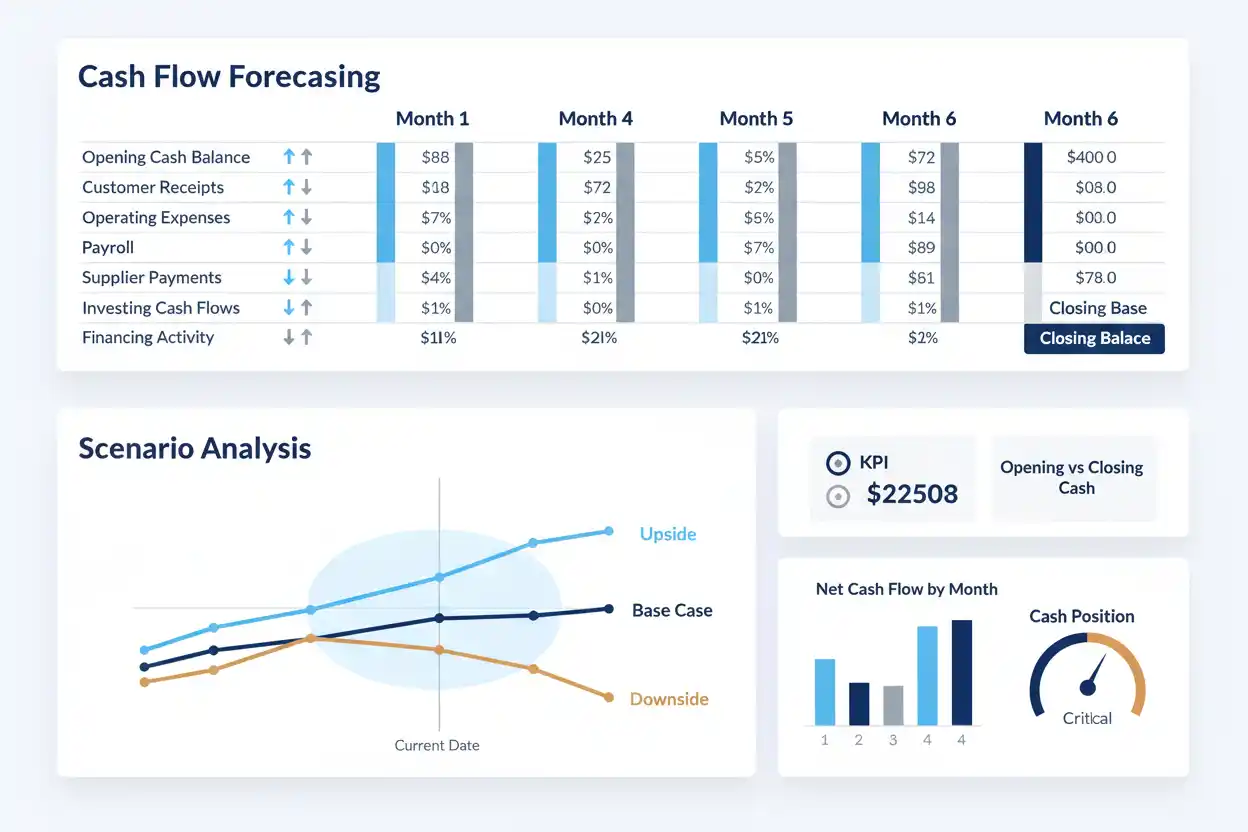

Cash flow forecasting estimates when cash is expected to enter and leave a business so management can project future cash balances, identify potential shortfalls, and make financing or spending decisions before cash becomes tight.
At its simplest, a cash flow forecast begins with available cash, adds expected cash inflows, subtracts expected cash outflows, and carries the resulting balance into the next forecast period.
Closing Cash Balance = Opening Cash Balance + Cash Inflows − Cash Outflows
If a business starts a month with $120,000, expects $185,000 of cash receipts, and plans $220,000 of cash payments:
Closing Cash Balance = $120,000 + $185,000 − $220,000
Closing Cash Balance = $85,000
That $85,000 becomes the opening cash balance for the next period unless the forecast includes another adjustment.
The arithmetic is straightforward. The quality of cash flow forecasting depends on the assumptions behind customer collections, supplier payments, payroll, taxes, inventory, capital expenditure, debt service, and other cash movements.
That makes cash forecasting a core part of business finance rather than simply a spreadsheet exercise.
What Is Cash Flow Forecasting?
Cash flow forecasting is the process of estimating future cash receipts, cash payments, and resulting cash balances over a defined period.
A forecast can cover several weeks, months, quarters, or years. The appropriate horizon depends on the decision.
A business facing immediate liquidity pressure may need a detailed weekly forecast. A stable company preparing an annual operating plan may work primarily with monthly periods. A long-term investment model may project cash flows for several years.
Regardless of horizon, the fundamental purpose is the same: understand the timing of cash before the cash movement actually happens.
This differs from a historical cash flow statement, which records what has already occurred.
The forecast looks forward.
Cash Flow Forecasting Formula
The basic formula for one period is:
Forecast Closing Cash = Opening Cash + Forecast Cash Inflows − Forecast Cash Outflows
For multiple periods, each closing balance becomes the next period’s opening balance.
For Month 1:
Month 1 Closing Cash = Month 1 Opening Cash + Month 1 Inflows − Month 1 Outflows
For Month 2:
Month 2 Opening Cash = Month 1 Closing Cash
Then:
Month 2 Closing Cash = Month 2 Opening Cash + Month 2 Inflows − Month 2 Outflows
The process continues across the forecast.
This rolling relationship is the foundation of most practical cash forecasts.
Cash Flow Forecasting Example
Consider a business beginning January with $100,000 of cash.
It expects the following January cash movements:
Customer receipts: $150,000
Other cash receipts: $10,000
Supplier payments: $65,000
Payroll: $55,000
Rent and overhead: $20,000
Equipment purchase: $15,000
Total expected inflows are:
Cash Inflows = $150,000 + $10,000 = $160,000
Total expected outflows are:
Cash Outflows = $65,000 + $55,000 + $20,000 + $15,000
Cash Outflows = $155,000
Closing cash becomes:
Closing Cash = $100,000 + $160,000 − $155,000
Closing Cash = $105,000
The company appears to finish January with $5,000 more cash than it started with.
However, that single monthly figure may conceal an important timing issue.
If most customer receipts arrive on January 29 but payroll and supplier bills are due on January 10, the business could experience a temporary cash deficit during the month despite ending January with $105,000.
Cash flow forecasting therefore needs enough time resolution to match the financial risk being managed.
Cash Flow Forecasting vs Cash Flow Statement
A cash flow statement and a cash flow forecast serve related but different purposes.
A cash flow statement reports historical cash movements. Public-company cash flow statements classify cash flows into operating, investing, and financing activities.
A cash flow forecast estimates future movements using assumptions.
Historical cash flow can inform the forecast, but it does not automatically predict the future.
A business may have historically spent $40,000 per month on payroll but already know that new hires will raise payroll to $60,000 next quarter.
Using the historical figure without the known change would understate expected cash outflows.
The best forecasts therefore combine reliable historical information with known future events and explicit assumptions.
Cash Flow Forecasting vs Profit Forecasting
Profit and cash are not interchangeable.
A company can record revenue before receiving the related customer cash. It can recognize expenses at a different time from the associated cash payment. Depreciation can reduce accounting profit without creating a current-period cash payment.
This distinction explains why a profitable business can still face a cash shortage.
Suppose a company records $200,000 of sales in March but customers are allowed 60 days to pay.
Those sales may support March accounting revenue, but much of the cash could arrive in May.
Meanwhile, March payroll, rent, suppliers, and taxes may still require cash.
A net profit forecast can therefore look healthy while the cash forecast reveals a financing gap.
Start With the Opening Cash Balance
Every short-term cash flow forecast needs a credible starting point.
The opening balance should represent the cash actually available under the forecast definition.
If the business has $150,000 in bank accounts but $30,000 is restricted and unavailable for normal operations, blindly using the full $150,000 could exaggerate liquidity.
Similarly, an unused credit facility should not automatically be presented as existing cash. It may be shown separately as potential financing capacity.
The opening balance anchors every period that follows, so errors at the start propagate through the entire forecast.
Forecast Customer Cash Receipts
For many businesses, customer collections are the largest cash inflow.
The key word is collections, not simply sales.
If all customers pay immediately, forecast revenue and forecast receipts may be similar. If customers receive 30-, 60-, or 90-day credit terms, the timing can be very different.
Suppose monthly sales are forecast at $300,000, but only 20% is collected in the month of sale and 80% is collected the following month.
Cash receipts need to follow that collection pattern rather than showing the full $300,000 as immediate cash.
Days sales outstanding can help evaluate historical collection behavior, but the forecast should also reflect known customer-specific terms and overdue balances.
Accounts Receivable and Forecast Accuracy
Accounts receivable deserve special attention because invoiced revenue can create a false sense of available liquidity.
A forecast should distinguish between invoices expected to be issued and cash expected to be collected.
If a $100,000 invoice is due in 30 days but the customer historically pays 20 days late, using the contractual date without judgment may overstate near-term cash.
Likewise, a disputed invoice should not be treated as certain cash merely because it appears in accounts receivable.
The forecast becomes stronger when major collections are tied to actual expected payment behavior.
This is also why changes in the cash conversion cycle can materially affect future liquidity.
Forecast Supplier Payments
Supplier outflows should reflect when cash is expected to leave the company, not just when expenses are recognized.
A company may purchase materials today but have 45 days to pay the supplier.
That timing can temporarily finance part of the operating cycle.
Days payable outstanding provides a useful historical indicator, but forecast payments should also reflect actual invoice due dates, negotiated payment schedules, planned purchases, and supplier arrangements.
A business should not improve a forecast artificially by assuming bills will simply be paid later than agreed.
Delayed payment can affect supplier relationships and may create fees or operating disruption.
Inventory Can Consume Cash Before Revenue Appears
Inventory-intensive businesses often spend cash before generating the related sale.
A retailer preparing for a holiday season may purchase inventory several months before customers buy it.
A manufacturer may need raw materials well before finished products are invoiced.
That means rapid sales growth can initially increase cash requirements.
Days inventory outstanding and inventory turnover help explain historical inventory efficiency, while the forecast translates planned purchases into specific future cash outflows.
This connection between inventory, collections, and supplier payments is why cash forecasting and working-capital analysis belong together.
Payroll Forecasting
Payroll is often one of the largest recurring cash commitments.
Forecasting it requires more than copying last month’s amount.
Known hires, departures, bonuses, commissions, overtime, payroll taxes, benefits, and scheduled compensation changes can alter future payments.
If a company plans to add ten employees over the next six months, the cash forecast should reflect each expected start date rather than applying the full additional payroll immediately or ignoring it until the employees arrive.
Payroll forecasting becomes especially important because businesses have limited flexibility to delay employee payments when cash becomes tight.
Fixed Costs and Cash Forecasts
Some operating payments remain relatively predictable from period to period.
Rent, software subscriptions, insurance, recurring professional fees, and certain salary costs may provide a stable baseline.
Understanding fixed costs can therefore help structure the forecast.
However, accounting cost classifications and cash timing should still be separated.
An annual insurance premium may behave economically like a fixed cost but create one large cash payment rather than twelve equal monthly payments.
Cash forecasting must model the actual payment schedule.
Variable Costs and Growth
Variable expenses generally increase as business activity increases.
A company forecasting higher sales may also need to forecast higher materials, fulfillment, commissions, card-processing charges, shipping, or other activity-linked payments.
Contribution margin helps show how much revenue remains after variable costs, but cash forecasting goes one step further by asking when those costs are actually paid.
If sales rise 30% while variable cash expenses rise roughly with volume, forecasting revenue without the associated costs will exaggerate future liquidity.
Capital Expenditures
Equipment, vehicles, facilities, technology infrastructure, and other capital investments can create large cash outflows.
Those payments may not appear as equivalent current-period expenses on the income statement because the assets can be depreciated over time.
The cash forecast still needs the actual payment.
Suppose a company plans to buy $250,000 of equipment in June.
If the purchase is paid entirely in June:
June Investing Cash Outflow = $250,000
If it is financed, the forecast may instead show the down payment and financing cash flows according to the transaction.
This distinction is one reason free cash flow and accounting earnings can move differently.
Debt Payments
Borrowing can create both cash inflows and future cash outflows.
When a business receives a loan, cash increases.
Subsequent principal and interest payments reduce cash according to the financing agreement.
A forecast should model the timing of both rather than treating borrowing as permanent additional liquidity.
The company’s debt-to-equity ratio may help describe capital structure, but the cash forecast needs the actual scheduled payments.
Similarly, a refinancing transaction can temporarily increase available cash while changing future obligations.
Taxes
Tax payments can create significant cash movements that do not occur evenly every month.
The correct treatment depends on the business, jurisdiction, tax type, and payment schedule.
A forecast should therefore include expected tax cash payments in the periods when management reasonably expects them to occur rather than smoothing every obligation into an arbitrary monthly amount.
Known deadlines and professional tax estimates can materially improve forecast accuracy.
Tax planning and tax compliance involve additional legal and accounting considerations beyond the cash forecast itself.
Operating, Investing and Financing Cash Flows
A useful long-term forecast can separate cash movements into the same broad economic categories used in historical cash-flow reporting.
Operating cash flows arise primarily from normal business activity, such as customer receipts, suppliers, employees, and operating expenses.
Investing cash flows generally relate to acquiring or disposing of long-lived assets and investments.
Financing cash flows relate to obtaining or returning capital, such as borrowing, debt repayment, equity investment, or distributions.
This separation helps management understand why the cash balance changes.
A company generating negative operating cash flow but positive total cash flow because it borrowed money has a different financial profile from one generating cash through operations.
Direct Cash Flow Forecasting
A direct cash forecast lists expected cash receipts and payments.
For short-term liquidity management, this approach is intuitive because it follows actual expected bank movements.
A simple structure can include customer receipts, supplier payments, payroll, rent, taxes, capital expenditure, financing payments, and other known movements.
The core calculation remains:
Closing Cash = Opening Cash + Receipts − Payments
The direct method is particularly useful when management needs to know whether enough cash will be available on specific dates or weeks.
Indirect Cash Flow Forecasting
An indirect forecast begins with projected accounting results and adjusts for noncash items and balance-sheet changes.
A simplified conceptual relationship is:
Operating Cash Flow ≈ Net Income + Noncash Charges ± Working Capital Adjustments
The exact calculation depends on the financial statements and accounting framework being used.
The indirect approach can be useful for longer-range financial modeling because the forecast income statement, balance sheet, and cash flow statement can be linked together.
However, a highly aggregated monthly indirect forecast may be less useful for identifying a specific payroll shortage next Thursday.
The method should match the decision.
Weekly vs Monthly Cash Flow Forecasting
Forecast frequency should reflect financial volatility.
A business with stable recurring receipts and substantial cash reserves may manage effectively with monthly projections.
A company with tight liquidity, irregular collections, or large individual payments may need weekly or even more detailed short-term visibility.
Imagine a business that begins and ends April with $100,000.
A monthly forecast might suggest no problem.
Yet if a $150,000 supplier payment is due April 5 and the largest customer payment arrives April 25, the cash balance could become negative between those dates.
A more granular forecast exposes the problem.
The 13-Week Cash Flow Forecast
A 13-week forecast is commonly used as a practical short-term liquidity horizon because it provides roughly one quarter of weekly visibility.
The structure is not a special accounting formula.
Each week follows the same relationship:
Ending Cash = Beginning Cash + Weekly Inflows − Weekly Outflows
The strength of a 13-week forecast comes from the level of operational detail.
Near-term customer receipts can be tied to specific invoices. Supplier payments can follow due dates. Payroll dates are known. Debt and tax payments can be inserted explicitly.
As the forecast extends outward, assumptions generally become less certain.
Monthly Cash Flow Forecast Example
Assume a business starts Quarter 1 with $200,000.
January inflows: $180,000
January outflows: $210,000
January Closing Cash = $200,000 + $180,000 − $210,000
January Closing Cash = $170,000
February inflows: $220,000
February outflows: $200,000
February Closing Cash = $170,000 + $220,000 − $200,000
February Closing Cash = $190,000
March inflows: $240,000
March outflows: $275,000
March Closing Cash = $190,000 + $240,000 − $275,000
March Closing Cash = $155,000
The company remains cash-positive throughout the quarter based on these monthly closing balances, but its cash reserve declines from $200,000 to $155,000.
That trend deserves attention even though no month finishes below zero.
Minimum Cash Balance
Many businesses do not want their forecast to approach zero.
Management may establish a minimum operating cash balance to provide flexibility for unexpected receipts or payments.
Suppose the company’s policy is to maintain at least $100,000.
If the forecast shows a closing balance of $70,000 in August, the relevant funding gap is not necessarily only the amount below zero.
Relative to the desired reserve:
Cash Reserve Gap = Required Minimum Cash − Forecast Cash
Cash Reserve Gap = $100,000 − $70,000 = $30,000
Management can then act before actual cash reaches a dangerous level.
Cash Flow Forecasting and Cash Runway
Cash runway estimates how long available cash may last at a given burn rate.
A simple runway formula is:
Cash Runway = Available Cash ÷ Monthly Net Burn
Cash flow forecasting is more detailed.
Rather than assuming a constant monthly burn, it can model changing revenue, hiring, collections, investments, financing, and expenses period by period.
For a startup with predictable, stable burn, a runway estimate provides a useful headline.
When burn changes materially over time, the detailed cash flow forecast is the more informative planning tool.
Cash Flow Forecasting and Burn Rate
Burn rate describes the pace at which a cash-consuming business is depleting cash.
Historical net burn can provide a starting assumption for a forecast, but simply repeating the current burn indefinitely may be unrealistic.
Suppose current monthly burn is $150,000.
Management plans to launch a product that increases cash receipts while also hiring new employees.
Future burn might first rise and later decline.
A cash forecast models that path explicitly.
Cash Flow Forecasting and the Cash Ratio
The cash ratio measures current cash and cash-equivalent resources relative to current liabilities under the selected formula.
It provides a balance-sheet snapshot.
Cash flow forecasting adds timing.
A company may currently have a comfortable cash ratio but know that a major annual payment is due next month.
Another business may have limited cash today but expect a contractually scheduled customer receipt before major obligations come due.
Static liquidity ratios and cash forecasts therefore complement one another rather than competing.
Cash Flow Forecasting and Current Ratio
The current ratio compares current assets with current liabilities.
A company can have a current ratio above 1 while still facing cash pressure if much of its current assets consist of slow-moving inventory or receivables that will not be collected soon.
Cash forecasting asks when those assets actually become usable cash and when liabilities require payment.
That timing dimension often explains why apparently adequate working capital does not always eliminate liquidity risk.
Cash Flow Forecasting and Break-Even Analysis
Break-even analysis estimates the sales level at which contribution covers fixed costs under the modeled assumptions.
A business can exceed accounting break-even yet still experience negative cash flow.
Customer collections may lag sales. Capital expenditures may be large. Debt principal may need repayment. Inventory may absorb cash.
Conversely, a company below accounting break-even may temporarily maintain cash through financing or customer prepayments.
Break-even analysis and cash flow forecasting therefore answer different questions.
One focuses on operating economics. The other focuses on cash timing.
Cash Flow Forecasting and Business Valuation
Future cash generation is central to many business valuation methods.
However, a valuation forecast and a short-term cash-management forecast do not necessarily have the same level of detail or purpose.
A valuation model may project annual cash flows over several years and focus on normalized long-term economics.
A liquidity forecast may model receipts and payments week by week.
Both require credible assumptions, but the required precision changes with the decision.
Base, Upside and Downside Forecasts
A single forecast can imply more certainty than management actually has.
Scenario analysis helps by changing important assumptions.
A base case represents management’s central expectation.
An upside case may assume stronger collections, sales, or margins.
A downside case may model delayed receipts, weaker revenue, higher costs, or an unexpected capital requirement.
Suppose the base case produces a minimum cash balance of $150,000.
The downside case produces only $20,000.
The business technically remains cash-positive in both cases, but the downside scenario reveals much less financial flexibility.
Cash Flow Sensitivity Analysis
Sensitivity analysis changes one assumption at a time to determine which variables have the largest effect on cash.
Management might test:
What if customer collections are 15 days slower?
What if sales are 10% below forecast?
What if material costs rise 8%?
What if hiring occurs two months earlier?
What if a major customer does not renew?
This process identifies the assumptions that deserve the closest monitoring.
For many businesses, the largest cash risk is not a small office expense. It is a major shift in sales, collections, inventory, payroll, or capital spending.
Forecast Variance Analysis
A forecast should not be created and forgotten.
After each period, compare forecast cash movements with actual results.
For an individual line:
Cash Flow Variance = Actual Cash Flow − Forecast Cash Flow
Suppose customer receipts were forecast at $250,000 but actual collections were $220,000.
Receipt Variance = $220,000 − $250,000
Receipt Variance = −$30,000
The next step is to identify why.
Were sales lower? Did customers pay late? Was one large invoice disputed? Was the forecast assumption unrealistic?
The explanation improves the next forecast.
Rolling Cash Flow Forecasts
A rolling forecast continually adds another future period as the current period closes.
For example, when one month finishes in a rolling 12-month model, management adds a new month at the end so the forecast always looks approximately 12 months ahead.
This prevents the planning horizon from shrinking as the year progresses.
A rolling approach is particularly useful when business conditions change frequently.
The forecast becomes a living management model rather than an annual document that becomes obsolete after several months.
Forecasting Seasonal Cash Flow
Seasonal businesses need to separate annual profitability from monthly liquidity.
A retailer may generate much of its annual profit during a short sales season while purchasing inventory months earlier.
A tourism business may accumulate cash during peak months and consume it during the off-season.
A seasonal forecast should therefore reflect actual expected timing.
Using a simple annual average can hide the periods when cash needs are greatest.
The same reasoning applies to businesses with annual insurance, tax, bonus, subscription, or maintenance payments.
How Growth Can Create a Cash Shortfall
Rapid growth is one of the most important reasons to forecast cash.
Suppose sales rise 50%.
The company may need more inventory, more employees, more production capacity, and larger receivables.
Those cash requirements can arrive before customer collections.
The cash conversion cycle helps explain the operating timing, while the forecast converts that timing into specific future balances.
A company can therefore grow profitably and still require external financing.
The faster the expansion, the larger the working-capital requirement can become.
How to Improve Cash Flow Forecast Accuracy
Accuracy begins with realistic inputs.
Near-term customer receipts should be tied to actual invoices and expected payment behavior where possible.
Supplier payments should reflect due dates.
Payroll should incorporate planned hiring and known compensation changes.
Capital expenditure should follow approved projects rather than an arbitrary monthly average.
Large one-time payments should be shown in the months they occur.
Forecast assumptions should also be documented so management can understand why a number changed.
Precision improves through iteration, not by making the spreadsheet more visually complicated.
Common Cash Flow Forecasting Mistakes
A frequent mistake is forecasting revenue instead of cash collections.
Another is recording expenses when incurred rather than when payment is expected.
Businesses can also forget debt principal, taxes, capital expenditure, seasonal inventory, annual payments, or financing transactions.
A forecast may become overly optimistic when every customer is assumed to pay exactly on time.
Using one flat monthly average can conceal weekly cash shortages.
Finally, management can weaken the process by ignoring forecast-versus-actual results. Without reviewing errors, the same bad assumptions can persist month after month.
When a Forecast Shows a Cash Shortfall
A projected shortfall is useful precisely because it appears before the actual shortage.
Depending on the underlying cause, management may accelerate legitimate collections, change purchasing timing, postpone discretionary capital expenditure, adjust hiring, negotiate supplier terms, change spending, obtain financing, or reconsider the operating plan.
The correct response depends on why the shortfall exists.
A temporary timing problem is different from a business that consistently spends more cash than its operations generate.
If negative cash results reflect a structural operating problem, simply borrowing more money may postpone rather than solve it.
Cash Flow Forecasting for Startups
Startups often have limited historical data and rapidly changing expenses.
That makes forecasts less certain, not less necessary.
A startup forecast should connect hiring, product development, marketing, customer growth, collections, infrastructure costs, and financing plans.
Its current burn rate can provide context, while cash runway gives management a simpler measure of how long funding may last.
The cash flow forecast explains how that runway changes over time.
Cash Flow Forecasting for Established Businesses
Established businesses often have better historical patterns but can still face forecasting challenges.
Seasonality, acquisitions, major customers, supply-chain changes, capital investments, debt maturities, and economic shifts can alter cash requirements.
Historical averages should therefore be treated as evidence, not destiny.
A mature company’s forecast may benefit from combining historical collection and payment patterns with known contractual and operational changes.
Frequently Asked Questions
What is cash flow forecasting?
Cash flow forecasting estimates future cash receipts, cash payments, and cash balances over a defined period so a business can anticipate liquidity needs.
What is the basic cash flow forecast formula?
Closing Cash = Opening Cash + Cash Inflows − Cash Outflows
The closing cash balance then becomes the next period’s opening balance.
Why is cash flow forecasting important?
It helps a business identify potential cash shortages, financing requirements, excess liquidity, and the timing effects of sales, expenses, investments, and working capital before those cash movements occur.
Is a cash flow forecast the same as a cash flow statement?
No. A cash flow statement reports historical cash movements. A cash flow forecast estimates future movements.
Is cash flow the same as profit?
No. Profit is an accounting measure. Cash flow reflects actual cash movements, whose timing can differ from when revenue and expenses are recognized.
How far ahead should cash flow be forecast?
The appropriate horizon depends on the business and decision. Tight-liquidity situations may require detailed weekly forecasting, while planning models may extend monthly projections across a year or longer.
What is a 13-week cash flow forecast?
It is a rolling short-term model that projects cash receipts, payments, and balances by week for approximately one quarter.
Should sales revenue equal forecast cash receipts?
Not necessarily. Credit sales may be collected after the sale is recognized, so expected customer payment timing needs to be modeled separately.
Can a profitable business have negative cash flow?
Yes. Receivables, inventory, capital expenditure, debt payments, and other timing differences can consume cash even when accounting profit is positive.
How do you forecast accounts receivable?
Estimate when existing and future invoices are likely to be collected using contractual terms, customer payment history, invoice status, and other relevant evidence.
How often should a cash flow forecast be updated?
Update frequency should match the company’s liquidity risk and operating volatility. Forecasts become more useful when actual results are compared with prior projections and assumptions are revised regularly.
What should happen when a cash forecast shows a shortage?
Management should identify the cause first, then evaluate appropriate actions such as collection timing, purchasing, expenses, financing, investment timing, or operating-plan changes.
Final Perspective
Cash flow forecasting turns future business activity into a timeline of expected liquidity.
The foundation is simple:
Closing Cash = Opening Cash + Cash Inflows − Cash Outflows
The difficult part is estimating those inflows and outflows realistically.
Revenue is not automatically cash received. Expenses are not always paid when recognized. Inventory can consume cash before sales occur. Growth can increase working-capital requirements. Debt can provide immediate liquidity while creating future payments.
A strong cash flow forecast captures those timing differences.
It should also change as the business changes.
The most useful forecast is therefore not the one that predicts every dollar perfectly. It is the one that gives management enough reliable forward visibility to recognize a developing cash problem while there is still time to make a better decision.