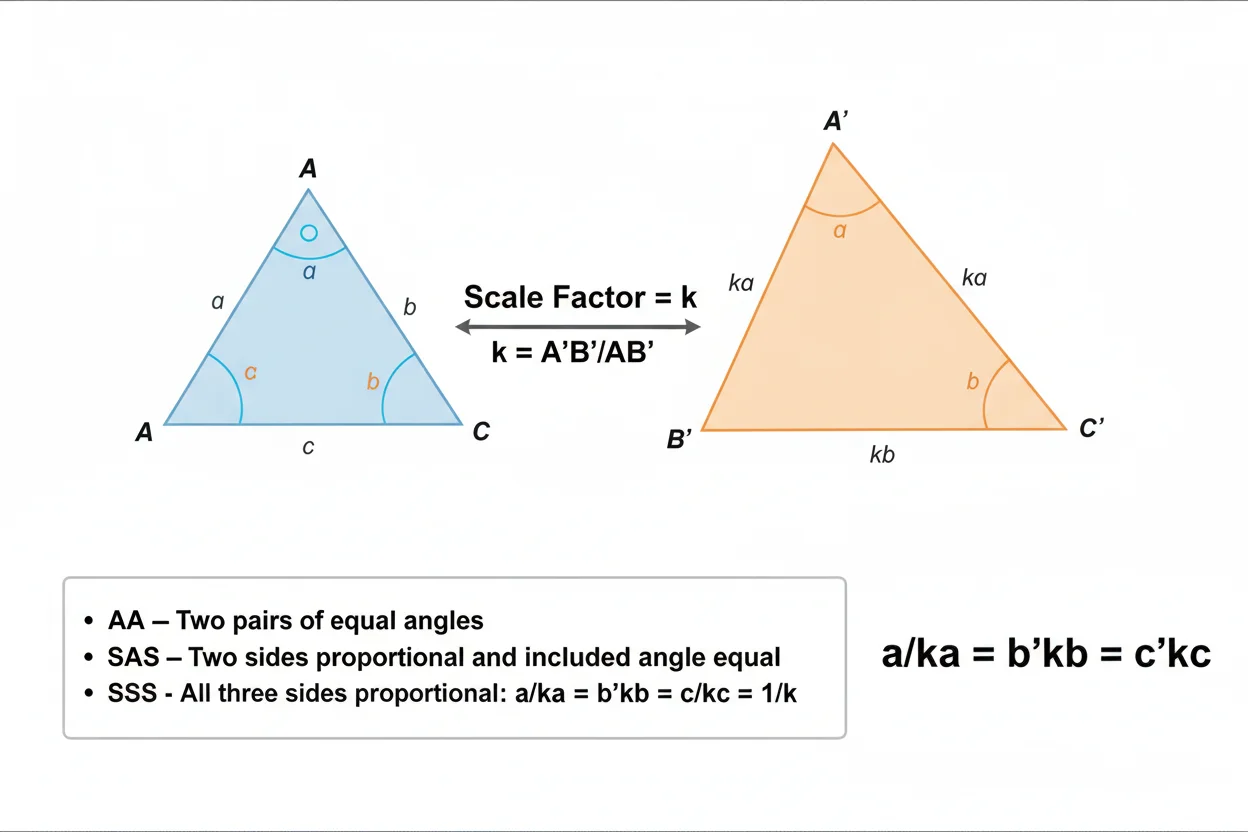

Similar triangles have the same shape but may have different sizes. Their corresponding angles are equal, and their corresponding side lengths are proportional. If one triangle is obtained from another by scale factor k, every corresponding length is multiplied by k. This means corresponding sides satisfy ratios such as a₁/a₂ = b₁/b₂ = c₁/c₂, corresponding perimeters have the same ratio k, and corresponding areas have ratio k². Triangle similarity can be established using AA, SAS, or SSS conditions without proving that every side and angle separately matches. Similar triangles are especially useful for indirect measurement, right-triangle trigonometry, slope, shadows, heights, parallel-line geometry, coordinate dilations, regular polygons, and proportional reasoning.
What Are Similar Triangles?
Two triangles are similar when:
corresponding angles are equal
and:
corresponding sides are proportional
If:
△ABC ∼ △DEF
the order of the letters identifies the correspondence:
A ↔ D
B ↔ E
C ↔ F
Therefore:
∠A = ∠D
∠B = ∠E
∠C = ∠F
and:
AB/DE = BC/EF = AC/DF
Correct correspondence is essential when setting up proportions.
Similar Does Not Mean Equal Size
Similar triangles can have different dimensions.
For example, triangles with side lengths:
3, 4, 5
and:
6, 8, 10
are similar.
Every side in the second triangle is:
2
times the corresponding side in the first.
Their angles are identical.
Their sizes are not.
Scale Factor
If triangle 2 is obtained from triangle 1 by multiplying every corresponding length by k:
k = corresponding side in triangle 2 / corresponding side in triangle 1
Then:
a₂ = ka₁
b₂ = kb₁
c₂ = kc₁
The number k is called the:
scale factor
If:
k > 1
the second triangle is larger.
If:
0 < k < 1
it is smaller.
Basic Scale-Factor Example
Triangle 1 has sides:
4, 6, 8
A similar triangle has corresponding shortest side:
10
Then:
k = 10/4
= 5/2
The remaining sides are:
6(5/2) = 15
and:
8(5/2) = 20
So the second triangle has sides:
10, 15, 20
Corresponding-Side Proportion
If:
△ABC ∼ △DEF
then:
AB/DE = BC/EF = AC/DF
You can also write consistent reciprocal ratios:
DE/AB = EF/BC = DF/AC
What matters is maintaining the same triangle order throughout the proportion.
Missing-Side Example
Suppose:
AB = 6
BC = 9
and the corresponding sides are:
DE = 10
EF = x
Then:
6/10 = 9/x
Cross-multiply:
6x = 90
Therefore:
x = 15
Another Proportion Example
Suppose a small triangle has corresponding sides:
5 and 7
A larger similar triangle has the side corresponding to 5 equal to:
12
Let the side corresponding to 7 be x.
Then:
5/12 = 7/x
Cross-multiply:
5x = 84
Therefore:
x = 84/5
= 16.8
AA Similarity
AA stands for:
Angle-Angle
If two angles of one triangle equal two corresponding angles of another triangle, the triangles are similar.
The third angles must also be equal because every triangle’s Interior Angles total:
180°
Therefore two angle matches are enough.
AA Example
Triangle 1 has angles:
40°, 60°, 80°
Triangle 2 contains angles:
40°
and:
60°
Its third angle must be:
80°
Therefore the triangles are similar by:
AA
No side measurements are required to establish similarity.
Why AAA Is Usually Called AA
If two pairs of corresponding angles are equal, the third pair is automatically equal.
Therefore checking all three angle pairs is unnecessary.
The criterion is conventionally called:
AA similarity
rather than AAA.
SAS Similarity
SAS similarity requires:
two pairs of proportional corresponding sides
and:
equal included angles
Suppose:
AB/DE = AC/DF
and:
∠A = ∠D
where those angles lie between the compared sides.
Then:
△ABC ∼ △DEF
SAS Example
Triangle 1 has sides around angle A:
AB = 6
AC = 9
Triangle 2 has:
DE = 10
DF = 15
The ratios are:
6/10 = 3/5
9/15 = 3/5
If:
∠A = ∠D
then the triangles are similar by SAS.
The Included Angle Matters
For SAS similarity, the equal angle must be between the two proportional side pairs.
Knowing two proportional sides and an unrelated angle does not automatically establish SAS similarity.
This parallels the importance of the included angle in the Law of Cosines.
SSS Similarity
SSS similarity requires all three pairs of corresponding sides to be proportional.
If:
AB/DE = BC/EF = AC/DF
then:
△ABC ∼ △DEF
No angles need to be measured explicitly.
SSS Example
Triangle 1:
3, 5, 7
Triangle 2:
6, 10, 14
Every second-triangle side is:
2
times the corresponding first-triangle side.
Therefore the triangles are similar by:
SSS
Similarity Versus Congruence
Congruent Triangles have:
the same shape
and:
the same size
Similar triangles require only:
the same shape
Congruence is therefore the special similarity case:
k = 1
If the scale factor is not 1, the triangles are similar but not congruent.
Corresponding Angles
If two triangles are similar:
all corresponding angles are equal
Scaling a triangle does not change its angles.
This is why one can enlarge or shrink a triangle while preserving its shape.
Corresponding Perimeters
If corresponding side lengths scale by k, perimeter also scales by k.
Therefore:
P₂/P₁ = k
Suppose:
P₁ = 24
and:
k = 3
Then:
P₂ = 72
This follows because Perimeter is the sum of linear side lengths.
Perimeter Example
A small triangle has sides:
3, 4, 5
so:
P₁ = 12
A similar triangle has scale factor:
5
Its sides are:
15, 20, 25
and:
P₂ = 60
Indeed:
60/12 = 5
Area Ratio of Similar Triangles
Areas scale with the square of the linear scale factor.
Therefore:
A₂/A₁ = k²
If:
side ratio = 3
then:
area ratio = 9
This is one of the most important similarity relationships.
Area-Ratio Example
Suppose two similar triangles have corresponding sides:
4
and:
10
Then:
k = 10/4
= 5/2
Area ratio:
A₂/A₁ = (5/2)²
Therefore:
A₂/A₁ = 25/4
If the smaller area is:
32
the larger area is:
32(25/4)
Therefore:
200
Recover Scale Factor From Area Ratio
If:
A₂/A₁ = R
then:
k = √R
Suppose similar triangles have areas:
25
and:
100
Then:
k = √(100/25)
= √4
Therefore:
k = 2
Every corresponding length in the larger triangle is twice as large.
Triangle Area and Similarity
The general Triangle Area formula is:
A = bh/2
If every corresponding length scales by k:
b → kb
and:
h → kh
Then:
A_new = (kb)(kh)/2
= k²A
This explains the squared area ratio directly.
Corresponding Altitudes
Corresponding altitudes of similar triangles are linear dimensions.
Therefore:
h₂/h₁ = k
The same is true for:
medians
angle bisectors
inradii
circumradii
Each scales by the ordinary linear scale factor.
Altitude Example
Suppose a triangle has altitude:
7
A similar triangle has side scale factor:
3/2
Then the corresponding altitude is:
7(3/2)
Therefore:
10.5
Median Scaling
The Triangle Medians also scale linearly.
If corresponding sides double:
every corresponding median doubles
while:
triangle area quadruples
This distinction between linear and area scaling is central to similar figures.
Right Triangles and Similarity
Right Triangles are similar whenever they have one equal acute angle.
Both already have:
90°
so another matching angle establishes AA similarity.
This is why right-triangle trigonometric ratios depend only on angle rather than triangle size.
Right-Triangle Similarity Example
Triangle 1 has:
opposite = 3
adjacent = 4
hypotenuse = 5
A similar triangle has hypotenuse:
20
Scale factor:
20/5 = 4
Therefore:
opposite = 12
adjacent = 16
The angle ratios remain unchanged.
Why Sine Is Constant for Similar Right Triangles
For an acute angle θ:
sinθ = opposite/hypotenuse
If a similar triangle scales both lengths by k:
sinθ = k(opposite)/k(hypotenuse)
The k cancels:
sinθ = opposite/hypotenuse
Therefore Sine is determined by the angle, not by the triangle’s size.
Cosine and Similarity
Likewise:
cosθ = adjacent/hypotenuse
Under scale factor k:
cosθ = kadjacent/khypotenuse
The scale factor cancels.
This is why all similar right triangles sharing θ have the same cosine.
Secant and Similarity
The Secant ratio is:
secθ = hypotenuse/adjacent
In similar right triangles, both numerator and denominator scale by k.
Therefore:
secθ
remains unchanged.
This gives a geometric explanation for secant as a function of angle rather than absolute size.
Tangent and Similarity
The tangent ratio:
tanθ = opposite/adjacent
also remains unchanged under scaling.
This relationship connects similar triangles directly to Slope.
A line with fixed slope creates infinitely many similar slope triangles.
Slope Triangles
Suppose a line has:
rise = 3
run = 4
Then:
slope = 3/4
A larger slope triangle on the same line might have:
rise = 6
run = 8
These triangles are similar because:
3/6 = 4/8 = 1/2
Their common angle with the horizontal is the same.
Why Slope Is Constant Along a Line
Every right triangle drawn along the same nonvertical straight line shares:
a right angle
and:
the same acute inclination angle
Therefore the slope triangles are similar by AA.
Corresponding ratios are equal:
rise/run = constant
This geometric similarity explains why a straight line has one constant slope.
Similarity From Parallel Lines
Parallel lines frequently create similar triangles.
If a line inside a triangle is parallel to one side, corresponding and alternate interior angles become equal.
This often establishes AA similarity.
The resulting side proportions can determine missing segment lengths.
Parallel-Line Example
In triangle ABC, suppose:
D lies on AB
E lies on AC
and:
DE ∥ BC
Then:
∠ADE = ∠ABC
∠AED = ∠ACB
Therefore:
△ADE ∼ △ABC
So:
AD/AB = AE/AC = DE/BC
Missing Segment With a Parallel Line
Suppose:
AD = 4
AB = 10
AE = 6
Find AC.
Use:
AD/AB = AE/AC
Therefore:
4/10 = 6/AC
Cross-multiply:
4AC = 60
So:
AC = 15
Triangle Proportionality Theorem
When a line parallel to one side of a triangle intersects the other two sides, it divides those sides proportionally.
Using the previous arrangement:
AD/DB = AE/EC
This is closely related to the similarity of:
△ADE
and:
△ABC
Rather than being a separate phenomenon, the proportionality follows from similar triangles.
Indirect Measurement
Similar triangles can measure distances that are difficult to access directly.
Typical examples include:
building heights
tree heights
widths across rivers
distances to inaccessible points
The method compares the unknown triangle with a measurable similar triangle.
Shadow Example
A:
2 m
vertical pole casts a:
1.5 m
shadow.
At the same time, a building casts a:
18 m
shadow.
Because the sun angle is the same, the height-shadow triangles are similar.
Set:
2/1.5 = H/18
Then:
1.5H = 36
Therefore:
H = 24 m
Why Shadow Triangles Are Similar
Both objects are vertical, creating:
90°
angles with level ground.
The sunlight rays are effectively parallel, so the acute angle formed with the ground is the same.
Thus the triangles are similar by:
AA
Their height-to-shadow ratios are equal.
Mirror Measurement
An observer can sometimes use a mirror on level ground to create similar triangles.
The sight line and reflection geometry establish equal angles.
If:
observer eye height / observer-mirror distance
equals:
object height / object-mirror distance
the unknown object height can be found proportionally.
The geometry must be set up so the corresponding angles are actually equal.
Similarity and the Pythagorean Theorem
Dropping an altitude from the right-angle vertex of a right triangle to its hypotenuse creates three similar triangles.
This provides a classic proof of the Pythagorean Theorem.
If the altitude divides hypotenuse c into:
p
and:
q
then similarity gives:
a² = cp
b² = cq
Adding:
a² + b² = c(p + q)
Since:
p + q = c
we obtain:
a² + b² = c²
Geometric Mean Relationships
The same right-triangle similarity gives:
h² = pq
where h is the altitude to the hypotenuse.
Thus:
h = √(pq)
The two legs satisfy:
a = √(cp)
b = √(cq)
These formulas arise specifically because all three triangles are similar.
Example With Hypotenuse Segments
Suppose:
p = 4
q = 9
Then:
c = 13
Altitude:
h = √36
= 6
One leg:
a = √(13·4)
= 2√13
Other leg:
b = √(13·9)
= 3√13
Similar Triangles and the Law of Sines
The Law of Sines states:
a/sinA = b/sinB = c/sinC
Similar triangles have identical corresponding angles, so their sine values match.
If one similar triangle is scaled by k, all of a, b, and c scale by k while the angle sines remain unchanged.
This is consistent with the law’s proportional structure.
Similar Triangles and Law of Cosines
The Law of Cosines is:
c² = a² + b² − 2ab cosC
If every side is multiplied by k:
(kc)² = (ka)² + (kb)² − 2(ka)(kb)cosC
Every term has factor:
k²
which cancels.
Therefore the corresponding angle C remains unchanged.
This algebraically confirms that uniform scaling preserves triangle shape.
Similarity and Congruence
If similar triangles have one pair of corresponding sides equal, then their scale factor is:
k = 1
All corresponding sides are therefore equal.
The triangles are then congruent.
So similarity plus one equal corresponding length can upgrade the relationship to congruence.
Coordinate Dilations
A dilation centered at the origin with scale factor k maps:
(x,y)
to:
(kx,ky)
If all triangle vertices undergo the same dilation, the new triangle is similar to the original.
Angles are preserved, while every distance is multiplied by:
|k|
For positive k, orientation from the center is preserved.
Coordinate Dilation Example
Original vertices:
A = (1,1)
B = (4,1)
C = (1,5)
Apply scale factor:
k = 2
New vertices:
A′ = (2,2)
B′ = (8,2)
C′ = (2,10)
Original legs:
3 and 4
New legs:
6 and 8
The triangles are similar with:
k = 2
Distance Formula Under Scaling
The Distance Formula between two points is:
d = √[(Δx)² + (Δy)²]
Under dilation by k:
Δx → kΔx
Δy → kΔy
Therefore:
d_new = √[k²(Δx² + Δy²)]
For positive k:
d_new = kd
This confirms coordinate distances scale correctly.
Slope Under Dilation
For a dilation centered at the origin:
rise → krise
run → krun
Therefore:
slope_new = krise/krun
= rise/run
The slope is unchanged.
This is another reason corresponding sides of dilated triangles remain parallel.
Similarity and Point-Slope Form
Suppose multiple right triangles are drawn along a line described by Point-Slope Form:
y − y₁ = m(x − x₁)
Every slope triangle on the line has:
rise/run = m
Thus all such triangles are similar.
The equation’s constant m is a direct algebraic representation of that similarity.
Similarity and Sector Area
Circular sectors with the same central angle are similar.
For equal θ:
arc length ∝ r
perimeter ∝ r
and Sector Area satisfies:
A = r²θ/2
Therefore:
area ∝ r²
If radius ratio is k:
sector area ratio = k²
This is the same area-scaling law as similar triangles.
Similar Sector Example
Two 90° sectors have radii:
3
and:
9
Scale factor:
3
Therefore their area ratio is:
9
The smaller area is:
9π/4
The larger area is:
81π/4
and:
(81π/4)/(9π/4) = 9
Similar Triangles in Regular Polygons
A Regular Polygon Area can be decomposed into congruent central triangles.
Regular polygons of the same number of sides are similar.
If their side-length ratio is k:
perimeter ratio = k
apothem ratio = k
circumradius ratio = k
area ratio = k²
Regular Polygon Example
Two regular hexagons have side lengths:
4
and:
10
Their linear scale factor is:
10/4 = 5/2
Therefore area ratio:
25/4
The larger hexagon has:
6.25
times the area.
Similar Triangles and Prism Geometry
If triangular bases of two similar Prism Volume solids scale by k, their base areas scale by:
k²
If the entire prisms are geometrically similar, their prism heights also scale by k.
Therefore volumes scale by:
k³
Triangle similarity thus extends naturally into three-dimensional scaling.
Similar Triangles and Pyramid Geometry
Parallel cross sections of a Pyramid Volume create similar polygons and, in axial slices, similar triangles.
If a smaller pyramid cut from the top has linear scale factor k relative to the full pyramid:
area ratio = k²
volume ratio = k³
This is why parallel cuts create predictable frustum-volume relationships.
Pyramid Cross-Section Example
Suppose a plane parallel to a pyramid base cuts off a smaller similar pyramid whose height is:
1/2
of the original.
Then:
linear scale factor = 1/2
The smaller base area is:
1/4
of the original base area.
The smaller pyramid volume is:
1/8
of the original volume.
Similarity and Frustum Geometry
A frustum formed by a cut parallel to the base of a cone or pyramid relies fundamentally on similarity.
For a conical frustum, radii of corresponding circular cross sections are proportional to their distances from the original cone apex.
For pyramidal frustums, corresponding base lengths follow the same proportional scaling.
These relationships support the Frustum Volume derivation.
Similar Triangles and Chords
Circle geometry often creates similar triangles through intersecting chords, secants, radii, or parallel chords.
For example, drawing radii to chord endpoints creates isosceles triangles.
Additional perpendiculars can produce pairs of right triangles with matching acute angles.
The Chord Length formulas can then be derived or applied using these proportional relationships.
Similarity From Angle Bisectors
An Angle Bisector Theorem problem often uses proportional side relationships within a triangle.
Although the angle bisector theorem is not simply an AA-similarity statement in its final form, standard proofs frequently construct or exploit similar triangles.
The theorem states that an internal angle bisector divides the opposite side in the ratio of the adjacent sides.
Similarity and Triangle Altitudes
Corresponding Triangle Altitudes scale by the same factor as corresponding sides.
Suppose similar triangles have:
side ratio = 4/3
If the smaller altitude is:
9
the corresponding larger altitude is:
12
The area ratio is then:
(4/3)² = 16/9
Similarity and Triangle Medians
Corresponding medians also scale linearly.
If:
k = 5/2
then every corresponding median is multiplied by:
5/2
This works because a dilation maps side midpoints to side midpoints and vertices to corresponding vertices.
Similarity and Circumradius
Corresponding circumradii scale by k.
If one triangle has:
R₁ = 4
and a similar triangle has:
k = 3
then:
R₂ = 12
This is consistent with the extended Law of Sines:
a/sinA = 2R
because side a scales while angle A remains fixed.
Similarity and Inradius
The inradius is also a linear measurement.
Therefore:
r₂/r₁ = k
If the triangle area scales by:
k²
and semiperimeter scales by:
k
the identity:
A = rs
remains consistent:
k²A = (kr)(ks)
Finding a Scale Factor From Perimeters
Because:
P₂/P₁ = k
a perimeter ratio directly gives the linear scale factor.
Suppose:
P₁ = 42
P₂ = 63
Then:
k = 63/42
= 3/2
Every corresponding side, altitude, median, inradius, and circumradius has ratio:
3/2
Find Area From Perimeter Ratio
Using the same example:
k = 3/2
Therefore:
A₂/A₁ = 9/4
If:
A₁ = 40
then:
A₂ = 40(9/4)
Therefore:
A₂ = 90
Finding Side Ratio From Area Ratio
Suppose:
A₂/A₁ = 49/16
Then:
k = √(49/16)
Therefore:
k = 7/4
So each corresponding length in triangle 2 is:
7/4
times the corresponding length in triangle 1.
Similarity With Algebraic Sides
Suppose corresponding sides are:
x + 2
and:
12
while another corresponding pair is:
5
and:
15
Set:
(x + 2)/12 = 5/15
Simplify:
(x + 2)/12 = 1/3
Then:
x + 2 = 4
Therefore:
x = 2
Another Algebraic Example
Suppose:
AB = 2x + 1
DE = 15
BC = x + 3
EF = 12
and:
AB/DE = BC/EF
Then:
(2x + 1)/15 = (x + 3)/12
Cross-multiply:
12(2x + 1) = 15(x + 3)
24x + 12 = 15x + 45
Therefore:
9x = 33
so:
x = 11/3
Similarity and Orientation
Similar triangles do not need to face the same direction.
One can be:
rotated
reflected
translated
or:
scaled
relative to the other.
The correspondence is determined by matching angles and proportional sides, not by visual orientation on the page.
Mirror-Image Similarity
A reflected triangle can still be similar to the original.
The orientation reverses, but:
angle measures remain equal
and:
corresponding side lengths remain proportional
This is why a diagram should not be judged solely by whether the triangles “look” aligned.
Side-Side-Angle Is Not a Similarity Criterion
SSA is not a general similarity criterion.
Two side ratios plus a nonincluded equal angle can sometimes produce different triangle configurations.
This is related to the ambiguous case of the Law of Sines.
Use:
AA
SAS with included angle
or:
SSS
as the standard similarity tests.
AAA Determines Shape but Not Size
Three angles determine a triangle’s shape but not its scale.
All triangles with angles:
30°, 60°, 90°
are similar.
They may have side lengths:
1, √3, 2
or:
5, 5√3, 10
or any proportional scaling.
This is why angle information establishes similarity rather than congruence.
Similarity and Units
Corresponding side ratios should compare compatible units.
Suppose one side is:
2 m
and its corresponding side is:
150 cm
Convert:
2 m = 200 cm
Then:
scale factor = 150/200
= 3/4
Mixing units without conversion would produce the wrong ratio.
Exact Fractions Versus Decimals
A scale factor such as:
7/3
is exact.
Using:
2.333…
can introduce rounding into later side or area calculations.
Keep exact ratios when practical, especially before squaring them for area comparisons.
Common Similar Triangles Mistakes
A common mistake is matching noncorresponding sides.
The order in:
△ABC ∼ △DEF
means:
A ↔ D
B ↔ E
C ↔ F
and the side correspondence follows from that order.
Another error is assuming triangles are similar because they look alike.
Similarity must be supported by:
AA
SAS
or:
SSS
For SAS, the equal angle must be included between the proportional sides.
Do not use side scale factor k as the area scale factor; area changes by:
k²
Likewise, perimeter changes by k, not k².
Convert mixed units before forming ratios.
Finally, remember that similarity preserves angles but does not require equal side lengths.
Frequently Asked Questions
What are similar triangles?
Similar triangles have equal corresponding angles and proportional corresponding sides.
What does △ABC ∼ △DEF mean?
It means:
A ↔ D
B ↔ E
C ↔ F
and corresponding sides follow the same order.
What are the three main similarity tests?
AA
SAS
SSS
What is AA similarity?
Two pairs of equal corresponding angles are enough to prove triangle similarity.
What is SAS similarity?
Two pairs of proportional sides and their equal included angle prove similarity.
What is SSS similarity?
All three pairs of corresponding sides are proportional.
What is the scale factor?
k = new corresponding length/original corresponding length
How do perimeters scale?
P₂/P₁ = k
How do areas scale?
A₂/A₁ = k²
How do altitudes scale?
By the same linear factor k.
How do medians scale?
By k.
How do circumradii and inradii scale?
Both scale by k.
Are all congruent triangles similar?
Yes. Their scale factor is:
1
Are all similar triangles congruent?
No. Only when:
k = 1
Why are right triangles with one equal acute angle similar?
They also share a 90° angle, so AA similarity applies.
Why are trigonometric ratios constant for a fixed angle?
All right triangles containing that acute angle are similar, so their corresponding side ratios are equal.
How is slope related to similar triangles?
Slope triangles along the same line are similar, so:
rise/run
remains constant.
How do you find a scale factor from an area ratio?
k = √(A₂/A₁)
How can I check a similarity calculation?
Verify the vertex correspondence, confirm every proportion uses matching sides in the same order, and check that perimeter ratios equal k while area ratios equal k².