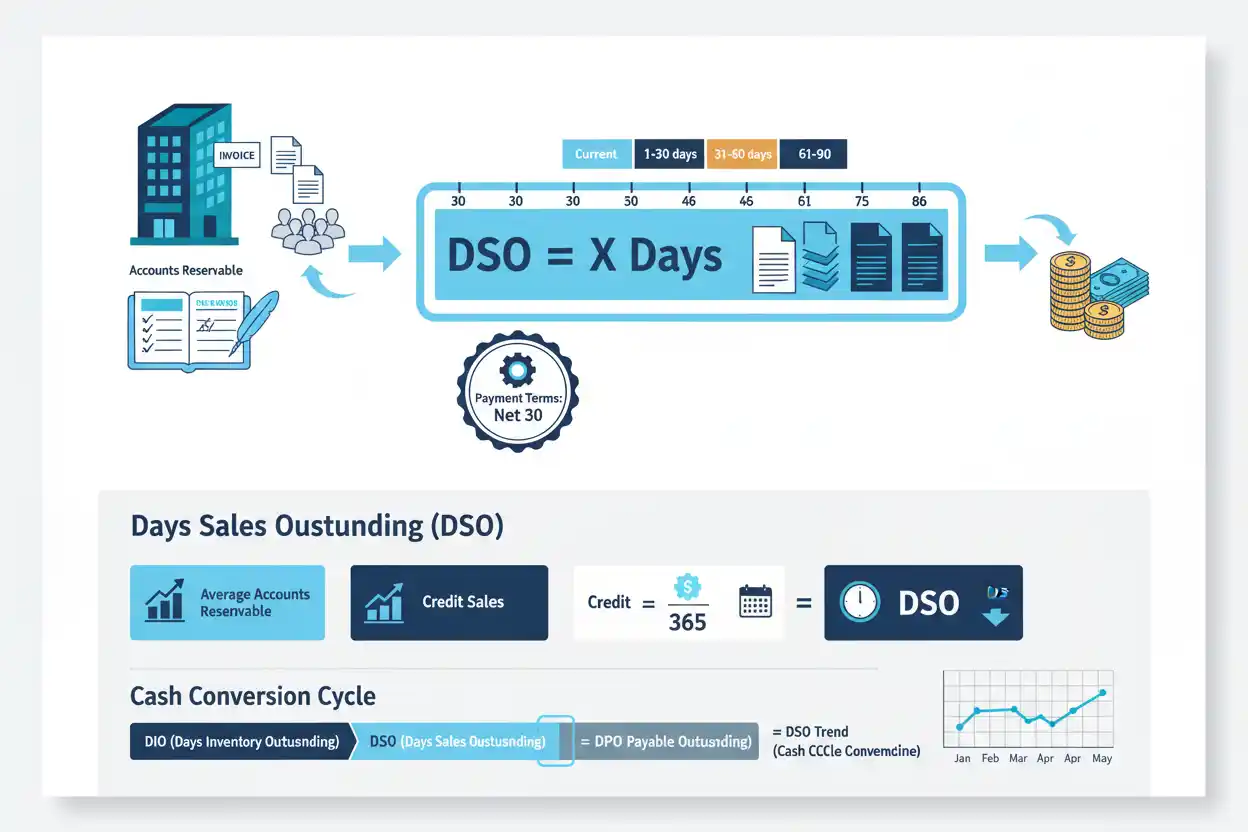

Days sales outstanding, commonly abbreviated DSO, estimates how long a company takes, on average, to collect payment after making sales that create accounts receivable.
The standard concept compares accounts receivable with the sales activity responsible for generating those receivables.
A common formula is:
Days Sales Outstanding = Average Accounts Receivable ÷ Credit Sales × Number of Days
If average accounts receivable is $500,000 and annual credit sales are $5 million:
DSO = $500,000 ÷ $5,000,000 × 365
DSO = 36.5 days
The company therefore takes approximately 37 days to collect its credit sales under this calculation.
A lower DSO generally means customer invoices convert to cash faster. A higher DSO generally means cash remains tied up in accounts receivable for longer.
Neither result can be judged correctly without context. Contractual payment terms, customer mix, billing accuracy, seasonality, revenue growth, disputed invoices, industry practice, and collection performance all affect the result.
Within business finance, days sales outstanding is especially important because it links customer payment behavior with working capital, liquidity, and the cash conversion cycle.
What Is Days Sales Outstanding?
Days sales outstanding measures the average collection period represented by accounts receivable.
A company that sells entirely for immediate cash may have very little trade receivable exposure.
A business that gives customers 30, 60, or 90 days to pay can carry substantial accounts receivable even when sales are strong.
DSO translates that receivable balance into a days-based measure.
Conceptually, it asks:
How long does the business wait between recognizing or invoicing a credit sale and collecting the related cash?
Suppose a company reports 45-day DSO.
That does not mean every customer pays on day 45.
Some may pay immediately. Others may pay on day 30, day 60, or much later. DSO combines the receivable portfolio into an average financial relationship.
Days Sales Outstanding Formula
A common DSO formula is:
DSO = Average Accounts Receivable ÷ Credit Sales × Days in Period
For an annual calculation:
DSO = Average Accounts Receivable ÷ Annual Credit Sales × 365
Average accounts receivable can be calculated as:
Average Accounts Receivable = (Beginning Accounts Receivable + Ending Accounts Receivable) ÷ 2
Suppose beginning receivables are $600,000 and ending receivables are $800,000.
Average Accounts Receivable = ($600,000 + $800,000) ÷ 2
Average Accounts Receivable = $700,000
If annual credit sales are $7 million:
DSO = $700,000 ÷ $7,000,000 × 365
DSO = 36.5 days
The business therefore carries approximately 37 days of credit sales in receivables.
DSO Using Ending Accounts Receivable
Some companies and analysts calculate DSO using the period-end receivable balance rather than average receivables.
That version can be written:
DSO = Ending Accounts Receivable ÷ Average Daily Credit Sales
Average daily credit sales are:
Average Daily Credit Sales = Credit Sales ÷ Days in Period
Suppose ending accounts receivable equals $900,000 and annual credit sales total $7.3 million.
Average Daily Credit Sales = $7,300,000 ÷ 365
Average Daily Credit Sales = $20,000
Then:
DSO = $900,000 ÷ $20,000
DSO = 45 days
Both ending-balance and average-balance approaches are used in practice.
The methodology should be identified before comparing DSO across businesses or periods.
Why Average Receivables Can Be Better
Sales occur throughout a period, while ending accounts receivable represents one date.
If receivables fluctuate significantly, one period-end balance may not represent the typical amount outstanding.
Suppose a seasonal business usually carries $300,000 of receivables but reaches $1 million immediately after its peak selling month.
Calculating DSO from the $1 million peak balance can make annual collection performance look slower than it normally is.
Using beginning and ending balances helps, while monthly or quarterly average receivables can provide even better information when customer activity is volatile.
The appropriate averaging method should reflect the analytical objective.
Days Sales Outstanding Example
Consider a B2B company with:
Beginning accounts receivable = $900,000
Ending accounts receivable = $1,100,000
Annual credit sales = $8 million
Average receivables are:
Average Accounts Receivable = ($900,000 + $1,100,000) ÷ 2
Average Accounts Receivable = $1,000,000
Now calculate DSO:
DSO = $1,000,000 ÷ $8,000,000 × 365
DSO ≈ 45.6 days
The company collects its credit sales in approximately 46 days on average under the calculation.
Whether that is strong performance depends heavily on its customer terms.
If most customers receive 60-day terms, 46-day DSO may indicate relatively fast payment.
If contractual terms are 30 days, the same DSO suggests that some customer balances remain unpaid beyond the expected schedule.
Credit Sales vs Total Revenue
Conceptually, DSO should compare accounts receivable with the sales that create those receivables.
That makes credit sales the preferable denominator when reliable information is available.
Cash sales do not create accounts receivable.
Suppose a retailer generates $10 million of total revenue, but only $2 million is sold on credit.
Average receivables equal $200,000.
Using total revenue:
DSO = $200,000 ÷ $10,000,000 × 365
DSO = 7.3 days
Using credit sales:
DSO = $200,000 ÷ $2,000,000 × 365
DSO = 36.5 days
The difference is substantial.
When external financial statements do not disclose credit sales separately, total or net sales may be used as a practical approximation. That limitation should be recognized rather than ignored.
What Does a High DSO Mean?
A high days sales outstanding means accounts receivable are large relative to sales under the chosen calculation.
Several explanations are possible.
Customers may be taking longer to pay.
The company may have intentionally offered longer credit terms.
A large customer could have delayed payment.
Invoices may contain errors or disputes.
Sales may have increased sharply near period-end.
Customer mix may have shifted toward large businesses or government entities with longer payment cycles.
High DSO therefore identifies a collection or timing characteristic; it does not automatically prove poor credit management.
The underlying receivables need examination.
What Does a Low DSO Mean?
A low DSO generally means the company collects customer invoices quickly.
This can support stronger liquidity because less cash remains tied up in receivables.
Possible causes include shorter payment terms, effective collections, customer deposits, card payments, automatic billing, high-quality customers, or a business model that receives payment before or shortly after delivery.
However, excessively restrictive credit terms can discourage customers.
A business could lower DSO dramatically by requiring immediate payment from everyone, yet lose profitable sales because competitors offer 30- or 60-day terms.
The financial goal is therefore not necessarily minimum DSO.
It is efficient collection within commercially appropriate credit terms.
What Is a Good DSO?
There is no universal good DSO.
The correct benchmark depends on customer contracts, industry, sales model, customer quality, geography, billing practices, seasonality, and business strategy.
A 55-day DSO may be excellent when customers contractually receive 60 days to pay.
The same 55 days can be poor when invoices are due in 20 days.
A stronger benchmark compares DSO with contractual terms and the company’s own historical performance.
Comparable competitors can provide additional context when their business and customer structures are similar.
DSO vs Payment Terms
One of the most useful comparisons is:
Actual DSO vs contractual customer payment terms.
Suppose the standard invoice term is net 30.
If DSO is 28 days, aggregate collections broadly occur within that period.
If DSO increases to 47 days while terms remain unchanged, management should investigate why.
Now suppose the business intentionally changes its standard terms from 30 to 60 days to win larger enterprise customers.
DSO may increase even when customers continue paying perfectly on time.
The higher DSO then reflects a commercial strategy rather than deteriorating collection discipline.
DSO and Accounts Receivable
Accounts receivable is money owed to the company for qualifying goods or services already provided or invoiced according to the applicable accounting arrangement.
Receivables are assets, but they are not cash.
If receivables rise faster than revenue, DSO can increase.
Suppose sales grow 10% while receivables grow 40%.
That divergence can indicate that more revenue remains uncollected.
The company should then determine whether the cause is payment terms, customer mix, billing delays, disputes, seasonality, or weaker collection behavior.
Receivables growth should not automatically be interpreted as sales strength.
DSO and Accounts Receivable Aging
An accounts receivable aging schedule provides detail that DSO cannot.
Receivables may be grouped by age, such as current, 1–30 days overdue, 31–60 days overdue, 61–90 days overdue, and older balances.
Suppose two businesses each report 45-day DSO.
Company A’s receivables are largely current under 60-day contractual terms.
Company B has a significant balance more than 90 days overdue despite standard 30-day terms.
The headline DSO is identical, but the collection risk differs substantially.
DSO is therefore most useful when paired with receivables aging.
DSO and Bad Debt Risk
Slower collections can increase exposure to customers whose financial condition deteriorates before they pay.
However, high DSO does not automatically mean receivables are uncollectible.
Credit quality, payment history, disputes, collateral, customer concentration, and economic conditions all matter.
A company should separately evaluate expected credit losses or allowances according to its accounting framework.
DSO can help identify changes worth investigating, but it is not itself a bad-debt formula.
DSO and the Cash Conversion Cycle
Days sales outstanding is the second major component of the cash conversion cycle.
Cash Conversion Cycle = DIO + DSO − DPO
Suppose:
Days inventory outstanding = 50 days
DSO = 40 days
Days payable outstanding = 35 days
Cash Conversion Cycle = 50 + 40 − 35
Cash Conversion Cycle = 55 days
If DSO falls from 40 to 30 days while DIO and DPO remain unchanged:
New Cash Conversion Cycle = 50 + 30 − 35
New Cash Conversion Cycle = 45 days
Collecting customers 10 days faster reduces the modeled cash conversion cycle by 10 days.
That is why receivables management can materially affect working-capital requirements.
DSO vs Days Inventory Outstanding
DIO measures the inventory stage of the operating cycle.
DSO measures the customer collection stage.
Suppose inventory remains on hand for 60 days and customers take another 45 days to pay after the sale.
Ignoring supplier-payment timing:
Operating Inventory and Collection Period = 60 + 45
= 105 days
Reducing inventory days without improving collections can leave a large amount of cash tied up after products have already been sold.
Similarly, strong collections cannot eliminate an inventory problem.
Each stage requires separate analysis.
DSO vs Days Payable Outstanding
DSO describes money customers owe the business.
DPO describes money the business owes suppliers.
Comparing them can provide insight into cash timing.
Suppose:
DSO = 60 days
DPO = 30 days
The business generally waits much longer for customer cash than it waits before paying suppliers.
That timing can create a financing gap.
Now suppose:
DSO = 20 days
DPO = 50 days
Customer cash arrives faster relative to supplier payment timing.
The relationship can support favorable working-capital economics, although inventory timing also needs to be considered.
DSO and Working Capital
Accounts receivable is generally part of current assets, so increasing receivables can increase working capital.
Working Capital = Current Assets − Current Liabilities
That can sound positive.
However, additional working capital tied up in overdue receivables may create a liquidity burden.
Suppose receivables increase by $500,000 because customers are taking longer to pay.
Current assets rise.
Working capital may rise.
Yet available cash falls relative to the position that would have existed if customers paid on time.
This is why the quality of working capital matters.
DSO and Current Ratio
Accounts receivable usually contributes to the numerator of the current ratio.
Suppose a company has:
Cash = $200,000
Receivables = $600,000
Inventory = $400,000
Other current assets = $100,000
Current liabilities = $650,000
Current assets equal:
Current Assets = $1,300,000
Current Ratio = $1,300,000 ÷ $650,000
Current Ratio = 2.00
The ratio appears strong.
If a large share of the $600,000 receivable balance is badly overdue, practical liquidity is weaker than the headline current ratio suggests.
DSO and receivables aging help assess that risk.
DSO and Quick Ratio
The quick ratio usually includes qualifying accounts receivable while excluding inventory.
That makes receivable quality particularly important.
A company can have a strong quick ratio because receivables are high.
If DSO is rising sharply, the quick-assets numerator may be becoming less liquid in practice.
This does not make the quick ratio incorrect.
It means the two metrics answer complementary questions:
How much qualifying liquid or near-liquid asset coverage exists?
and
How quickly are receivables actually turning into cash?
DSO and Cash Ratio
Accounts receivable is excluded from the conventional cash ratio.
That distinction helps explain why a company can have a strong current or quick ratio and a much weaker cash ratio.
Suppose customers owe the business $5 million, but cash on hand is only $500,000.
The receivables can support future liquidity only when collected.
If DSO rises, that conversion takes longer.
Therefore, DSO can help explain the gap between reported near-term assets and immediately available cash.
DSO and Cash Flow Forecasting
Cash flow forecasting translates receivables into specific expected collection dates.
DSO provides a high-level historical or operating average.
Suppose DSO is 42 days.
Management still needs to know whether a $1 million invoice is expected next week or two months from now.
A cash forecast provides that detail.
Conversely, invoice-level forecasts can become extremely granular. DSO provides a compact way to determine whether overall collection speed is improving or deteriorating.
Both belong in effective liquidity management.
DSO and Operating Cash Flow
Longer collection periods can reduce operating cash flow relative to accounting profit when receivables increase.
Suppose sales and net income rise, but customers increasingly purchase on credit and pay later.
The income statement can show stronger performance while the statement of cash flows reveals cash absorbed by receivables.
A rising DSO can help explain that divergence.
This is one reason profit and cash should never be treated as interchangeable.
DSO and Free Cash Flow
Changes in receivables can also affect free cash flow.
A company that collects customers faster can release cash previously tied up in receivables.
A company whose receivable balance grows rapidly can consume additional operating cash.
However, a one-time reduction in receivables cannot be repeated indefinitely.
Sustainable free cash flow ultimately depends on the economics of the business rather than continuously accelerating collections.
DSO and Revenue Growth
Rapid growth can increase accounts receivable even when collection performance remains stable.
Suppose a business doubles credit sales while DSO remains at 45 days.
Receivables should also increase substantially because the company now has a larger volume of invoices outstanding at any point.
A rising receivable balance alone therefore does not prove collection deterioration.
DSO helps normalize the receivable balance for the level of sales.
This makes it particularly useful for growing businesses.
How Growth Can Increase DSO
Growth can still increase DSO if the new customer mix pays more slowly.
Suppose a company historically sells to small businesses that pay in 20 days.
It then wins large enterprise contracts with 60-day payment terms.
Revenue rises rapidly, but DSO can also increase.
The higher DSO may be entirely consistent with agreed terms.
Management then needs to determine whether the additional margin and customer value justify the larger working-capital requirement.
DSO and Customer Concentration
A business dependent on a few large customers can experience substantial DSO volatility.
Suppose one customer represents 40% of accounts receivable.
If that customer pays one large invoice a week after quarter-end instead of before quarter-end, period-end DSO can change materially.
The company’s overall collection process may not have deteriorated.
Customer concentration therefore increases the importance of examining invoice-level and customer-level data alongside the aggregate ratio.
DSO and Customer Credit Quality
Offering credit creates a trade-off.
Flexible terms can increase sales and strengthen customer relationships.
They also expose the company to delayed payment or default.
Customers with strong credit quality may justify longer terms.
Higher-risk customers may require deposits, shorter terms, credit limits, guarantees, or other controls.
DSO does not replace credit analysis.
It shows the aggregate outcome of the credit policy and collection process.
DSO and Billing Accuracy
Not all slow payments are customer-credit problems.
Incorrect invoices can delay collection.
Common causes include wrong purchase-order references, pricing disputes, missing tax information, incomplete delivery documentation, incorrect customer entities, or billing sent to the wrong department.
Improving invoice accuracy can reduce DSO without changing contractual payment terms or pressuring customers.
That makes billing operations a legitimate working-capital function.
DSO and Invoice Timing
Delayed invoicing can create an invisible collection problem.
Suppose work is completed on January 1, but the invoice is not issued until January 20.
The customer then has 30 days to pay.
Cash may not arrive until approximately February 19.
The formal customer-payment period is 30 days, yet operationally the business waited around 50 days after completing the work.
Traditional DSO based on booked receivables may not capture every pre-invoice delay.
Companies with project-based billing should therefore monitor billing cycle time as well.
DSO and Disputed Invoices
Disputes can increase DSO because a customer may withhold payment until pricing, quantity, quality, contract terms, or documentation is resolved.
A company may respond by improving contract clarity, order documentation, billing accuracy, and dispute-resolution processes.
Collections teams cannot always solve the root cause themselves.
Sometimes the real problem originates in sales, fulfillment, contracting, or customer service.
A rising DSO can therefore expose broader process weaknesses.
DSO and Sales Incentives
Sales teams can create poor receivables economics when incentives reward revenue without considering payment quality.
A salesperson may be motivated to close a large contract with unusually generous payment terms.
Revenue rises immediately under the applicable accounting rules, but cash arrives much later.
Management can therefore consider customer credit terms and collection quality when designing sales policies.
The appropriate approach depends on the business model.
DSO and Discounts for Early Payment
Businesses sometimes offer early-payment discounts to accelerate cash collections.
Suppose a $100,000 invoice allows a $2,000 discount when the customer pays substantially earlier.
If the customer uses the discount, the company receives $98,000 sooner instead of $100,000 later.
The business is effectively paying $2,000 for faster access to cash.
Whether that trade is attractive depends on liquidity needs, financing costs, margin, customer behavior, and the number of days accelerated.
Lower DSO is not free when discounts are used to achieve it.
DSO and Customer Lifetime Value
Longer payment terms can sometimes help acquire or retain economically valuable customers.
Suppose an enterprise customer requires 60-day payment terms but produces exceptionally strong customer lifetime value.
Rejecting that customer solely to protect a 30-day DSO target can destroy more value than the additional working-capital requirement costs.
Collection efficiency should therefore be balanced with customer economics.
The objective is not minimum receivable days at any commercial cost.
DSO and Customer Acquisition Cost
A company can spend heavily on customer acquisition cost and then wait months to collect customer payments.
That creates two layers of financing need.
Cash leaves first to acquire the customer.
Then it may leave again to deliver the product or service.
Customer cash arrives later.
Fast growth under this model can produce attractive accounting revenue while consuming substantial cash.
CAC, DSO, contribution margin, and cash payback therefore belong in the same customer-economics discussion.
DSO and Contribution Margin
Contribution margin measures how much sales revenue remains after relevant variable costs.
DSO measures how long the company waits to collect the receivable.
A sale can have excellent contribution economics but poor cash timing.
Suppose a project creates $50,000 of contribution but the customer pays six months later.
The project may be profitable, yet the company still needs to finance operations during the collection period.
Financial performance therefore has both an economic and timing dimension.
DSO and Burn Rate
For cash-consuming businesses, slower collections can increase burn rate.
Suppose a startup normally collects $300,000 from customers each month.
Payment delays reduce monthly collections temporarily to $200,000 while cash expenses remain unchanged.
Net cash burn increases by $100,000 for that period.
The company’s underlying sales may not have changed.
The cash timing changed.
This distinction matters when diagnosing why burn rate deteriorated.
DSO and Cash Runway
Slower collections can shorten cash runway.
Suppose a company has $1.2 million in available cash and normally burns $100,000 per month.
Runway = $1,200,000 ÷ $100,000 = 12 months
Collection delays increase net burn to $150,000.
New Runway = $1,200,000 ÷ $150,000
New Runway = 8 months
Runway falls by four months even though the company’s contracted sales have not necessarily declined.
That is why cash runway models should reflect actual collection timing rather than booked revenue alone.
DSO and Business Valuation
Persistent deterioration in receivables collection can affect business valuation indirectly through working-capital requirements and cash-flow forecasts.
Two businesses can report identical revenue and operating profit while requiring different amounts of capital because one collects customers much more slowly.
The slower-collection business may need more financing to support the same sales base.
Valuation depends on many more factors than DSO, but working-capital requirements can influence the cash flow ultimately available to investors.
DSO and Debt
A company can use borrowing to finance long collection periods.
That may be economically sensible for predictable, high-quality receivables.
However, financing receivables introduces interest costs and leverage.
Measures such as debt ratio and debt-to-equity ratio answer broader capital-structure questions.
DSO explains one possible reason the company needs that financing.
Accounts Receivable Financing
Businesses can sometimes borrow against or sell qualifying receivables to access cash before customers pay.
This can improve immediate liquidity.
However, financing carries costs, eligibility requirements, recourse provisions, credit considerations, and contractual terms.
The financing does not necessarily change the customer’s underlying payment behavior.
A company with structurally weak collections should therefore avoid treating receivables financing as a substitute for fixing billing or credit problems.
Seasonal Effects on DSO
Seasonality can cause DSO to change even when customer payment behavior remains stable.
Suppose a company generates most of its sales in the final month of the quarter.
Period-end accounts receivable can be unusually high because many invoices are new and not yet due.
Another quarter with sales concentrated earlier can show a much lower period-end receivable balance.
Average-balance methods and comparisons with equivalent seasonal periods help reduce misleading conclusions.
DSO for Subscription Businesses
Subscription companies with automatic card payments can have very different receivable economics from invoiced enterprise subscription businesses.
A consumer subscription charged monthly to a card may generate little traditional accounts receivable.
An enterprise software provider may invoice annual contracts with negotiated payment terms.
Both are subscription companies, but their DSO benchmarks can differ dramatically.
Business model matters more than category labels.
DSO for Professional Services
Consulting, legal, engineering, marketing, and other professional-service firms often invoice clients after work has been performed or at contractual milestones.
DSO can become particularly important because payroll may need to be paid long before client cash arrives.
Project delays, disputed scope, unbilled work, milestone approval, and invoice processing can all influence cash timing.
Monitoring DSO alone may therefore be insufficient; billing-cycle efficiency and unbilled receivables can also matter.
DSO for Manufacturers and Distributors
Manufacturers and distributors often sell significant volumes on trade credit.
They must finance inventory first, then wait again for customer payment.
This makes the combination of DIO and DSO especially important.
Suppose inventory remains 70 days and DSO is 50 days.
Before considering supplier financing, approximately 120 days are represented across the inventory and customer-collection stages.
A strong DPO can offset part of that requirement, but the operating model can still consume substantial working capital.
How to Reduce Days Sales Outstanding
A company can reduce DSO by collecting valid invoices faster without unnecessarily damaging customer relationships.
Potential improvements include clearer credit terms, faster invoicing, better invoice accuracy, automated reminders, easier payment methods, stronger credit screening, faster dispute resolution, deposits, milestone billing, and dedicated follow-up on overdue accounts.
The right intervention depends on the reason DSO is high.
If customers pay late because invoices are wrong, stricter credit policy will not solve the core problem.
If DSO is high because contractual terms are intentionally 90 days, collection reminders cannot reduce it to 30 without changing the commercial agreement.
Diagnosis should come first.
Improving DSO Through Faster Invoicing
Suppose a company takes 10 days after completing work to send invoices.
Reducing that delay to one day moves the collection process forward by nine days without changing customer payment terms.
If customers still take 30 days after invoice receipt:
Old operational cash timing:
10-Day Billing Delay + 30-Day Customer Term = 40 Days
Improved timing:
1-Day Billing Delay + 30-Day Customer Term = 31 Days
Although traditional DSO calculations depend on accounting recognition and receivable balances, faster billing can still materially accelerate cash.
Improving DSO Through Credit Policy
A company can establish credit limits and payment terms that reflect customer risk.
Customers with strong payment history may qualify for more flexible terms.
Higher-risk customers may require deposits, shorter terms, partial prepayment, or other safeguards.
The objective is not to refuse all credit.
Trade credit can support profitable sales.
The objective is to ensure the company understands the cash and credit risk it accepts in exchange for those sales.
Improving DSO Through Collection Prioritization
Not every overdue invoice deserves identical attention.
A small invoice one day late is different from a major customer balance 90 days overdue.
Companies can prioritize collections according to amount, lateness, customer risk, dispute status, and strategic importance.
This helps direct collection resources toward balances with the greatest financial impact.
DSO supplies the aggregate signal; receivables aging helps determine where action is needed.
Estimating Cash Released From Lower DSO
A reduction in DSO can be translated into an approximate receivable balance change.
Suppose annual credit sales equal $7.3 million.
Average daily credit sales are:
Average Daily Credit Sales = $7,300,000 ÷ 365
Average Daily Credit Sales = $20,000
If DSO falls sustainably by 10 days:
Estimated Receivables Reduction = $20,000 × 10
Estimated Receivables Reduction = $200,000
Under stable sales assumptions, the company may carry approximately $200,000 less in receivables.
The actual cash effect depends on collection timing, write-offs, seasonality, taxes, and other operating changes.
DSO Trend Analysis
Suppose DSO changes:
Year 1: 38 days
Year 2: 43 days
Year 3: 57 days
The rising trend deserves investigation.
The company may have loosened credit terms.
Customers may be paying later.
Enterprise customers may have become a larger share of revenue.
Billing disputes may have increased.
Sales may be concentrated unusually near period-end.
Now suppose DSO falls:
Year 1: 60 days
Year 2: 49 days
Year 3: 41 days
That can indicate stronger collections, shorter terms, customer mix changes, or better billing.
Trend direction identifies change; the receivable data explain its quality.
Comparing DSO Across Companies
Cross-company DSO comparison requires caution.
Companies may use average or ending receivables.
One may use credit sales while another uses total net sales.
Some calculations use a quarter, trailing two months, or another period.
Customer terms and business models can differ dramatically.
A company selling primarily to government agencies should not automatically be benchmarked against a retailer collecting card payments immediately.
Before ranking companies, compare the methodology and underlying economics.
Can DSO Be Zero?
Yes, or close to zero, when the business has little or no accounts receivable.
A company that receives payment immediately at the point of sale may maintain negligible receivables.
Under the conventional formula:
DSO = $0 Accounts Receivable ÷ Credit Sales × Days = 0
However, if the company has no credit sales at all, DSO may simply be irrelevant rather than a meaningful measure of superior performance.
Can DSO Be Negative?
Under conventional inputs, DSO ordinarily should not be negative because accounts receivable and sales are generally nonnegative.
A negative result can arise from unusual accounting items, offsets, customer prepayments, data problems, or a company-specific modified definition.
The calculation should be reviewed before interpreting a negative number as normal collection performance.
Can DSO Exceed 365 Days?
Mathematically, yes.
If accounts receivable exceed the annual sales base used in the denominator, DSO can exceed 365 days.
That would generally warrant substantial investigation.
However, unusual business structures, very low current-period sales, long-term receivables, acquisitions, or inconsistent inputs can create extreme numbers.
A very high DSO should never be interpreted without reviewing the underlying balances.
Common Days Sales Outstanding Mistakes
One mistake is using total revenue when only a small portion of sales creates receivables without acknowledging the approximation.
Another is combining annual sales with an unrepresentative period-end receivable balance.
Businesses may compare DSO calculated with different periods or methodologies.
A high receivable balance may also be interpreted as poor collections even when revenue increased sharply near period-end.
Perhaps the largest mistake is treating lower DSO as universally better.
Offering credit can create valuable customer relationships and profitable growth.
The objective is efficient collection, not elimination of every receivable.
Limitations of Days Sales Outstanding
DSO compresses an entire customer receivable portfolio into one average number.
It cannot identify individual overdue customers.
It does not show invoice disputes.
It does not distinguish credit quality.
It can be affected by sales timing and seasonality.
It can hide differences between customer segments.
The ratio also depends on the calculation methodology.
For these reasons, DSO should be paired with accounts receivable aging, payment terms, customer concentration, write-offs, cash forecasts, and collection data.
How to Analyze DSO Properly
Begin by documenting the formula.
Determine whether the calculation uses ending or average receivables.
Identify whether the denominator is credit sales or total sales.
Then compare DSO with customer payment terms.
Review the historical trend and receivables aging.
Segment major customers where necessary.
Connect DSO with DIO and DPO through the cash conversion cycle.
Finally, examine the impact on working capital, cash flow, financing, and customer economics.
The objective is not simply to reduce days sales outstanding.
It is to determine whether the company is collecting the right customers on commercially appropriate terms quickly enough to support sustainable cash flow.
Frequently Asked Questions
What is days sales outstanding?
Days sales outstanding estimates how long a company takes on average to collect customer accounts receivable relative to its credit-sales activity.
What does DSO stand for?
DSO stands for days sales outstanding.
What is the DSO formula?
DSO = Average Accounts Receivable ÷ Credit Sales × Number of Days
Another common approach uses ending receivables divided by average daily sales.
How do you calculate average accounts receivable?
Average Accounts Receivable = (Beginning Accounts Receivable + Ending Accounts Receivable) ÷ 2
More frequent averages can improve analysis when receivables fluctuate significantly.
What does a DSO of 45 days mean?
It means the company carries approximately 45 days of sales in accounts receivable under the calculation.
Is high DSO bad?
Not automatically. It can reflect long contractual payment terms, customer mix, rapid recent sales growth, seasonality, or genuinely slow collections.
Is low DSO good?
Usually faster collections support liquidity, but extremely restrictive customer terms can reduce sales or weaken competitiveness.
What is a good DSO?
There is no universal target. Compare DSO with customer payment terms, historical performance, collection quality, and comparable businesses.
Should DSO use credit sales or total sales?
Credit sales are conceptually preferable because they create accounts receivable. Total sales are sometimes used when credit-sales data are unavailable.
Is DSO part of the cash conversion cycle?
Yes.
Cash Conversion Cycle = DIO + DSO − DPO
How does DSO affect cash flow?
Higher DSO can keep more cash tied up in accounts receivable. Lower DSO can accelerate collections and reduce receivables under otherwise stable conditions.
How can a business reduce DSO?
Faster billing, accurate invoices, appropriate credit terms, easier payments, active collection, deposits, customer credit controls, and faster dispute resolution can reduce DSO when they address the underlying cause.
Final Perspective
Days sales outstanding converts the accounts receivable balance into an understandable collection-time measure:
DSO = Average Accounts Receivable ÷ Credit Sales × Days
A 45-day DSO means the business carries approximately 45 days of credit sales in receivables under the chosen calculation.
But the number has no universal grading scale.
Forty-five days can represent excellent collection performance under 60-day contracts and poor performance under 20-day contracts.
Likewise, reducing DSO can improve liquidity, but forcing every customer onto immediate-payment terms can destroy valuable sales.
The useful question is not:
“How low can we make DSO?”
It is:
“Are customers paying according to economically appropriate terms, are receivables converting into cash efficiently, and does our collection cycle support the amount of growth and working capital the business can finance?”
That is the role of days sales outstanding within a strong business-finance system.