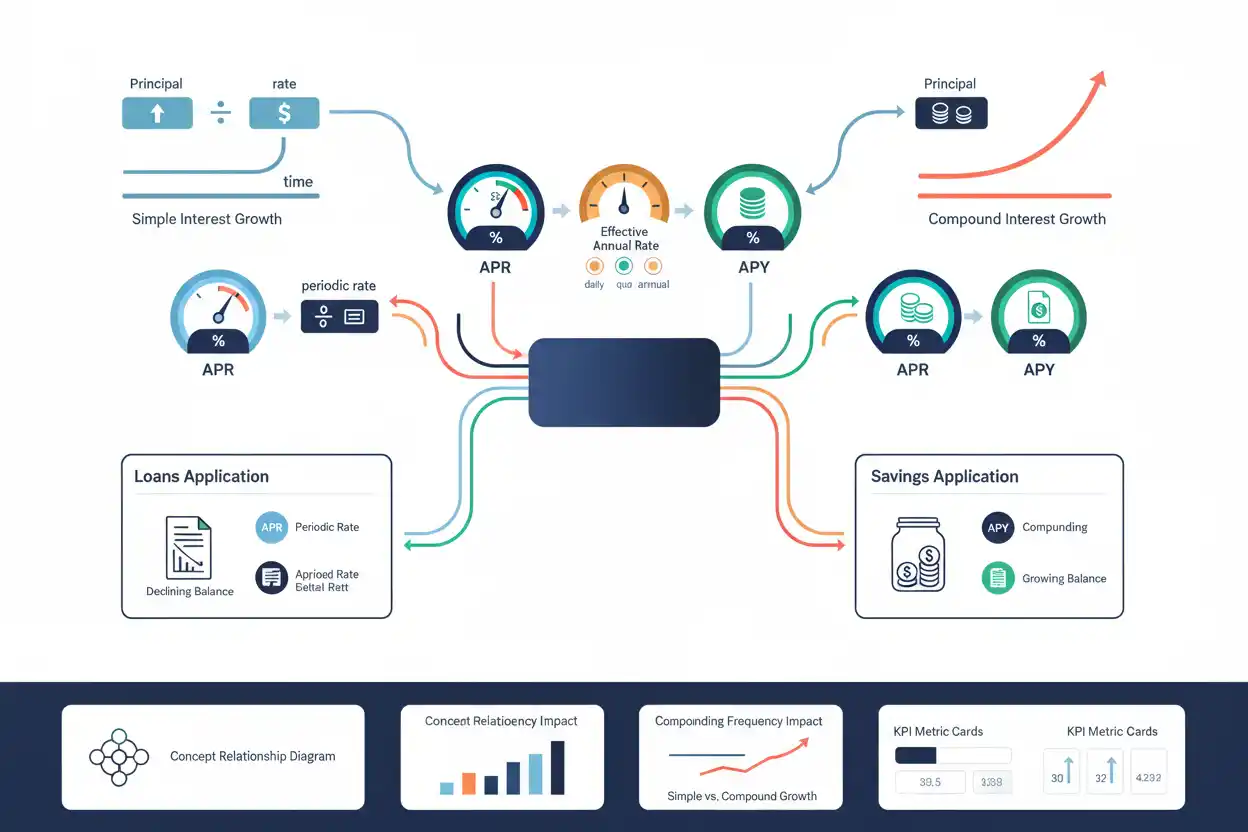
Interest rates express the price of borrowing money or the return associated with lending or depositing money, usually as a percentage.
The difficult part is that not every percentage labeled as a rate means the same thing.
A loan might show:
a nominal interest rate, APR, monthly periodic rate, or effective annual rate.
A savings account might show:
an interest rate and APY.
Two percentages can look almost identical while representing different calculations.
Understanding interest rate basics therefore requires separating five concepts:
interest rate, periodic rate, APR, APY, and effective annual rate.
The broader Loans & Credit cluster applies these concepts across loans, credit cards, repayment schedules, and financing fees, while Finance connects them with investment and business decisions.
What Is an Interest Rate?
An interest rate represents the percentage applied to a principal or balance under a financial agreement.
For a simple annual example:
Principal = $10,000
Annual rate = 6%
One year’s simple interest is:
Interest = Principal × Rate × Time
Interest = $10,000 × 6% × 1
Interest = $600
The $600 represents the borrowing cost or interest earned under the simplified assumptions.
Interest Rate vs Interest
An interest rate is a percentage.
Interest is usually a dollar amount.
Suppose:
Principal = $20,000
Rate = 8%
Then one-year simple interest is:
Interest = $20,000 × 8%
Interest = $1,600
The rate is 8%.
The dollar interest is $1,600.
Keeping percentages and dollar costs separate prevents many common finance errors.
Principal
Principal is the amount on which the interest calculation is based.
For a loan, this can be the outstanding principal balance.
For a deposit, it is the balance earning interest.
The relevant principal can change over time.
That change becomes especially important in reducing-balance borrowing.
Periodic Interest Rate
An annual rate often needs to be converted into a periodic rate.
For a nominal 12% annual rate with monthly periods:
Monthly Periodic Rate = 12% ÷ 12
Monthly Periodic Rate = 1%
For daily calculations using 365 days:
Daily Periodic Rate = 12% ÷ 365
Daily Periodic Rate ≈ 0.03288%
The actual divisor must match the contract’s convention.
Simple Interest
A simple interest loan calculates interest from principal without charging interest on previous interest in the same way as a compound structure.
The basic formula is:
Simple Interest = Principal × Rate × Time
Suppose:
Principal = $10,000
Rate = 10%
Time = 2 years
Interest = $10,000 × 10% × 2
Interest = $2,000
This does not automatically describe how installment payments are scheduled.
Daily Simple Interest
Daily simple interest measures time in days.
Daily Interest = Outstanding Principal × Annual Rate ÷ Day-Count Basis
Suppose:
Principal = $10,000
Annual rate = 8%
Basis = 365
Daily Interest ≈ $10,000 × 8% ÷ 365
Daily Interest ≈ $2.19 per Day
As principal falls, the daily dollar amount also falls.
Accrued Interest
Accrued interest is interest that has accumulated over an elapsed period but has not yet been settled.
Suppose daily interest equals $2.19 and 20 days pass:
Accrued Interest ≈ $2.19 × 20
Accrued Interest ≈ $43.80
The accrual concept describes how much interest has accumulated, not necessarily whether that interest compounds.
Compound Interest
A compound interest loan allows previously added interest to contribute to later interest.
The standard balance-growth formula is:
Future Balance = P × (1 + r ÷ m)^(mt)
Where:
P = principal
r = nominal annual rate
m = compounding periods per year
t = years
Compound Interest Example
Suppose:
Principal = $10,000
Nominal annual rate = 12%
Compounding = monthly
Time = 1 year
Monthly rate:
12% ÷ 12 = 1%
Ending balance:
Future Balance = $10,000 × (1.01)¹²
Future Balance ≈ $11,268.25
Interest:
Interest ≈ $1,268.25
By comparison, 12% simple annual interest would produce only $1,200 during the same year.
The difference comes from interest-on-interest.
Nominal Interest Rate
A nominal annual rate generally states an annual percentage without fully incorporating the effect of within-year compounding into that percentage.
For example:
Nominal annual rate = 12%
Monthly rate = 1%
Multiplying 1% by 12 returns 12%.
But compounding 1% monthly produces an annual result above 12%.
That leads to the effective annual rate.
Effective Annual Rate
The effective annual rate incorporates periodic compounding.
The formula is:
Effective Annual Rate = (1 + r ÷ m)^m − 1
Using 12% nominal interest compounded monthly:
Effective Rate = (1 + 0.12 ÷ 12)¹² − 1
Effective Rate ≈ 12.68%
The detailed nominal vs effective interest rate page owns that comparison.
Why Effective Rate Matters
Suppose two investments or financing structures show:
Option A: 12% compounded annually
Option B: 12% nominal compounded monthly
Option A effective rate:
12.00%
Option B effective rate:
≈12.68%
The quoted annual numbers are identical, but the actual annual compounding effect differs.
What Is APR?
APR means annual percentage rate.
In consumer lending contexts, APR is an annualized measure of credit cost.
It can differ from the contractual interest rate because applicable financing charges can affect the calculation.
For example:
Interest rate = 8%
APR = 8.7%
The 8% rate may drive contractual interest calculations, while the 8.7% APR gives a broader annualized borrowing-cost measure.
Interest Rate vs APR
The distinction is:
Interest Rate = Price Applied Under the Loan’s Interest Terms
APR = Annualized Cost of Credit
A lower interest rate does not necessarily mean a lower APR when one loan has substantially higher financing fees.
That makes APR particularly useful when comparing similar credit products.
What Is APY?
APY means annual percentage yield.
It is commonly used to express annual yield on deposit accounts while incorporating compounding.
A familiar compound-yield formula is:
APY = (1 + r ÷ m)^m − 1
Suppose:
Nominal deposit rate = 5%
Compounding = monthly
Then:
APY = (1 + 0.05 ÷ 12)¹² − 1
APY ≈ 5.12%
The APY exceeds the 5% nominal rate because of compounding.
APR vs APY
The APR vs APY page owns the detailed comparison.
The broad distinction is:
APR = Primarily Borrowing-Cost Measure
APY = Annual Yield Including Compounding
The terms should not be treated as direct opposites with universally symmetric formulas.
APR can incorporate financing charges and credit-specific calculation rules.
Interest Rate vs APY
Suppose a savings account advertises:
Interest rate = 4.00%
APY = 4.07%
The difference can result from periodic compounding.
APY helps depositors compare accounts whose interest-crediting frequencies differ.
Nominal Rate vs APR
Nominal interest rate and APR can also differ for reasons other than compounding.
Suppose:
Loan rate = 7%
Origination fee = $500
The loan origination fee can raise the annualized credit cost even though the contractual interest rate remains 7%.
This can create APR above the nominal loan rate.
Loan Payments and Interest Rates
The loan payments formula converts principal, periodic rate, and term into an installment.
Payment = P × [r(1 + r)ⁿ] ÷ [(1 + r)ⁿ − 1]
A higher rate generally increases the payment when principal and term remain unchanged.
EMI and Interest Rates
An EMI is an equal monthly installment.
For a fixed-rate amortizing loan, the monthly rate is a core formula input.
A rate increase therefore raises EMI unless another feature—such as loan term—is changed.
Loan Term and Interest Rates
The loan term affects the amount of time interest can accumulate.
A lower rate over 10 years can still produce more total interest than a slightly higher rate over three years if principal remains outstanding much longer.
Rate and term must therefore be analyzed together.
Fixed vs Variable Interest Rates
A fixed vs variable interest rate comparison asks whether the contractual percentage itself can change.
A fixed 7% rate remains 7% under its fixed-rate terms.
A variable rate might follow:
Variable Rate = Benchmark + Margin
and therefore adjust over time.
Flat vs Reducing Balance Interest
The flat vs reducing balance interest distinction asks which principal base is used.
A 10% flat rate applied to original principal can be substantially more expensive than a 10% reducing-balance rate.
This is why the percentage alone never tells the complete story.
Interest Coverage and Borrowing Rates
A business’s interest coverage ratio can deteriorate when borrowing rates rise.
Suppose:
EBIT = $500,000
Interest = $100,000
Coverage:
5.0×
If interest rises to $150,000:
Coverage ≈ 3.33×
The interest rate therefore affects not only borrowing cost but financial risk.
Business Loan APR
Business loan APR can require careful interpretation because commercial lending disclosures may not follow one universal consumer-credit methodology.
Businesses should compare:
cash received, fees, payment timing, total repayment, and annualized economic cost.
Auto Loan APR
Auto loan APR is useful because an auto loan’s interest rate can differ from the annualized borrowing cost after applicable finance charges.
A borrower should compare APR with APR rather than mixing APR and nominal rates.
Personal Loan APR
Personal loan APR becomes particularly useful when lenders charge different origination fees.
A loan with a lower nominal rate can still be more expensive if large upfront financing costs apply.
Leasing Costs and Interest-Like Charges
Leasing costs use a different structure from ordinary loan interest.
Vehicle leases, for example, can use a money factor and rent charge rather than a conventional loan APR.
Comparing lease financing with loan financing therefore requires converting the economic cash flows carefully rather than treating every percentage as identical.
How to Compare Interest Rates Correctly
Before comparing two percentages, identify:
- Is the rate annual or periodic?
- Is it nominal or effective?
- Does it include fees?
- Does it compound?
- Is interest based on original or outstanding principal?
- Can the rate change?
- What is the loan term?
- What total dollar interest will be paid?
Only after answering those questions is a rate comparison meaningful.
Rate Comparison Example
Suppose:
Loan A: 8% rate, no fee
Loan B: 7.5% rate, substantial origination fee
Loan B has the lower stated interest rate.
But Loan A can still have the lower APR and total cost.
Similarly:
Loan C: 10% flat rate
Loan D: 10% reducing-balance rate
The percentages are identical, but Loan C can be dramatically more expensive.
Inflation and Interest Rates
Interest rates are often quoted in nominal terms.
A separate real interest rate concept adjusts for inflation.
A simplified approximation is:
Real Rate ≈ Nominal Rate − Inflation Rate
If nominal interest is 7% and inflation is 3%:
Approximate Real Rate ≈ 4%
For precision, a compounding-adjusted real-rate formula can be used, but that belongs to a distinct real-vs-nominal analysis rather than basic loan pricing.
Common Interest Rate Mistakes
A common mistake is assuming every annual percentage means APR.
Another is treating APR and APY as interchangeable.
Borrowers also compare flat-rate percentages with reducing-balance rates directly.
A fourth mistake is ignoring compounding frequency.
Another is assuming a lower monthly payment proves the rate is better.
Finally, a variable starting rate should never be compared with a fixed rate without considering future resets.
Frequently Asked Questions
What is an interest rate?
It is the percentage applied to a principal or balance under a borrowing, lending, or deposit arrangement.
What is the basic simple-interest formula?
Interest = Principal × Rate × Time
What is a periodic rate?
It is the rate applied for a specific period, such as a month or day.
What is APR?
APR is an annualized measure of borrowing cost used in credit contexts.
What is APY?
APY expresses annual yield and incorporates the effect of compounding.
What is an effective annual rate?
It is the actual annual mathematical rate after within-year compounding.
What is the effective-rate formula?
Effective Annual Rate = (1 + r ÷ m)^m − 1
Is APR the same as the loan interest rate?
Not necessarily. Fees and other credit-cost elements can make APR different.
Is APY always higher than the nominal rate?
With a positive nominal rate and compounding more than once per year, APY is normally higher under the standard formula.
What is the difference between simple and compound interest?
Simple interest does not generate interest on previous interest, while compound interest can.
Does a lower rate always mean a cheaper loan?
No. Fees, term, principal, calculation method, and compounding can change total cost.
What should I compare when choosing financing?
Compare the contractual rate, APR, periodic payment, fees, term, total repayment, calculation method, and whether the rate can change.
Final Takeaway
Interest rate basics begin with recognizing that one percentage can represent several different concepts.
The most important distinctions are:
Periodic Rate = Annual Nominal Rate ÷ Periods per Year
Effective Annual Rate = (1 + r ÷ m)^m − 1
APR = Annualized Borrowing-Cost Measure
APY = Annual Yield Including Compounding
A nominal 12% rate compounded monthly produces an effective annual rate of approximately 12.68%.
A 5% deposit rate compounded monthly produces an APY of approximately 5.12%.
Meanwhile, a loan’s APR can exceed its contractual interest rate because applicable fees increase borrowing cost.
Before comparing financial offers, identify what the percentage measures, what balance it applies to, how often it is applied, whether fees are included, whether it compounds, and whether the rate can change.