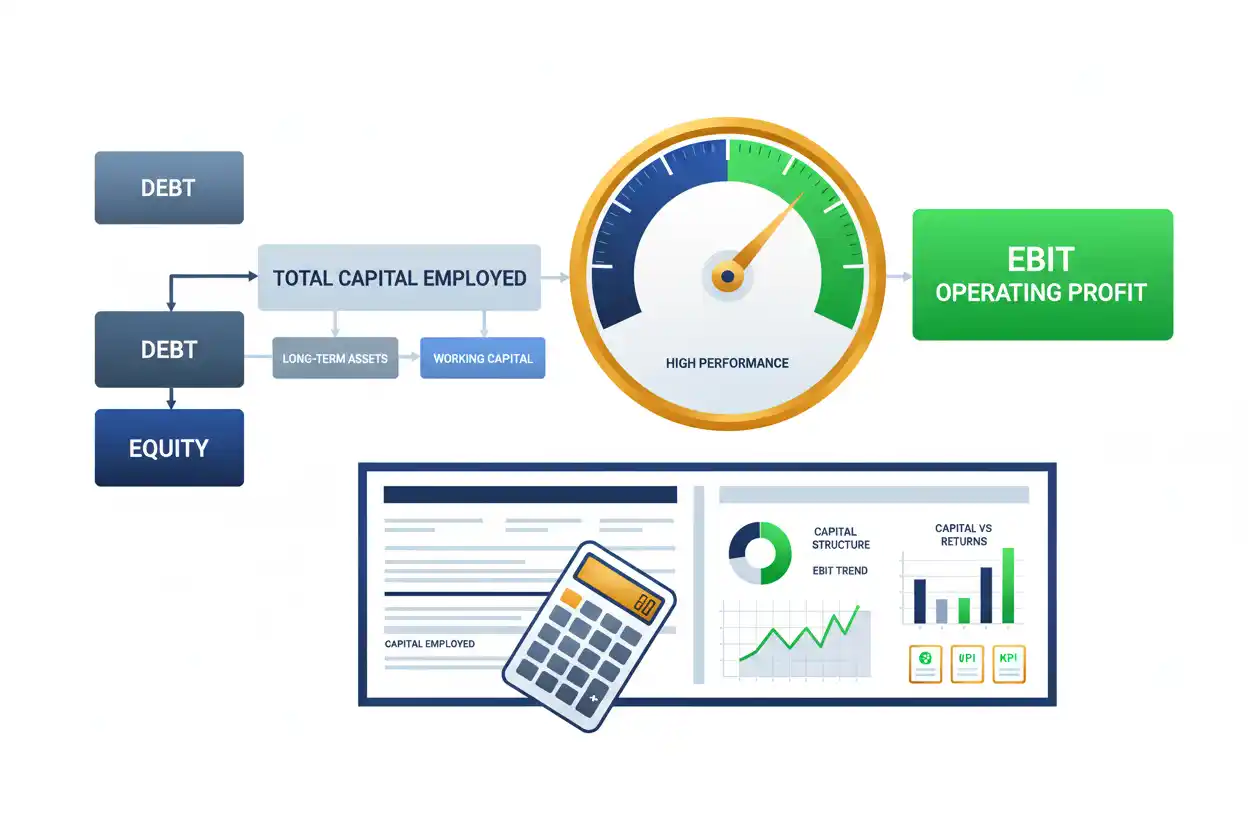

Return on capital employed measures how effectively a business generates operating earnings from the capital committed to it. It is commonly abbreviated ROCE.
A widely used formula is:
Return on Capital Employed = EBIT ÷ Average Capital Employed × 100
Suppose a company generates $600,000 of EBIT and has average capital employed of $3 million.
ROCE = $600,000 ÷ $3,000,000 × 100
ROCE = 20%
A 20% ROCE means the company generated EBIT equal to 20% of the capital employed during the period under that definition.
ROCE is especially useful within business finance because it connects operating profitability with the amount of long-term capital required to produce it. However, ROCE definitions can vary between companies and analysts, so the numerator and denominator should always be checked before comparing percentages.
What Is Return on Capital Employed?
Return on capital employed evaluates operating return relative to the capital committed to a business.
The ratio asks:
How much operating profit is the company generating from the capital employed in the business?
A common construction uses EBIT as the numerator because EBIT represents earnings before interest and taxes.
The denominator represents capital employed.
A common balance-sheet formula is:
Capital Employed = Total Assets − Current Liabilities
An equivalent accounting construction, when classifications align, is:
Capital Employed = Shareholders’ Equity + Non-Current Liabilities
This follows from the balance-sheet relationship:
Assets = Liabilities + Equity
However, company-specific ROCE definitions can include or exclude particular debt, cash, leases, noncontrolling interests, or other balances.
Therefore, the formula should be defined before interpretation.
Return on Capital Employed Formula
A common formula is:
ROCE = EBIT ÷ Capital Employed × 100
For a period-based calculation, using average capital employed often provides a better match:
ROCE = EBIT ÷ Average Capital Employed × 100
Average capital employed can be calculated as:
Average Capital Employed = (Beginning Capital Employed + Ending Capital Employed) ÷ 2
This produces:
ROCE = EBIT ÷ [(Beginning Capital Employed + Ending Capital Employed) ÷ 2] × 100
Using an average denominator is particularly useful when the business’s capital base changed materially during the period.
How to Calculate Capital Employed
Suppose a company’s balance sheet shows:
Total assets = $5,000,000
Current liabilities = $1,800,000
Then:
Capital Employed = $5,000,000 − $1,800,000
Capital Employed = $3,200,000
The same company might have:
Shareholders’ equity = $2,000,000
Non-current liabilities = $1,200,000
Therefore:
Capital Employed = $2,000,000 + $1,200,000
Capital Employed = $3,200,000
Both approaches produce the same amount in this simplified example.
Complete ROCE Example
Suppose a company reports:
EBIT = $600,000
Beginning capital employed = $2,800,000
Ending capital employed = $3,200,000
First calculate average capital employed:
Average Capital Employed = ($2,800,000 + $3,200,000) ÷ 2
Average Capital Employed = $3,000,000
Now calculate ROCE:
ROCE = $600,000 ÷ $3,000,000 × 100
ROCE = 20%
The company’s return on capital employed is 20%.
In simplified terms, the business generates $0.20 of EBIT for every $1.00 of average capital employed.
Why Use EBIT?
EBIT is commonly used because capital employed can include both equity financing and long-term debt financing.
If interest expense were deducted before calculating the return, the numerator would partly reflect how the business is financed.
Using EBIT keeps the focus closer to operating earnings before financing costs.
This helps answer:
How productively is the business using the capital committed to operations, regardless of the specific split between debt and equity?
However, not every company defines ROCE using exactly the same earnings measure.
Some reported ROCE calculations use adjusted operating earnings, pre-tax income, or other defined returns.
Consistency matters more than assuming every ROCE calculation is identical.
EBIT vs Operating Profit in ROCE
Operating profit and EBIT can be similar or identical in some financial statements.
They are not guaranteed to be the same.
A company may report non-operating income or expenses that affect EBIT but fall outside operating income.
When calculating ROCE, use the numerator required by the chosen methodology.
If the formula specifically states:
ROCE = EBIT ÷ Capital Employed
then EBIT should be used consistently.
Do not silently substitute net profit, EBITDA, or another earnings subtotal.
Why Use Average Capital Employed?
EBIT covers an entire financial period.
Ending capital employed represents only one date.
Suppose:
Beginning capital employed = $2 million
Ending capital employed = $4 million
EBIT = $500,000
Using ending capital:
ROCE = $500,000 ÷ $4,000,000
ROCE = 12.5%
Using average capital:
Average Capital Employed = ($2M + $4M) ÷ 2
Average Capital Employed = $3M
Then:
ROCE = $500,000 ÷ $3,000,000
ROCE ≈ 16.67%
The denominator choice materially changes the result.
When capital changes substantially, average capital employed usually provides a better period match.
What Does a 20% ROCE Mean?
A 20% ROCE means EBIT equals 20% of the capital employed under the selected calculation.
If average capital employed is $10 million:
EBIT = $10 million × 20%
EBIT = $2 million
If average capital employed is $100 million:
EBIT = $20 million
ROCE therefore normalizes operating earnings by the amount of capital supporting them.
That makes it more informative for capital-efficiency analysis than comparing EBIT dollars alone.
What Does a 10% ROCE Mean?
Suppose:
EBIT = $1 million
Average capital employed = $10 million
Then:
ROCE = $1 million ÷ $10 million × 100
ROCE = 10%
The company generates $0.10 of EBIT for every $1.00 of average capital employed.
Whether that is strong or weak depends on the industry, business risk, capital costs, historical performance, and available investment alternatives.
What Is a Good ROCE?
There is no universal good ROCE.
A capital-intensive manufacturer, utility, telecommunications business, retailer, software company, and professional-services company can have very different capital requirements.
A useful ROCE benchmark generally considers:
the company’s historical performance;
direct competitors;
industry capital intensity;
business risk;
cost of capital;
and the sustainability of earnings.
The ratio should also be calculated consistently across the companies being compared.
A 20% adjusted ROCE from one business is not necessarily comparable with a 15% reported ROCE from another if the calculations use different numerators or capital definitions.
Higher ROCE vs Lower ROCE
All else equal, higher ROCE means the company is generating more operating earnings for each dollar of capital employed.
Suppose two companies each employ $10 million of capital.
Company A generates $1 million EBIT:
ROCE = 10%
Company B generates $2 million:
ROCE = 20%
Company B generates twice as much EBIT from the same amount of employed capital.
However, “all else equal” is essential.
Differences in risk, accounting, asset age, acquisitions, business mix, and investment cycles can all influence the ratio.
Can ROCE Be Negative?
Yes.
If EBIT is negative and capital employed is positive, ROCE is negative.
Suppose:
EBIT = −$400,000
Average capital employed = $5 million
Then:
ROCE = −$400,000 ÷ $5,000,000 × 100
ROCE = −8%
A negative ROCE means the business generated an operating loss relative to the capital employed during the period.
That can occur during recessions, restructurings, startup phases, operational problems, or temporary investment periods.
ROCE vs Return on Assets
The workbook maps return on assets directly to this page.
A common ROA formula is:
ROA = Net Income ÷ Average Total Assets × 100
ROCE commonly uses:
ROCE = EBIT ÷ Average Capital Employed × 100
There are two major differences.
First, ROA often uses net income, while ROCE commonly uses EBIT.
Second, ROA uses total assets, while ROCE usually removes current liabilities from the capital base or constructs capital from longer-term financing sources.
Suppose:
Net income = $600,000
EBIT = $900,000
Average assets = $10 million
Average capital employed = $6 million
ROA:
$600,000 ÷ $10M = 6%
ROCE:
$900,000 ÷ $6M = 15%
The percentages answer different questions.
ROCE vs Return on Equity
The workbook also maps return on equity.
ROE commonly measures:
ROE = Net Income ÷ Average Shareholders’ Equity × 100
ROCE measures earnings relative to a broader capital base that can include both equity and debt financing.
Suppose:
Net income = $1 million
EBIT = $1.6 million
Average equity = $4 million
Average capital employed = $8 million
ROE:
$1M ÷ $4M = 25%
ROCE:
$1.6M ÷ $8M = 20%
ROE focuses on shareholder capital.
ROCE focuses more broadly on capital employed in the business.
ROCE vs Return on Invested Capital
The workbook maps return on invested capital directly because ROCE and ROIC are closely related.
A common ROIC construction uses:
ROIC = NOPAT ÷ Average Invested Capital × 100
ROCE often uses:
ROCE = EBIT ÷ Average Capital Employed × 100
The major conceptual difference is taxation.
ROIC commonly uses an after-tax operating-profit numerator.
ROCE is often presented on a pre-tax EBIT basis.
The denominator definitions can also differ.
For example, a ROIC calculation may exclude excess cash or other non-operating assets that remain inside another company’s ROCE capital definition.
Therefore:
ROCE ≠ ROIC Automatically
Always inspect the formulas.
ROCE vs ROI
ROI is a broad investment-return concept.
A simple ROI calculation might be:
ROI = Investment Gain ÷ Investment Cost × 100
ROCE is a company-level capital-efficiency measure using a defined earnings numerator and capital-employed denominator.
Suppose a company spends $500,000 on one machine and earns a modeled $100,000 project gain.
A simple project ROI could be 20%.
That does not mean the entire company has 20% ROCE.
ROCE evaluates the broader capital employed in the business.
ROCE vs Rental Property Returns
The workbook maps rental property returns as another sibling.
A property cap rate typically uses:
Cap Rate = Property NOI ÷ Property Value × 100
ROCE uses company-level operating earnings relative to capital employed.
A building’s 7% cap rate is therefore not a 7% ROCE.
The numerators, denominators, financing treatment, and analytical purposes differ.
ROCE vs Asset Turnover
Asset turnover measures revenue generated from assets:
Asset Turnover = Revenue ÷ Average Assets
ROCE measures operating earnings generated from capital employed.
A business can generate high revenue from its capital but still have low ROCE if operating margins are weak.
Conversely, a business can have lower turnover but strong ROCE if it earns high margins.
This leads to a useful decomposition.
ROCE and Operating Margin
A simplified ROCE analysis can be understood through operating profitability and capital turnover.
Conceptually:
ROCE = EBIT Margin × Capital Turnover
Where:
EBIT Margin = EBIT ÷ Revenue
and:
Capital Turnover = Revenue ÷ Capital Employed
Multiplying:
(EBIT ÷ Revenue) × (Revenue ÷ Capital Employed)
Revenue cancels:
ROCE = EBIT ÷ Capital Employed
This shows that ROCE can improve because the business:
earns more operating profit per sales dollar;
generates more sales from each dollar of capital;
or improves both.
The site’s operating margin page owns the margin calculation itself.
ROCE Decomposition Example
Suppose:
Revenue = $8 million
EBIT = $800,000
Capital employed = $4 million
EBIT margin:
$800,000 ÷ $8 million = 10%
Capital turnover:
$8 million ÷ $4 million = 2.0
Therefore:
ROCE = 10% × 2
ROCE = 20%
The same 20% ROCE could arise from a very different model.
For example:
EBIT margin = 20%
Capital turnover = 1.0
Again:
ROCE = 20%
One company earns thin margins but turns capital rapidly.
The other earns higher margins but requires more capital for each sales dollar.
ROCE and Revenue Growth
Revenue growth does not automatically improve ROCE.
Suppose revenue increases 20% but capital employed rises 50% to support new facilities, inventory, and receivables.
If EBIT does not increase proportionally, ROCE can fall.
Growth creates attractive capital economics only when the incremental earnings justify the incremental capital committed.
This is why ROCE is valuable when evaluating expansion.
It prevents sales growth from being viewed independently of the resources required to support it.
ROCE and Operating Leverage
Operating leverage can help EBIT grow faster than revenue once fixed operating costs are covered.
Suppose a company has substantial existing capacity.
Revenue rises 15%.
EBIT rises 40%.
If little additional capital is required, ROCE can improve sharply.
However, once capacity is exhausted, management may need another factory, warehouse, fleet, or technology platform.
Capital employed can then rise and temporarily reduce ROCE.
ROCE and Working Capital
Working capital can materially affect capital employed.
Suppose a company grows rapidly and needs more:
inventory;
accounts receivable;
and operating cash.
If current operating assets increase faster than current liabilities, more capital can become tied up in the operating cycle.
Unless the additional working capital produces sufficient EBIT, ROCE declines.
Working-capital discipline can therefore improve capital efficiency without requiring cuts to productive long-term assets.
ROCE and Receivables Turnover
The workbook directly maps receivables turnover to this article.
Suppose two companies generate identical sales and EBIT.
Company A collects customers quickly.
Company B carries much larger receivables because customers pay slowly.
Company B requires more capital to finance its operating cycle.
If all other factors are equal, this larger capital requirement can reduce ROCE.
Better collection efficiency can therefore support higher capital returns.
ROCE and Inventory Turnover
Inventory turnover can affect ROCE in the same way.
Suppose two retailers generate the same sales and operating profit.
Retailer A requires $1 million of average inventory.
Retailer B requires $4 million.
The second business ties up much more capital to generate identical economics.
Unless there is a strategic reason for the larger inventory balance, its capital efficiency is weaker.
ROCE and Cash Conversion Cycle
The cash conversion cycle connects inventory, receivables, and supplier-payment timing.
A shorter cash cycle can reduce the amount of capital required to support a given level of operations.
For example, if a business collects customers faster while maintaining sustainable supplier terms, less capital remains trapped in working capital.
That can improve ROCE even if EBIT remains unchanged.
Current Liabilities and Capital Employed
Under the common balance-sheet approach:
Capital Employed = Total Assets − Current Liabilities
Therefore, current liabilities reduce the capital-employed denominator.
Suppose:
Total assets = $10 million
Current liabilities = $3 million
Capital employed:
$7 million
If EBIT is $1 million:
ROCE ≈ 14.29%
If current liabilities increase to $4 million while assets and EBIT remain unchanged:
Capital Employed = $6 million
ROCE ≈ 16.67%
The ratio improves mathematically.
However, a company should not increase short-term liabilities merely to manufacture a higher ROCE.
Liquidity and financing risk still matter.
ROCE and Quick Ratio
Because the workbook links the neighboring return pages with working-capital metrics, quick ratio provides useful context.
A company can improve reported capital efficiency while creating a weaker short-term liquidity position.
For example, relying heavily on current liabilities can reduce the capital-employed denominator under one ROCE definition.
Yet the same short-term obligations can put pressure on liquidity.
Return and liquidity metrics therefore need to be analyzed together rather than optimized independently.
ROCE and Current Ratio
The current ratio compares current assets with current liabilities.
ROCE focuses on operating return relative to capital.
Suppose management aggressively reduces inventory and receivables.
Capital employed can decline and ROCE can improve.
But if working capital is cut too far, the company may create stock shortages, customer-service problems, or liquidity stress.
Efficient capital management is not the same as minimizing working capital at all costs.
ROCE and Financial Leverage
Financial leverage affects the way capital is financed.
One important feature of ROCE is that it can evaluate returns across a capital base supported by both debt and equity.
This differs from ROE, which uses only equity in the denominator.
A company cannot improve economic performance merely by replacing equity with debt if operating earnings and total employed capital remain unchanged.
The effect on ROE may be much larger because its denominator changes more directly.
ROCE and Debt-to-Equity
Debt-to-equity ratio provides the financing context that ROCE alone does not.
Suppose two companies both report 18% ROCE.
Company A uses modest debt.
Company B is highly leveraged.
Their operating capital efficiency appears similar under that ROCE measure, but their financial risk can be very different.
Combining ROCE with leverage ratios helps separate return generation from financing risk.
ROCE and Interest Coverage
Interest coverage becomes important when debt forms a substantial part of capital employed.
ROCE can remain healthy while a company takes on so much debt that interest obligations become difficult to support.
Conversely, a conservatively financed company may have substantial coverage even with a more modest ROCE.
Return on capital does not eliminate the need to analyze debt-service capacity.
ROCE and Cost of Capital
ROCE is often compared conceptually with the company’s required return on capital.
The site’s weighted average cost of capital page owns the WACC calculation.
At a high level, a company generally wants returns generated on capital to exceed the economic cost of funding that capital over time.
However, a raw pre-tax ROCE should not be compared mechanically with an after-tax WACC without ensuring that both figures are measured on a compatible basis.
Comparability of numerator, denominator, taxes, and period matters.
Example: ROCE vs Cost of Capital
Suppose a company reports:
ROCE = 18%
and an appropriately constructed required return is materially below that level.
This can indicate attractive capital economics.
Now suppose ROCE falls persistently below the relevant capital hurdle.
The business may be investing resources without generating adequate returns.
However, newly constructed assets or growth projects can depress current ROCE before reaching mature profitability.
The conclusion should therefore consider the investment cycle and future economics.
ROCE and Economic Value Added
Economic value added addresses a related but different concept: whether operating profit exceeds an explicit capital charge.
ROCE is a percentage return.
Economic value added is generally expressed as a value amount after charging for capital.
A company can therefore use ROCE to evaluate the rate of return on capital and EVA to evaluate modeled economic profit after the cost of that capital.
The pages should remain distinct.
ROCE and Operating Cash Flow
Operating cash flow provides another necessary perspective.
ROCE usually relies on accounting earnings such as EBIT.
A company can report strong EBIT and ROCE while collecting customers slowly or building large inventories.
Cash generation can therefore lag accounting performance.
Sustainable capital efficiency is more convincing when operating earnings convert into cash consistently.
ROCE and Free Cash Flow
Free cash flow becomes especially relevant for capital-intensive companies.
A business can report strong ROCE but require significant capital expenditure to maintain or expand its asset base.
Accounting returns and cash available after investment can therefore differ.
ROCE evaluates earnings relative to capital employed.
Free cash flow evaluates cash remaining after the relevant operating and capital cash movements.
ROCE and Business Valuation
Business valuation often considers the durability of capital returns.
A company capable of reinvesting large amounts of capital at attractive returns can have very different long-term economics from one that earns high ROCE only because it has few opportunities to reinvest.
Similarly, high historical ROCE does not guarantee high future returns.
Competition can reduce margins.
Growth can require more capital.
Technology can change.
Valuation therefore depends on both current return levels and the sustainability of future reinvestment economics.
ROCE and Capital Expenditure
Capital expenditure can reduce ROCE temporarily.
Suppose a company builds a new $10 million facility.
Capital employed rises immediately.
The facility may take two years to reach normal production.
During the construction and ramp-up period, EBIT generated from the new capital can be minimal.
ROCE can decline even though management expects the investment to produce attractive long-term returns.
This is why capital-intensive businesses should often be examined across full investment cycles.
Mature Assets Can Raise ROCE
Older assets can create the opposite accounting effect.
As property, plant, and equipment depreciates, its carrying amount can decline.
If EBIT remains stable, capital employed can become smaller.
ROCE therefore increases.
A mature business using heavily depreciated assets may appear more capital-efficient than a competitor that recently replaced its equipment.
Accounting age and replacement requirements should therefore be considered when comparing ROCE.
Acquisitions and ROCE
Acquisitions can increase capital employed through:
new assets;
goodwill;
intangible assets;
additional debt;
and equity issued to fund the transaction.
If the acquired earnings do not immediately contribute a full period of EBIT, ROCE can decline initially.
Longer-term analysis should determine whether the acquisition eventually generates adequate returns on the additional capital committed.
A decline immediately after an acquisition is not automatically evidence that the transaction failed.
Goodwill and ROCE
Some ROCE definitions include goodwill in capital employed.
Others adjust or exclude it.
This choice can materially change the ratio for acquisitive companies.
Suppose:
EBIT = $2 million
Capital employed including goodwill = $20 million
ROCE = 10%
If $5 million of goodwill is excluded under an adjusted methodology:
Adjusted Capital Employed = $15 million
Adjusted ROCE ≈ 13.33%
Both percentages can be mathematically correct under their respective definitions.
They should not be presented as though they are the same measure.
ROCE Trend Analysis
Suppose ROCE develops as follows:
Year 1 = 9%
Year 2 = 11%
Year 3 = 14%
Year 4 = 17%
The business appears to be generating progressively more operating earnings relative to its capital base.
Possible reasons include higher margins, stronger capital turnover, better working-capital efficiency, improved capacity utilization, or asset disposals.
Now consider:
Year 1 = 20%
Year 2 = 17%
Year 3 = 13%
Year 4 = 9%
The decline deserves investigation.
Possible causes include weaker EBIT, heavy investment, acquisitions, excess working capital, poor utilization, or unfavorable business conditions.
How Revenue Growth Can Lower ROCE
Suppose:
Year 1 EBIT = $1 million
Capital employed = $5 million
ROCE = 20%
The company expands.
Year 2 EBIT increases to $1.4 million, but capital employed rises to $10 million.
ROCE = 14%
EBIT grew 40%.
Yet capital employed doubled.
The business is more profitable in absolute dollars but less efficient in generating returns from capital.
Whether that decline is concerning depends on whether the newly invested capital is still ramping toward future earnings.
How Working-Capital Improvement Can Raise ROCE
Suppose:
EBIT = $1 million
Capital employed = $8 million
ROCE = 12.5%
Management reduces excess inventory and improves customer collections, freeing $2 million of capital without reducing EBIT.
New capital employed:
$6 million
New ROCE:
$1 million ÷ $6 million × 100
ROCE ≈ 16.67%
No additional profit was required.
The company improved the efficiency of the capital already supporting the business.
Comparing ROCE Across Industries
Cross-industry comparisons can be misleading.
A utility may require enormous infrastructure.
A manufacturer may need factories and inventory.
A retailer can depend heavily on stores and working capital.
A software company may produce substantial revenue with comparatively little physical capital.
These structural differences affect capital employed.
ROCE is usually most useful for comparing companies with similar economics or evaluating one company’s performance over time.
Comparing ROCE Across Companies
Before comparing ROCE figures, check:
which earnings numerator is used;
whether the ratio is pre-tax or after-tax;
whether capital is average or period-end;
whether excess cash is excluded;
whether goodwill is included;
whether leases are adjusted;
whether current debt is included;
whether the figure is reported or adjusted;
and whether the periods match.
A difference of several percentage points can result from methodology rather than true economic performance.
Negative Capital Employed
In unusual cases, an Assets − Current Liabilities construction can produce very low or even negative capital employed.
This can happen in business models with substantial current liabilities relative to recorded assets or where accounting classifications create unusual balance-sheet structures.
Once the denominator approaches zero or becomes negative, ROCE can become mathematically extreme or economically difficult to interpret.
In those situations, the ratio should not be used mechanically.
Examine the actual capital structure and use a denominator appropriate to the business.
ROCE When Capital Employed Is Zero
If capital employed is zero:
ROCE = EBIT ÷ 0
The ratio is undefined.
It should not be reported as 0%.
Division by zero has no valid numerical result.
A zero or near-zero denominator is a sign that another analytical framework may be more useful.
Adjusted ROCE
Companies sometimes report adjusted ROCE.
An adjusted formula might remove specified gains, losses, restructuring costs, acquisition effects, or unusual balance-sheet items.
Conceptually:
Adjusted ROCE = Adjusted Return ÷ Adjusted Capital Employed × 100
Adjusted ROCE can help analyze recurring business economics.
However, every adjustment changes comparability.
Readers should inspect the reconciliation instead of assuming the adjusted number is inherently better than the reported figure.
Common ROCE Mistakes
One frequent mistake is using net income in a formula labeled EBIT-based ROCE without saying so.
Another is using total assets instead of capital employed; that moves the calculation toward ROA.
Analysts also compare one company’s average-capital ROCE with another company’s ending-capital ROCE.
A fourth mistake is assuming ROCE and ROIC are identical.
Users can also compare pre-tax ROCE directly with an after-tax cost-of-capital number without adjusting for the mismatch.
Another problem is interpreting higher ROCE as automatically favorable even when the increase came from underinvestment, excessive current liabilities, or asset write-downs.
Finally, reported and adjusted ROCE figures should not be mixed without checking the definitions.
Limitations of Return on Capital Employed
ROCE is valuable but not standardized to one universal calculation.
Companies can define both earnings and capital employed differently.
Accounting values can differ materially from economic asset values.
Depreciation and asset age affect the denominator.
Acquisitions and goodwill can distort comparisons.
Working-capital structure can influence capital employed substantially.
ROCE uses accounting earnings rather than cash flow.
It can also be difficult to interpret for companies with very low or negative capital employed.
For these reasons, ROCE works best as part of a broader capital-efficiency analysis.
How to Analyze ROCE Properly
Start by defining the numerator.
For the common version:
Numerator = EBIT
Then define capital employed consistently:
Capital Employed = Total Assets − Current Liabilities
or use another explicitly stated company-specific definition.
If possible, calculate average capital employed:
Average Capital Employed = (Beginning + Ending Capital Employed) ÷ 2
Then:
ROCE = EBIT ÷ Average Capital Employed × 100
Compare the ratio with prior periods and genuinely comparable businesses.
Next, break the change into operating margin and capital turnover.
Examine working capital, acquisitions, asset purchases, disposals, and capital expenditures.
Compare ROCE with ROA, ROE, and ROIC.
Finally, examine operating and free cash flow and consider whether returns are high enough relative to the economic cost of capital.
This approach reveals not only what ROCE is, but why the business earns that return and whether the result appears sustainable.
Why Return on Capital Employed Matters
Return on capital employed connects operating earnings with the capital required to produce them.
A common formula is:
ROCE = EBIT ÷ Average Capital Employed × 100
with:
Capital Employed = Total Assets − Current Liabilities
A higher ROCE generally indicates stronger operating earnings relative to capital employed.
However, the ratio becomes most useful when the drivers are understood.
A company can increase ROCE through better operating margins, stronger capital turnover, improved working-capital efficiency, or more productive assets.
It can also increase ROCE mechanically by reducing the denominator.
The key question is therefore not simply:
“Is ROCE high?”
It is:
“Does the company consistently generate attractive operating earnings from the capital committed to the business, and can it continue doing so without weakening liquidity, underinvesting, or taking excessive risk?”
Frequently Asked Questions
What is return on capital employed in simple terms?
Return on capital employed measures how much operating earnings a company generates relative to the capital committed to the business.
What is the ROCE formula?
A common formula is:
ROCE = EBIT ÷ Average Capital Employed × 100
How do you calculate capital employed?
A common formula is:
Capital Employed = Total Assets − Current Liabilities
When classifications align, it can also be represented as shareholders’ equity plus non-current liabilities.
Why is EBIT used for ROCE?
EBIT measures earnings before interest and taxes, making it useful for evaluating operating returns across capital financed by both debt and equity.
What does a 20% ROCE mean?
It means EBIT equals approximately 20% of the capital employed under the selected calculation. A company with $5 million of capital employed and 20% ROCE would generate about $1 million of EBIT.
What is a good ROCE?
There is no universal good percentage. ROCE should generally be compared with the company’s history, similar businesses, industry economics, risk, and an appropriately comparable capital-return requirement.
Is higher ROCE always better?
Not automatically. Higher ROCE can indicate greater capital efficiency, but it can also result from asset reductions, underinvestment, unusually high current liabilities, accounting adjustments, or a smaller capital denominator.
Can ROCE be negative?
Yes. If EBIT is negative while capital employed is positive, ROCE will be negative.
What is the difference between ROCE and ROA?
ROA commonly uses net income divided by average total assets. ROCE commonly uses EBIT divided by capital employed, which generally excludes current liabilities from the asset-funded capital base.
What is the difference between ROCE and ROE?
ROE measures net income relative to shareholders’ equity. ROCE evaluates earnings relative to a broader capital base that can include both equity and debt.
What is the difference between ROCE and ROIC?
ROIC commonly uses after-tax operating profit such as NOPAT divided by invested capital. ROCE is often based on pre-tax EBIT and capital employed. Exact company definitions can differ.
Why can ROCE fall after a company invests in growth?
Capital employed can increase before a new factory, acquisition, technology platform, or expansion reaches full profitability. EBIT may therefore grow more slowly than the capital denominator during the investment and ramp-up period.