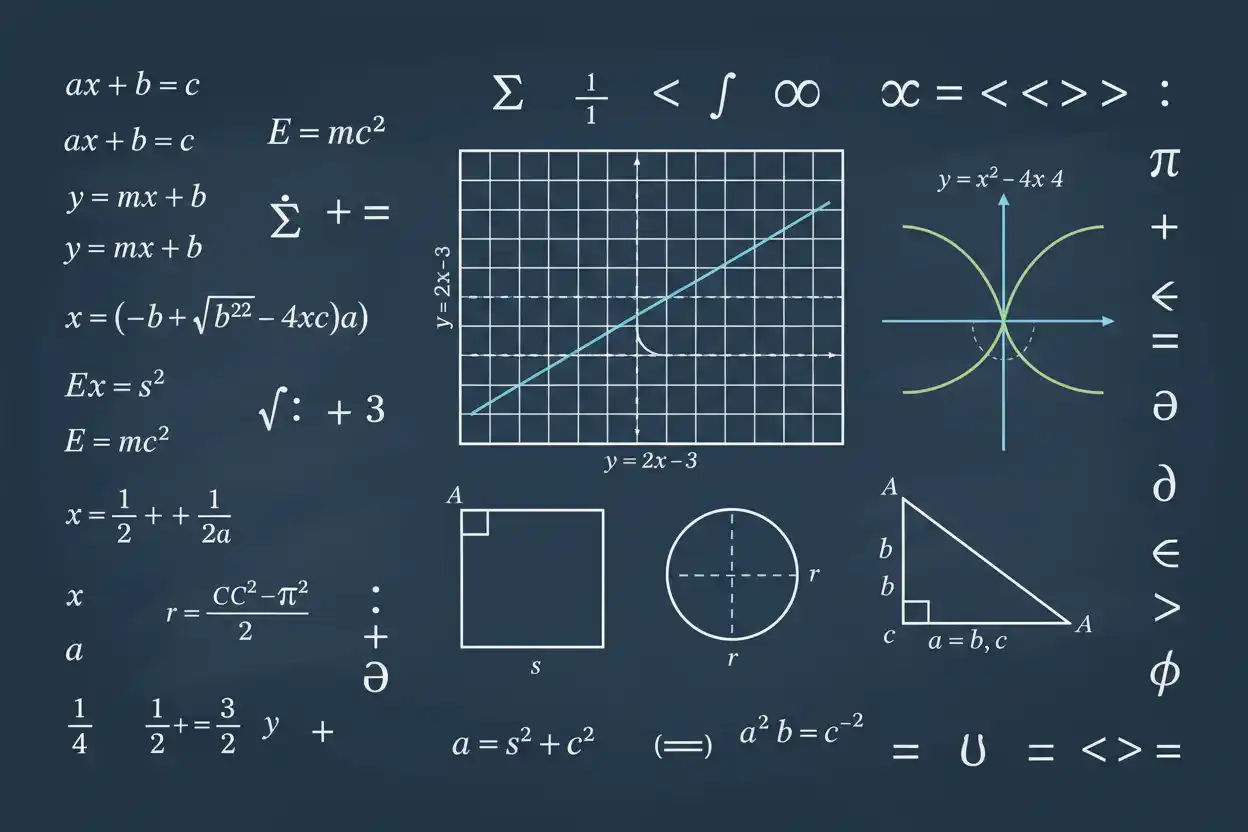

Algebra is the branch of mathematics that uses symbols, variables, expressions, equations, and functions to represent relationships and solve problems involving unknown quantities.
In arithmetic, you might calculate:
7 + 5 = 12
In algebra, one of those quantities can be unknown:
x + 5 = 12
Subtract 5 from both sides:
x = 7
That simple idea—representing unknown or changing quantities with symbols—scales into equations, inequalities, functions, polynomials, sequences, complex numbers, and many other mathematical tools.
This guide explains the central structure of algebra and connects the major concepts. Detailed procedures for specialist topics such as the quadratic equation, complex numbers, and logarithmic equation are covered separately so each topic can be developed without turning this algebra hub into one enormous problem set.
What Is Algebra?
Algebra generalizes arithmetic.
Instead of working only with known numbers, algebra allows quantities to be represented using variables such as:
x, y, a, b, n
A variable can represent:
- an unknown number;
- a changing quantity;
- an input;
- an output;
- or a general number that makes a rule true.
For example:
y = 2x + 3
describes a relationship between two variables.
If:
x = 4
then:
y = 2(4) + 3 = 11
The equation can represent infinitely many input-output pairs rather than one isolated arithmetic calculation.
Why Algebra Matters
Algebra provides a language for describing patterns and relationships.
It is used to answer questions such as:
How much will something cost when quantity changes?
What unknown value makes an equation true?
How does one variable depend on another?
Where does a graph cross an axis?
How quickly does a sequence grow?
What values satisfy several mathematical conditions?
Algebra also supports later work in geometry, statistics, calculus, physics, engineering, economics, computer science, finance, and many other fields.
The Basic Parts of an Algebraic Expression
Consider:
3x + 7
The expression contains:
Variable: (x)
Coefficient: (3)
Constant: (7)
A term is a part of an expression separated by addition or subtraction.
In:
5x² − 3x + 8
the terms are:
5x²
−3x
8
Understanding this structure makes simplification, factoring, and equation solving easier.
Expression vs. Equation
An expression does not contain an equality statement.
Example:
3x + 5
An equation states that two expressions are equal:
3x + 5 = 20
The distinction is fundamental.
You can simplify or evaluate an expression.
You solve an equation to find values that make the equality true.
Evaluating an Algebraic Expression
Suppose:
2x² + 3x − 4
and:
x = 2
Substitute:
2(2²) + 3(2) − 4
Calculate the exponent:
2(4) + 6 − 4
Then:
8 + 6 − 4 = 10
The expression evaluates to:
10
Substitution is one of the most frequently used operations in algebra.
Order of Operations
Algebra uses the same order-of-operations principles as arithmetic.
A common structure is:
- grouping symbols;
- exponents;
- multiplication and division;
- addition and subtraction.
For:
3 + 2(4² − 5)
calculate:
4² = 16
then:
16 − 5 = 11
then:
2 × 11 = 22
finally:
3 + 22 = 25
Correct order prevents expressions from being interpreted inconsistently.
Like Terms
Terms can be combined when they contain the same variable raised to the same power.
For example:
3x + 5x = 8x
and:
4x² − x² = 3x²
But:
3x + 5x²
cannot be combined into one term because (x) and (x²) represent different powers.
The Distributive Property
One of the most important algebra rules is:
a(b + c) = ab + ac
Example:
3(x + 4)
becomes:
3x + 12
For subtraction:
−2(x − 5)
becomes:
−2x + 10
Distribution is central to simplifying expressions, solving equations, and multiplying polynomial expressions.
Properties of Equality
Equation solving depends on preserving equality.
If:
a = b
then adding the same number to both sides keeps them equal:
a + c = b + c
Likewise:
a − c = b − c
ac = bc
and, when (c \neq 0):
a ÷ c = b ÷ c
The practical rule is simple:
Whatever valid operation you perform on one side of an equation must also be performed on the other side.
Solving a One-Step Equation
Consider:
x + 8 = 15
Subtract 8 from both sides:
x = 7
Check:
7 + 8 = 15
The value satisfies the original equation.
Solving a Two-Step Equation
Consider:
3x + 5 = 20
Subtract 5:
3x = 15
Divide by 3:
x = 5
Check:
3(5) + 5 = 20
The solution is correct.
More detailed strategies belong on the specialist solving equations page.
Linear Equations
A linear equation contains variables only to the first power when written in standard linear form.
Example:
2x + 6 = 18
Solution:
2x = 12
x = 6
For two variables, a linear relationship can be written:
y = mx + b
where:
(m) is the slope,
and (b) is the y-intercept.
The related slope-intercept form page develops that representation in detail.
Equations With Variables on Both Sides
Consider:
5x + 2 = 3x + 10
Subtract (3x):
2x + 2 = 10
Subtract 2:
2x = 8
Divide:
x = 4
Check:
Left:
5(4) + 2 = 22
Right:
3(4) + 10 = 22
Both sides match.
Inequalities
An inequality compares expressions rather than stating that they are exactly equal.
Common symbols include:
<, >, ≤, ≥
Example:
2x + 3 > 11
Subtract 3:
2x > 8
Divide by 2:
x > 4
A key rule is that multiplying or dividing both sides by a negative number reverses the inequality sign.
For example:
−2x > 10
Divide by (-2):
x < −5
The broader inequality guide covers the calculation rules, while inequalities focuses on interval notation and related representation.
Absolute Value
Absolute value represents distance from zero.
|5| = 5
and:
|−5| = 5
An absolute value equation such as:
|x| = 7
has two solutions:
x = 7
and:
x = −7
because both numbers are seven units from zero.
Functions
A function maps each allowed input to exactly one output.
For example:
f(x) = 2x + 1
If:
x = 3
then:
f(3) = 2(3) + 1 = 7
Function notation provides a compact way to express relationships and evaluate outputs.
Functions are one of algebra’s most important bridges to calculus and higher mathematics.
Domain and Range
The domain is the set of allowed input values.
The range is the set of possible output values.
For:
f(x) = 1/x
(x = 0) is not allowed because division by zero is undefined.
So zero is excluded from the domain.
The domain and range guide develops these restrictions and representations in more detail.
Composite Functions
Functions can be combined.
If:
f(x) = 2x
and:
g(x) = x + 3
then:
(f ∘ g)(x) = f(g(x))
Substitute (g(x)) into (f):
f(x + 3) = 2(x + 3)
so:
(f ∘ g)(x) = 2x + 6
The order matters. The composite function page covers those combinations directly.
Inverse Functions
An inverse function reverses the mapping of a function when an inverse exists.
If:
f(x) = 2x + 3
set:
y = 2x + 3
Swap (x) and (y):
x = 2y + 3
Solve for (y):
y = (x − 3)/2
Therefore:
f⁻¹(x) = (x − 3)/2
Applying a function and its inverse returns the original input within the relevant domain.
Piecewise Functions
A piecewise function uses different formulas for different input ranges.
For example:
f(x) = x + 1, when x < 0
f(x) = x², when x ≥ 0
To evaluate the function, first identify which condition the input satisfies.
Piecewise functions are useful when relationships change across different regions or conditions.
Direct Variation
In direct variation, one quantity changes proportionally with another.
y = kx
where (k) is the constant of variation.
If:
y = 12 when x = 3
then:
12 = 3k
so:
k = 4
The relationship is:
y = 4x
Inverse Variation
y = k/x
As one variable increases, the other decreases proportionally under the model.
Suppose:
y = 6 when x = 2
Then:
6 = k/2
so:
k = 12
Therefore:
y = 12/x
Joint Variation
Joint variation occurs when a quantity varies directly with two or more variables.
For example:
z = kxy
If:
z = 24, x = 2, y = 3
then:
24 = k(2)(3)
24 = 6k
k = 4
So:
z = 4xy
Variation models provide algebraic ways to express proportional relationships.
Exponents
An exponent indicates repeated multiplication.
x³ = x × x × x
Important exponent rules include:
xᵃ × xᵇ = xᵃ⁺ᵇ
xᵃ ÷ xᵇ = xᵃ⁻ᵇ
when (x \neq 0),
and:
(xᵃ)ᵇ = xᵃᵇ
Example:
x³ × x² = x⁵
These rules support polynomial, exponential, and logarithmic algebra.
Exponential Equations
An exponential equation contains a variable in an exponent.
Example:
2ˣ = 16
Since:
16 = 2⁴
the solution is:
x = 4
More complicated exponential equations can require logarithms.
Logarithmic Equations
A logarithmic equation contains logarithmic expressions.
Because logarithms and exponentials are inverse operations:
log_b(a) = c
means:
bᶜ = a
For example:
log₂(8) = 3
because:
2³ = 8
Domain restrictions are important because logarithm inputs must satisfy the applicable positivity conditions.
Polynomials
A polynomial is an expression built from variables, coefficients, nonnegative integer powers, and arithmetic operations.
Example:
3x³ − 2x² + 5x − 7
The highest exponent is called the degree.
This polynomial has degree:
3
The polynomial equation page focuses on equations constructed from polynomial expressions.
Adding Polynomials
Combine like terms.
Suppose:
(3x² + 2x + 1) + (x² − 5x + 4)
Then:
4x² − 3x + 5
Terms with the same variable and exponent can be combined directly.
Multiplying Polynomials
Consider:
(x + 2)(x + 3)
Distribute:
x(x + 3) + 2(x + 3)
x² + 3x + 2x + 6
Combine:
x² + 5x + 6
This expression can also be factored back into:
(x + 2)(x + 3)
Factoring
Factoring rewrites an expression as a product.
For example:
x² + 5x + 6
becomes:
(x + 2)(x + 3)
because:
(x + 2)(x + 3) = x² + 5x + 6
The specialist factoring quadratics guide focuses on quadratic expressions and their factors.
Difference of Squares
One important factoring identity is:
a² − b² = (a − b)(a + b)
For example:
x² − 25
can be written:
x² − 5²
therefore:
x² − 25 = (x − 5)(x + 5)
The difference of squares page develops that identity and its applications.
Quadratic Equations
A quadratic equation has the form:
ax² + bx + c = 0
where:
a ≠ 0
Example:
x² − 5x + 6 = 0
Factor:
(x − 2)(x − 3) = 0
So:
x = 2
or:
x = 3
Quadratics can also be solved by completing the square or with the quadratic formula.
Quadratic Formula
For:
ax² + bx + c = 0
the quadratic formula is:
x = (−b ± √(b² − 4ac)) ÷ 2a
This formula can solve any quadratic equation with appropriate number-system interpretation.
The expression:
b² − 4ac
is the discriminant.
Discriminant
For a quadratic equation:
ax² + bx + c = 0
the discriminant is:
D = b² − 4ac
Its value helps describe the roots.
For real coefficients:
- (D > 0): two distinct real roots;
- (D = 0): one repeated real root;
- (D < 0): nonreal complex-conjugate roots.
The specialist discriminant page handles these cases in detail.
Cubic Equations
A cubic equation has highest power 3.
General form:
ax³ + bx² + cx + d = 0
Cubic equations can sometimes be solved by factoring, recognizing rational roots, substitutions, or general cubic methods.
The algebra hub only needs the structural idea: cubics extend polynomial equation solving beyond degree two.
Polynomial Long Division
Polynomial long division divides one polynomial by another using a process similar to numerical long division.
For example:
(x² + 3x + 2) ÷ (x + 1)
Since:
x² + 3x + 2 = (x + 1)(x + 2)
the quotient is:
x + 2
with remainder zero.
Rational Expressions
A rational expression is a ratio of polynomial expressions.
Example:
(x + 1)/(x − 2)
The denominator cannot equal zero, so:
x ≠ 2
Domain restrictions are essential whenever algebraic expressions involve division.
Rational Equations
A rational equation contains one or more rational expressions.
Example:
1/x = 2
Multiply by (x), assuming (x \neq 0):
1 = 2x
Therefore:
x = 1/2
Solutions should always be checked against denominator restrictions.
Partial Fractions
Partial fractions decomposes a rational expression into simpler rational components.
For example, an expression such as:
1/[(x − 1)(x + 1)]
can be represented as a combination of terms with simpler denominators.
This technique is useful in algebra and becomes especially important in calculus.
Radicals
A radical expression contains roots such as:
√x
or:
∛x
Because:
√25 = 5
radicals provide another way to represent fractional powers.
The radical expressions guide covers simplifying and operating with radicals.
Radical Equations
A radical equation places a variable inside a radical.
Example:
√x = 5
Square both sides:
x = 25
More complicated radical equations can generate extraneous candidate solutions, so substitution back into the original equation is essential.
Arithmetic Sequences and Series
An arithmetic sequence changes by a constant difference.
Example:
3, 7, 11, 15, …
Common difference:
d = 4
A corresponding arithmetic series adds terms from an arithmetic sequence.
A common finite-series formula is:
Sₙ = n/2[2a₁ + (n − 1)d]
The specialist page develops the notation and alternative forms.
Geometric Series
A geometric sequence changes by a constant ratio.
Example:
2, 6, 18, 54, …
Common ratio:
r = 3
The related geometric series sums geometric terms.
For a finite geometric series:
Sₙ = a₁(1 − rⁿ)/(1 − r)
when:
r ≠ 1
Binomial Theorem
The binomial theorem expands powers such as:
(a + b)ⁿ
A general form is:
(a + b)ⁿ = Σ C(n,k)aⁿ⁻ᵏbᵏ
For a simple example:
(a + b)² = a² + 2ab + b²
The coefficients are closely related to Pascal triangle.
Pascal Triangle
Pascal’s Triangle begins:
1
1 1
1 2 1
1 3 3 1
1 4 6 4 1
Each interior number is the sum of the two numbers above it.
The rows provide coefficients for binomial expansions.
For example:
(a + b)³ = a³ + 3a²b + 3ab² + b³
Complex Numbers
Complex numbers extend the real number system using the imaginary unit:
i² = −1
A complex number has the form:
a + bi
where (a) and (b) are real numbers.
Example:
3 + 2i
Complex numbers allow algebra to represent solutions that do not exist among real numbers alone.
Complex Roots
Consider:
x² + 1 = 0
Then:
x² = −1
so:
x = ±i
These are complex roots.
Complex roots appear naturally when polynomial equations do not have enough real roots to account for their degree.
De Moivre’s Theorem
De Moivre’s theorem connects powers of complex numbers with trigonometric form:
[r(cos θ + i sin θ)]ⁿ = rⁿ[cos(nθ) + i sin(nθ)]
It is useful for computing powers and roots of complex numbers.
This is an advanced algebra topic compared with basic equation solving, but it demonstrates how symbolic methods extend into the complex plane.
Solving Algebra Problems Systematically
A reliable algebra workflow is:
First, identify what is unknown.
Next, translate the relationship into an expression or equation.
Simplify each side where appropriate.
Use inverse operations or algebraic transformations to isolate the unknown.
Respect domain restrictions.
Check the proposed solution in the original problem.
This final check is especially important for rational, radical, logarithmic, and other equations where transformations can introduce invalid solutions.
Example: Translating a Word Problem
Suppose:
A number increased by 8 equals 23.
Let:
x = the number
Translate:
x + 8 = 23
Subtract 8:
x = 15
Check:
15 + 8 = 23
The algebraic model captures the verbal relationship directly.
Example: Percentage Relationship
Suppose a number is 40% of 70.
Let:
x = unknown amount
Then:
x = 0.40 × 70
x = 28
Algebra becomes especially useful when the unknown appears in a more complicated position.
Example: Unknown Original Value
Suppose a value increases 20% and becomes 120.
Let the original be (x):
1.20x = 120
Divide:
x = 100
This is algebraic reversal of a percentage increase.
Example: Distance Relationship
Suppose distance equals rate multiplied by time:
d = rt
If:
d = 180
and:
t = 3
then:
180 = 3r
r = 60
Algebra lets one formula be rearranged to solve for different unknown quantities.
Rearranging Formulas
From:
d = rt
solve for (r):
r = d/t
Solve for (t):
t = d/r
Formula rearrangement is algebra applied to general symbolic relationships rather than one numerical equation.
Common Algebra Mistakes
A frequent mistake is performing an operation on only one side of an equation.
Another is combining unlike terms.
Signs can be lost when distributing a negative coefficient.
Students may divide by an expression that could be zero without considering the restriction.
Squaring both sides of an equation can create extraneous solutions.
Another common error is canceling terms across addition rather than common factors in multiplication.
Domain restrictions should also be checked for rational, radical, and logarithmic expressions.
Why Checking Solutions Matters
Suppose a transformation gives a candidate answer.
Substitute it back into the original equation.
For example:
2x + 5 = 17
Candidate:
x = 6
Check:
2(6) + 5 = 17
17 = 17
The solution is verified.
For more advanced equations, checking is even more important because some valid algebraic manipulations can introduce extra candidate solutions.
Algebra and Graphs
An equation can often be represented graphically.
For:
y = 2x + 1
every coordinate pair satisfying the equation lies on the line.
For:
y = x²
the graph is a parabola.
Graphing connects symbolic algebra with geometry and makes relationships such as roots, intersections, domain, range, and rates of change easier to visualize.
Algebra and Mathematical Modeling
Algebra is useful whenever a real-world relationship can be represented symbolically.
Examples include:
Revenue = Price × Quantity
Distance = Rate × Time
Simple Interest = Principal × Rate × Time
Cost = Fixed Cost + Variable Cost per Unit × Quantity
The variables can then be rearranged to answer different questions.
That is why algebra underlies so many formulas across business, science, and engineering.
How Algebra Topics Fit Together
Basic expressions lead to equations.
Equations lead to functions and graphs.
Polynomial expressions lead to factoring and polynomial equations.
Quadratics introduce the discriminant and complex roots.
Exponentials connect with logarithms.
Functions connect with composition, inverses, domain, and range.
Sequences lead to arithmetic and geometric series.
Rational expressions introduce denominator restrictions.
Radicals introduce roots and extraneous-solution checks.
Complex numbers extend algebra beyond the real number line.
These are not isolated tricks. They are parts of one symbolic system.
Algebra Learning Order
A practical progression is to become comfortable with expressions and arithmetic properties first.
Then develop equation and inequality solving.
After that, functions, graphs, and variation become easier to understand.
Polynomials, factoring, and quadratics build on those skills.
Rational expressions, radicals, exponentials, and logarithms add new operation types and restrictions.
Complex numbers and higher-degree polynomial work extend the same reasoning further.
The exact learning order can vary, but each stage becomes easier when the underlying symbolic rules are solid.
Frequently Asked Questions
What is algebra in simple terms?
Algebra is mathematics that uses symbols and variables to represent unknown or changing quantities and the relationships between them.
What is a variable?
A variable is a symbol, usually a letter such as (x) or (y), representing an unknown or changeable value.
What is an algebraic expression?
An algebraic expression is a combination of numbers, variables, and operations without an equality sign.
Example:
3x + 5
What is an equation?
An equation states that two expressions are equal.
Example:
3x + 5 = 20
How do you solve a basic algebra equation?
Use valid inverse operations on both sides until the unknown is isolated.
For:
3x + 5 = 20
subtract 5 and divide by 3:
x = 5
What is the difference between an expression and an equation?
An expression represents a quantity.
An equation states that two quantities are equal and can be solved for unknown values.
What is a coefficient?
A coefficient is a number multiplying a variable.
In:
7x
the coefficient is 7.
What is a constant?
A constant is a fixed numerical term without a variable.
In:
3x + 8
the constant is 8.
What are like terms?
Like terms contain the same variables raised to the same powers.
3x + 5x = 8x
but:
3x + 5x²
cannot be combined.
What is the distributive property?
a(b + c) = ab + ac
It allows multiplication to be distributed across terms inside parentheses.
What is a function?
A function assigns exactly one output to each allowed input.
What are domain and range?
The domain is the set of allowed inputs.
The range is the set of resulting outputs.
What is a polynomial?
A polynomial is an algebraic expression made from variables, coefficients, and nonnegative integer powers.
What is a quadratic equation?
A quadratic equation has the general form:
ax² + bx + c = 0
with (a \neq 0).
What is the quadratic formula?
x = (−b ± √(b² − 4ac)) ÷ 2a
It gives solutions to quadratic equations.
What is a rational expression?
A rational expression is a ratio of two polynomials, with denominator values that make the denominator zero excluded from the domain.
What is a radical equation?
A radical equation contains a variable inside a root expression.
What is an exponential equation?
An exponential equation places a variable in an exponent.
What is a logarithmic equation?
A logarithmic equation contains logarithmic expressions and is closely connected to exponential relationships.
What are complex numbers?
Complex numbers have the form:
a + bi
where:
i² = −1
Why is algebra important?
Algebra provides a general language for representing relationships, solving unknown quantities, rearranging formulas, analyzing functions, and building mathematical models used throughout mathematics, science, engineering, finance, and technology.