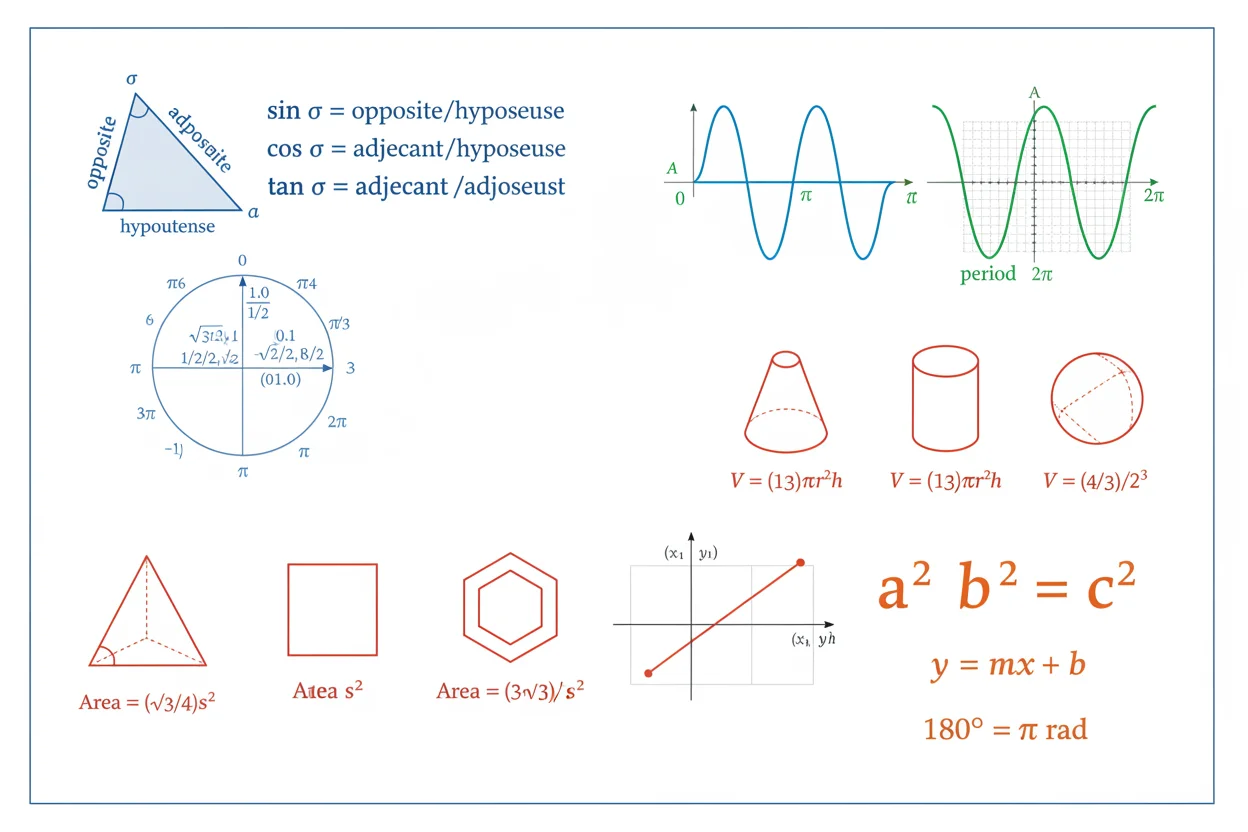
Geometry and trigonometry provide a connected framework for studying shape, size, position, distance, angle, and spatial relationships. Geometry focuses on points, lines, triangles, circles, polygons, coordinate systems, area, perimeter, surface area, and volume. Trigonometry focuses on relationships between angles and side lengths through functions such as sine, cosine, tangent, secant, cosecant, and cotangent. The two subjects meet most directly in triangles: geometric information describes the figure, while trigonometric ratios and laws allow unknown sides and angles to be calculated. Coordinate geometry extends these ideas to points and lines through formulas for distance, slope, midpoint, and equations. Circle geometry introduces radii, chords, sectors, arcs, and angular relationships, while solid geometry extends measurement to cylinders, cones, prisms, pyramids, spheres, and frustums. This guide provides the broad structure and key formulas, while specialist topics handle individual theorems and calculations in detail.
Geometry and Trigonometry at a Glance
Geometry asks questions such as:
How long is this segment?
What is the area of this figure?
What angle is formed here?
How far apart are these points?
What is the volume of this solid?
Trigonometry adds questions such as:
What side length corresponds to this angle?
What angle produces this ratio?
How can a non-right triangle be solved?
How do angles repeat around a circle?
Together, geometry and trigonometry turn diagrams into numerical relationships.
Basic Geometric Objects
A point represents a location.
A line extends indefinitely in both directions.
A line segment has two endpoints.
A ray has one endpoint and extends indefinitely in one direction.
An angle is formed by two rays sharing a common endpoint called the vertex.
Many geometric constructions and formulas can ultimately be described using these simple objects.
Angles
Angles measure rotation between rays or directions.
Common classifications include:
acute angle: 0° < θ < 90°
right angle: θ = 90°
obtuse angle: 90° < θ < 180°
straight angle: θ = 180°
reflex angle: 180° < θ < 360°
A full rotation is:
360°
Angles can also be measured in radians.
Degrees and Radians
The two standard angle units are degrees and radians.
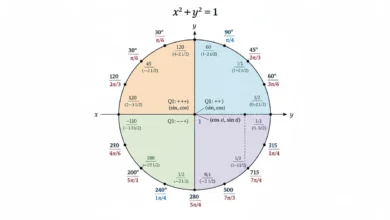
A full circle is:
360° = 2π radians
Therefore:
180° = π radians
To convert degrees to radians:
radians = degrees × π/180
To convert radians to degrees:
degrees = radians × 180/π
The specialist Degrees and Radians treatment develops these conversions and their trigonometric use in more detail.
Example: Convert 60° to Radians
Use:
radians = 60 × π/180
Simplify:
radians = π/3
Therefore:
60° = π/3
Likewise:
90° = π/2
180° = π
270° = 3π/2
360° = 2π
Perimeter
Perimeter measures total distance around a two-dimensional figure.
For a rectangle:
P = 2l + 2w
And For a square:
P = 4s
For a triangle:
P = a + b + c
The broader Perimeter framework covers how boundary length changes across common shapes.
Perimeter is measured in linear units such as:
cm
m
ft
Area
Area measures the size of a two-dimensional region.
Common formulas include:
rectangle: A = lw
square: A = s²
triangle: A = bh/2
parallelogram: A = bh
trapezoid: A = (b₁ + b₂)h/2
circle: A = πr²
The broader Area Formulas reference organizes formulas across many shapes.
Area is measured in square units.
Rectangle Area
For a rectangle:
A = lw
If:
l = 8
and:
w = 5
then:
A = 8(5)
= 40
The specialist Rectangle Area treatment focuses on rectangular dimensions, inverse calculations, and related applications.
Triangle Area
For a triangle:
A = bh/2
where b is a base and h is the perpendicular height to that base.
If:
b = 10
and:
h = 6
then:
A = 10(6)/2
= 30
The height must be perpendicular to the chosen base.
Heron’s Formula
If all three side lengths are known but a height is not, Heron Formula can calculate triangle area.
First find the semiperimeter:
s = (a + b + c)/2
Then:
A = √[s(s − a)(s − b)(s − c)]
For sides:
3, 4, 5
we have:
s = 6
Therefore:
A = √[6(3)(2)(1)]
= √36
= 6
Parallelogram Area
A parallelogram has:
A = bh
where h is perpendicular to the base.
The dedicated Parallelogram Area formula should not be confused with multiplying two adjacent slanted side lengths unless those sides are perpendicular.
If angle θ between adjacent sides a and b is known:
A = ab sinθ
which provides a direct bridge between geometry and trigonometry.
Trapezoid Area
For parallel bases b₁ and b₂ and perpendicular height h:
A = (b₁ + b₂)h/2
This is the formula developed on Trapezoid Area.
It can be interpreted as:
average of parallel side lengths × height
Kite and Rhombus Area
For perpendicular diagonals d₁ and d₂, the area formula:
A = d₁d₂/2
applies to common kite and rhombus configurations.
The dedicated Kite Area and Rhombus Area pages address each shape’s properties and alternative formulas.
Regular Polygon Area
For a regular polygon with perimeter P and apothem a:
A = aP/2
The Regular Polygon Area method works because the polygon can be divided into congruent triangles meeting at its center.
If side length and number of sides are given, trigonometry can also be used to derive the apothem.
Interior Angles of Polygons
For an n-sided polygon, the sum of the interior angles is:
S = (n − 2)180°
The Interior Angles formula follows from dividing the polygon into:
n − 2
triangles.
For a pentagon:
S = (5 − 2)180°
= 540°
For a regular polygon, each interior angle is:
[(n − 2)180°]/n
Exterior Angles
For a convex polygon, one exterior angle at each vertex sums to:
360°
For a regular n-gon:
exterior angle = 360°/n
The Exterior Angles relationship provides a convenient way to determine the number of sides of a regular polygon from one exterior angle.
Polygon Diagonals
The number of diagonals in an n-sided polygon is:
D = n(n − 3)/2
The Polygon Diagonals formula accounts for every connection between nonadjacent vertices without counting each diagonal twice.
For:
n = 6
we get:
D = 6(3)/2
= 9
Triangle Angle Sum
Every Euclidean triangle has interior-angle sum:
A + B + C = 180°
If two angles are:
50°
and:
60°
the third is:
180° − 50° − 60°
= 70°
This basic fact supports many more advanced triangle theorems.
Right Triangles
A Right Triangle contains one 90° angle.
The side opposite the right angle is the hypotenuse.
The other two sides are legs.
A broader Right Triangles overview connects side relationships, trigonometric ratios, special triangles, and applications.
Pythagorean Theorem
For a right triangle with legs a and b and hypotenuse c:
a² + b² = c²
This is the Pythagorean Theorem.
For:
a = 3
b = 4
we obtain:
c² = 9 + 16
= 25
so:
c = 5
The theorem is fundamental to distance, coordinate geometry, and vector length.
Similar Triangles
Two triangles are similar when corresponding angles are equal and corresponding side lengths are proportional.
If the scale factor from one triangle to another is k:
corresponding lengths scale by k
areas scale by k²
The Similar Triangles framework is widely used for indirect measurement, geometric proofs, and proportional reasoning.
Congruent Triangles
Congruent Triangles have the same size and shape.
Corresponding sides and angles match exactly.
Common congruence criteria include:
SSS
SAS
ASA
AAS
and for right triangles, appropriate hypotenuse-leg conditions.
Congruence is stronger than similarity because the scale factor is exactly 1.
Angle Bisector Theorem
In triangle ABC, suppose the bisector of angle A meets side BC at D.
The Angle Bisector Theorem states:
BD/DC = AB/AC
The angle bisector divides the opposite side in the same ratio as the two adjacent sides.
This allows unknown segment lengths to be found using proportions.
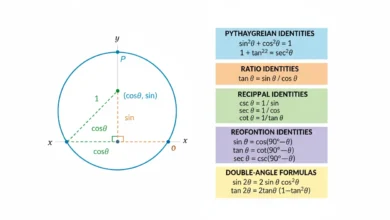
Trigonometric Ratios
For an acute angle θ in a right triangle:
sinθ = opposite/hypotenuse
cosθ = adjacent/hypotenuse
tanθ = opposite/adjacent
These three ratios form the foundation of elementary trigonometry.
Their reciprocal functions are:
cscθ = 1/sinθ
secθ = 1/cosθ
cotθ = 1/tanθ
Sine
The Sine function relates an angle to the ratio:
sinθ = opposite/hypotenuse
Suppose:
θ = 30°
and:
hypotenuse = 10
Since:
sin30° = 1/2
the opposite side is:
opposite = 10(1/2)
= 5
Cosine
The Cosine function gives:
cosθ = adjacent/hypotenuse
If:
θ = 60°
and:
hypotenuse = 12
then:
adjacent = 12 cos60°
= 12(1/2)
= 6
Tangent
The Tangent ratio is:
tanθ = opposite/adjacent
If:
opposite = 8
and:
adjacent = 6
then:
tanθ = 8/6
= 4/3
An inverse tangent can then find θ when the side ratio is known.
Reciprocal Trigonometric Functions
The reciprocal functions are:
cscθ = 1/sinθ
secθ = 1/cosθ
cotθ = 1/tanθ
The dedicated Cosecant, Secant, and Cotangent pages cover their formulas, domains, and relationships.
These functions become especially useful in identities and more advanced trigonometric calculations.
Inverse Trigonometric Functions
If a ratio is known and an angle is unknown, an Inverse Trigonometric Functions calculation can recover an appropriate angle.
For example:
sinθ = 0.5
can give:
θ = sin⁻¹(0.5)
For the principal acute value:
θ = 30°
Inverse trigonometric notation describes inverse functions, not reciprocals.
Thus:
sin⁻¹x
does not mean:
1/sin x
Law of Sines
For any triangle with sides a, b, c opposite angles A, B, C:
a/sinA = b/sinB = c/sinC
This is the Law of Sines.
It is especially useful when a side-angle opposite pair is known.
For example, if:
a = 8
A = 40°
B = 60°
then:
b/sin60° = 8/sin40°
so:
b = 8sin60°/sin40°
The law extends trigonometric triangle solving beyond right triangles.
Law of Cosines
The Law of Cosines states:
c² = a² + b² − 2ab cosC
and corresponding cyclic forms.
It is useful when:
two sides and included angle are known
or:
all three sides are known
If:
C = 90°
then:
cos90° = 0
so the formula reduces to:
c² = a² + b²
which is the Pythagorean theorem.
Coordinate Geometry
Coordinate geometry represents geometric objects numerically through points:
(x, y)
or:
(x, y, z)
This allows distances, slopes, midpoints, lines, circles, and intersections to be calculated algebraically.
It forms one of the strongest links between pure geometry and algebra.
Distance Formula
For points:
(x₁, y₁)
and:
(x₂, y₂)
the Distance Formula is:
d = √[(x₂ − x₁)² + (y₂ − y₁)²]
In three dimensions:
d = √[(x₂ − x₁)² + (y₂ − y₁)² + (z₂ − z₁)²]
The formula is a coordinate version of the Pythagorean theorem.
Distance Example
Let:
A = (1, 2)
and:
B = (5, 5)
Then:
d = √[(5 − 1)² + (5 − 2)²]
= √(16 + 9)
= 5
Thus the points are 5 units apart.
Midpoint Formula
The Midpoint Formula averages corresponding coordinates.
For:
A = (x₁, y₁)
and:
B = (x₂, y₂)
the midpoint is:
M = ((x₁ + x₂)/2, (y₁ + y₂)/2)
For:
(2, 3)
and:
(8, 7)
we get:
M = (5, 5)
Slope Between Two Points
The Slope between:
(x₁, y₁)
and:
(x₂, y₂)
is:
m = (y₂ − y₁)/(x₂ − x₁)
provided:
x₂ ≠ x₁
Slope measures vertical change per unit horizontal change.
A vertical line has undefined slope because its horizontal change is zero.
Line Through Two Points
A Line From Two Points can be constructed by first calculating slope:
m = (y₂ − y₁)/(x₂ − x₁)
and then using point-slope form.
The Point-Slope Form equation is:
y − y₁ = m(x − x₁)
This form is especially convenient when one point and the slope are already known.
Line Intersection
Two nonparallel lines intersect where both equations are simultaneously true.
The Line Intersection process solves the corresponding pair of equations.
For:
y = 2x + 1
and:
y = −x + 7
set them equal:
2x + 1 = −x + 7
so:
3x = 6
x = 2
Then:
y = 5
The intersection is:
(2, 5)
Circle Basics
A circle is the set of all points at a fixed distance r from a center.
The central measurements in Circles: Radius, Diameter, Area include:
diameter = 2r
circumference = 2πr
area = πr²
These formulas form the foundation for arc, sector, chord, and equation problems.
Circle Circumference
The Circle Circumference formula is:
C = 2πr
or:
C = πd
For:
r = 5
we obtain:
C = 10π
Circumference is a length and therefore uses linear units.
Circle Area
The Circle Area formula is:
A = πr²
For:
r = 5
we get:
A = 25π
Because area is two-dimensional, the units are squared.
Circle Equation
A circle with center:
(h, k)
and radius r has Circle Equation:
(x − h)² + (y − k)² = r²
For a circle centered at the origin:
x² + y² = r²
The formula again follows from the distance relationship between a point on the circle and its center.
Arc Length
For a circle of radius r and central angle θ measured in radians:
s = rθ
The Arc Length formula can also be written in degrees:
s = (θ/360°)2πr
The radian form:
s = rθ
is especially important because it directly connects angular measure with linear distance.
Sector Area
A sector is a portion of a circle bounded by two radii and an arc.
For θ measured in radians, Sector Area is:
A = r²θ/2
In degrees:
A = (θ/360°)πr²
For half a circle:
θ = π
so:
A = πr²/2
as expected.
Chord Length
A chord joins two points on a circle.
For radius r and central angle θ:
c = 2r sin(θ/2)
This is the core Chord Length relationship.
For a diameter:
θ = 180°
so:
c = 2r sin90°
= 2r
which correctly gives the diameter.
Polar and Rectangular Coordinates
The Polar and Rectangular Form connection uses:
x = r cosθ
y = r sinθ
and:
r = √(x² + y²)
These formulas combine coordinate geometry with trigonometry.
Polar coordinates are often especially convenient for circular and rotational geometry.
Surface Area
Surface Area measures the total area of the exposed faces or curved boundary of a three-dimensional object.
Unlike planar area, a solid can contain several surfaces that must be added.
Units remain square units, such as:
cm²
or:
m²
Volume
Volume measures three-dimensional space occupied by a solid.
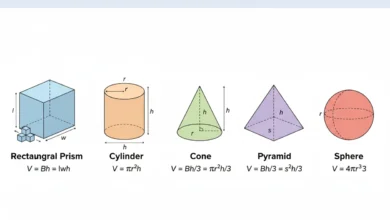
Common patterns include:
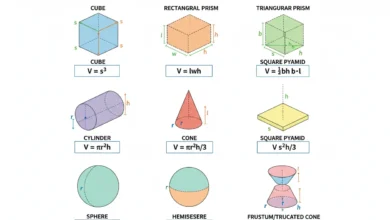
prism: V = base area × height
cylinder: V = πr²h
pyramid: V = Bh/3
cone: V = πr²h/3
sphere: V = 4πr³/3
Volume uses cubic units.
Prism Volume
For a prism:
V = Bh
where B is the area of the base and h is the perpendicular distance between the parallel bases.
The Prism Volume formula applies to rectangular prisms, triangular prisms, and more general prism bases.
Pyramid Volume
For a pyramid:
V = Bh/3
The Pyramid Volume formula uses the base area B and perpendicular height h.
The factor:
1/3
distinguishes a pyramid from a prism with the same base and height.
Cylinder Volume
The Cylinder Volume formula is:
V = πr²h
A cylinder can be viewed as a circular prism:
base area = πr²
so:
volume = base area × height
Cylinder Surface Area
For a closed right circular cylinder, Cylinder Surface Area is:
S = 2πr² + 2πrh
The first term represents the two circular ends.
The second is the lateral curved surface.
A problem asking only for lateral area uses:
2πrh
Cone Volume
The Cone Volume formula is:
V = πr²h/3
A cone with the same circular base and perpendicular height as a cylinder has one-third the cylinder’s volume.
Cone Surface Area
For a closed right circular cone:
S = πr² + πrℓ
where:
ℓ = slant height
The Cone Surface Area formula separates base area from lateral area.
If r and perpendicular height h are known:
ℓ = √(r² + h²)
by the Pythagorean theorem.
Sphere Volume
The Sphere Volume formula is:
V = 4πr³/3
For:
r = 3
we have:
V = 4π(27)/3
= 36π
Sphere Surface Area
The Sphere Surface Area formula is:
S = 4πr²
For:
r = 3
we get:
S = 36π
The same numerical coefficient appears in the preceding r = 3 examples, but the quantities and units differ.
Frustum Volume
A frustum can be formed by cutting the top from a cone or pyramid with a plane parallel to the base.
For a conical frustum with radii R and r and height h, the Frustum Volume formula is:
V = πh(R² + Rr + r²)/3
It reduces to the cone formula when one radius is zero.
Geometry and Scale Factors
If corresponding lengths are multiplied by scale factor:
k
then perimeter scales by:
k
area scales by:
k²
volume scales by:
k³
For example, doubling every dimension of a cube multiplies its volume by:
2³ = 8
This distinction is essential when comparing similar figures and solids.
Geometry and Units
Always match the dimensional quantity to its units.
Length:
cm
Area:
cm²
Volume:
cm³
Angles:
degrees or radians
Mixing linear and squared units is a common sign that the wrong formula or quantity has been used.
Choosing a Geometry Formula
Start by identifying what the problem gives and what it asks for.
If the unknown is a side of a right triangle, consider:
Pythagorean theorem
or:
sine, cosine, tangent
If a non-right triangle has an opposite side-angle pair, consider the Law of Sines.
And If two sides and the included angle are known, consider the Law of Cosines.
If the question asks for a region’s size, determine whether it is:
perimeter
area
surface area
or:
volume
The shape and known measurements then determine the specialist formula.
Choosing a Trigonometric Ratio
For a right triangle relative to angle θ:
sine uses opposite and hypotenuse
cosine uses adjacent and hypotenuse
tangent uses opposite and adjacent
Choose the ratio containing both:
the known side
and:
the unknown side
For example, if adjacent and hypotenuse are involved, cosine is the direct choice.
Example: Find a Missing Right-Triangle Side
Suppose:
θ = 35°
hypotenuse = 12
and the opposite side x is unknown.
Use sine:
sin35° = x/12
Therefore:
x = 12sin35°
Using an approximate value:
x ≈ 6.88
The exact calculator value depends on using degree mode because θ was given in degrees.
Example: Find an Angle
Suppose a right triangle has:
opposite = 7
adjacent = 10
Then:
tanθ = 7/10
So:
θ = tan⁻¹(0.7)
Therefore:
θ ≈ 35.0°
The inverse function is used because the ratio is known and the angle is unknown.
Geometry, Trigonometry, and Calculus
Geometry and trigonometry also provide many of the shapes and functions used later in calculus.
Circle formulas underlie rotational geometry.
Trigonometric functions appear in derivatives and integrals.
Distances, slopes, and curves support coordinate and analytic geometry.
The cluster therefore connects naturally with broader calculus and linear-algebra ideas without replacing their specialized methods.
Common Geometry and Trigonometry Mistakes
One common mistake is selecting a formula before identifying the actual shape or triangle type.
Right-triangle trigonometric ratios should not be applied directly to arbitrary non-right triangles without introducing an altitude or using a more general law.
Calculator angle mode must match the problem’s units.
Area formulas require perpendicular heights, not necessarily slanted side lengths.
For circles, distinguish:
radius
from:
diameter
For solids, distinguish:
surface area
from:
volume
and use square versus cubic units accordingly.
Coordinate-distance formulas require subtracting corresponding coordinates before squaring.
When using the Law of Sines, pair each side with its opposite angle.
When using shifted or scaled figures, remember that lengths, areas, and volumes scale with different powers of the scale factor.
Frequently Asked Questions
What is geometry?
Geometry is the study of shapes, dimensions, positions, distances, angles, areas, and spatial relationships.
What is trigonometry?
Trigonometry studies relationships between angles and side lengths, especially through sine, cosine, tangent, and related functions.
How are geometry and trigonometry connected?
Geometry provides the shapes and spatial relationships, while trigonometry provides formulas for calculating unknown lengths and angles from those relationships.
What are the three main right-triangle ratios?
sinθ = opposite/hypotenuse
cosθ = adjacent/hypotenuse
tanθ = opposite/adjacent
What is the Pythagorean theorem?
For a right triangle:
a² + b² = c²
where c is the hypotenuse.
What is the triangle angle sum?
A + B + C = 180°
What is the formula for distance between two points?
d = √[(x₂ − x₁)² + (y₂ − y₁)²]
What is the midpoint formula?
((x₁ + x₂)/2, (y₁ + y₂)/2)
What is the area of a circle?
A = πr²
What is the circumference of a circle?
C = 2πr
What is the arc-length formula?
For θ in radians:
s = rθ
What is the Law of Sines?
a/sinA = b/sinB = c/sinC
What is the Law of Cosines?
c² = a² + b² − 2ab cosC
What is the difference between area and surface area?
Area measures a two-dimensional region. Surface area measures the combined two-dimensional boundary surfaces of a three-dimensional object.
What is the difference between surface area and volume?
Surface area is measured in square units. Volume measures occupied three-dimensional space and is measured in cubic units.
How do I know which trigonometric function to use?
In a right triangle, choose sine, cosine, or tangent based on which known and unknown sides appear relative to the chosen angle.
Why do degrees and radians matter?
They are different angle units. Trigonometric calculations must use the unit expected by the formula or calculator setting.
How can I check a geometry answer?
Confirm the figure and formula, verify units, test whether the magnitude is reasonable, and substitute the result back into any governing equation or theorem when possible.